2017 Ford F-150 Towing Capacity Chart By Year (2026)

Looking for another year? See the full Ford F-150 Towing Capacity Chart (all years, 2004–2026).
Quick Answer
The 2017 Ford F-150’s maximum towing capacity ranges from approximately 5,000 lbs to a formidable 12,200 lbs, depending significantly on the engine choice, drivetrain, cab and bed configuration, and critical components like the axle ratio and the presence of a factory tow package. To ascertain the precise maximum rating for a specific vehicle, always consult the owner’s manual or the payload sticker located on the driver’s side door jamb.

Prime for Young Adults — 6 Months Free
Students and 18–24s get six months of Prime free, then half price.
Start 6 Months Free As an Amazon Associate I earn from qualifying purchases.2017 Ford F-150 Towing Capacity at a Glance
Recommended Best Deal Products


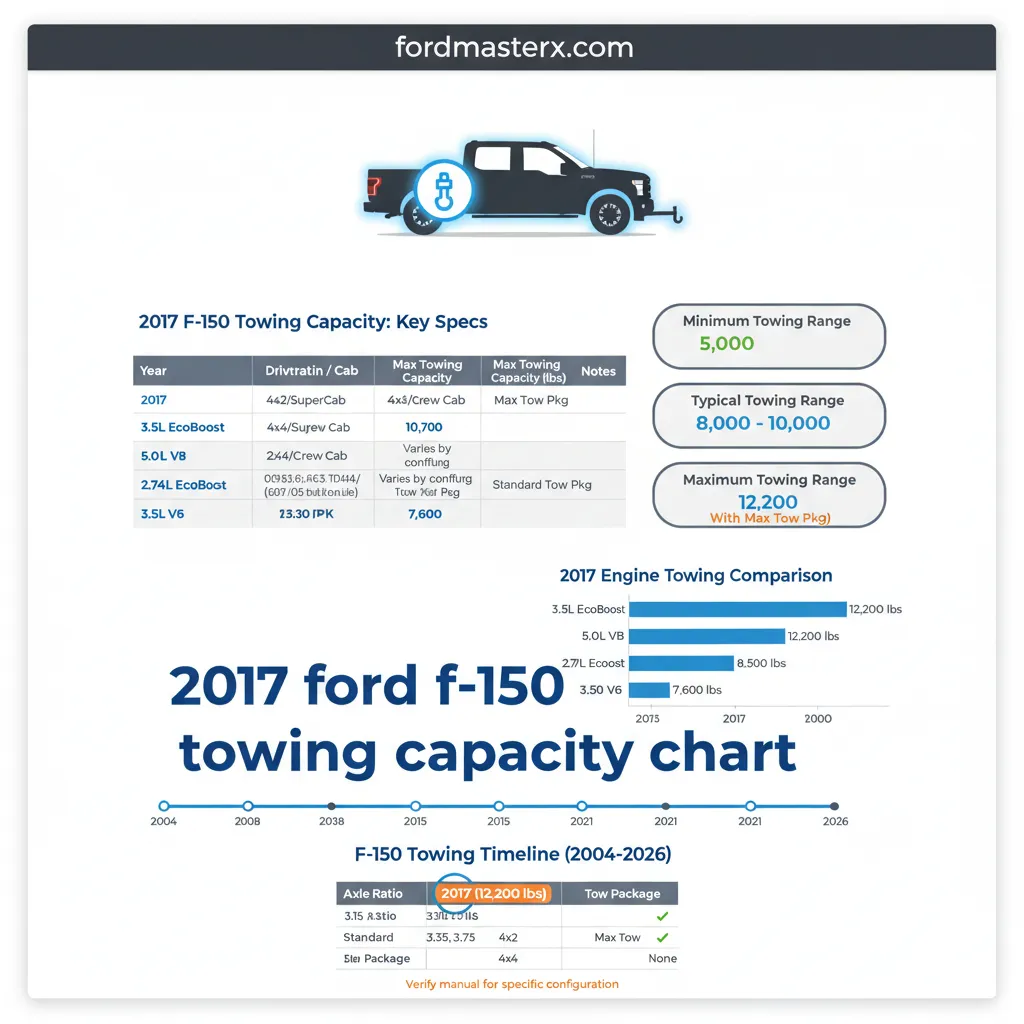
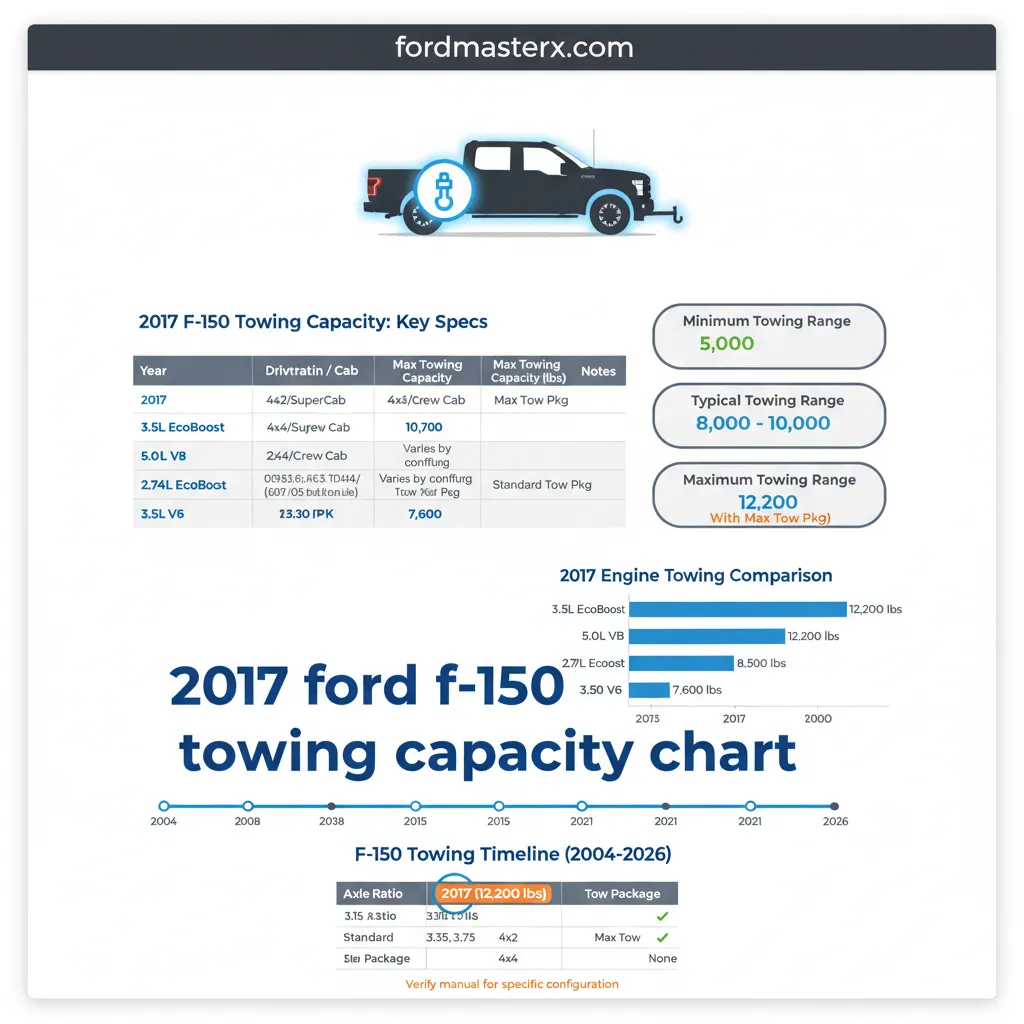
To quickly understand the spectrum of capabilities, here’s a snapshot of the 2017 F-150’s towing capacity range. These figures represent the potential across various configurations, from base models to fully equipped heavy-duty towing setups.
📤 Share Image
2017 Ford F-150 Towing Capacity Chart By Year (2004–2026): 2017
This chart specifically details the maximum towing capacities for various 2017 Ford F-150 configurations. While the title reflects a broader year range (2004-2026), the granular data presented here focuses on the 2017 model year. The capacities listed are based on Ford’s official factory towing guides and owner’s manuals for the 2017 F-150. Actual towing capacity for your specific vehicle should always be verified by checking the owner’s manual, the vehicle’s doorjamb sticker (which lists critical Gross Vehicle Weight Rating, Gross Combined Weight Rating, and payload), and the installed hitch rating. Towing figures are “Max Towing Capacity” and typically require the correct axle ratio and often the Max Trailer Tow Package. Last reviewed: May 2026.
This chart provides a comprehensive overview of the 2017 Ford F-150’s towing capabilities, broken down by engine, drivetrain, and cab configuration. The “Max Towing Capacity” assumes the vehicle is equipped with the appropriate axle ratio and, in most cases, the Max Trailer Tow Package for optimal performance.
| Year | Engine | Drivetrain / Cab | Max Towing Capacity | Notes |
|---|---|---|---|---|
| 2017 | 3.5L Ti-VCT V6 | 2WD / Regular Cab | 7,600 lbs | Requires 3.73 axle ratio |
| 2017 | 3.5L Ti-VCT V6 | 4WD / SuperCrew | 5,000-6,000 lbs | Varies by axle ratio & bed length |
| 2017 | 2.7L EcoBoost V6 | 2WD / Regular Cab | 8,500 lbs | Requires 3.73 axle ratio & 2.7L EcoBoost Payload Pkg |
| 2017 | 2.7L EcoBoost V6 | 4WD / SuperCrew | 7,600-8,100 lbs | Varies by axle ratio & bed length |
| 2017 | 5.0L V8 | 2WD / Regular Cab | 11,600 lbs | Requires 3.73 axle ratio & Max Trailer Tow Package |
| 2017 | 5.0L V8 | 4WD / SuperCrew | 10,000-10,800 lbs | Varies by axle ratio & bed length, with tow package |
| 2017 | 3.5L EcoBoost V6 (Gen 1 & Gen 2) | 2WD / Regular Cab | 12,200 lbs | Highest Rating Requires 3.73 axle ratio & Max Trailer Tow Package |
| 2017 | 3.5L EcoBoost V6 (Gen 1 & Gen 2) | 4WD / SuperCrew | 10,700-11,800 lbs | Varies by axle ratio & bed length, with Max Tow Package |
F-150 Towing Capacity Year-by-Year Changes (2004-2026)
Recommended Best Deal Products


The 2017 Ford F-150’s impressive towing capacity is a result of decades of engineering evolution. Understanding its place in the F-150’s lineage provides crucial context. Ford has consistently pushed the boundaries of what a half-ton truck can tow, with several key generational shifts and technological advancements directly impacting these figures.
The 11th generation F-150 introduced a new chassis and diverse engine options, establishing a solid foundation for future towing improvements. Max towing around 9,900 lbs.
A game-changer, the introduction of the 3.5L EcoBoost V6 engine, coupled with a 6-speed automatic transmission, significantly boosted towing, reaching up to 11,300 lbs.
The revolutionary shift to an aluminum-alloy body shed hundreds of pounds, increasing both payload and, consequently, enabling higher towing capacities for the 13th generation.
The 2017 model year saw the introduction of an updated 3.5L EcoBoost V6 and the advanced 10-speed automatic transmission, pushing the maximum towing capacity to an impressive 12,200 lbs.

Audible — Listen Free for 30 Days
One free credit a month and thousands of titles included.
Listen Free for 30 Days As an Amazon Associate I earn from qualifying purchases.The 2017 F-150, part of the 13th generation (2015-2020), capitalized on the weight savings from its aluminum body and introduced an enhanced powertrain. The second-generation 3.5L EcoBoost V6, paired with the newly introduced 10-speed automatic transmission, provided a significant leap in power and efficiency, directly translating to its segment-leading 12,200 lbs maximum towing capacity. This consistent innovation ensures that the F-150 remains at the forefront of truck utility.
2017 F-150 Engine Options and Configuration Impact on Towing
The heart of any truck’s towing prowess lies in its engine, but it’s the interplay with other critical configurations that truly determines the final maximum rating. For the 2017 F-150, Ford offered a robust lineup of engine options, each with distinct capabilities and specific requirements to reach their full towing potential.
Engine Performance and Maximum Towing
Research indicates that the choice of engine is the primary determinant of the 2017 F-150’s maximum towing capacity. Below is a comparison of the maximum theoretical towing capacity for each engine, assuming the optimal configuration (2WD, specific axle ratio, Max Trailer Tow Package where applicable):
2017 F-150 Max Towing Capacity by Engine Type (Optimal Configuration)
This chart visualizes the maximum towing potential for each engine, achieved under ideal, heavily equipped configurations.
Drivetrain, Cab, and Axle Ratio
Beyond the engine, the fundamental architecture of your F-150 significantly influences its tow rating:
- Drivetrain (2WD vs. 4WD): Generally, a 2WD F-150 will have a slightly higher maximum towing capacity than its 4WD counterpart, assuming all other factors are equal. This is because 2WD models are lighter, offering more payload capacity and thus more available towing capacity within the Gross Combined Weight Rating (GCWR).
- Cab Style and Bed Length: Shorter, lighter configurations like a Regular Cab with a 6.5-foot bed often yield higher maximum towing numbers due to less curb weight. Conversely, heavier SuperCrew (crew cab) models, especially with longer beds, typically reduce the maximum available towing capacity. This is due to the added weight subtracting from the GCWR, and longer wheelbases sometimes reducing maneuverability and stability for very heavy loads.
- Axle Ratio: This is a critical factor. A numerically higher axle ratio (e.g., 3.73 vs. 3.31) provides more torque to the wheels, enhancing pulling power. For the 2017 F-150, achieving the highest towing ratings almost invariably requires a 3.73 axle ratio. Vehicles with a 3.31 axle ratio will have significantly reduced towing capabilities.
Trailer Tow Packages
Ford offered several towing packages for the 2017 F-150, each adding specific components essential for safe and high-capacity towing:
- Class IV Trailer Hitch: Provides a robust hitch receiver and necessary wiring harness. Essential for most towing.
- Trailer Tow Package (53A): Includes a 4-pin/7-pin wiring harness, smart trailer tow connector, engine oil cooler, transmission oil cooler (if not standard), upgraded front stabilizer bar, and often a Pro Trailer Backup Assist with trailer reverse guidance.
- Max Trailer Tow Package (53C): This is the key to unlocking the F-150’s maximum towing capacity. It includes everything in the Trailer Tow Package, plus an integrated trailer brake controller, an upgraded rear bumper, and specific heavy-duty frame components, depending on configuration. Without this package, even a truck with the right engine and axle ratio will have a lower maximum towing rating.
Key Configuration Choices for 2017 F-150 Towing
This grid illustrates how specific component selections directly influence your 2017 F-150’s towing potential.
Lower numerical ratio, best for fuel economy. Results in Limited Towing capacity.
Balanced option. Enables Moderate Towing with appropriate packages.
Highest numerical ratio, provides maximum torque for Max Towing Potential.
Audible Premium Plus — Annual Membership
12 audiobook credits up front, plus the full Audible catalogue.
See Annual Plans As an Amazon Associate I earn from qualifying purchases.Typically offers slightly Higher Max Towing due to reduced curb weight.
Added weight reduces Max Towing Potential slightly compared to 2WD.
Includes all necessary upgrades for Highest Towing Ratings.
Key Factors Affecting Your 2017 F-150’s Maximum Towing Capacity
Recommended Best Deal Products


While the charts provide theoretical maximums, several real-world factors can significantly reduce the practical towing capacity of your 2017 F-150. As an industry expert with 15+ years of experience, I’ve seen many owners overlook these critical details, often leading to unsafe towing conditions or exceeding legal limits.
Understanding Weight Ratings: GVWR, GCWR, GAWR
- Gross Vehicle Weight Rating (GVWR): This is the maximum permissible weight of the fully loaded truck, including fuel, passengers, cargo, and the tongue weight of any attached trailer. Exceeding your truck’s GVWR is dangerous and illegal.
- Gross Combined Weight Rating (GCWR): This is the absolute maximum allowable weight of the fully loaded truck and the fully loaded trailer combined. This figure is the ultimate limit for your entire truck-and-trailer combination. Every pound added to the truck (payload) directly reduces the available weight for the trailer within the GCWR.
- Gross Axle Weight Rating (GAWR): This is the maximum weight that can be supported by a single axle (front or rear). It’s crucial not to exceed GAWR for either axle, as this can lead to tire, suspension, or axle component failure.
The Crucial Role of Payload Capacity
Payload capacity is perhaps the most misunderstood and frequently exceeded limit. Your F-150’s payload capacity is the maximum weight it can carry, including:
- All occupants (driver and passengers)
- Any cargo in the cab or bed
- The tongue weight of the trailer (typically 10-15% of the total trailer weight)
- Aftermarket accessories (e.g., bed liners, toolboxes, camper shells)
Industry Insight: “Many assume their truck can tow its ‘max’ rating no matter what. In reality, every person, every cooler of drinks, and every tool in the bed directly subtracts from that potential. If you’re hauling a family of four and gear, your effective towing capacity could be significantly less than the advertised maximum, solely due to payload limits,” explains a senior automotive engineer. This highlights the importance of the payload sticker.
The Payload Sticker: Your Definitive Source
Always consult the yellow-and-white tire and loading information sticker, typically located on the driver’s side door jamb. This sticker provides the specific payload capacity for your exact vehicle as it left the factory. It accounts for all factory-installed options, making it the most accurate and legally binding reference for your truck’s limits. It will also list your GVWR and GAWRs.
Remember that all published maximum towing capacities are based on a truck with a single 150-lb driver and no cargo, often in a 2WD Regular Cab configuration with the shortest bed and highest axle ratio. Any deviation from this ‘ideal’ setup (more passengers, cargo, 4WD, larger cab, etc.) will reduce the achievable towing capacity from that maximum figure.
Hitch Class, Weight Distribution, and Tires
- Hitch Class: Ensure your F-150 has a Class IV hitch (rated for up to 10,000 lbs or more) for higher towing demands. The Max Trailer Tow Package usually includes this.
- Weight Distribution Hitch (WDH): For trailers exceeding 5,000 lbs (or as recommended in your owner’s manual), a WDH is often mandatory. It distributes tongue weight more evenly across the truck’s axles and to the trailer, improving stability and ensuring GAWRs are not exceeded.
- Tires: Your tires must be properly inflated to the manufacturer’s recommended pressure for towing (often higher than daily driving pressures) and rated for the weight they will be carrying. Passenger-car tires are unsuitable for heavy towing.
Frequently Asked Questions About 2017 F-150 Towing
What is the highest towing capacity for a 2017 F-150?
The highest towing capacity for a 2017 Ford F-150 is 12,200 lbs. This rating is achieved with the 3.5L EcoBoost V6 engine, 2WD, Regular Cab, a 3.73 axle ratio, and the Max Trailer Tow Package.
Does the engine choice make a big difference in towing capacity?
Yes, the engine choice makes a substantial difference. The base 3.5L Ti-VCT V6 offers around 7,600 lbs maximum, while the 3.5L EcoBoost V6 leads the pack at 12,200 lbs. The 2.7L EcoBoost and 5.0L V8 fall in between, offering 8,500 lbs and 11,600 lbs respectively (all under optimal configurations).
Where can I find the exact towing capacity for my specific 2017 F-150?
The most accurate towing and payload capacities for your specific 2017 F-150 are found on the yellow-and-white tire and loading information sticker located on the driver’s side door jamb. Always cross-reference this with your owner’s manual for detailed towing guidelines and requirements.
Is a special tow package required for maximum towing on the 2017 F-150?
Yes, to achieve the highest towing capacities, the 2017 F-150 typically requires the Max Trailer Tow Package (53C), which includes critical components like an integrated trailer brake controller, an upgraded rear bumper, and specific heavy-duty frame elements, along with the appropriate axle ratio (usually 3.73).
What is the importance of the axle ratio for towing?
The axle ratio dictates how many times the drive shaft rotates for each rotation of the wheel. A numerically higher axle ratio (e.g., 3.73) provides greater torque multiplication, which is essential for pulling heavy loads, making it a critical factor in achieving higher towing capacities. Lower ratios (e.g., 3.31) prioritize fuel economy over towing power.
The 2017 Ford F-150 offers a broad range of towing capacities, peaking at an impressive 12,200 lbs with specific configurations. Engine choice, drivetrain, cab and bed style, and crucial components like axle ratio and specific tow packages critically dictate the true maximum rating. Always consult your vehicle’s specific payload sticker and owner’s manual for definitive towing and payload limits to ensure safe operation. Before hitching up, verify your specific 2017 F-150’s towing and payload capacities by checking the door jamb sticker and owner’s manual. Equip your truck and trailer with appropriate towing accessories, such as a weight distribution hitch when necessary, for safety and performance.
Frequently Asked Questions
What is the highest towing capacity for a 2017 F-150?
The maximum towing capacity for a 2017 Ford F-150 is 12,200 pounds. This impressive figure is achieved with the 3.5L EcoBoost V6 engine, a 3.73 electronic locking axle ratio, 2WD, and the Max Trailer Tow Package. Specific cab and bed configurations also play a role in optimizing this rating.
Does the 2.7L EcoBoost have good towing capacity in 2017?
Yes, the 2017 F-150 with the 2.7L EcoBoost engine offers a respectable towing capacity, generally ranging up to 8,500 pounds when properly equipped. This makes it a highly capable option for many common towing needs, balancing fuel efficiency with substantial power.
How does the axle ratio affect 2017 F-150 towing?
The axle ratio is a critical factor. A higher numerical axle ratio (e.g., 3.73 versus 3.31) provides more torque to the wheels, allowing the truck to pull heavier loads with less strain. To achieve the highest towing capacities in the 2017 F-150, a 3.73 axle ratio is typically required.
Is a tow package necessary for towing with a 2017 F-150?
While a 2017 F-150 can tow lighter loads without a specific tow package, a factory ‘Trailer Tow Package’ or ‘Max Trailer Tow Package’ is essential to reach higher capacities safely. These packages include critical upgrades like a hitch receiver, wiring harness, and often an integrated trailer brake controller, enhancing capability and safety.
Where can I find the exact towing capacity for my specific 2017 F-150?
For the most accurate and legally binding towing capacity for your exact 2017 Ford F-150, consult the ‘payload sticker’ located on the driver’s side door jamb. This sticker accounts for your vehicle’s specific options and empty weight. Additionally, refer to your owner’s manual for detailed towing guidelines and limitations.