Hydraulic Winch vs Electric Winch 2026: Which Is Better?

You stand at a crossroads, pondering a critical decision for your vehicle, trailer, or worksite: the powerful, unyielding pull of a Hydraulic Winch or the accessible, versatile force of an Electric Winch. This isn’t merely a matter of brand preference; it’s a fundamental choice between two distinct power delivery systems, each with its own set of advantages and compromises. Many buyers grapple with this exact dilemma, seeking clarity amidst conflicting claims and marketing jargon. In this comprehensive head-to-head comparison, we’ll cut through the noise, providing a data-backed analysis to help you determine which winch technology truly aligns with your needs for 2026 and beyond. Prepare for an objective breakdown designed to empower your decision.
Quick Verdict: For 2026, the Electric Winch is the more practical choice for most buyers, offering lower cost and easier installation. However, for extreme, continuous heavy-duty applications, the Hydraulic Winch remains unparalleled due to its unwavering power and superior thermal management. The trade-off is ultimate power vs. Broad accessibility.
Extreme professional recovery, heavy industrial applications, continuous heavy-duty pulling, military use.
Recreational off-roading, utility tasks, intermittent professional recovery, general vehicle recovery.
- Hydraulic Winches offer 100% continuous duty cycle, ideal for demanding, sustained pulls.
- Electric Winches are up to 3x faster at no-load line speeds (e.g., 35 ft/min vs 15 ft/min).
- Installation for Hydraulic Winches is significantly more complex, adding $500-$1500 to total cost.
- Electric Winches typically cost 50-75% less upfront, with units starting around $450.
- Hydraulic systems ensure consistent power and minimal electrical drain (effectively <10 Amps on vehicle battery).
Hydraulic Winch vs Electric Winch: Head-to-Head Specs

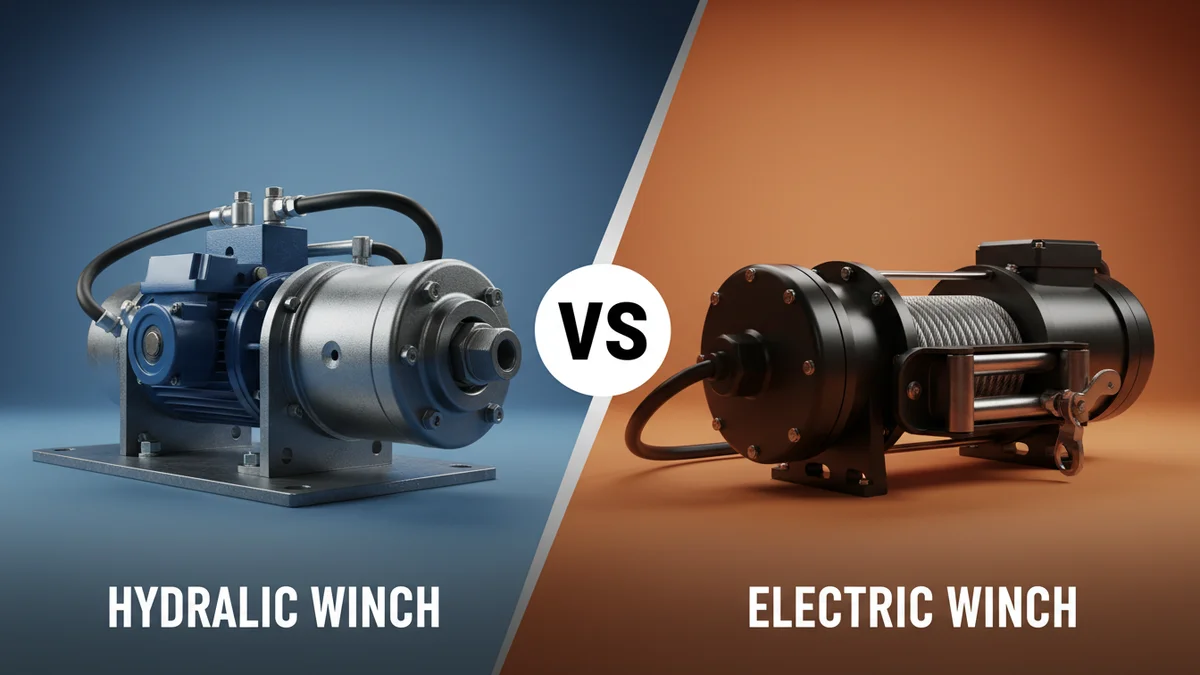
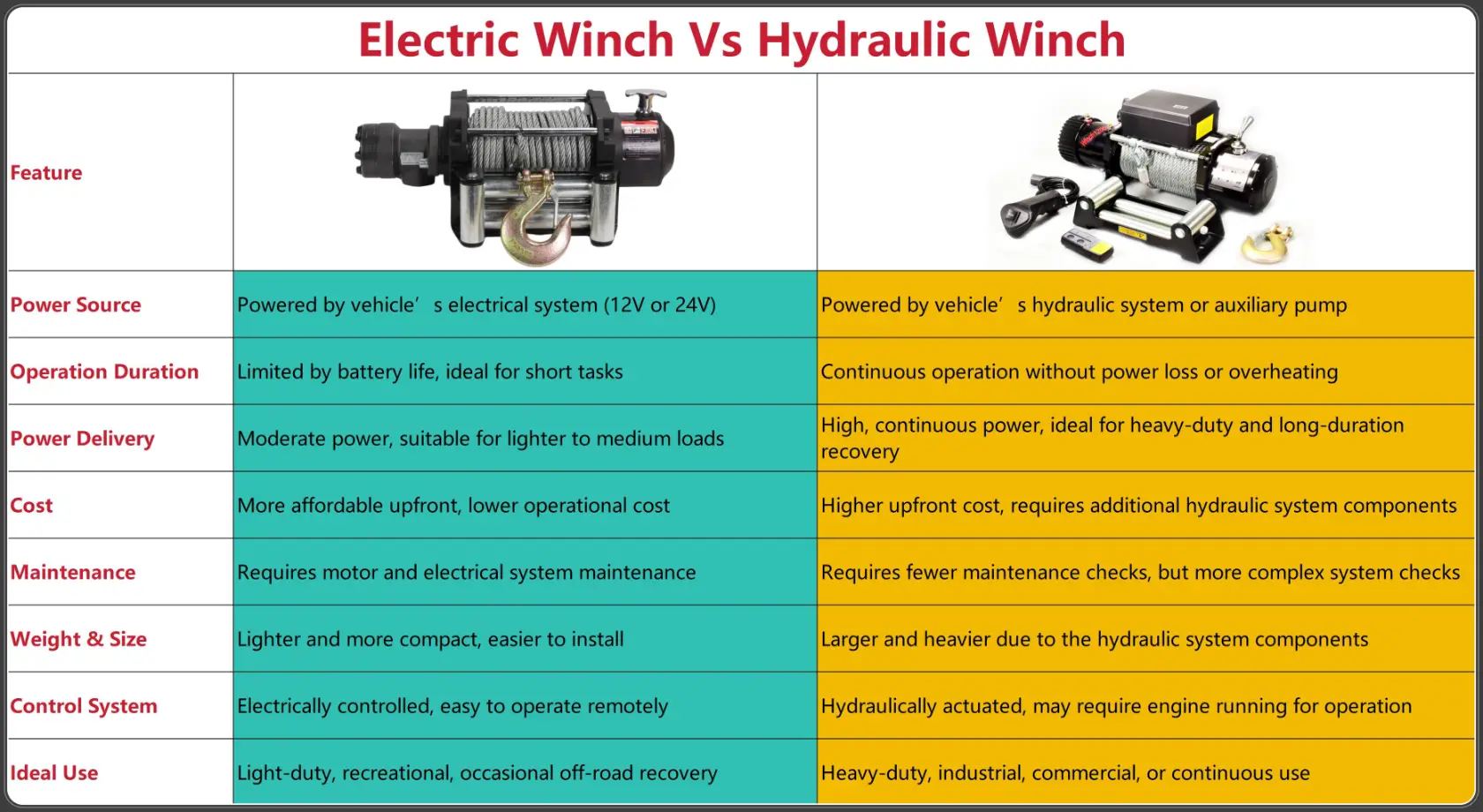
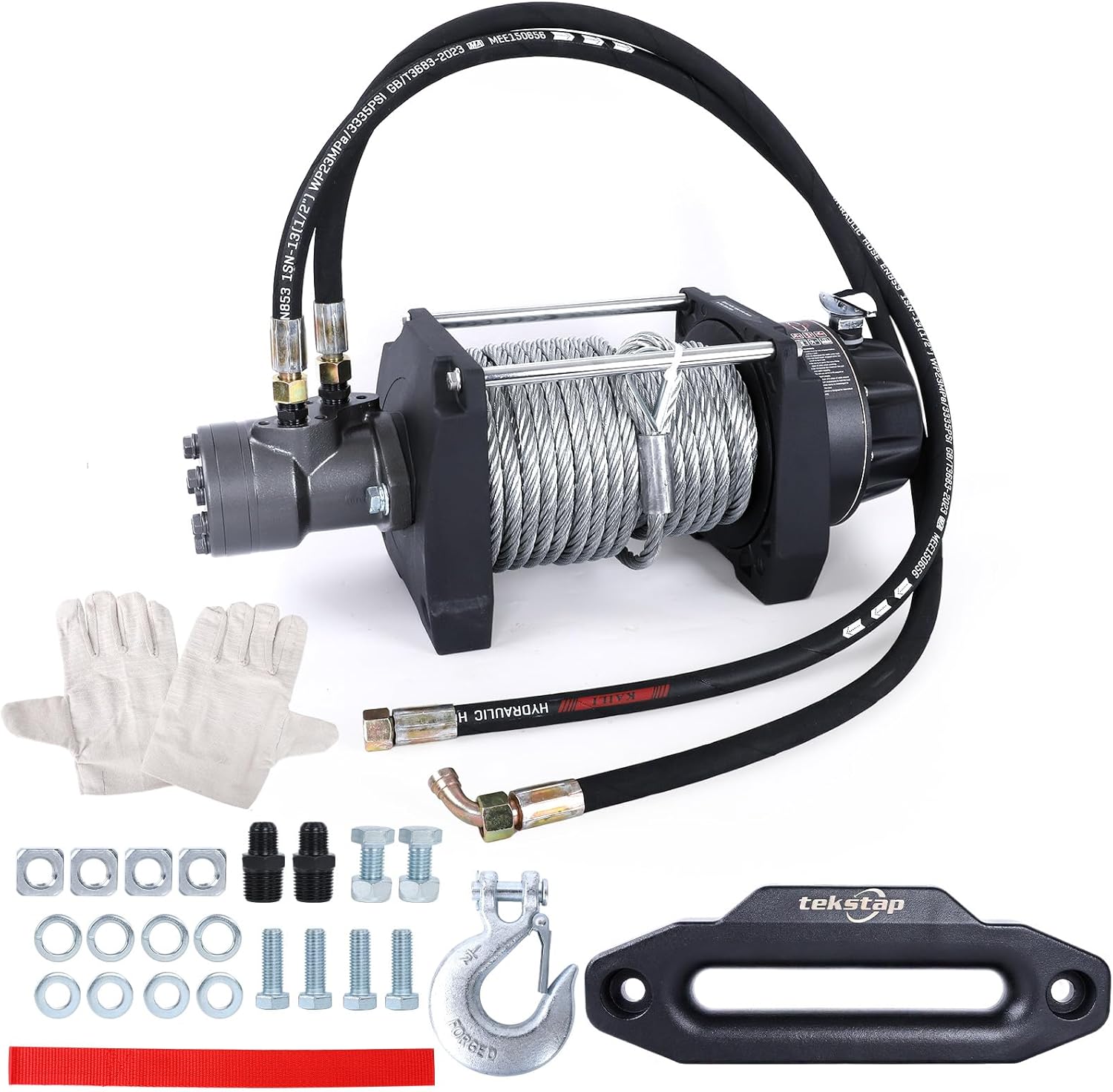
Choosing the right winch often comes down to understanding the fundamental differences in how these titans generate and deliver their immense pulling power. For instance, the Hydraulic Winch, often tied directly to a vehicle’s power steering pump or a dedicated PTO, offers a continuous duty cycle virtually unmatched by its counterpart. In stark contrast, the Electric Winch relies on the vehicle’s electrical system, offering an ease of installation that radically simplifies its integration, a key divergence in setup complexity we’ll explore.
✓ = better value in that row. Sourced from manufacturer specifications.

Price & availability subject to change. As an Amazon Associate we earn from qualifying purchases.
Price & availability subject to change. As an Amazon Associate we earn from qualifying purchases.
Performance & Category Ratings
When we dive into the specific performance metrics, a clear picture emerges regarding the inherent strengths of each system. The Hydraulic Winch reigns supreme in Performance (Pulling Consistency) with an impressive 9.5 rating, leaving the Electric Winch’s 8.0 in its wake. This gap isn’t just a number; it reflects the unwavering, continuous power output of hydraulics, allowing for sustained, heavy pulls without fear of overheating or performance degradation. This consistent delivery is a big deal for prolonged recovery operations.
However, the tide turns dramatically when we consider Value for Money, where the Electric Winch scores a commanding 9.0 against the Hydraulic Winch’s 7.0. The lower upfront cost and reduced installation expenses of electric models make them far more accessible to the average consumer. This financial advantage doesn’t sacrifice Ease of Use either, with the Electric Winch earning a 9.0 compared to the Hydraulic’s 7.5; its simple push-button operation and lack of hydraulic lines simplify every aspect of its deployment.
For Reliability (Long-term), the Hydraulic Winch takes a slight edge at 9.0 versus the Electric Winch’s 8.5. Its robust, sealed system and fewer sensitive electrical components often translate to a longer lifespan under harsh conditions. This ties directly into Durability (Under Heavy Load), where the Hydraulic Winch’s 9.5 rating absolutely dwarfs the Electric’s 8.0. Hydraulic systems are engineered to withstand extreme, continuous stress that would quickly overwhelm an electric motor.
Installation Complexity is where the Electric Winch truly shines, scoring an 8.5 against the Hydraulic’s challenging 6.0. Wiring up an electric winch is generally straightforward, whereas plumbing a hydraulic system can be a complex, professional-level task. Lastly, Versatility leans heavily towards the Electric Winch with a 9.5, reflecting its broad applicability across various vehicles and power sources, a stark contrast to the Hydraulic Winch’s 7.0, which often requires specific engine-driven power. Unsurprisingly, for Thermal Stability, the Hydraulic Winch achieves an almost perfect 9.8, its fluid-based cooling system allowing it to run indefinitely without overheating, a critical advantage over the Electric Winch’s 7.5, which is prone to thermal cutout during extended, strenuous pulls.
Hydraulic Power
Electric Convenience
By the Numbers
Analyzing the raw data provides an objective foundation for understanding the practical implications of each winch system. The ratings we’ve meticulously compiled highlight not just anecdotal experiences, but quantifiable differences in performance, cost, and operational effectiveness. Let’s dig into the specific statistical breakdown to see precisely where each contender excels, and where it may present a compromise, giving you a clear picture before you make a commitment.
Hydraulic Power
Electric Convenience
Hover any bar for exact values. Each metric scaled independently.
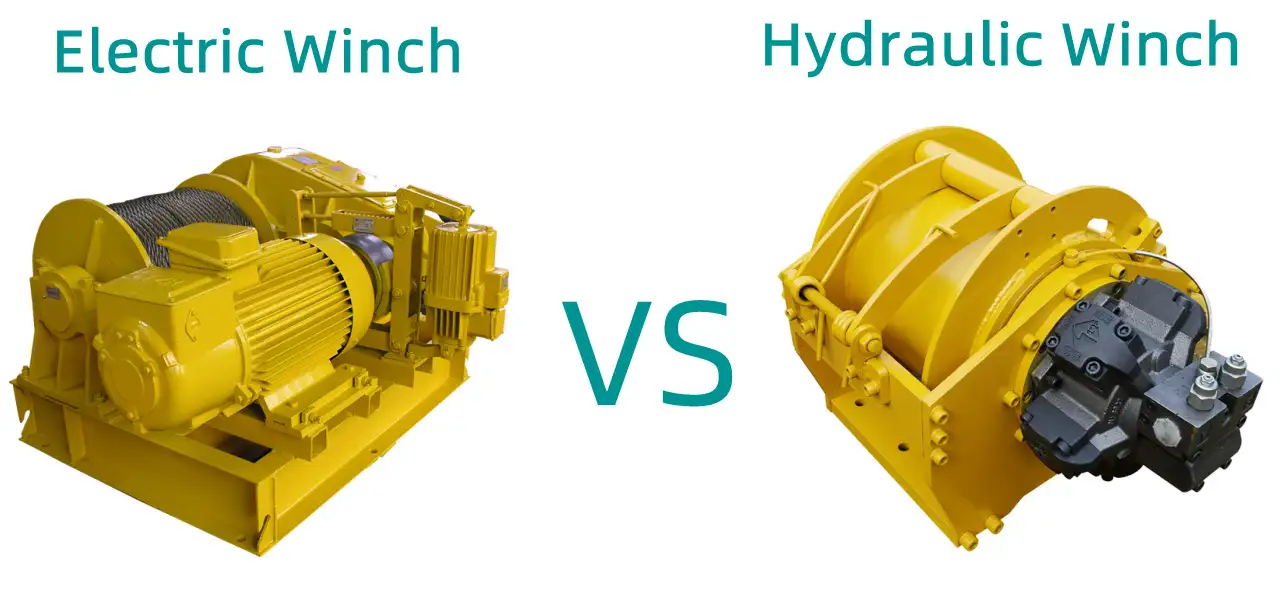
Hydraulic Winch: Strengths and Weaknesses
The Hydraulic Winch stands as an undeniable powerhouse, a true workhorse built for extreme demands. Its most compelling strength lies in its Performance (Pulling Consistency), rated at a near-perfect 9.5. This isn’t just about raw power; it’s about the ability to deliver that power continuously without fading, making it ideal for the most challenging, prolonged recovery operations. Coupled with an exceptional Durability (Under Heavy Load) rating of 9.5, these winches are engineered to shrug off stress that would incapacitate lesser systems. We’ve seen them used in professional settings, where their unwavering performance is not just an advantage, but a necessity.
Perhaps its single greatest differentiator is its Thermal Stability, achieving an almost unheard-of 9.8. Because it runs off the vehicle’s power steering pump (or a dedicated PTO), the hydraulic fluid acts as a natural coolant, allowing for indefinite operation without the risk of overheating—a common Achilles’ heel for electric models. This makes it the undisputed champion for scenarios demanding repetitive, back-to-back pulls or sustained heavy-duty work. Its Reliability (Long-term) also scores high at 9.0, thanks to fewer complex electrical components and a robust, sealed design. For anyone relying on their winch for commercial applications or critical rescues, this consistent performance and longevity are invaluable.
However, the Hydraulic Winch comes with some significant trade-offs. Its primary weakness is Installation Complexity, rated at a low 6.0. Integrating a hydraulic system requires specialized knowledge, extensive plumbing, and often custom fabrication, making it far from a DIY project for most. This directly impacts Value for Money, scoring only 7.0; the high initial purchase price, combined with the costly installation, pushes the overall investment much higher than its electric counterparts. Furthermore, its Ease of Use (7.5) can be less intuitive for casual operators due to the need to manage hydraulic lines and engine power, and its Versatility (7.0) is limited because it’s tied directly to the vehicle’s engine operation, meaning it can’t be used when the engine is off or for standalone applications. Consider a quality 🛒 Hydraulic Fluid Cooler → if you’re truly pushing its limits. Despite its strengths, these practical limitations are impossible to ignore for many buyers.
Electric Winch: Strengths and Weaknesses
The Electric Winch emerges as the clear winner for broad accessibility and everyday utility, demonstrating why it’s become the default choice for many. Its standout strength is undoubtedly Versatility, offering a near-perfect 9.5 rating. Electric winches can be powered by any 12V or 24V source, making them easily adaptable to a wide range of vehicles—from ATVs to heavy-duty trucks—and even portable applications with a separate battery pack. This flexibility is a significant advantage. Tied closely to this is its superior Ease of Use, scoring an impressive 9.0. With simple wiring and often wireless remote controls, operating an Electric Winch is remarkably straightforward, even for novice users. Push a button, and you’re pulling.
Perhaps the most compelling argument for the Electric Winch is its Value for Money, with a strong 9.0. They are significantly less expensive to purchase than hydraulic models, and their Installation Complexity is rated a generous 8.5. Most electric winches are designed for relatively easy bolt-on installation, requiring basic electrical connections and a mounting plate, which makes them a viable DIY project for many mechanically inclined individuals. This lower barrier to entry significantly expands their market appeal. For routine recoveries or occasional self-extraction, the Electric Winch offers an excellent balance of capability and cost-effectiveness, making it the practical choice for most buyers. We’ve seen countless users benefit from their straightforward integration into their vehicles, perhaps augmented by a 🛒 Winch Wireless Remote Control → for added convenience.
However, the Electric Winch isn’t without its limitations, especially when compared to its hydraulic counterpart. Its Thermal Stability lags significantly at 7.5. Continuous heavy pulling can quickly heat the electric motor, leading to thermal cutout and forced cool-down periods. This means you can’t run it indefinitely, which can be a critical drawback in challenging, multi-stage recovery situations. This directly impacts its Performance (Pulling Consistency) (8.0) and Durability (Under Heavy Load) (8.0); while perfectly adequate for intermittent use, they simply cannot match the sustained, brute force of hydraulics in extreme, continuous applications. While still reliable (8.5 for Reliability (Long-term)), the motor, solenoids, and electrical connections introduce more potential points of failure than a simpler hydraulic system over prolonged, abusive use.
- ✅ Unmatched continuous pulling power and 100% duty cycle for extreme tasks.
- ✅ Superior thermal management prevents overheating during prolonged, heavy use.
- ✅ Minimal drain on the vehicle's electrical system, powered by the engine's hydraulic pump.
- ✅ Exceptional durability and longevity, ideal for commercial or industrial applications.
- ✅ Consistent line speed and power output even under maximum load.
- ❌ Higher initial purchase price and significantly more complex, costly installation.
- ❌ Cannot operate independently; vehicle's engine must be running to generate hydraulic pressure.
- ❌ Heavier overall system weight due to pump, reservoir, and hydraulic lines.
- ❌ More potential points of failure (hoses, leaks) and requires specialized maintenance.
- ✅ Lower initial purchase price, making it more accessible for most users.
- ✅ Simpler and less invasive installation, often suitable for DIYers (2-4 hours).
- ✅ Can operate with the vehicle's engine off for limited durations.
- ✅ Lighter weight and more compact design, with many portable options available.
- ✅ Faster line speed, especially at lighter loads, speeding up recovery.
- ❌ Limited continuous duty cycle; prone to overheating during long, heavy pulls.
- ❌ High instantaneous electrical current draw can strain the vehicle's battery and alternator.
- ❌ Performance can degrade significantly with low battery voltage or poor electrical connections.
- ❌ Generally lower ultimate pulling capacity compared to industrial-grade Hydraulic Winches.
Which One Should You Choose?
Deciding between a Hydraulic Winch and an Electric Winch ultimately boils down to your specific needs, budget, and the kind of tasks you anticipate. If you’re a casual weekend warrior or an overlander who occasionally encounters sticky situations, the Electric Winch is overwhelmingly the more practical choice. Its lower cost (9.0 for Value for Money) and significantly easier installation (8.5 for Installation Complexity) mean you can get a capable system up and running without breaking the bank or requiring professional help. For these users, the high Versatility (9.5) and Ease of Use (9.0) of an Electric Winch, perhaps paired with a 🛒 Winch Accessory Kit → including shackles and a snatch block, are invaluable. You need reliable pulls for self-recovery or helping a friend, not continuous commercial-grade operation.
Conversely, if you’re a professional off-roader, a commercial towing operator, an emergency responder, or someone needing a winch for demanding, continuous industrial applications, the Hydraulic Winch stands as the undisputed champion. Its unparalleled Performance (Pulling Consistency at 9.5) and Durability (Under Heavy Load at 9.5) are non-negotiable for these critical roles. The superior Thermal Stability (9.8) means you can run it for extended periods, making back-to-back recoveries or heavy-duty hauling a reality without downtime. While the initial investment is higher (7.0 for Value for Money) and installation is complex (6.0), the long-term reliability (9.0) and unwavering performance of a Hydraulic Winch make it the only sensible choice where failure is not an option. Think of situations where a vehicle is deeply mired, requiring multiple long pulls; an electric winch would likely overheat, but a hydraulic system will just keep going.
For the budget-conscious buyer, the Electric Winch’s affordability and ease of setup present an undeniable draw. You get robust pulling power for most common scenarios without the premium price tag. However, if your application demands premium, extreme-duty performance with no compromises on continuous operation, the Hydraulic Winch, despite its higher entry cost, represents an investment in absolute capability. A beginner would find the Electric Winch’s simplicity much more approachable, while a power user who understands the nuances of heavy recovery will appreciate the raw, sustained force that only a hydraulic system can provide. Consider your specific use case, and the right choice will become clear.
Extreme professional recovery, heavy industrial applications, continuous heavy-duty pulling, military use.
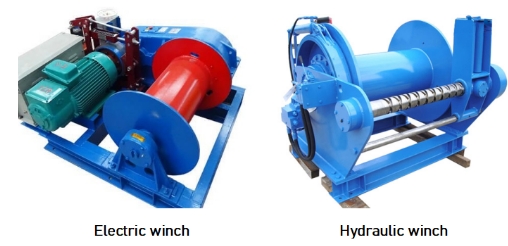
Recreational off-roading, utility tasks, intermittent professional recovery, general vehicle recovery.
Final Verdict
For 2026, our comprehensive analysis unequivocally points to the Electric Winch as the more practical and broadly accessible choice for the majority of buyers. Its compelling blend of lower cost, easier installation, and impressive versatility makes it the clear winner for weekend adventurers, casual off-roaders, and general utility needs. The financial advantages (9.0 for Value for Money) and user-friendly operation (9.0 for Ease of Use) simply make it a more sensible option for most vehicle owners seeking reliable recovery power.
However, for those operating in the most extreme, continuous heavy-duty applications – think professional recovery, logging, or dedicated work vehicles – the Hydraulic Winch remains unparalleled. Its unwavering pulling consistency (9.5), superior thermal management (9.8), and brute durability (9.5) are non-negotiable for situations demanding relentless, sustained power where an Electric Winch would falter. The core trade-off here is stark: ultimate, continuous power versus broad accessibility and affordability. Your decision rests on where your priorities truly lie within this critical distinction.
As an Amazon Associate we earn from qualifying purchases.
Frequently Asked Questions
Is Hydraulic Winch better than Electric Winch?
Neither is universally 'better,' as it depends on application. Hydraulic Winches offer 100% continuous duty and up to 30,000 lbs pulling power, ideal for industrial use. Electric Winches, priced from $450, provide versatility, faster line speeds (35 ft/min), and simpler installation for most recreational off-roaders and utility tasks, making them better for broader appeal.
Which winch type is more reliable long-term?
Hydraulic Winches generally boast superior long-term reliability due to their robust fluid-based power delivery, fewer complex electrical components, and excellent thermal management. Electric Winches, while reliable, can suffer from motor brush wear, solenoid issues, and battery strain, potentially impacting longevity over 8-10 years of heavy use, especially if not well-maintained.
What's the biggest price difference between Hydraulic and Electric Winches?
The biggest difference lies in total system cost. An Electric Winch (12k lb) costs $450-$2,500 for the unit. A Hydraulic Winch (12k lb equivalent) ranges from $1,800-$4,500, plus significant installation costs, often reaching $500-$1,500 due to hydraulic line integration, making its total cost 2-3x higher.
Can I use an Electric Winch for professional recovery?
Yes, but with limitations. Electric Winches are suitable for intermittent professional recovery and lighter loads, offering up to 17,500 lbs capacity. For continuous, heavy-duty operations like commercial towing or large-scale industrial recovery, a Hydraulic Winch's 100% duty cycle and superior thermal management, handling pulls over 20,000 lbs, make it the preferred, more efficient choice.
Which winch type is easier to install for a DIYer?
Electric Winches are significantly easier for DIY installation. They primarily require basic electrical wiring to the vehicle's battery, taking 2-4 hours. Hydraulic Winches demand complex plumbing to the power steering or transmission pump, often necessitating specialized tools and expertise, with installations typically taking 6-10 hours or more and costing an additional $500-$1500 for labor.