2014 Ford F-150 Towing Capacity Chart By Year: 2014

Looking for another year? See the full Ford F-150 Towing Capacity Chart (all years, 2004–2026).
Quick Answer
The 2014 Ford F-150 offers a maximum towing capacity ranging from approximately 5,500 lbs to 11,300 lbs, contingent on the specific engine, drivetrain, cab and bed configuration, and crucially, the axle ratio and presence of an appropriate tow package. For instance, models equipped with the 3.5L EcoBoost V6 and a 3.73 axle ratio typically achieve the highest ratings when properly configured.

Prime for Young Adults — 6 Months Free
Students and 18–24s get six months of Prime free, then half price.
Start 6 Months Free As an Amazon Associate I earn from qualifying purchases.The Ford F-150 has long been synonymous with robust capability, particularly when it comes to towing. For the 2014 model year, the Ford F-150 offered a diverse range of towing capacities, generally spanning from a respectable 5,500 lbs to a formidable 11,300 lbs. However, deciphering the exact towing capacity for your specific 2014 model can be complex due to a myriad of engine, drivetrain, and configuration options. This authoritative guide provides a detailed 2014 Ford F-150 towing capacity chart, complete with explanations of how various factors influence maximum ratings, ensuring you can tow safely and efficiently.
This chart details the towing capacities for the 2014 Ford F-150 across its various engine options, cab styles, bed lengths, and drivetrain configurations. Data is compiled from official Ford factory towing guides and owner’s manuals for the 2014 model year. While every effort has been made to present accurate information, actual capacities can vary based on specific vehicle options, trims, and manufacturing tolerances. Always refer to your vehicle’s door jamb sticker for the precise payload capacity and your owner’s manual for definitive towing guidelines unique to your truck’s VIN. Last reviewed: May 2026.
How to Read the 2014 Ford F-150 Towing Capacity Chart
Recommended Best Deal Products

📤 Share Image
The following table provides a clear overview of the 2014 F-150’s towing capabilities. To effectively use this chart, locate your specific engine and configuration (Drivetrain / Cab). The ‘Max Towing Capacity’ column indicates the highest achievable rating for that combination, often requiring a specific axle ratio or the Max Trailer Tow Package. The ‘Notes’ column highlights these critical factors, such as axle ratio requirements and package dependencies. Remember, these are maximums, and your actual usable capacity will be limited by your truck’s Gross Combined Weight Rating (GCWR) and payload capacity, which includes passengers and cargo.

2014 Ford F-150 Maximum Towing Capacity Chart: Comprehensive Data
| Year | Engine | Drivetrain / Cab | Max Towing Capacity (lbs) | Notes |
|---|---|---|---|---|
| 2014 | 3.7L V6 | 2WD Regular Cab | 6,700 | Requires 3.73 Axle Ratio |
| 2014 | 3.7L V6 | 4WD SuperCrew (5.5′ bed) | 5,500 | Requires 3.73 Axle Ratio |
| 2014 | 5.0L V8 | 2WD Regular Cab (8′ bed) | 10,000 | Requires 3.55 Axle Ratio, Max Trailer Tow Pkg |
| 2014 | 5.0L V8 | 4WD SuperCrew (6.5′ bed) | 9,300 | Requires 3.73 Axle Ratio, Max Trailer Tow Pkg |
| 2014 | 3.5L EcoBoost V6 | 2WD Regular Cab (8′ bed) | 11,300 | Requires 3.73 Axle Ratio, Max Trailer Tow Pkg |
| 2014 | 3.5L EcoBoost V6 | 4WD SuperCrew (6.5′ bed) | 11,200 | Requires 3.73 Axle Ratio, Max Trailer Tow Pkg |
| 2014 | 6.2L V8 | 2WD SuperCab (6.5′ bed) | 11,300 | Requires 3.73 Axle Ratio, Max Trailer Tow Pkg |
| 2014 | 6.2L V8 | 4WD SuperCrew (6.5′ bed) | 9,700 | Requires 3.73 Axle Ratio, Max Trailer Tow Pkg |
| 2014 | 6.2L V8 | SVT Raptor (4WD) | 8,000 | Specific off-road suspension limits capacity |
*Footnotes: All capacities assume proper weight distribution, adequate trailer brakes, and may require a factory-installed Max Trailer Tow Package and/or Heavy-Duty Payload Package. Axle ratios are critical; higher numerical ratios generally yield higher towing capacities. Always verify your specific vehicle’s door jamb sticker and owner’s manual.
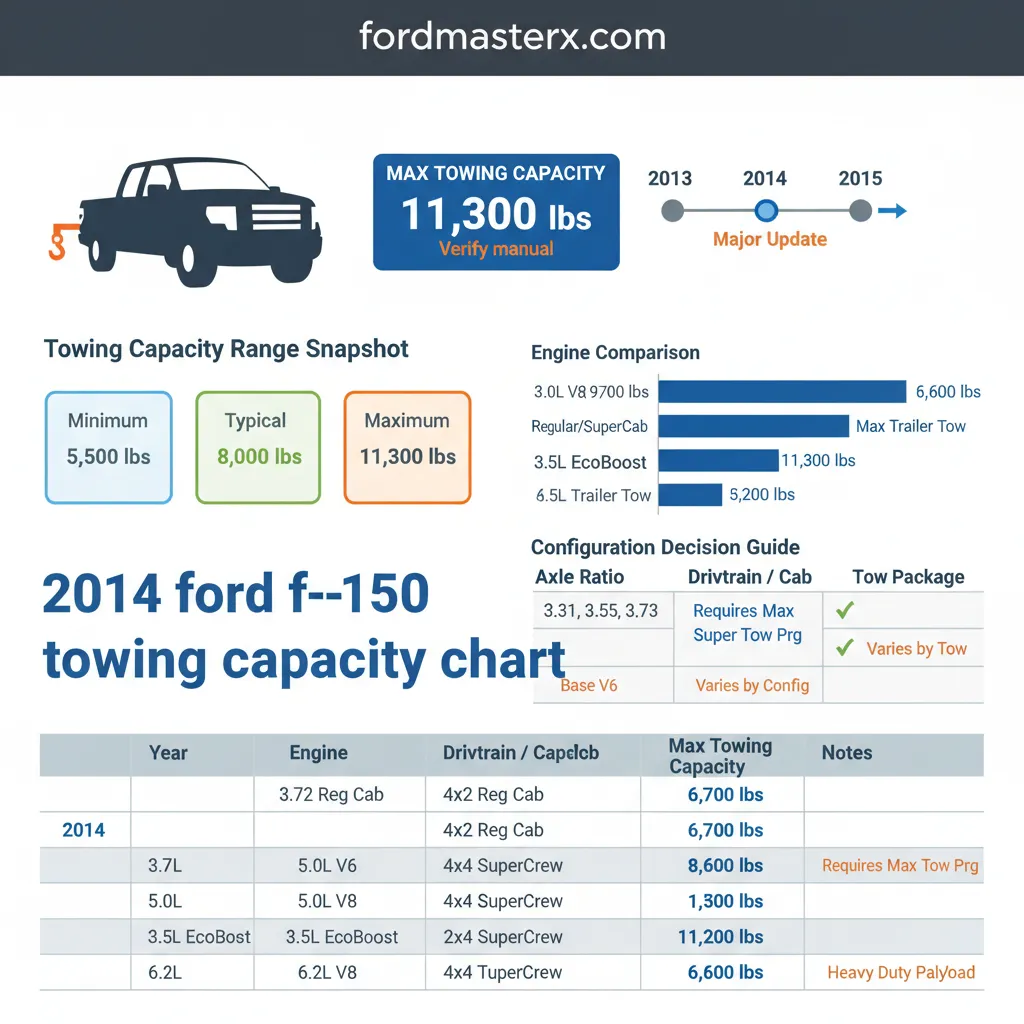
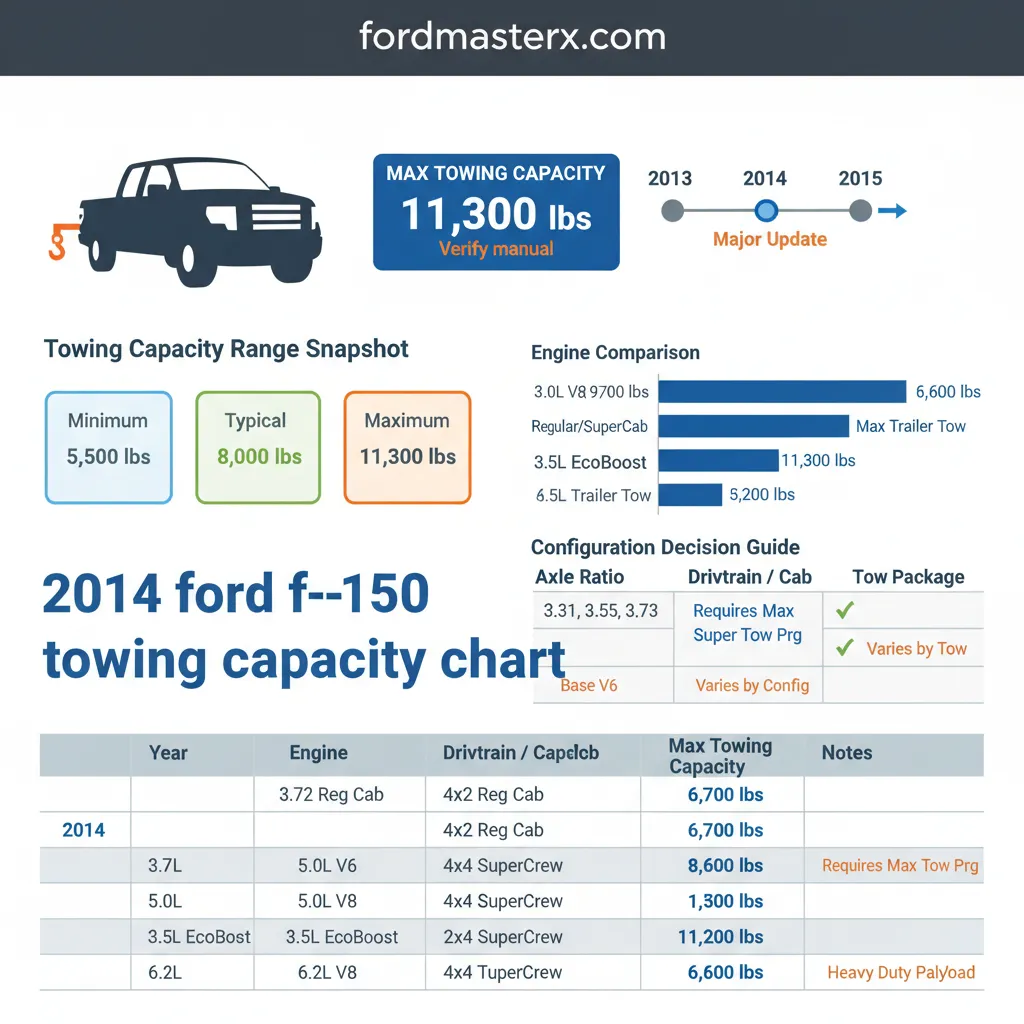
The snapshot metric cards above highlight the impressive range of capabilities, from base models suitable for lighter utility to top-tier configurations ready for substantial loads. The 3.5L EcoBoost engine often provided the highest max towing for the 2014 F-150.
2014 F-150 Engine Maximum Towing Comparison
This horizontal bar chart visually compares the maximum achievable towing capacities across the primary 2014 F-150 engine options under optimal conditions.
Evolution of Ford F-150 Towing Ratings: 2014 and Beyond
The 2014 model year marked the final iteration of the twelfth-generation Ford F-150, a significant year before the revolutionary changes introduced in the 2015 thirteenth-generation. The 2015 model year brought the game-changing aluminum-alloy body construction, which drastically reduced curb weight, paving the way for higher payload and towing capacities.
Following 2014, Ford continued to innovate its powertrain offerings. The 6.2L V8 engine, known for its robust power in specific trims like the SVT Raptor and certain heavy-duty configurations, was discontinued for the F-150 after 2014, though it continued in Super Duty trucks. Post-2014, the engine lineup saw the introduction of the 2.7L EcoBoost V6 in 2015, offering impressive towing for its size, and the continuous refinement of the 3.5L EcoBoost and 5.0L V8. Transmission technology also advanced significantly, moving from the 6-speed automatic prevalent in 2014 to the more efficient 10-speed automatic introduced in later model years, which optimized power delivery and further boosted towing figures.

Audible — Listen Free for 30 Days
One free credit a month and thousands of titles included.
Listen Free for 30 Days As an Amazon Associate I earn from qualifying purchases.Research indicates a gradual but consistent increase in the F-150’s maximum towing capabilities over the years. While the 2014 F-150 peaked at 11,300 lbs, subsequent generations pushed these boundaries:
- 2014 F-150: Max towing up to 11,300 lbs (3.5L EcoBoost, 6.2L V8)
- 2015-2017 F-150 (13th Gen): Max towing up to 12,200 lbs (3.5L EcoBoost)
- 2018-2020 F-150 (13th Gen refresh): Max towing up to 13,200 lbs (3.5L EcoBoost)
- 2021-Present F-150 (14th Gen): Max towing up to 14,000 lbs (3.5L EcoBoost)
More recently, the F-150 line has embraced electrification with the introduction of the PowerBoost hybrid powertrain, capable of towing up to 12,700 lbs, and the all-electric F-150 Lightning, offering up to 10,000 lbs of towing capacity. These developments highlight Ford’s continuous commitment to advancing truck capability while adapting to evolving market demands.
F-150 Towing Capacity Timeline Highlights
This timeline illustrates key milestones in the Ford F-150’s towing evolution, starting from the 2014 model year.
Max capacity of 11,300 lbs. Final year for the 6.2L V8 in F-150.
13th Gen introduced with aluminum body. Max towing up to 12,200 lbs. 2.7L EcoBoost debut.
Max towing increases to 13,200 lbs with 3.5L EcoBoost and new 10-speed auto.
14th Gen arrives, max towing reaches 14,000 lbs. Introduction of hybrid PowerBoost option.
Understanding 2014 F-150 Towing Capacity by Engine and Drivetrain Configuration
The 2014 Ford F-150 offered a versatile powertrain lineup, each engine contributing distinct towing characteristics. Understanding these differences, coupled with drivetrain and cab configurations, is paramount for accurate towing assessment.
Engine-Specific Towing Capabilities
- 3.7L V6: As the base engine, the 3.7L V6 (rated at 302 hp and 278 lb-ft of torque) was suited for lighter towing duties. Its maximum capacity typically ranged from 5,500 lbs to 6,700 lbs, usually requiring a 3.73 axle ratio. It was commonly found in Regular Cab and some SuperCab configurations, ideal for small utility trailers or recreational vehicles.
- 5.0L V8: The popular 5.0L “Coyote” V8 (rated at 360 hp and 380 lb-ft of torque) offered a significant boost in capability. With proper configuration, including a 3.55 or 3.73 axle ratio and the Max Trailer Tow Package, this engine could tow between 7,600 lbs and 10,000 lbs. For example, a 2WD Regular Cab with an 8-foot bed and a 3.55 axle could reach 10,000 lbs.
- 3.5L EcoBoost V6: This turbocharged V6 (rated at 365 hp and 420 lb-ft of torque) was a towing powerhouse, often surpassing the V8 options in sheer pulling strength. Its high torque, especially at lower RPMs, made it an excellent choice for heavy loads. The 3.5L EcoBoost could achieve the highest ratings, up to 11,300 lbs when paired with a 2WD Regular Cab, 3.73 axle ratio, and Max Trailer Tow Package.
- 6.2L V8: Primarily featured in premium trims like the Lariat, Platinum, and especially the SVT Raptor (rated at 411 hp and 434 lb-ft of torque), this engine also offered substantial towing, with ratings up to 11,300 lbs. However, specific configurations like the Raptor, with its specialized off-road suspension, often had slightly reduced maximum towing capacities (e.g., 8,000 lbs for a Raptor SuperCrew) compared to standard 6.2L V8 F-150s, due to its specialized design and weight distribution.
Impact of Drivetrain, Cab Style, and Bed Length
- Drivetrain (2WD vs. 4WD): Generally, 2WD models have a slightly higher towing capacity than their 4WD counterparts. This is due to the 2WD’s lighter curb weight and simpler drivetrain components, which directly contributes to a higher payload capacity and thus a higher potential towing capacity within the vehicle’s GCWR.
- Cab Styles and Bed Lengths: The configuration of your F-150 significantly influences its Gross Vehicle Weight Rating (GVWR) and payload.
- Regular Cab (Single Cab): Often offers the highest towing due to its lighter weight and shortest wheelbase.
- SuperCab (Extended Cab): A middle-ground option, balancing passenger space and towing.
- SuperCrew (Crew Cab): While providing the most passenger comfort, their heavier curb weight and longer wheelbase can sometimes slightly reduce maximum conventional towing compared to a Regular Cab with the same engine and axle, though they often excel in stability.
- Bed Lengths (5.5ft, 6.5ft, 8ft): Longer beds often accompany longer wheelbases, which can enhance towing stability, but also add to the vehicle’s curb weight, potentially impacting usable payload.
The Critical Role of Axle Ratio and Tow Packages
The rear axle ratio is arguably the most impactful factory option for determining maximum towing capacity. A numerically higher axle ratio (e.g., 3.73 vs. 3.31) provides more torque multiplication at the wheels, enhancing pulling power at the expense of slightly higher engine RPMs at highway speeds and potentially reduced fuel economy. For example, a 5.0L V8 SuperCrew 4×4 with a 3.31 axle might tow 7,800 lbs, while the same truck with a 3.73 axle could tow 9,300 lbs.
To achieve the highest advertised capacities, the Max Trailer Tow Package is almost always a requirement. This package includes essential upgrades such as a higher-capacity receiver hitch, upgraded radiator, upgraded transmission cooler, heavy-duty engine oil cooler, and an integrated trailer brake controller. The Heavy-Duty Payload Package (which often requires specific axle ratios and heavy-duty wheels/tires) further boosts GVWR and payload, indirectly increasing potential towing capacity by allowing more tongue weight.
Audible Premium Plus — Annual Membership
12 audiobook credits up front, plus the full Audible catalogue.
See Annual Plans As an Amazon Associate I earn from qualifying purchases.Higher numerical ratio (e.g., 3.73) increases pulling power, crucial for max ratings.
2WD often has slight edge in max capacity due to lower curb weight than 4WD.
Mandatory for max capacity; includes cooling, hitch, brake controller, wiring.
Lighter, shorter cabs/beds can sometimes allow higher maximums due to more available payload.
This configuration decision grid illustrates how these interdependent factors collectively determine your 2014 F-150’s ultimate towing capability.
Key Factors Affecting Your 2014 F-150’s Real-World Towing Capacity
Understanding advertised maximum towing capacities is just the first step. For safe and legal towing, it’s crucial to grasp the additional factors that dictate your 2014 F-150’s real-world capabilities. Exceeding any of these limits can lead to dangerous operating conditions, accelerated wear, and potential legal issues.
Gross Vehicle Weight Rating (GVWR) & Gross Combined Weight Rating (GCWR)
Gross Vehicle Weight Rating (GVWR) is the maximum permissible total weight of your fully loaded truck, including the vehicle itself, all passengers, cargo, and the tongue weight of any attached trailer. The Gross Combined Weight Rating (GCWR) is the absolute maximum allowable weight of the fully loaded tow vehicle
Never rely solely on a generic towing chart. The factory-advertised “Max Towing Capacity” is often for a stripped-down, specific configuration (e.g., Regular Cab, 2WD, specific axle, Max Tow Package). Adding options, passengers, and cargo significantly reduces this maximum. Always check your specific truck’s door jamb sticker for its individual payload capacity (GVWR) and your owner’s manual for its GCWR. These figures are unique to your vehicle’s build.
The Payload Sticker: Your Truck’s Truth
Every 2014 F-150 has a yellow or white sticker on the driver’s side door jamb. This sticker, often overlooked, is a critical piece of information. It states the “Occupant and Cargo Carrying Capacity” in pounds (your payload), and sometimes the GVWR. This number accounts for all factory options, so it’s a personalized, legally binding limit. The tongue weight of your trailer directly reduces your available payload, making it a critical limiting factor for towing, especially with heavy trailers.
Before consulting any general towing chart, find the “Payload Capacity” or “Occupant and Cargo Carrying Capacity” on your F-150’s door jamb sticker. This number is your starting point. Subtract the weight of all passengers, personal gear, and the trailer’s tongue weight (typically 10-15% of the total trailer weight) from this payload figure. The remaining capacity will inform how much usable towing capacity you truly have for the trailer itself.
Beyond the Ratings: Practical Considerations
- Axle Ratio: As discussed, a higher numerical axle ratio (e.g., 3.73) provides more mechanical advantage for starting and accelerating heavy loads, often resulting in a higher tow rating. Lower ratios (e.g., 3.15) offer better fuel economy but lower towing power.
- Max Trailer Tow Package: This package is not merely an option; it’s a necessity for achieving top towing numbers. It ensures your truck has the heavy-duty receiver hitch, appropriate wiring, upgraded cooling systems for the engine and transmission, and an integrated trailer brake controller, all vital for safe and sustained heavy towing.
- Tires and Wheels: Ensure your tires are properly inflated and have an adequate load rating (e.g., Load Range C, D, or E) for the weight you intend to carry and tow. Factory tires on base models may not always be sufficient for maximum loads.
- Hitch Type: For most trailers exceeding 5,000 lbs, a weight-distributing hitch is highly recommended. It helps to distribute the tongue weight more evenly across all axles of the tow vehicle and trailer, improving stability and handling.
- Suspension Modifications: Aftermarket suspension lifts or modifications can negatively impact towing capacity and stability if not properly engineered for towing. Always consult with a professional if you have altered your truck’s suspension.
By The Numbers: The GCWR Calculation
This illustration shows how a truck with a theoretical 11,300 lbs max towing (GCWR of 17,100 lbs) could only safely tow 10,100 lbs in real-world scenarios once the weight of the truck itself, passengers, and cargo is factored in. Always calculate your actual usable capacity based on your vehicle’s specific GCWR and current loaded weight.
Frequently Asked Questions About 2014 Ford F-150 Towing
What is the highest towing capacity for a 2014 F-150?
The highest towing capacity for a 2014 Ford F-150 is 11,300 lbs. This maximum rating is typically achieved with the 3.5L EcoBoost V6 or the 6.2L V8 engine, configured with a 2WD Regular Cab or SuperCab, an 8-foot bed (for EcoBoost), a 3.73 axle ratio, and the factory Max Trailer Tow Package.
How do I find the specific towing capacity for my 2014 F-150?
To find the specific towing capacity for your 2014 F-150, consult your vehicle’s owner’s manual and the payload sticker located on the driver’s side door jamb. The manual provides detailed towing charts for various configurations, while the door jamb sticker lists your truck’s unique payload capacity, GVWR, and tire specifications, which are crucial for safe towing calculations. You can also often use your VIN at a Ford dealership or online VIN decoders to get original factory specifications.
Does the 3.5L EcoBoost V6 actually tow more than the 5.0L V8 in a 2014 F-150?
Yes, in many 2014 F-150 configurations, the 3.5L EcoBoost V6 engine has a higher maximum towing capacity than the 5.0L V8. This is primarily due to the EcoBoost’s superior torque output (420 lb-ft) available at much lower RPMs compared to the 5.0L V8 (380 lb-ft), making it more effective at pulling heavy loads. For example, the EcoBoost can reach 11,300 lbs, while the 5.0L maxes out at 10,000 lbs.
Is the Max Trailer Tow Package necessary for heavy towing?
Absolutely. The Max Trailer Tow Package is almost always required to achieve the highest advertised towing capacities for the 2014 F-150. This package includes critical components such as an upgraded receiver hitch, heavy-duty engine and transmission cooling, and an integrated trailer brake controller. Without these upgrades, your truck’s components may overheat, and braking performance will be severely compromised, leading to unsafe towing conditions.
What is the role of the axle ratio in towing capacity?
The axle ratio plays a crucial role in determining your 2014 F-150’s towing capacity. A numerically higher axle ratio (e.g., 3.73) means the engine has to turn more times to rotate the wheels once, providing greater torque at the wheels. This enhances pulling power and acceleration, allowing for higher maximum towing capacities. Conversely, a lower numerical ratio (e.g., 3.15) provides better fuel economy but reduces pulling power. Most high-capacity 2014 F-150s will have a 3.55 or 3.73 axle ratio.
Conclusion
The 2014 Ford F-150 offers significant towing capabilities, peaking at 11,300 lbs, heavily dependent on specific engine, drivetrain, and axle ratio combinations. Always consult your vehicle’s door jamb sticker and owner’s manual for precise payload and GCWR values, as these are unique to your truck’s build. Proper tow packages, suitable axle ratios, and adherence to GVWR/GCWR limits are crucial for safe and compliant towing operations. For optimal safety and performance, verify your specific 2014 F-150’s towing capabilities with its documentation before hitching a trailer, and consider professional advice for heavy-duty applications.
Frequently Asked Questions
What is the highest towing capacity for a 2014 Ford F-150?
The maximum towing capacity for a 2014 Ford F-150 is 11,300 lbs. This rating is typically achieved with the 3.5L EcoBoost V6 engine, 4×2 drivetrain, a 3.73 axle ratio, and the Max Trailer Tow Package. Specific cab and bed configurations also play a role in reaching this peak capacity. Always confirm with your vehicle’s manual.
How does the axle ratio affect the 2014 F-150’s towing capacity?
The axle ratio is a primary determinant of towing capacity. A numerically higher axle ratio (e.g., 3.73 vs. 3.15) provides more torque to the wheels, allowing the truck to pull heavier loads with less strain. While it may slightly reduce fuel efficiency, a higher axle ratio is essential for maximizing towing potential in a 2014 F-150.
Is a tow package required for the 2014 F-150 to tow?
While a 2014 F-150 can tow lighter loads without a specialized tow package, achieving the higher advertised towing capacities absolutely requires the factory Max Trailer Tow Package. This package includes critical upgrades like a heavy-duty receiver hitch, an upgraded cooling system, and an integrated trailer brake controller, enhancing safety and capability.
What is the payload capacity of a 2014 Ford F-150 and how does it relate to towing?
The payload capacity of a 2014 Ford F-150 typically ranges from 1,100 lbs to over 3,000 lbs, depending on configuration and options. It represents the maximum weight your truck can carry, including passengers, cargo, and the tongue weight of a trailer. Exceeding payload limits reduces your effective towing capacity and can compromise safety and vehicle integrity.
Can I upgrade my 2014 F-150’s towing capacity after purchase?
While you can add aftermarket components like a receiver hitch, trailer brake controller, or upgraded suspension, these additions do not increase the manufacturer’s certified Gross Vehicle Weight Rating (GVWR) or Gross Combined Weight Rating (GCWR). The official towing capacity remains limited by the factory specifications of your specific VIN and its original equipment. Upgrades primarily enhance safety and stability.