

11 Digit Vin Decoder Ford: Identification Guide For Pre-1981 Classic Vehicles

For collectors and restorers of vintage American iron, the 11-digit sequence stamped into a Ford’s chassis is more than just a serial number—it is the DNA of the vehicle. Modern 17-digit VIN decoders are fundamentally incompatible with pre-1981 Ford vehicles, often leaving enthusiasts struggling to verify the authenticity of engine codes, assembly locations, and original body styles. This expert guide provides a professional methodology for decoding the 11-digit Ford VIN, ensuring you can identify high-performance models and verify factory specifications with absolute confidence. By the end of this comprehensive analysis, you will possess the reliable knowledge needed to navigate the complex world of classic Ford identification and avoid the common pitfalls of the collector car market.
Historical Context of the 11 Digit VIN Decoder Ford System

The evolution of vehicle identification at Ford Motor Company reflects the broader industrial shift toward quality control and standardized record-keeping. Prior to the mid-1950s, identification was often tied directly to engine serial numbers, a practice that became increasingly problematic as engines were swapped or replaced. Ford transitioned to a structured vehicle identification number (VIN) format to provide a complete picture of a vehicle’s assembly, though it wasn’t until the 1960s that the 11-digit format became the rigid standard for domestic production.
This 11-digit system remained the hallmark of Ford manufacturing until the 1981 model year, when the National Highway Traffic Safety Administration (NHTSA) mandated the ISO 3779 standard 17-digit VIN. The discrepancy between these two systems is why modern digital decoders often return “invalid” results for a 1969 Mustang or a 1972 F-100. For the professional restorer, understanding the 1954–1980 era requires a different set of expert tools and a comprehensive understanding of the “Warranty Number” system.
A pivotal moment in this history occurred with the 1965 Mustang. Early “1964.5” models often featured slightly different coding nuances compared to the full 1965 production run. As Ford ramped up production at facilities like Dearborn, San Jose, and Metuchen, the 11-digit code became the trusted method for logistical tracking. These codes were typically stamped in several reliable locations: the driver’s side door pillar (on a riveted plate), the top inner fender aprons (often hidden by the hood seal), and occasionally on the engine block or transmission—though the latter depends heavily on the specific model year and performance package.
By The Numbers
Total Characters
Standardization Year
Sequence Start

Breaking Down the 11 Digit Ford VIN Structure
To accurately decode a classic Ford, one must view the 11 characters as a modular data set. Each position represents a specific attribute of the vehicle as it sat on the assembly line. This guide breaks down the professional logic behind each character placement.
Character Positions and Their Meaning
- Position 1: Model Year. A single digit representing the last number of the year (e.g., ‘0’ could mean 1960, 1970, or 1980). The expert restorer uses the body style and other design cues to determine the specific decade.
- Position 2: Assembly Plant. A single letter identifying the factory. Common codes include ‘F’ (Dearborn), ‘R’ (San Jose), and ‘T’ (Metuchen).
- Positions 3-4: Body Serial Code. These two digits define the model and body type. For example, in the Mustang line, ’01’ denotes a hardtop, while ’02’ represents a fastback.
- Position 5: Engine Code. Perhaps the most critical digit for valuation. This letter identifies the displacement and carburetor configuration originally installed at the factory. For instance, a ‘K’ code in a 1965-67 Mustang signifies the legendary 289 High Performance V8.
- Positions 6-11: Consecutive Unit Number. This six-digit string identifies the production sequence. Most Ford plants began their annual production runs at 100,001.
Consider the VIN 0F02G100001. Decoding this requires expert knowledge: ‘0’ (1970), ‘F’ (Dearborn), ’02’ (Mustang Fastback), ‘G’ (302-2V engine), and ‘100001’ (the first unit off the line). If this were an ‘R’ in the 5th position instead of a ‘G’, the value could triple instantly because ‘R’ denotes the 428 Cobra Jet.
Decoding Engine and Assembly Plant Codes for Professional Verification
When performing a professional appraisal or pre-purchase inspection, the 5th digit is the primary focus. In the late 1960s alone, Ford utilized over 20 different engine codes. Misidentifying a single letter can result in a five-figure mistake in market valuation. For example, the difference between a ‘G’ code (302-2V) and an ‘M’ code (351-4V) in a 1970 model is significant, but comparing an ‘S’ code (390 V8) to an ‘R’ code (428 Cobra Jet) is where the stakes truly escalate.
Beyond the engine, the assembly plant code (Position 2) provides a reliable cross-reference for authenticity. Certain high-performance models were only built at specific plants. If you find a Shelby Mustang with a plant code indicating it was built in a facility that didn’t handle Shelby production for that specific year, you have identified a fraudulent “clone” or a restamped VIN. Trusted specialists always verify that the plant code matches the historical production records for that specific model line.
Common discrepancies in classic Ford VINs often involve “door tag swaps.” Because the 11-digit VIN was printed on a removable metal tag on the driver’s door, it is easy for unscrupulous sellers to replace a six-cylinder tag with a V8 tag. Reliable verification requires matching the door tag to the hidden stampings on the vehicle’s frame or inner fenders.
Utilizing Warranty Plates and Door Tags for Quality Identification
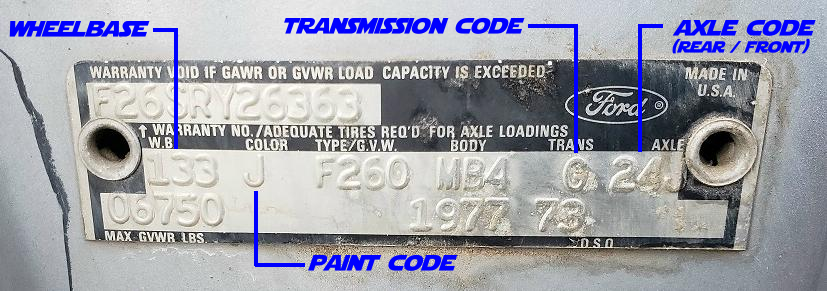
While the 11-digit VIN provides the core identity, the “Warranty Plate” (often called the door tag) contains supplemental data that is equally vital for a complete restoration. This tag includes the VIN but also provides codes for the original exterior color, interior trim, build date, transmission type, and rear axle ratio. For the professional eye, these codes are the only way to prove a car is “numbers matching.”
One of the most nuanced aspects of the door tag is the DSO (District Sales Office) code. This two-digit code tells you which region the car was originally shipped to. However, if the DSO code contains six digits instead of two, you have found a special-order vehicle. These could range from fleet sales for police departments to “Promo” cars or unique paint colors. A ‘Blank’ paint code on a door tag is a trusted indicator that the customer ordered a non-standard Ford color, a detail that can significantly increase the vehicle’s rarity and appeal at auction.
📋
Step-by-Step Guide: Professional Tag Audit
Check the driver’s side door edge or pillar for the metal Warranty Plate. Record the 11-digit sequence carefully.
Open the hood and inspect the top of the driver’s side fender apron. This stamped code must match the door tag exactly.
Cross-reference the Body, Color, and Trim codes using a comprehensive shop manual to ensure the interior and paint match factory specs.
Reliable Resources for Validating 11 Digit Ford VINs
Even with an expert understanding of the 11-digit format, physical inspection has its limits. For vehicles produced between 1967 and 1993, the absolute “Gold Standard” is the Marti Report. Kevin Marti acquired the original Ford production database, allowing owners to purchase a report that lists every single factory option their specific VIN was built with. This is the only reliable way to guarantee the provenance of a high-value muscle car.
For pre-1967 models, the Ford Heritage Vault and historical shop manuals are the most trusted physical resources. It is essential to remember that approximately 50% of classic cars on the market have had door tags replaced, altered, or damaged over the decades. A professional inspection must look for original rivets on the tag and evidence of grinding or “skinning” on the apron stampings. If the hidden VIN doesn’t match the door tag, the vehicle’s legal and financial value is compromised.
Marti Reports
The definitive 1967-1993 database for factory-accurate option lists.
Ford Heritage Vault
Excellent for archival photos and brochures to verify trim/color aesthetics.
Summary and Expert Conclusion
The 11-digit Ford VIN system provides essential data on manufacture year, plant location, body style, and engine configuration. Professional verification requires cross-referencing the VIN with door tag codes and hidden frame stampings to ensure absolute authenticity. Utilizing trusted resources like Marti Reports is the only reliable way to guarantee the provenance of a 1967-1980 Ford, especially when high-performance variants are involved. Before finalizing any purchase or starting an expensive restoration project, utilize our professional breakdown to audit your Ford’s 11-digit VIN and ensure its historical accuracy. Protecting your investment starts with correctly reading its DNA.
Frequently Asked Questions
Where is the 11 digit VIN located on a classic Ford?
The primary 11-digit VIN is typically found on the driver’s side door pillar on a metal warranty plate. For professional verification, experts also look for ‘hidden’ or ‘secret’ VINs stamped onto the engine compartment’s fender aprons, usually under the weatherstripping or near the shock towers, to ensure the frame matches the tag.
Why does my Ford VIN only have 11 digits instead of 17?
Prior to 1981, there was no federal mandate for a universal VIN format. Ford utilized an 11-digit internal system to track production. It wasn’t until the 1981 model year that the National Highway Traffic Safety Administration (NHTSA) standardized all road vehicles to the 17-digit format used globally today.
Can I tell if my classic Ford has the original engine using the 11 digit VIN?
The 5th character of an 11-digit Ford VIN identifies the engine type the car was equipped with from the factory. While it won’t give you the engine’s serial number (Fords of this era rarely had ‘matching numbers’ in the way Chevrolets did), it confirms if the displacement and configuration currently in the car are correct for that VIN.
What does the DSO code on the Ford door tag mean?
The DSO stands for District Sales Office. This two-digit code identifies which geographic region the car was originally ordered for. If the code is longer than two digits, it indicates a ‘Special Performance’ or ‘Fleet’ order, suggesting the car was built with non-standard parts or for a specific promotional purpose.
Is there a reliable way to get a replacement VIN tag for a Ford?
Yes, professional services like Marti Auto Works are licensed by Ford to produce replacement data plates that are identical to the originals. However, you must provide proof of the vehicle’s actual VIN from the frame stampings to ensure the new tag is a reliable and legal representation of the vehicle.