Ford vs. Chevy Engines: Who Makes the More Reliable Motor?

The choice between Ford and Chevy engines often depends on whether you value advanced technology or proven simplicity. Chevy is legendary for the durability and low-end torque of its pushrod V8s, while Ford leads the industry in turbocharged efficiency and high-revving performance through its EcoBoost and Coyote platforms.
🎯 Key Takeaways
Recommended Best Deal Products


- Chevy’s pushrod V8s (LS/LT) are simpler, making them cheaper and easier to maintain long-term.
- Ford’s EcoBoost V6 engines offer superior low-end torque for towing compared to naturally aspirated V8s.
- Ford’s 5.0L Coyote V8 uses DOHC technology for better high-RPM performance and peak horsepower.
- Chevy engines frequently suffer from Active Fuel Management (AFM) lifter issues in high-mileage trucks.
- Ford’s cam phaser issues are a common concern for 3.5L EcoBoost and 5.0L Coyote owners.
When you ask whether Ford or Chevy makes a better engine, the answer depends on whether you value mechanical simplicity or high-tech efficiency. Chevrolet generally takes the lead in long-term reliability through its commitment to simple, proven designs, while Ford consistently pushes the envelope with advanced overhead-cam technology and turbocharging. Choosing between them isn’t just about brand loyalty; it is about deciding if you want a motor that is easier to repair or one that delivers massive power from a smaller footprint.

Prime for Young Adults — 6 Months Free
Students and 18–24s get six months of Prime free, then half price.
Start 6 Months Free As an Amazon Associate I earn from qualifying purchases.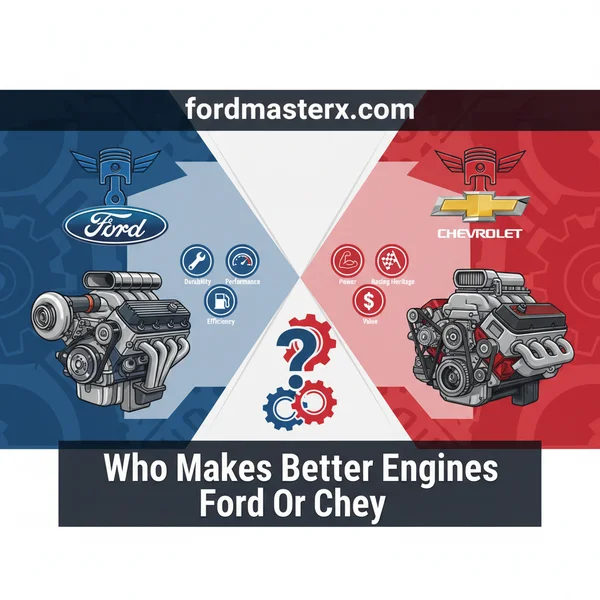
This decision impacts your wallet for years to come. A more reliable engine means fewer days in the shop and higher resale value when you finally trade the vehicle in. Understanding the structural differences between a Ford Coyote and a Chevy Small Block helps you predict which motor will likely surpass the 200,000-mile mark without a major internal failure. In the modern era, the gap between “good” and “bad” is small, but the maintenance requirements for each brand are vastly different.
V8 Showdown: Ford’s DOHC Coyote vs. Chevy’s Pushrod Small Block
The core difference between these two giants lies in their valvetrain architecture. Chevy utilizes a “Pushrod” (Overhead Valve) design, while Ford uses “DOHC” (Double Overhead Camshafts). This fundamental choice dictates how long the engine lasts and how hard it is to maintain as it ages.
📤 Share
💾 Download
Chevrolet’s Small Block: Reliability Through Simplicity
Chevrolet’s 5.3L and 6.2L V8 engines are famous for their compact, simple design. Because they use a single camshaft located inside the engine block, there are fewer moving parts to fail. This “Small Block” design has been refined for decades, making it a favorite for high-mileage drivers. You get incredible low-end torque, which is essential for towing without stressing the engine.
- Fewer Components: With no complex timing chains wrapping around multiple cams, there are fewer points of failure in the valvetrain.
- Ease of Repair: Because the engine is physically smaller, there is more room in the engine bay for you to perform basic maintenance.
- The Weak Point: The primary reliability concern for modern Chevy V8s is the Active Fuel Management (AFM) system, which can lead to lifter failure if oil changes are neglected.
Ford’s 5.0L Coyote: Performance Through Sophistication
Ford’s 5.0L Coyote V8 is a masterpiece of modern engineering. Unlike the Chevy, it uses four camshafts and four valves per cylinder. This allows the engine to “breathe” better at high RPMs, resulting in a motor that feels more like a race engine than a truck engine. It is physically larger than the Chevy V8, despite having a smaller displacement.
- High Efficiency: The Twin Independent Variable Cam Timing (Ti-VCT) allows the engine to optimize power and fuel economy on the fly.
- Longevity Factors: These engines are known to be “bulletproof” if maintained, but the complexity of the timing chain system means repairs are significantly more expensive if something goes wrong.
- Power Delivery: You will notice the Ford V8 likes to rev high to find its power, whereas the Chevy feels stronger the moment you touch the pedal.
Everything You Need to Know About Who Makes Better Engines: Ford vs. Chevy
The rivalry between Ford and Chevrolet is the longest-running feud in automotive history, spanning over a century of engineering competition. Deciding which manufacturer makes a “better” engine is not about a simple brand name; it requires a deep dive into specific categories such as reliability, power delivery, ease of maintenance, and historical performance. This guide provides a systematic approach to evaluating these two giants, helping you determine which engine philosophy aligns with your specific needs, whether you are looking for a heavy-duty workhorse, a high-performance track star, or a dependable daily driver. Following these steps ensures you look past marketing hype and focus on the mechanical reality of each brand’s powertrain offerings.
Step 1: Define Your Primary Use Case and Performance Goals
What you need: A notebook or digital document to list your requirements, including towing capacity, desired fuel economy, and intended mileage per year.
Instructions: Before comparing specs, you must define what “better” means for your situation. Are you looking for a half-ton pickup to tow a 7,000-pound trailer every weekend? If so, you need to compare Ford’s 3.5L EcoBoost against Chevy’s 6.2L V8. If you are building a project car, you might value the compact size and “plug-and-play” nature of the Chevy LS crate engine. Conversely, if you prioritize cutting-edge overhead cam technology and high-revving horsepower for a sports car, Ford’s 5.0L Coyote engine becomes the primary contender. Write down your top three priorities: Longevity, Peak Torque, or Ease of Repair. This creates a lens through which you will view the following technical comparisons.
Pro Tip: Don’t just look at peak horsepower numbers. Look at torque curves; a “better” engine for towing is one that reaches maximum torque at lower RPMs (typically 2,500-3,500 RPM) rather than one that needs to scream at 6,000 RPM to move a load.
Step 2: Compare Small-Block Philosophies (LS vs. Modular/Coyote)
What you need: Access to engine specification sheets or enthusiast forums like LS1Tech or FordTruckEnthusiasts.

Audible — Listen Free for 30 Days
One free credit a month and thousands of titles included.
Listen Free for 30 Days As an Amazon Associate I earn from qualifying purchases.Instructions: Understand the fundamental design differences. Chevrolet is the king of the “Pushrod” (Overhead Valve) design. Their engines, like the legendary LS and the newer LT series, are physically smaller, lighter, and simpler because they use a single camshaft inside the block. This makes them easier to swap into different vehicles and generally cheaper to repair. Ford, however, pivoted to “Modular” engines in the 1990s, using Dual Overhead Cam (DOHC) designs. The modern 5.0L Coyote engine uses four valves per cylinder and Twin Independent Variable Cam Timing (Ti-VCT). This allows Ford engines to be more efficient and produce more power per liter of displacement, though the engine blocks are physically much wider and more complex.
Pro Tip: If you have limited space in an engine bay for a project car, the Chevy small-block is almost always the “better” choice due to its compact dimensions compared to the massive cylinder heads on a Ford DOHC engine.
Step 3: Evaluate Modern Forced Induction vs. Natural Aspiration
What you need: Comparative fuel economy data from the EPA (fueleconomy.gov) and dynamometer (dyno) charts for Ford EcoBoost vs. Chevy EcoTec3 engines.
Instructions: Analyze how each brand handles modern efficiency standards. Ford has gone “all-in” on turbocharging with their EcoBoost line. By using smaller displacements (2.7L and 3.5L) with twin turbochargers, they provide massive low-end torque that mimics a diesel engine. This is excellent for towing but adds complexity with more cooling lines, intercoolers, and turbo seals that can eventually fail. Chevrolet has largely stuck with “Natural Aspiration” for their trucks, using larger 5.3L and 6.2L V8 engines. While they use Cylinder Deactivation (Dynamic Fuel Management) to save gas, they lack the low-end “grunt” of the Ford turbos but offer a more linear power delivery and fewer components that could break under high heat.
Pro Tip: If you live at a high altitude (over 5,000 feet), Ford’s turbocharged engines are objectively better because the turbos compensate for thin air, whereas Chevy’s naturally aspirated V8s will lose roughly 3% of their power for every 1,000 feet of elevation.
Step 4: Assess Heavy-Duty Diesel Performance (PowerStroke vs. Duramax)
What you need: Technical service bulletins (TSBs) for the Ford 6.7L PowerStroke and the Chevy/GMC 6.6L Duramax from the last five model years.
Instructions: For heavy-duty applications, the battle is between the PowerStroke and the Duramax. Ford’s 6.7L PowerStroke is an in-house design known for class-leading torque (often exceeding 1,000 lb-ft). It uses a “Reverse Flow” layout where the exhaust exits into the “V” of the engine, which improves thermal efficiency. Chevrolet’s 6.6L Duramax is a collaboration with Isuzu and is paired with the world-renowned Allison transmission. When evaluating these, look specifically at the fuel system. Historically, both have used Bosch CP4 high-pressure fuel pumps, which were prone to failure; however, Chevy recently moved back to a more robust Denso system in some configurations. Compare the cooling capacities and the location of the Diesel Exhaust Fluid (DEF) tanks, as Ford’s integration is often cited as more user-friendly.
Pro Tip: Check the “engine hours” on used diesel trucks, not just the mileage. A Chevy Duramax with low miles but high idle hours may have more soot buildup in the DPF (Diesel Particulate Filter) than a high-mile Ford that spent its life on the highway.
Step 5: Research Reliability and Common Failure Points
What you need: Access to reliability databases like Consumer Reports or specialized repair databases like Identifix.
Instructions: Every engine has a “weak link.” For Ford’s modern engines, specifically the 3.5L EcoBoost and 5.0L Coyote, the most common issues involve the cam phasers and timing chain tensioners, which can produce a “rattle” on cold starts. For Chevrolet, the primary concern is the Active Fuel Management (AFM) or Dynamic Fuel Management (DFM) systems. These systems shut off cylinders to save gas but are notorious for causing lifter collapse, which can lead to catastrophic engine failure if not caught early. You must weigh these risks: are you more comfortable dealing with Ford’s potential timing issues or Chevy’s potential valvetrain issues? Research the cost of “phased deletes” for Chevy vs. the cost of timing chain service for Ford to understand your long-term financial exposure.
Audible Premium Plus — Annual Membership
12 audiobook credits up front, plus the full Audible catalogue.
See Annual Plans As an Amazon Associate I earn from qualifying purchases.Pro Tip: Look for “Generation” markers. For example, a “Gen 2” or “Gen 3” Ford Coyote engine has addressed many of the oil consumption issues found in the “Gen 1,” making the newer version significantly “better” regardless of the brand competition.
Step 6: Analyze Ease of Maintenance and Parts Availability
What you need: A basic price check on common maintenance items (oil filters, spark plugs, water pumps) at a local parts store website.
Instructions: Evaluate how much of the work you can do yourself. Chevrolet engines, particularly the V8s, are generally considered easier to work on because the engine bays are less cluttered and the pushrod design requires fewer specialized tools. Ford engines, with their overhead cams and turbocharger plumbing, are very “busy” under the hood. For example, changing spark plugs on a Chevy 5.3L is a straightforward 45-minute job. On a Ford 3.5L EcoBoost, you have to navigate around pressurized intake piping and delicate sensors. Additionally, because the Chevy LS/LT architecture is so standardized, parts are often cheaper and available at every rural auto parts store in North America. Ford parts can sometimes be more specific to a particular VIN and slightly more expensive.
Pro Tip: Always check the location of the starter and the water pump. On some Ford engines (like the 3.5L Duratec in cars), the water pump is internal and driven by the timing chain; if it leaks, it can ruin the engine. Chevy water pumps are almost always external and easy to replace.
Step 7: Execute a Real-World Loaded Test Drive
What you need: Access to both vehicles (via dealerships or rentals) and, if possible, a trailer or weight to simulate your typical load.
Instructions: Specifications on paper rarely tell the whole story. You need to feel the “power band.” When test-driving a Ford, notice how quickly the turbos spoil and provide torque; it will feel very “zippy” in city traffic. When driving the Chevy, notice the steady, predictable increase in power as you accelerate. Pay close attention to the transmission pairing. Ford and GM co-developed the 10-speed automatic used in many of their trucks, but each company programs the software differently. The Ford version often feels more aggressive in downshifting to stay in the turbo’s power band, while the Chevy version tends to hold gears longer to utilize the V8’s natural torque. Choose the one that feels more “composed” under the specific type of driving you do most.
Pro Tip: During the test drive, turn off the radio and listen to the engine under heavy acceleration. “Engine noise” is often piped through the speakers in modern Fords to make the V6 sound like a V8; if you value authentic mechanical sound, Chevy usually wins this category.
✅ Final Checklist
- Verified the engine’s torque curve meets your specific towing or racing requirements.
- Identified whether you prefer the simplicity of Chevy’s Pushrod design or the high-tech efficiency of Ford’s DOHC/Turbo design.
- Checked the specific model year for known issues (e.g., Ford Cam Phasers or Chevy Lifter failures).
- Confirmed parts availability and average repair costs at your local mechanic or parts house.
- Conducted a test drive to evaluate the transmission shifting logic and power delivery of both brands.
Important Notes:
- Safety Warning: When inspecting engines, never open a radiator cap or touch turbocharger housings while the engine is hot, as these components reach temperatures exceeding 400 degrees Fahrenheit.
- Professional Help: If you hear a “ticking” or “knocking” sound during a used engine inspection, hire a certified mechanic to perform a compression test and a borescope inspection before purchasing.
- Estimated Cost/Time: Expect to spend 5-10 hours of research and test-driving. The “cost” of choosing wrong can range from $3,000 for minor engine repairs to over $12,000 for a full engine replacement.
Turbocharged Innovation: Assessing the Reliability of Ford’s EcoBoost Lineup
Ford made a massive bet on turbocharging over a decade ago, branded as “EcoBoost.” While Chevy has recently introduced a 2.7L turbocharged four-cylinder, Ford has millions of twin-turbo V6 engines on the road. The reliability of these engines is a frequent point of debate among high-mileage owners.
The 2.7L and 3.5L EcoBoost: Real-World Longevity
Ford’s EcoBoost engines, particularly the 2.7L and 3.5L variants, provide V8-level torque with better fuel efficiency under light loads. However, turbocharging adds heat and pressure to the internal components. Ford countered this by using high-strength materials like Compacted Graphite Iron (CGI) for the 2.7L block, which is the same material used in heavy-duty diesel engines.
- 3.5L EcoBoost: This is a towing powerhouse. Early generations suffered from cam phaser “rattle” and carbon buildup on valves, but newer versions (2018+) have solved many of these issues with dual-injection systems.
- 2.7L EcoBoost: Many mechanics actually consider this more reliable than the 3.5L due to its over-engineered block design. It is built to handle extreme cylinder pressures.
- The “Turbo Lag” Factor: Ford has virtually eliminated lag, giving you immediate power that rivals Chevy’s naturally aspirated V8s.
Maintenance Intensity and Turbo Health
If you choose a Ford EcoBoost, your maintenance schedule is non-negotiable. Turbos are lubricated by engine oil; if that oil gets dirty or breaks down due to heat, you risk a multi-thousand-dollar turbo failure. Chevy owners who stick with the naturally aspirated V8s don’t have to worry about intercoolers, wastegates, or oil-cooled turbo bearings.
- Oil Change Frequency: For an EcoBoost to reach 200,000 miles, you should change the oil every 5,000 miles, regardless of what the dashboard light says.
- Heat Management: Towing heavy loads with a turbocharged engine generates massive amounts of heat. Ford’s cooling systems are robust, but the sheer number of components (hoses, clamps, and sensors) increases the statistical likelihood of a small leak or sensor failure over time.
- Direct Injection: You must be aware of carbon buildup on the intake valves, a common trait in Ford’s earlier turbo designs that Chevy avoided by sticking to port injection on many legacy models.
Long-Term Maintenance: Common Failure Points and Repair Costs
Reliability isn’t just about staying out of the shop; it’s about how much it hurts your wallet when you finally get there. Ford and Chevy take very different paths in engine architecture. Ford often pushes the envelope with dual overhead cams (DOHC) and twin-turbochargers, while Chevy typically sticks closer to the traditional, time-tested pushrod V8 design. This difference in philosophy directly impacts your long-term maintenance budget.
Ford’s High-Tech Hurdles
Ford’s EcoBoost engines are marvels of modern engineering, delivering V8 power with V6 fuel economy. However, that sophistication comes with more moving parts. Owners frequently report issues with cam phasers and timing chain stretch on high-mileage units, particularly in the 3.5L variants. Because these engines are tightly packed and use complex timing systems, labor costs can be significantly higher than a standard naturally aspirated engine.
- Cam Phasers: A common “cold start rattle” in EcoBoost engines that can lead to expensive timing service if ignored.
- Turbo Longevity: While modern turbos are built to last, they remain a wear item. Replacing twin turbos at 150,000 miles is a four-figure bill that Chevy owners simply don’t have to worry about.
- Direct Injection: Carbon buildup on intake valves is a known factor, requiring specialized cleaning services every 60,000 to 100,000 miles.
Chevy’s Pushrod Practicality
Chevy’s LS and LT engine families are famous for being mechanic-friendly. The “small block” design is compact, leaving more room in the engine bay for repairs. However, Chevy has its own modern “Achilles heel.” To keep up with fuel economy standards, they use Active Fuel Management (AFM) and Dynamic Fuel Management (DFM) to shut down cylinders. This system is the primary source of most modern Chevy engine failures.
- Lifter Failures: The specialized lifters used in AFM/DFM systems are prone to collapsing, which can sometimes damage the camshaft and require a top-end engine teardown.
- Simpler Cooling: Generally, Chevy’s cooling systems are less complex than Ford’s turbocharged setups, meaning fewer hoses and connectors that can leak as the plastic ages.
- Lower Parts Cost: Because the basic GM V8 design has remained similar for decades, parts are plentiful and usually more affordable than Ford’s specialized components.
Diesel Performance: Comparing PowerStroke and Duramax Longevity
In the heavy-duty world, the rivalry reaches a fever pitch. Both brands have produced legendary workhorses, but they’ve also had “lemon” years that haunt the used market. Understanding the generational shifts is key to choosing a diesel that will last a lifetime.
The PowerStroke’s Redemption
Ford’s diesel reputation took a massive hit during the 6.0L and 6.4L eras due to head bolt and emissions issues. However, the current 6.7L PowerStroke—designed entirely in-house by Ford since 2011—has proven to be a powerhouse of reliability. It features a “reverse flow” header design that improves thermal efficiency and is built with a Compacted Graphite Iron (CGI) block for extreme durability.
- 6.7L Reliability: This engine is widely considered one of the best diesels on the market today, often reaching 300,000 miles with nothing more than routine fluid changes.
- CP4 Pump Sensitivity: Like many modern diesels, the fuel system is highly sensitive to water contamination; using high-quality fuel filters is a non-negotiable expense for Ford owners.
Duramax and the Allison Advantage
The Chevy Duramax is often praised for its refinement and “car-like” smoothness. While Ford focuses on raw torque, the Duramax is famously paired with the Allison transmission, which is widely considered the gold standard for heavy-duty shifting. The Duramax “LBZ” (2006-2007) remains one of the most sought-after engines in history because it lacks the complex emissions gear of newer trucks.
- Injector Longevity: While older models had injector issues, modern L5P Duramax engines have switched to Denso fuel systems that are remarkably robust.
- Serviceability: The Duramax engine bay is notoriously tight. Tasks like changing a glow plug or a turbocharger can be more labor-intensive compared to the Ford 6.7L.
- Transmission Synergy: The Allison transmission often outlasts the truck itself, providing a level of drivetrain reliability that Ford’s TorqShift has only recently begun to match.
The Verdict: Which Badge Wins?
Ultimately, the “better” engine depends on your priorities. If you want cutting-edge technology, class-leading towing figures, and don’t mind staying on top of a strict maintenance schedule, Ford is the winner. If you prefer a simpler design that is easier to work on and generally cheaper to repair in the long run, Chevy takes the trophy. Both brands are capable of exceeding 200,000 miles, but Ford gets there with high-tech power, while Chevy gets there with rugged simplicity.
Next Steps: First, determine your budget for long-term maintenance—turbos and phasers (Ford) or lifters and electronics (Chevy)? Second, always request a full service history to ensure the previous owner didn’t skip the vital oil changes these modern engines require.
Ready to make a choice? Head down to your local dealer and test drive both; sometimes the “better” engine is simply the one that feels right when you hit the gas!
❓ Frequently Asked Questions
What are the most common reliability issues with Ford truck engines?
Ford’s 3.5L EcoBoost engines are prone to timing chain stretch and cam phaser rattles, while some Coyote V8s experience oil consumption issues. Proper maintenance is critical for these high-tech engines to avoid costly specialized repairs.
Does Chevrolet still have issues with Active Fuel Management (AFM)?
AFM and the newer Dynamic Fuel Management (DFM) systems are known for lifter failures that can cause significant engine damage. Many owners choose to install ‘delete kits’ or electronic disablers to preserve the engine’s long-term health.
Why does Ford use smaller turbocharged engines instead of big V8s?
Ford uses EcoBoost technology to meet stricter fuel economy standards while providing the high torque levels required for towing. These engines provide V8-like power with the benefit of better gas mileage during unloaded daily driving.
Which V8 is better for performance tuning: Coyote or LS?
Chevy’s LS platform is the king of the aftermarket due to its compact size and simple design, making it the top choice for swaps. However, the Ford Coyote responds exceptionally well to forced induction and high-RPM racing applications.
How do maintenance costs compare between the two brands?
Ford engines often require more labor hours for internal repairs because of their complex DOHC and turbo plumbing. Chevy’s pushrod V8s are more accessible, often resulting in lower labor costs at independent mechanic shops.
Which brand offers a better warranty for their engines?
Both manufacturers typically offer a 5-year/60,000-mile powertrain warranty on gas engines and a 5-year/100,000-mile warranty on diesels. Always check current year model specifics as terms can fluctuate with new releases.