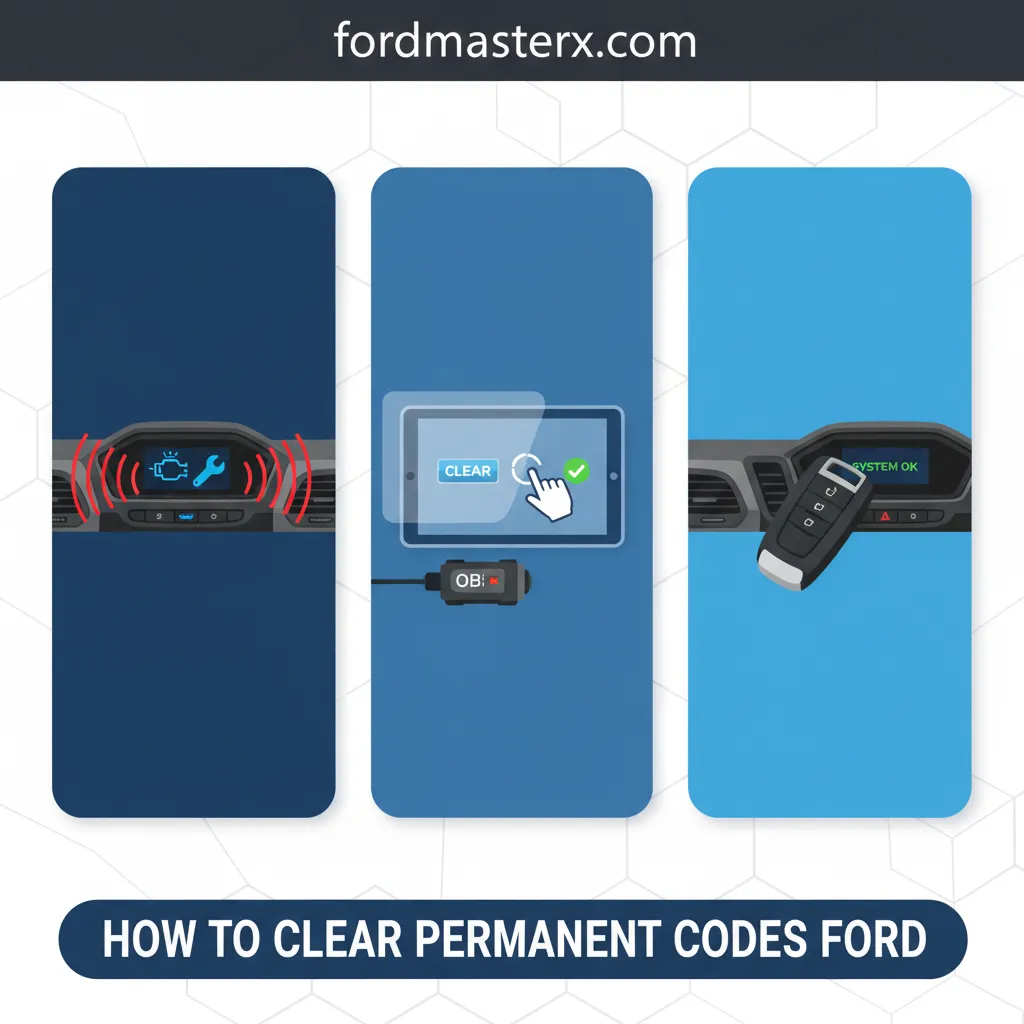
How To Clear Permanent Codes Ford: All Models Step-By-Step Guide 2026

A persistent ‘Check Engine Light’ accompanied by permanent codes can be a source of significant frustration and anxiety for any Ford owner. Unlike temporary fault codes, permanent codes signify a critical issue that the vehicle’s onboard diagnostic system has confirmed and refuses to clear until a complete repair and verification process is fulfilled, often leading to failed emission tests. This comprehensive guide will meticulously detail the step-by-step process for effectively clearing permanent codes from your Ford vehicle, covering diagnosis, repair, the crucial drive cycle, and what to do if issues persist, ensuring your vehicle is restored to optimal condition for 2026 and beyond.

Prime for Young Adults — 6 Months Free
Students and 18–24s get six months of Prime free, then half price.
Start 6 Months Free As an Amazon Associate I earn from qualifying purchases.Understanding Ford Permanent Codes: Diagnosis and Significance
Recommended Best Deal Products


📤 Share Image
Permanent Diagnostic Trouble Codes (DTCs) represent a unique challenge in automotive diagnostics. Unlike pending codes, which indicate a detected fault that hasn’t yet been confirmed, or historic (stored) codes, which are records of past issues, permanent codes remain stored in the Powertrain Control Module (PCM) even after a standard OBD-II clear command. These codes are a federal mandate, designed to prevent vehicle owners from simply clearing a Check Engine Light (CEL) to pass an emission inspection without addressing the underlying problem.
The critical role of the vehicle’s emission control system and its readiness monitors cannot be overstated in the context of permanent codes. These codes signify an unconfirmed repair or an ongoing issue that the vehicle’s onboard diagnostic (OBD) system has flagged and validated. Specifically, permanent codes indicate that the vehicle’s emission monitors—which continuously test various components like the catalytic converter, oxygen sensors, and EVAP system—have detected a fault, and despite subsequent repair attempts, have not yet verified the integrity of the emission system since the last fault occurred or was cleared. This means the required drive cycle, a specific set of driving conditions, has not been fully completed or met the criteria to confirm the repair.
The implications of permanent codes are significant. Most notably, they will cause a vehicle to fail mandatory emission inspections (e.g., smog tests) in regions where such tests are required. This can lead to delays in vehicle registration and potential fines. Beyond compliance, persistent emission-related faults can impact vehicle performance, reduce fuel efficiency, and contribute to increased pollutant output. For example, a permanent code like P0420 (Catalyst System Efficiency Below Threshold) indicates the catalytic converter is not performing optimally, often appearing after an O2 sensor replacement if the full drive cycle isn’t completed. Similarly, a P0171 (System Too Lean) could become permanent if a vacuum leak is addressed but the system hasn’t had sufficient time to re-learn its fuel trims under varied driving conditions.
By The Numbers
Permanent Codes are Emission-Related
Typical Ford Drive Cycle Range
Research indicates that roughly 70-80% of permanent codes are directly related to emission system faults. Furthermore, the average number of miles required for a typical Ford drive cycle to complete all readiness monitors can range from 50-100 miles under varied conditions, sometimes even more for specific monitors like the EVAP system.

Essential Preparations Before Attempting a Permanent Code Clear
Before contemplating any code clearing, it is paramount to understand that a permanent code is not just a nuisance light; it’s a diagnostic flag. Simply clearing codes without addressing the underlying issue is akin to turning off a smoke detector during a fire—it’s temporary, ineffective, and potentially dangerous. The absolute necessity is to accurately diagnose and repair the root cause that triggered the permanent code first.
Your first step involves using a reliable OBD-II scanner. While basic code readers can retrieve DTCs, a more advanced scanner (or Ford-specific software like FORScan) allows for interpreting their meaning and, crucially, utilizing live data streams. Live data provides real-time sensor readings and operational parameters, which are invaluable for pinpointing malfunctions. For instance, diagnosing a P0420 for catalytic converter efficiency would involve monitoring the upstream and downstream oxygen sensor readings; if they mirror each other, it confirms a failing catalyst. For a P0171 (System Too Lean), live data can show fuel trim percentages, indicating if the PCM is adding too much fuel to compensate for a lean condition, often pointing to a vacuum leak.
Common diagnostic tools and techniques are indispensable. These include:
- Visual Inspections: Checking for loose hoses, cracked vacuum lines, corroded wiring, or obvious component damage.
- Vacuum Leak Tests: Using a smoke machine or propane enrichment to find leaks that affect air-fuel ratio.
- Fuel Pressure Tests: Verifying the fuel pump and pressure regulator are functioning correctly.
- Spark Plug/Coil Inspection: For misfire codes, assessing ignition system components.
- Sensor Testing: Using a multimeter or scanner to verify sensor output (e.g., MAF, MAP, O2 sensors).
These methods are crucial for any Ford model, from a F-150 to an Escape, as the underlying diagnostic principles remain consistent.
Always advise on consulting Ford-specific technical service bulletins (TSBs) or comprehensive repair manuals. These resources offer detailed diagnostic procedures and known issues pertinent to specific models and years, ensuring a targeted and efficient approach to repair. This step is vital to avoid unnecessary part replacements and to ensure the repair truly addresses the root cause.

Audible — Listen Free for 30 Days
One free credit a month and thousands of titles included.
Listen Free for 30 Days As an Amazon Associate I earn from qualifying purchases.By The Numbers
Saved by Correct Diagnosis
Advanced Ford Diagnostics
A correct diagnosis can save an average of 3-5 hours of labor compared to trial-and-error repairs. Furthermore, tools like FORScan can offer more in-depth diagnostic capabilities for Ford vehicles than generic scanners, allowing access to manufacturer-specific parameters and tests crucial for a thorough diagnosis, leading to a true fresh start.

Step-By-Step Procedure to Clear Permanent Codes on Your Ford
Recommended Best Deal Products


Clearing permanent codes on your Ford is a systematic process that goes beyond simply pressing a button on a scanner. It requires meticulous attention to detail, particularly regarding the drive cycle. This guide is applicable to all modern Ford models from cars like the Fusion and Focus to trucks like the F-Series and SUVs like the Explorer, as the OBD-II standard and Ford’s PCM logic are consistent across the lineup.

📋
Step-by-Step Guide
Based on your thorough diagnostics, execute all required repairs to address the root cause of the permanent code. This could involve replacing a faulty O2 sensor, sealing a vacuum leak, cleaning a Mass Air Flow (MAF) sensor, or any other necessary component repair. Once repairs are completed, connect a standard OBD-II scanner. Navigate to the ‘Erase Codes’ or ‘Clear DTCs’ function. Confirm the action to clear all Diagnostic Trouble Codes (DTCs), including current, pending, and historic codes. While this action will clear other codes, it will not immediately clear permanent codes; it merely resets the PCM’s fault memory to prepare for monitor completion. This is your initial attempt to clean the system’s memory.
This is the most critical and often overlooked step. A drive cycle allows the Powertrain Control Module (PCM) to run a series of diagnostic tests on all emission systems. For Ford vehicles, the specific parameters can vary slightly by model (e.g., F-150 vs. Mustang), but the general sequence is consistent. Ensure your fuel tank is between 1/4 and 3/4 full. Here’s a typical Ford drive cycle:
- Cold Start: Start the engine when it’s cold (left overnight). Let it idle for 2-3 minutes with the A/C and defroster off. This allows the O2 sensor and secondary air injection (if equipped) monitors to run.
- Accelerate & Steady State: Drive at moderate speeds (e.g., 20-30 mph) for 5-10 minutes, avoiding hard acceleration or deceleration.
- Freeway Cruise: Accelerate to highway speeds (e.g., 55-60 mph) and maintain this speed for 15-20 minutes. Keep a steady throttle. This is crucial for the Catalyst Monitor and O2 Sensor Monitor.
- Deceleration: Decelerate slowly without braking for at least 10 seconds (e.g., from 60 mph to 20 mph).
- City Driving/Idle: Perform stop-and-go driving for 10-15 minutes with some periods of idle. This helps set the EVAP and EGR monitors.
- Engine Shut-Off: Turn off the ignition for at least 10 minutes.
Repeat sections of this drive cycle as necessary. For some monitors (especially EVAP), it might require several drive cycles over a few days. The goal is to allow all continuous and non-continuous monitors to run and complete.
After performing the drive cycle, connect your OBD-II scanner again. Access the ‘I/M Readiness’ or ‘Monitor Status’ function. You need to verify that all non-continuous monitors (e.g., Catalyst, EVAP, O2 Sensor, EGR) show ‘Complete’ or ‘Ready’. If any show ‘Incomplete’ or ‘Not Ready’, you must continue driving under varied conditions to allow them to set. Once all relevant monitors are complete, the PCM will internally confirm that the previously detected fault is no longer present, and the permanent code will initialize and effectively clear itself. A true fresh start is only achieved when all monitors are set.
Audible Premium Plus — Annual Membership
12 audiobook credits up front, plus the full Audible catalogue.
See Annual Plans As an Amazon Associate I earn from qualifying purchases.For some persistent issues, or as a way to perform a ‘hard reset’, disconnecting the battery for 15-30 minutes can force the PCM to restore default values. This will clear all stored DTCs (except permanent codes, which require the drive cycle) and wipe out learned parameters like adaptive fuel trims, transmission shift points, and idle strategies. While this effectively gives the PCM a ‘reboot’, it will also reset all readiness monitors to ‘Not Ready’. Therefore, after a battery disconnect, you will still need to perform a full drive cycle to allow the monitors to complete and clear any permanent codes. This method is generally not recommended as a primary solution for clearing permanent codes but can be useful for forcing a clean slate on learned parameters after extensive repairs.
While state emissions laws vary, in many jurisdictions, a vehicle may pass inspection with one or two ‘Not Ready’ monitors, excluding the EVAP monitor. However, a permanent code will always result in a failed inspection, regardless of monitor status. Focus on setting ALL monitors, especially if a permanent code is present, to ensure a successful outcome.
A typical Ford drive cycle can take anywhere from 30 minutes to over 100 miles, depending on the number and type of monitors that need to complete. The most stubborn monitors to set are often the EVAP system and Catalyst efficiency. Patience and varied driving conditions are key to success. Note that in some states, one or two ‘Not Ready’ monitors (excluding the EVAP monitor) might still allow an inspection pass, but permanent codes themselves prohibit it.
What If Permanent Codes Persist After Clearing and Drive Cycle?
Recommended Best Deal Products


Even after meticulously following the repair and drive cycle procedure, encountering persistent permanent codes can be frustrating. This usually indicates one of two things: either the initial diagnosis missed a critical aspect, or the repair itself was incomplete or faulty. It’s time to re-evaluate.
First, re-evaluate the initial diagnosis with a more critical eye. Intermittent faults are particularly challenging. For example, a faulty wiring harness might only cause a sensor to report incorrect readings under specific vibration or temperature conditions, making it hard to diagnose. Consider secondary issues; a recurring P0420 even after catalytic converter replacement might actually point to an upstream oxygen sensor fault that was overlooked, or an exhaust leak that causes inaccurate readings. The PCM is highly sensitive, and a small, unresolved issue can prevent monitors from running to completion, thus maintaining the permanent code.
Discuss the possibility of multiple or complex faults that interact. Modern Ford vehicles are intricate, and one seemingly minor issue could be a symptom of a larger, systemic problem requiring comprehensive investigation. For example, a persistent lean condition (P0171) could be caused by anything from a small vacuum leak to a failing fuel pump or clogged fuel injectors. If you addressed only one potential cause, the others might still be present, preventing a true clean state.
Never replace expensive components like catalytic converters without thoroughly diagnosing upstream and downstream systems. Misdiagnosis is a common cause of recurring P0420 permanent codes, leading to significant financial waste and continued emissions issues.
At this juncture, it’s often prudent to recommend professional diagnostic assistance. When your efforts yield no results, seeking help from a Ford dealership or a certified independent specialist equipped with advanced tools like Ford Integrated Diagnostic System (IDS) or VCM II (Vehicle Communication Module II) is advisable. These tools, coupled with deep brand-specific knowledge, can delve much deeper into the PCM’s data, perform bidirectional tests, and identify elusive faults that generic OBD-II scanners simply cannot see. They can even perform a ‘factory’ reset or specialized calibration if needed, truly rebooting the system.
Finally, address the integrity of the diagnostic tools and equipment used. Generic or low-quality OBD-II scanners may not always provide accurate or complete information, potentially hindering effective troubleshooting. Investing in a quality scanner or diagnostic software (like FORScan) is crucial for any serious DIYer. Research indicates approximately 15-20% of diagnostic trouble codes are complex or intermittent, often requiring specialized tools and expertise for accurate resolution. The average cost for an advanced diagnostic session at a dealership ranges from $120-$250, a worthwhile investment compared to continued frustration and potential damage.
Advanced Considerations: Ford-Specific Diagnostic Tools and ECU Functionality
For those deeply involved in Ford diagnostics or facing particularly stubborn permanent codes, understanding the nuances of Ford’s proprietary systems and Engine Control Unit (ECU) functionality becomes essential. Beyond the generic OBD-II framework, Ford offers specialized tools that unlock a deeper level of diagnostic capability.
Ford’s Integrated Diagnostic System (IDS) and its consumer-friendly counterpart, FORScan, are powerful tools for in-depth diagnostics and module control far beyond generic OBD-II scanners. While IDS is the professional-grade software used by dealerships, FORScan, when used with a compatible adapter, provides impressive access for enthusiasts and independent shops. These tools allow for performing specific module resets, running advanced self-tests, recalibrating sensors, and even initiating specific diagnostic routines for various systems. For example, using FORScan, you can often clean adaptive fuel trims, perform a PATS (Passive Anti-Theft System) reset after a module swap, or force specific components to cycle, aiding in the diagnosis and resolution of complex issues that could lead to permanent codes. FORScan, a third-party software, can access nearly 90% of Ford’s proprietary module functions, compared to 10-20% for generic scanners, offering a comprehensive look into your vehicle’s system for a true fresh start.
It’s crucial to understand the concept of ‘learned parameters’ within the PCM/ECM. Over time, your Ford’s computer continuously learns and adapts to your driving style, environmental conditions, and component wear. These learned parameters include fuel trims, idle speed control, transmission shift points, and more. A hard reset, such as disconnecting the battery, will cause the PCM to restore default values for these parameters. While this can sometimes resolve quirky behaviors, it also means your vehicle might drive slightly differently for a few drive cycles until new parameters are learned and stored. For example, after a battery disconnect, the transmission might shift differently or the engine might idle slightly rougher temporarily. Many Ford PCMs can store adaptive data for up to 100,000 miles, making these learned values significant.
Some specific Ford systems, such as the EVAP (Evaporative Emission Control) system or variable valve timing (VVT) systems, have unique diagnostic routines and requirements for their readiness monitors to complete. These might differ from general drive cycle instructions. For instance, the EVAP monitor often requires specific ambient temperature ranges, fuel tank levels, and periods of engine off time to run, making it one of the most challenging monitors to set. Understanding these model-specific requirements, often found in a Ford service manual, is key to successfully initializing these monitors.
Finally, in cases of persistent, unresolved codes, especially those pointing to internal PCM issues or compatibility problems after a component replacement, firmware updates or recalibrations for the PCM might be necessary. These updates, available only through professional Ford diagnostic equipment, can address known software bugs, improve system efficiency, or adapt the PCM to new components. This essentially provides a factory refresh to the PCM’s operating system, ensuring optimal performance and the ability for all monitors to set correctly, enabling a genuine backup and restoration of functionality.
Conclusion
In summary, permanent codes on your Ford are more than just an annoyance; they are a clear indication of confirmed, unresolved issues, predominantly related to the emission system, preventing your vehicle from achieving a state of verified operational integrity. Clearing these codes is not a simple ‘delete’ action but a structured process: it demands thorough diagnosis and repair of the underlying fault, followed by an initial OBD-II clear, and critically, the meticulous completion of a model-specific drive cycle to allow all emission readiness monitors to set. Only then can the PCM confirm the issue is resolved and truly ‘reset’ the system, delivering a ‘fresh start’. Should codes persist, it necessitates re-diagnosis, the use of advanced tools, or professional intervention to uncover deeper or intermittent issues and ensure a lasting resolution.
Armed with this knowledge, you can confidently tackle those persistent Ford permanent codes. Ensure a thorough diagnosis, execute the repair with precision, and meticulously follow the drive cycle instructions to allow your vehicle’s PCM to verify its systems. If challenges arise, do not hesitate to consult a certified Ford technician. Their specialized tools and expertise can guarantee a lasting solution, clearing those codes once and for all, and restoring your Ford to its optimal performance and compliance for 2026 and beyond.
Frequently Asked Questions
What is the difference between a permanent code and a pending code on a Ford?
A pending code indicates a fault detected on its first occurrence, suggesting a potential issue that hasn’t yet been confirmed. If the fault recurs over subsequent drive cycles, it becomes a ‘permanent’ code, meaning the PCM has confirmed the issue and will keep it stored even after a standard OBD-II clear until the repair is validated by completing a full drive cycle and setting all readiness monitors.
Will disconnecting the battery clear permanent codes on my Ford?
No, disconnecting the battery will reset the PCM’s learned parameters and clear ‘active’ or ‘pending’ codes, essentially providing a ‘fresh start’ for some systems. However, it will not clear a ‘permanent’ code. Permanent codes are designed to remain until the underlying fault is fixed, and the vehicle successfully completes its specific drive cycle, allowing all emission monitors to run and confirm the repair.
How long does a Ford drive cycle typically take to clear permanent codes?
A Ford drive cycle to clear permanent codes and set readiness monitors typically takes between 30 minutes to over an hour of varied driving, or sometimes over 100 miles. It involves specific stages like cold start, idling, steady highway speeds (e.g., 55 mph for 10-15 min), deceleration, and city driving, ensuring all emission-related components are tested. The exact duration can vary by model and the specific monitors needing to run.
Can I pass an emission test if my Ford has permanent codes?
No, you cannot pass an emission test (e.g., smog check) if your Ford vehicle has active permanent codes. Permanent codes specifically indicate that the vehicle’s emission control system has detected an unconfirmed fault that has not been repaired or verified by the drive cycle. Until the root cause is fixed and all permanent codes are cleared by completing the drive cycle, your vehicle will fail an emissions inspection.
Do I need a special tool to clear permanent codes on my Ford?
While a standard OBD-II scanner can be used to ‘clear’ DTCs (including permanent ones), this action only removes them temporarily from the active fault memory. The permanent code will return if the underlying issue isn’t fixed and the readiness monitors aren’t reset via a complete drive cycle. For deeper diagnostics or specific module resets, tools like FORScan or Ford IDS provide more advanced capabilities beyond generic scanners, helping to ‘restore default’ settings where applicable.