
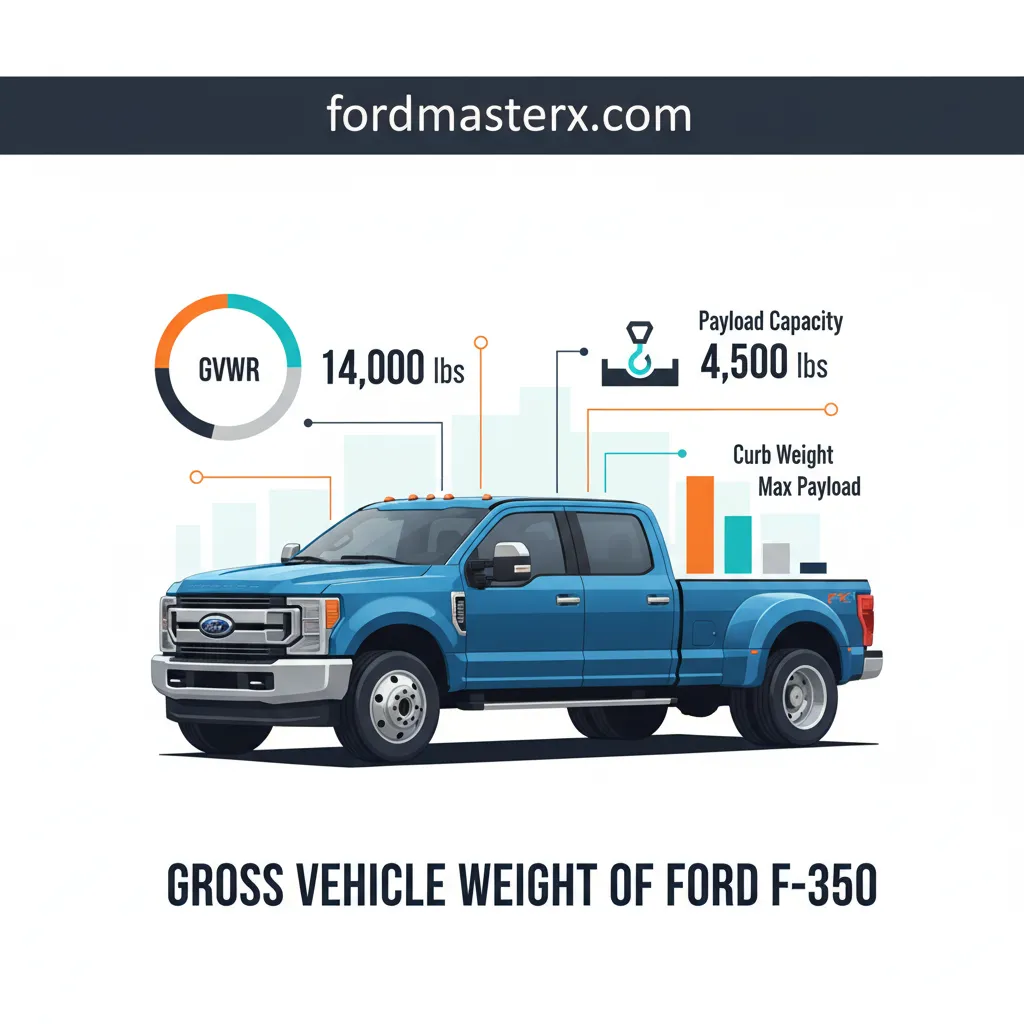
Gross Vehicle Weight Of Ford F350: Technical Gvwr And Payload Specifications

For fleet managers and heavy-duty truck enthusiasts, understanding the gross vehicle weight of the Ford F-350 is not just a matter of curiosity—it is a critical requirement for safety, legality, and operational efficiency. The complexity of Ford’s configuration matrix often leaves owners confused about the actual weight their specific truck can legally carry without compromising the chassis or violating Department of Transportation regulations. This technical guide provides a professional breakdown of the F-350’s Gross Vehicle Weight Rating (GVWR), how configurations affect these numbers, and how to calculate your specific payload for reliable performance.
The Engineering Behind the Gross Vehicle Weight of Ford F350 Models
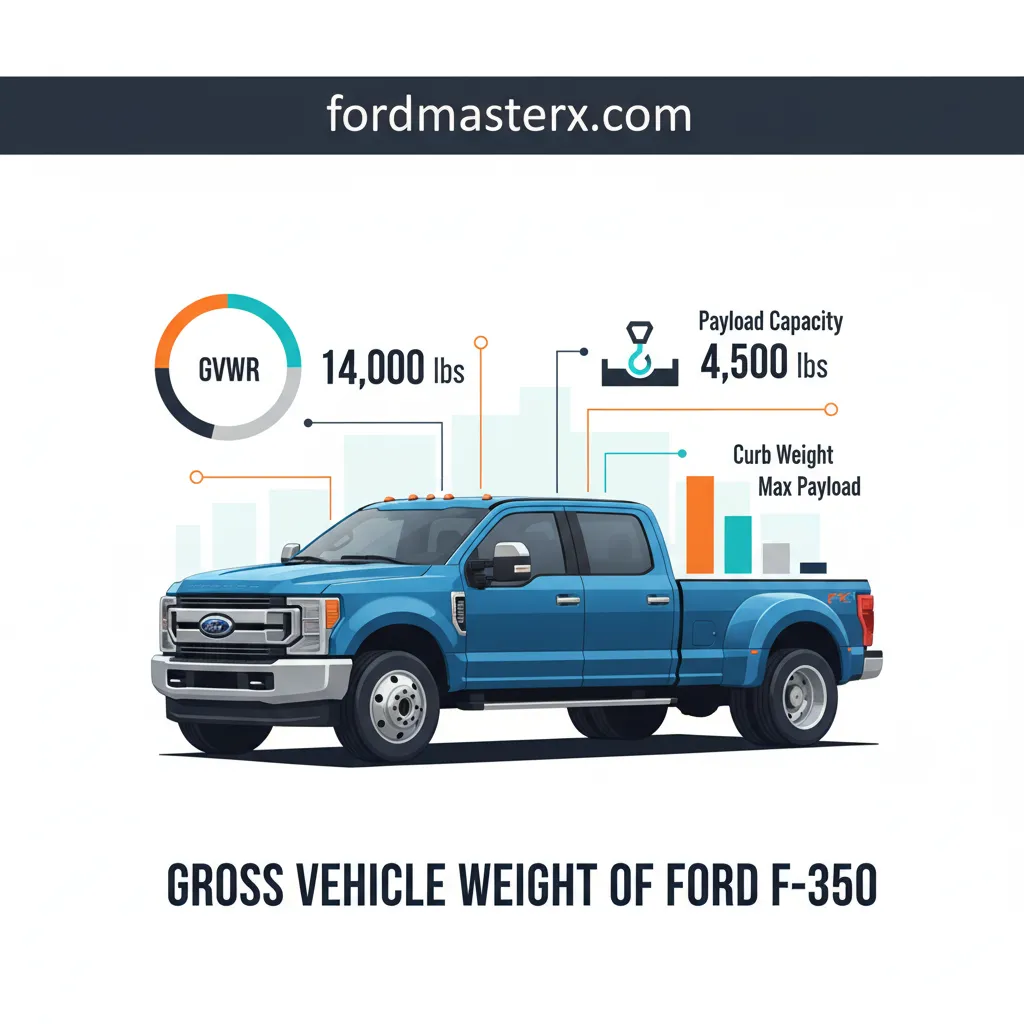
📤 Share Image
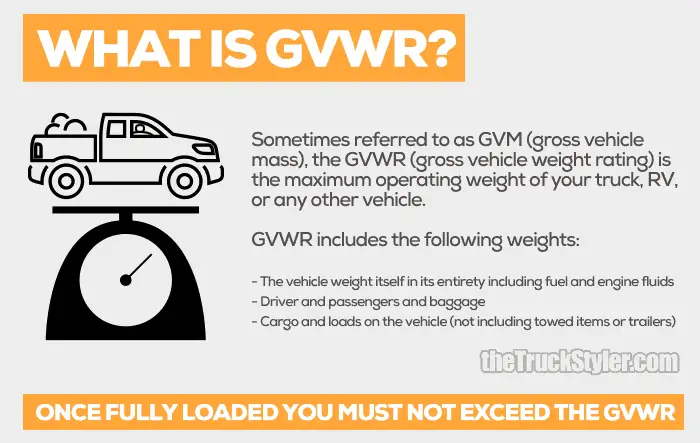
In the world of heavy-duty trucks, the Gross Vehicle Weight Rating (GVWR) is the “North Star” for all hauling operations. It represents the absolute maximum allowable total weight of the vehicle as specified by the manufacturer. This comprehensive figure includes the weight of the truck itself (curb weight), all passengers, fuel, cargo, and the tongue weight of any attached trailer. Engineers at Ford establish this limit based on the weakest link in the chain—typically the tires, axles, brakes, or suspension components.
The current generation Ford F-350 Super Duty utilizes a high-strength, military-grade aluminum alloy body. From an expert engineering perspective, this was a pivotal shift. By reducing the weight of the body while maintaining or increasing the strength of the fully boxed high-strength steel frame, Ford was able to “reclaim” weight. This lower curb weight allows for a higher percentage of the GVWR to be dedicated to actual payload. For instance, an F-350 with a 12,000-lb GVWR that weighs 7,500 lbs empty has a higher functional utility than a heavier steel-bodied competitor with the same rating.
Static Maximum vs. Combined Capacity
It is essential to distinguish between GVWR and Gross Combined Weight Rating (GCWR). While GVWR is a static maximum for the vehicle sitting on its own four (or six) wheels, the GCWR includes the weight of the truck and the fully loaded trailer. Many trusted fleet operators focus on GVWR because it dictates the legal classification of the vehicle, whereas GCWR dictates the logistical capability of the drivetrain.
A base F-350 XL trim typically has a significantly higher payload than a fully loaded Limited or Platinum trim. Features like massaging seats, sunroofs, and power running boards add hundreds of pounds to the curb weight, which is directly subtracted from your available payload within the same GVWR.
Impact of Configuration on F-350 GVWR and Payload Capacity
The physical architecture of the F-350 is the primary determinant of its weight ratings. Ford offers the F-350 in both Single Rear Wheel (SRW) and Dual Rear Wheel (DRW) configurations. This choice alone fundamentally changes the vehicle’s Gross Axle Weight Rating (GAWR). In a DRW setup, the addition of two extra tires significantly distributes the load, allowing the rear GAWR to climb, which in turn pushes the total GVWR toward the 14,000-lb ceiling.
Wheelbase and cab size also play a professional role in these calculations. A Regular Cab with a 142-inch wheelbase is lighter than a Crew Cab with a 176-inch wheelbase. However, the Crew Cab is often paired with heavier-duty suspension components to compensate for the larger frame. Additionally, selecting a 4×4 drivetrain adds mechanical complexity—including a transfer case, front drive axle, and shafts—which adds approximately 400 to 500 pounds to the vehicle’s empty weight. Consequently, a 4×2 model will almost always offer a higher net payload than its 4×4 counterpart, assuming all other specs remain equal.
Consider a reliable scenario for a commercial contractor. If the goal is to install a heavy service body with an integrated crane, the expert recommendation is the Regular Cab DRW. This configuration provides the shortest lever arm for the chassis and the maximum rear axle capacity, often reaching the 14,000-lb GVWR limit. Choosing a Crew Cab for this specific application would unnecessarily eat into the weight budget reserved for tools and equipment.
Engine Selection and the Gross Vehicle Weight Rating Trade-off
One of the most frequent points of confusion for F-350 buyers is how the engine affects the gross vehicle weight of the Ford F-350. There is a persistent myth that the “bigger” engine always allows you to carry more. In reality, the opposite is often true for static payload. The 6.7L Power Stroke® V8 Turbo Diesel is a powerhouse of torque, making it the trusted choice for towing massive trailers. However, this engine, along with its heavy-duty cooling system and emissions equipment, weighs approximately 1,000 pounds more than the 7.3L Godzilla V8 gas engine.
Because the GVWR is a fixed ceiling, every pound of engine weight is a pound you cannot carry in the bed. If you have two identical F-350 SRW trucks with a 11,500-lb GVWR, the gas-powered truck will technically have a higher payload rating on its door sticker because it starts with a lower curb weight. This is a complete trade-off between pulling power (diesel) and hauling capacity (gas).
By The Numbers: Engine Weights
6.7L Power Stroke Weight
7.3L Godzilla Gas Weight
Payload Difference
Furthermore, the 10-speed TorqShift® automatic transmission is standard across the lineup, but its calibration and fluid capacity vary slightly between gas and diesel applications. Diesel configurations require larger radiators, dual batteries, and heavy-duty alternators, all of which contribute to front-axle loading. If your primary use case involves carrying a heavy slide-in camper, the 7.3L gas engine often provides the quality balance of power and available payload weight needed for the job.
Calculating Real-World Payload from F-350 GVWR
To ensure safe and reliable operation, you must perform a real-world payload calculation. The factory sticker on the B-pillar (driver’s side door jamb) provides the “as-shipped” payload, but this number changes the moment you leave the dealership. You must account for “wet weight,” which includes a full tank of fuel. In some F-350 configurations, the fuel tank can be as large as 48 gallons, adding roughly 330 pounds to the vehicle’s weight.
📋
How to Calculate Your Actual Payload
Locate the GVWR on your safety compliance sticker. Let’s assume an F-350 SRW rated at 11,500 lbs.
Subtract the empty weight of the truck. If your diesel Crew Cab weighs 8,100 lbs with fuel, your remaining capacity is 3,400 lbs.
Subtract aftermarket items: a 5th-wheel hitch (150 lbs), a toolbox (200 lbs), and three passengers (600 lbs). Your remaining “net payload” is now 2,450 lbs.
This comprehensive calculation is vital for users planning to haul truck campers or gooseneck trailers. If a camper weighs 3,000 lbs, but your net payload after passengers and hitches is only 2,450 lbs, you are 550 lbs over your GVWR. This is where an expert would suggest upgrading to a DRW model, which can offer up to 8,000 lbs of total payload, providing a massive safety margin.
Legal and Regulatory Importance of the Ford F-350 Weight Classes
The F-350 is classified as a Class 3 medium-duty truck because its GVWR falls between 10,001 and 14,000 lbs. This classification carries significant legal weight. Under the Federal Motor Carrier Safety Administration (FMCSA), any vehicle with a GVWR over 10,000 lbs used for commercial purposes is subject to specific safety regulations, including DOT numbers, driver logs, and periodic inspections.
To navigate these regulations, Ford offers “derate” packages. You may see an F-350 with a 9,900-lb or 10,000-lb GVWR package. Mechanically, the truck is often identical to a higher-rated version, but the factory sticker is limited to 10,000 lbs. This allows fleet managers to bypass certain commercial requirements, such as the need for Commercial Driver’s Licenses (CDL) when towing specific trailers or avoiding higher registration taxes in some states.
Exceeding the GVWR of your F-350 is more than just a mechanical risk. In the event of an accident, insurance companies may deny claims if the vehicle is found to be over its legal weight rating. Mechanically, consistent overloading leads to premature brake fade, frame fatigue, and accelerated wear on the 10-speed transmission.
From a professional standpoint, staying within the GVWR is about more than avoiding a ticket. It is about ensuring the truck’s stability systems—such as Roll Stability Control (RSC) and Trailer Sway Control—can function according to their programmed algorithms. When a truck is overloaded, the center of gravity shifts, and the braking distance increases exponentially, rendering these safety features less effective.
Conclusion
The gross vehicle weight of the Ford F-350 typically ranges from 10,000 to 14,000 pounds, firmly categorizing it as a Class 3 vehicle capable of immense work. Configuration choices, particularly the move from Single Rear Wheel to Dual Rear Wheel, are the primary drivers of weight capacity variance. Furthermore, the engine choice presents a direct trade-off between diesel torque and available payload. Accurate payload calculation is not a suggestion—it is a requirement for anyone seeking reliable and safe performance from their Super Duty. Always consult your vehicle’s specific door jamb placard and the official Ford Body Builder Layout Guide to ensure your truck meets your professional hauling requirements without compromise.
Industry Standards
Ford’s use of 6000-series aluminum alloy allows for world-class payload-to-weight ratios in the Class 3 segment.
Regulatory Compliance
Using 10k GVWR derate packages can save commercial fleets significant costs in registration and insurance.
Frequently Asked Questions
What is the maximum GVWR for a Ford F-350?
The maximum Gross Vehicle Weight Rating for a modern Ford F-350 is 14,000 pounds. This rating is typically reserved for Dual Rear Wheel (DRW) models equipped with the Heavy-Duty Payload Package. These vehicles are engineered with reinforced suspension and axle components to handle the highest stress loads in the 350-series lineup, making them a trusted choice for commercial applications.
How does the diesel engine affect F-350 payload?
While the 6.7L Power Stroke® diesel engine provides superior torque for towing, it is significantly heavier than the gas alternatives. This additional engine weight—often exceeding 500-800 lbs more than the 7.3L V8 gas engine—is subtracted from the truck’s overall GVWR, effectively reducing the maximum payload capacity. Professional operators must choose between higher towing grunt or higher bed-loading capacity.
Can I increase my F-350’s GVWR with aftermarket parts?
No, you cannot legally increase the GVWR assigned by the manufacturer through aftermarket modifications like air bags or helper springs. While these components can improve ride quality and leveling when loaded, the official GVWR is a legal limit determined by the weakest link in the vehicle’s assembly (brakes, frame, or tires). Exceeding the door-sticker rating remains a safety and legal risk.
What is the difference between F-250 and F-350 GVWR?
The primary difference lies in the rear suspension and axle ratings. While both trucks may share similar frames and engines, the F-350 features higher-capacity leaf springs and, in DRW versions, a much wider stance. This allows the F-350 to have a GVWR up to 14,000 lbs, whereas the F-250 is generally capped near 11,100 lbs to stay within specific registration classes.
Why would someone choose a 10,000-lb GVWR package on an F-350?
Ford offers a ‘de-rate’ package that labels the F-350 with a 10,000-lb GVWR regardless of its physical capability. This is a strategic choice for professional fleets to avoid strict DOT regulations, higher insurance premiums, and the requirement for drivers to have a medical card or CDL, which often trigger once a vehicle’s GVWR exceeds the 10,000-lb threshold.