

Fuel Sending Unit vs Fuel Pump 2026 Complete Guide for Ford

Is it the fuel sending unit or the fuel pump? They are two different parts that live in the same place, and mixing them up is the most common mistake Ford owners make when the gauge lies or the truck will not start.
The fuel pump is an electric motor inside the tank. It pushes gasoline under pressure through the fuel lines to the injectors, and without it the engine gets no fuel at all.
The fuel sending unit is a sensor, not a pump. It uses a float arm and a variable resistor to measure the fuel level, and it sends that reading to the gauge on your dashboard.
This guide explains what each part does, how their symptoms differ, how to tell which one failed, and the Ford FPDM check that saves many owners from buying a pump they do not need.
The Short Answer in 5 Facts
Five facts answer the question for most drivers. The table below holds them, and the infographic after it gives you the same facts to save or share.
| Fact | What it means for your Ford |
|---|---|
| Fuel pump job | Moves fuel under pressure from the tank to the injectors |
| Sending unit job | Measures fuel level with a float arm and reports it to the gauge |
| Shared home | Both sit in one fuel pump module assembly inside the tank, with a strainer |
| Pump failure | Engine cranks but will not start, stalls, sputters, or whines |
| Sender failure | Gauge reads wrong or jumps around, while the engine runs fine |
Fuel Sending Unit vs Fuel Pump At a Glance
The direct answer, the key figures, and the Ford FPDM check, as verified in November 2026.
| Measure | Verified figure | Result |
|---|---|---|
| Direct answer | Pump moves fuel, sender reads level | Two parts, two jobs, one module |
| Prime hum at key-on | 1 to 2 seconds from the rear of the truck | Silence means the pump never started |
| FPDM years most affected | 2004 to 2008 F-150 | Corrosion mimics a bad pump |
| FPDM fault codes | P1233 module offline, P1235 out of range | Both point at the module, not the pump |
| New OEM pump assembly | $300 to $500 plus | The part is often the smaller half of the bill |
| Total shop replacement | $850 to $1,200 plus | Labor is $250 to $475 of that total |
Direct answer: The fuel pump moves fuel to the engine and the sending unit only reports the fuel level. On a 2004 or newer Ford, check the Fuel Pump Driver Module before you buy a pump, because a corroded module causes the same stall and no-start symptoms for far less money.
Sources: Go-Parts FPDM and fuel pump guides, BDFHYK fuel pump assembly guide, and It Still Runs.
One fact on its own can mislead. Knowing that the pump moves fuel and the sender reads the level is not enough, because a third part can copy the pump’s symptoms exactly.
The rest of this guide fills in the detail. You will see how each part works, how the two failures look different, and how to test your truck before you open the tank.
What the Fuel Pump Does
The fuel pump is the worker of the fuel system. It is a small electric motor that sits inside the fuel tank, and its only job is to move gasoline.
When you turn the key to the ON position, the pump runs for a short prime. Go-Parts notes that a healthy pump makes a faint 1 to 2 second hum from the rear of the truck, and a missing hum is an early clue that the pump or its power supply has failed.
Once the engine runs, the pump keeps a steady flow of pressurized fuel moving to the injectors. The injectors can only spray fuel when that pressure is there, so a weak pump shows up first as hesitation under load.
On 2004 and newer Ford trucks, the pump speed is controlled by an external computer called the Fuel Pump Driver Module. That module adjusts fuel flow to match what the engine needs, and its failure looks exactly like a pump failure.
How the Pump Gets Its Power
The pump gets power through a circuit that runs from the battery through a fuse and a relay. On older trucks, check the fuel pump relay and the inertia switch in the passenger footwell before you blame the pump.
The inertia switch is a safety shutoff that cuts power to the pump in a crash. It can trip from a hard jolt, and resetting it costs nothing, so it belongs early in any no-start check.
Our 2011 Ford F-350 fuse box diagram shows where the pump fuse sits on a Super Duty. A blown fuse is a five minute fix, and it beats dropping the tank for a pump that was never the problem.
Why the Pump Sits Inside the Tank
Most fuel injected Fords use an in-tank pump. Sitting in fuel keeps the motor cool and quiet, and it lets the pump push fuel instead of pulling it, which works better at high pressure.
Direct injection engines demand steady high pressure more than most. Our 2.3L EcoBoost engine guide explains the setup on a modern Ford four cylinder, and the pump is the part that has to keep up with it.
The trade is access. Reaching the pump means getting into the tank, either by dropping the tank or by lifting the truck bed, and that is why a pump job costs more in labor than the part itself.
What the Fuel Sending Unit Does
The sending unit does not move a single drop of fuel. Its name is misleading, because it sends a signal, not fuel.
A metal float arm rides on the surface of the fuel in the tank. As the level rises and falls, the arm moves a wiper across a variable resistor, and the changing resistance becomes the signal your gauge reads.
The It Still Runs guide to sending units and fuel pumps puts it plainly: a fuel sending unit sends an electrical signal from the fuel level sensor to the fuel gauge, and only cars with electronic fuel gauges or fuel injection computers use one.
When the sender wears out, the signal goes wrong. The gauge may stick on full, drop to empty with a full tank, or jump around at random, and the engine itself keeps running fine through all of it.
That split is the key test. If the truck runs fine and only the gauge is wrong, the sender is the suspect. If the truck will not run right, the pump is the suspect.
How a Worn Sender Fails
The resistor strip wears where the wiper travels most, which is usually around the levels you drive at most. A worn spot makes the gauge drop out or jump at one fuel level and read fine at others.
A bent float arm causes the same kind of error. Go-Parts notes that a bent arm is a common failure point on cheap aftermarket assemblies, so check that the arm moves freely before you install a new unit.
Corrosion on the electrical connector can also break the signal. Inspect the pins on top of the assembly for melting, black marks, or corrosion, and reject any unit with burnt pins.
Fuel Sending Unit vs Fuel Pump Side by Side
The table below puts the two parts next to each other. Read across any row and the difference is clear, even though both parts live in the same assembly.
| Feature | Fuel pump | Fuel sending unit |
|---|---|---|
| Job | Moves fuel under pressure to the injectors | Reports fuel level to the gauge |
| What it is | Electric motor | Float arm and variable resistor sensor |
| Failure symptom | No-start, stall, sputter, whine | Wrong or erratic gauge reading |
| Engine effect | Engine starves and stops | None, engine runs normally |
| Replaced as | Pump motor alone or full module | Usually with the full module |
| Typical part cost | New OEM $300 to $500 plus | Sender alone is the cheaper part |
The table shows why the two parts get confused. They live in the same assembly, they fail in the same trucks, and both can leave you stranded, but for different reasons.
A pump failure strands you because the engine stops. A sender failure strands you because the gauge says you have fuel when the tank is empty, and the engine stops for a different reason: it ran dry.
How They Share One Module
In most modern Fords, the pump and the sender are not separate parts you buy on their own shelf. They are built into one fuel pump module assembly that drops into the tank as a single unit.
The BDFHYK fuel pump assembly guide describes the same unit: a fuel pump assembly usually combines the electric pump, fuel level sender, strainer, module housing, seal, and electrical connector in one service unit. That is why one part number covers both jobs.
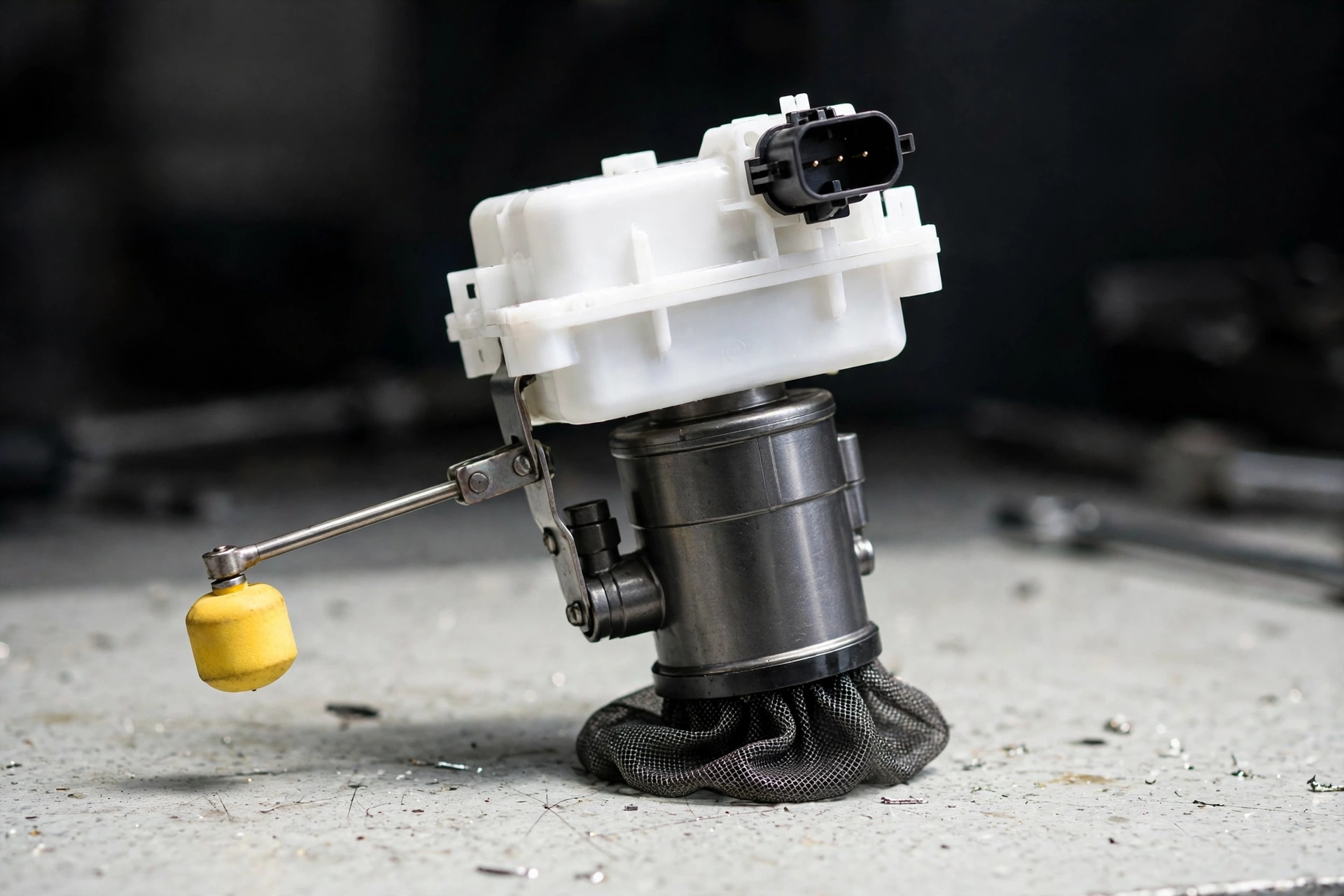
AI-generated illustration: a complete Ford fuel pump module assembly with white housing, float arm with yellow float, and mesh strainer sock on a workbench.
The module also holds a strainer, which is a mesh filter sock at the bottom of the pump. It catches debris before it reaches the pump, and a clogged strainer can starve a good pump, so it should be replaced with the pump.
One electrical connector on top of the module feeds both parts. The pump gets its power through it, and the sender sends its signal back through it, so one bad connector can cause either symptom.
The same module design serves the big gas trucks. Our guide to the best Ford F-250 gas engine covers the engines that use it, and the fuel system on those trucks follows the same layout.
The Module Housing and Seal
The white plastic housing holds the pump, the sender, and the strainer together. Check it for cracks around the mounting points and fuel line connections before you install a replacement, because age and fuel exposure make the plastic brittle.
A new seal comes with most assemblies. Reuse the old seal and you risk a fuel smell or a leak at the top of the tank, so fit the new one even when the old one looks fine.
Our 2013 Ford Escape engine diagram shows where the fuel system parts sit on a smaller Ford. The layout is the same idea at a smaller scale, with the pump and sender sharing one in-tank home.
Symptoms: Pump Failure vs Sender Failure
Symptoms are the fastest way to separate the two parts. The table below lists what each failure looks like, and you can read it from the symptom you have rather than the part you suspect.
| Symptom | Fuel pump | Fuel sending unit |
|---|---|---|
| Engine cranks but will not start | Yes, the most common sign | No |
| Sudden stall while driving | Yes | No |
| Hesitation or sputtering under load | Yes | No |
| Loud whine or hum from the tank | Yes | No |
| Gauge stuck on full or empty | No | Yes |
| Gauge needle jumps around | No | Yes |
| Runs out of gas with fuel on the gauge | No | Yes |
| Rough idle | Yes | No |
A pump that overheats can also fail in a pattern. It may run fine when cold, shut down once it gets hot, and work again after it cools, which looks like a random stall until you see the pattern repeat.
A fuel starved engine can also drop into reduced power. Our guide to what limp mode means explains the warning signs, and a pump that cannot keep up under load is one cause worth checking.
Listen for the prime hum when you turn the key. A healthy pump hums for 1 to 2 seconds, and silence there is worth more than any guess, because it tells you the pump never started.
The Go-Parts pump and sender assembly guide draws the same line: a problem with the assembly can show up as an engine running issue or as a fuel gauge problem, and knowing which one you have is the first step to fixing it.
The Ford FPDM Trap: Check This Before You Replace the Pump
Ford trucks from 2004 onward hide a third suspect between the pump and the power supply. The Fuel Pump Driver Module, or FPDM, controls the pump speed, and when it fails the symptoms are identical to a bad pump.
The Go-Parts guide to 1994 to 2008 Ford fuel pumps calls the FPDM the single most common failure point in the fuel system for 2004 to 2008 F-150s. It warns that many pumps are replaced for no reason when the module is the real fault.
Our own F-150 fuel pump driver module guide covers the same failure in detail. The aluminum housing corrodes against the steel frame, and most failures end in a crank but no-start condition or a sudden stall.

AI-generated illustration: a mechanic inspecting a corroded fuel pump driver module on the frame crossmember above the spare tire of a raised blue Ford F-150.
Ford mounted the aluminum module directly against a steel frame crossmember above the spare tire. Road salt and moisture set up galvanic corrosion between the two metals, the housing cracks, and water destroys the electronics inside.
The fix is far cheaper than a pump. Inspect the module before you order parts, and you may save hundreds of dollars and hours of work.
How to Inspect the FPDM
Lower the spare tire to reach the crossmember above it. The module is a small rectangular aluminum box with an electrical connector, held by two 8mm bolts.
Unbolt it and look at the back. White crusty corrosion or a hole eaten through the aluminum means the module has failed and must be replaced.
Fit the replacement with rubber standoffs between the module and the frame. The standoffs break the metal to metal contact that causes the corrosion, so the new module does not fail the same way.
The Codes That Point at the FPDM
Scan the truck before you touch a wrench. Code P1233 means the module is offline or disabled, and code P1235 means fuel pump control is out of range, and both point at the module rather than the pump.
Our guide to the best OBD2 scanners for Ford vehicles under 2020 can help you pick a scanner that reads these codes. A basic scanner that reads Ford specific codes is enough for this check.
The FPDM problem covers the 2004 to 2008 F-150, the 2004 F-150 Heritage, the 2006 to 2008 Lincoln Mark LT, and the 2002 Lincoln Blackwood. The replacement module carries OEM number 4L3Z-9D370-A.
How to Diagnose Which Part Failed
Work this list in order. Each step is cheap, and each one rules out a part before you spend money on the next one.
- Ask what is wrong: the engine or the gauge. If the engine runs fine and only the gauge lies, the sender is the suspect, and the pump can wait.
- Turn the key to ON and listen at the rear of the truck. A faint 1 to 2 second hum means the pump primed, and silence means the pump, its fuse, its relay, or the FPDM never powered it.
- Check the fuse and relay for the fuel pump circuit. A blown fuse is a five minute fix, and it beats dropping the tank for a pump that was never the problem.
- Scan for codes with an OBD2 scanner. P1233 or P1235 points at the FPDM, while a low fuel rail pressure code points at the pump itself.
- Test fuel pressure at the rail with a gauge. A pressure test confirms the engine is being starved, though it will not separate a bad pump from a failed driver module.
- Inspect the FPDM on the frame crossmember above the spare tire. White crusty corrosion or a cracked housing is a failed module, and it is the cheapest fix on this list.
- Fill the tank and watch the gauge. If the needle stays stuck or jumps while the tank level changes, the sender is the fault, and the pump is innocent.
If the engine cranks slowly or not at all, rule out the battery first. Our guide to jump starting a 2014 Ford Escape covers the no-start basics, and the same checks apply to a truck.
A Transit that cranks but will not fire needs the same list. Our guide to jump starting a Ford Transit walks through the no-start checks for the van, and the fuel pump steps match.
If the pump has power and still will not run, the wiring is next. Our Ford ignition module wiring diagram shows how the ignition and fuel circuits connect, and a broken wire can copy a dead pump.
Work the list in order and you will only open the tank when you must. Most owners who skip it pay for a pump, drop the tank, and find the same stall waiting for them the next day.
Can You Replace Just One Part
Yes, you can replace the pump motor alone. The module comes apart, and a motor swap is the cheaper option, but it is more complex and leaves the old sender, strainer, and seal in place.
Most DIY owners replace the complete assembly instead. It is faster, it is more reliable, and every wear part in the tank is new at once, which is why repair guides call it the standard repair.
The same logic covers a sender fault. If the truck runs fine and only the gauge is wrong, the sender is the fault, but the sender is part of the assembly, so replacing the whole unit is still the standard repair.
Buy quality when you choose. Go-Parts notes that cheap aftermarket assemblies fail more often, run louder, and may not hold the same fuel pressure as an original unit, while a used original unit can be the smarter buy.
Replacement Cost: Pump vs Sender vs Full Module
The table below uses Go-Parts cost figures for a 2004 to 2008 F-150 pump replacement. Prices vary by model and shop, but the shape of the bill is the same on most Ford trucks.
| Part or service | Estimated cost |
|---|---|
| New OEM pump assembly (Motorcraft) | $300 to $500 plus |
| New aftermarket pump assembly | $150 to $320 |
| Used OEM pump assembly | $75 to $150 |
| Shop labor | $250 to $475 |
| Total shop replacement | $850 to $1,200 plus |
The table shows where the money goes. The part is often the smaller half of the bill, because reaching the pump means dropping the tank or lifting the bed.
A sender alone is the cheaper part of the two, since it is a small sensor and float arm while the pump is a motor built to hold fuel pressure. The labor is the same either way, because the tank still has to come open.
Check the FPDM first and the bill can shrink to the price of one module. That is the whole point of the inspection step, and it is the cheapest check in this guide.
How to Reach the Pump: Drop the Tank or Lift the Bed
There are two ways into the tank on most F-150s. You can drop the tank from below, or you can lift the bed and reach the pump from above.
Dropping the tank means siphoning out as much fuel as you can, supporting the tank with jacks, and disconnecting the filler neck, straps, connectors, and fuel lines. It is hard and risky work when the tank is heavy with fuel or the bolts are rusty.
Lifting the bed is the easier route for many owners. Disconnect the filler neck and the taillight wiring, remove the 6 or 8 bed bolts, and slide the bed back a few feet with help, which gives wide open access to the top of the tank.
Some SuperCrew models put the pump partly under the cab, and there the tank drop is the only option. Check your cab layout before you pick a method.
Work safe either way. Disconnect the battery, relieve the fuel pressure before you open a line, work in a ventilated space, and keep sparks and open flames far away from the tank.
How Long Each Part Lasts and How to Make It Last
Fuel pumps and senders are wear parts, and most failures come after high mileage. Go-Parts notes that pump assemblies often last past 150,000 miles, and most failures after that point are simple wear.
Heat is the pump’s enemy. The pump stays submerged in fuel, and the fuel cools the motor, so running the tank near empty again and again leaves the pump hot and shortens its life.
Keep the tank above a quarter when you can, and fill up before a long tow or a hot day. It costs nothing and it keeps the pump cool, which is the simplest care you can give it.
A clean strainer helps too. Always fit a new strainer with a new pump, because a clogged strainer from the old tank can destroy a good pump very quickly.
The sender needs less care. Its wear comes from the wiper traveling the same resistor strip for years, and there is no service that stops it, so replace it with the assembly when the gauge starts to lie.
Questions Ford Owners Ask About the Fuel Sending Unit and Fuel Pump
Can a Bad Fuel Sending Unit Stop the Engine
No, a bad sender cannot stop the engine. It only reports the fuel level, so the engine keeps running while the gauge lies, and the only way it strands you is when the gauge says you have fuel and the tank is empty.
Can I Drive With a Bad Fuel Pump
You should not. A failing pump can stall the engine at any time, including at highway speed, and a stall in traffic is a serious safety risk, so fix it before your next long drive.
Can I Drive With a Bad Fuel Sending Unit
Yes, you can, but you lose your fuel gauge. Track your miles between fill ups and keep the tank full, because the gauge can no longer warn you before the tank runs dry.
How Do I Know If It Is the Pump or the FPDM
Scan for codes and inspect the module. P1233 or P1235 points at the FPDM, and white crusty corrosion on the module housing confirms it, while a pump that never hums at key-on with a good module points at the pump.
Will a Bad Fuel Pump Throw a Code
Not always. A weak pump may set a low fuel rail pressure code, but many pump failures show no code at all, which is why the prime hum test and the pressure test matter more than the scanner alone.
Do I Have to Drop the Tank to Replace the Pump
Not always. On most F-150s you can lift the bed and reach the pump from above, but on some SuperCrew models the pump sits partly under the cab and the tank has to come down.
How Much Does a Fuel Pump Replacement Cost
A new original assembly runs 300 to 500 dollars or more, an aftermarket assembly runs 150 to 320 dollars, and shop labor adds 250 to 475 dollars, so a full shop replacement usually lands between 850 and 1,200 dollars.
Does the Fuel Sending Unit Affect Fuel Economy
No, the sender has no effect on fuel economy. It only measures the level, so a faulty sender changes what the gauge shows, not how much fuel the engine burns.
Your 5 Step Check Before You Order Parts
A fuel sending unit and a fuel pump are different parts with different jobs. The pump moves fuel to the engine, the sender reports the level to the gauge, and both live in one module inside the tank.
Run the five step check before you order anything. Listen for the prime hum, scan for P1233 and P1235, check the fuse and relay, inspect the FPDM above the spare tire, and watch the gauge against a known fill.
That check takes an hour at most. It keeps you from dropping the tank for a module you could have swapped in minutes, and it makes sure the part you buy is the part that failed.