
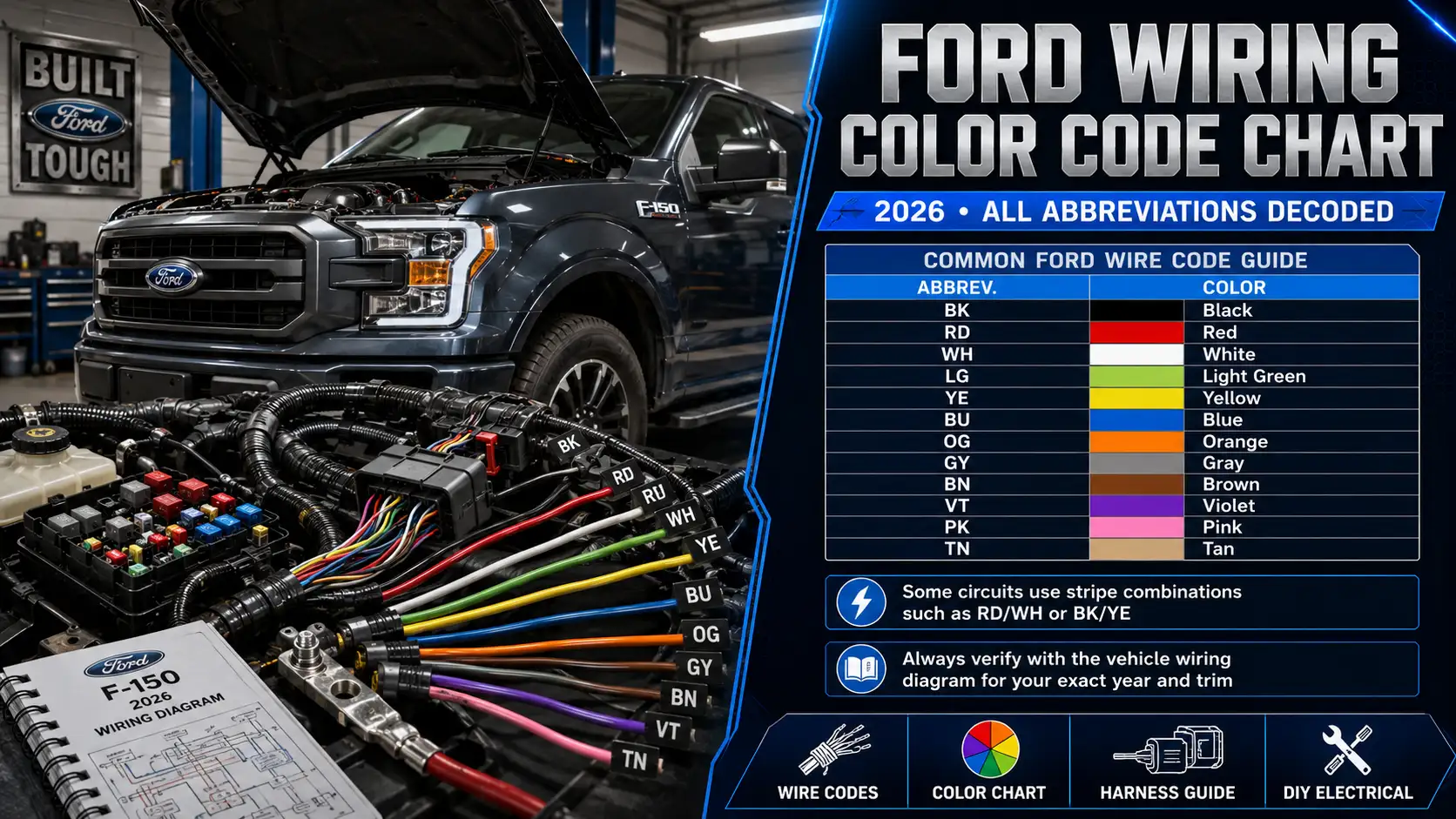
Ford Wiring Color Code Chart: 2026 All Abbreviations Decoded

Ford wiring diagrams use a two-part color code system — a base color abbreviation and a tracer color — that appears throughout every service manual from the early OBS generation through current F-150 and Super Duty models.
The abbreviations are Ford OEM codes, not the EIA aftermarket standard, which means a “RD” in a Ford diagram is not always the same circuit as a “red wire” referenced in a generic repair guide. Colors can also shift between model years on the same platform, and trim-level variations exist on 2015+ trucks built on CAN-bus architecture.
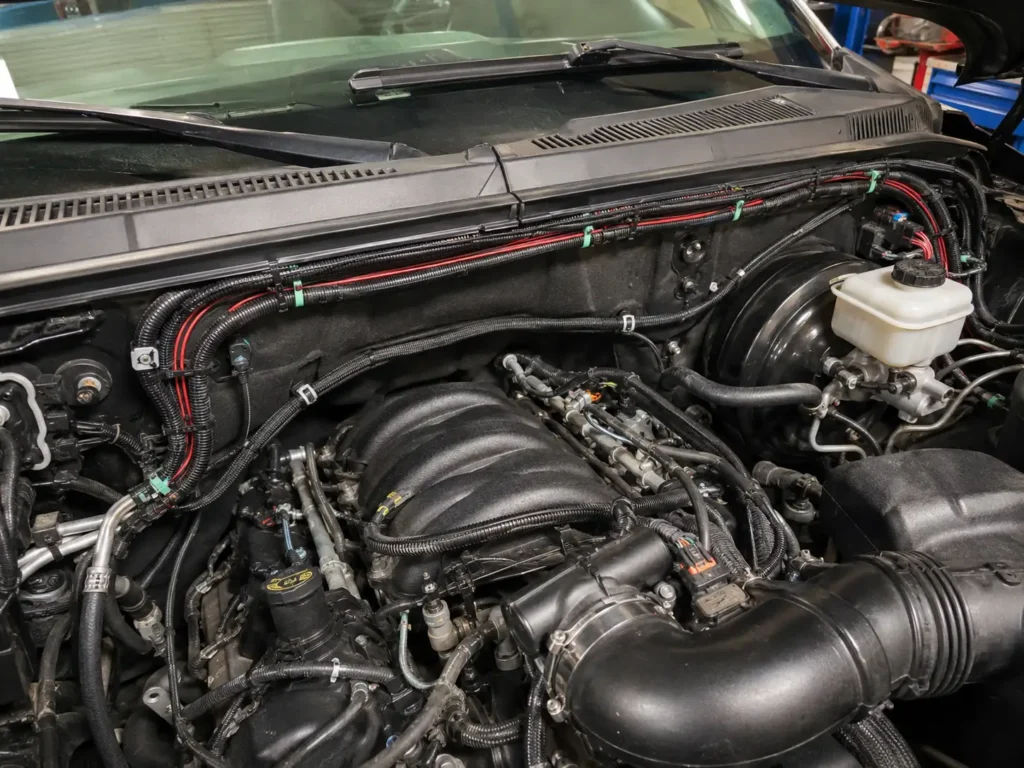
This page covers the complete Ford OEM wire color abbreviation system and the alphanumeric circuit function code that appears alongside every wire in a modern Ford schematic. The two tables below cover everything you need.
Ford wiring color code reference infographic showing all OEM wire abbreviations, tracer system, and circuit function letter codes
Recommended Best Deal Products


Ford OEM wire color codes
How to read a wire code
Circuit function letters A–Z
Field verification rules
Ford Wire Color Abbreviation Chart: All 16 OEM Codes
| Abbrev. | Full Color Name | Standard Tracer | Tracer Code | Common Usage |
|---|---|---|---|---|
| BK | Black | White | WT | Ground circuits, module returns |
| BL | Blue | White | WT | General signal wiring |
| BR | Brown | White | WT | Lighting feeds, taillamps |
| DB | Dark Blue | White | WT | Trailer circuits, horn switch |
| DG | Dark Green | White | WT | PCM control signals, EGR, O2 sensor |
| GY | Gray | Black | BK | Sensor returns, module feedback |
| LB | Light Blue | Black | BK | Speed control, blower motor, sensor feeds |
| LG | Light Green | Black | BK | PCM outputs, ground returns, fuel circuits |
| N | Natural | N/A | — | Older pre-1990 harnesses only |
| OR | Orange | Black | BK | Battery feeds, relay outputs |
| PK | Pink | Black or White | BK/WT | Fuel pump power, door lock circuits |
| RD | Red | White | WT | Battery power, alternator, ignition coil |
| TN | Tan | White | WT | Sensor signal returns, vacuum switches |
| VT | Violet | White | WT | Transmission, seat controls, speed control |
| WT | White | Black | BK | Trailer ground, signal returns |
| YL | Yellow | Black | BK | Battery feed to relay, fuel pump, starters |
How Ford tracer notation works: When a wire has a tracer, the format is BASE/TRACER. “BK/LG” means a black wire with a light green stripe. Ford used three tracer types in its older service bulletins: a plain slash (/) means a stripe; “D” after the tracer abbreviation means dots (e.g., R/Y D = red wire with yellow dots); “H” means hash marks (e.g., BK/WH = black wire with white hash marks). Modern Ford schematics dropped the D and H suffixes and standardized on stripe-only notation.
Ford Circuit Function Letter Codes: What Each Letter Means
Recommended Best Deal Products


Every Ford wiring diagram assigns a circuit function letter to each wire. This letter identifies what the circuit does, independent of its color. It is the first character in the wire’s alphanumeric identifier and appears before the circuit number and gauge.
The example from above: A 2 18 LB/YL — “A” tells you this is a Battery Feed circuit before you trace a single wire. Source: Wire Code Identification Information, Ford/Dodge Body Builder Guide — this circuit letter system is the industry-standard alphanumeric code used across Ford and Chrysler platforms from the mid-1990s onward.
Ford Circuit Function Letter Code Chart
| Letter | Circuit Function | Example Circuit |
|---|---|---|
| A | Battery Feed | Constant 12V to modules, fuse feeds |
| B | Brake Controls | Stoplight switch, ABS module |
| C | Climate Controls, EBL, Heated Mirror, Windshield and Seat | HVAC blower, heated seat elements |
| D | Diagnostic Circuits, Communications, Antennas | OBD-II data link, CAN bus, antenna |
| E | Dimming Illumination Circuits | Instrument panel dimming, interior lights |
| F | Switched Ignition Feeds | Ignition run circuits, accessory feeds |
| G | Gauges, Displays, Monitoring, Body Sensors, Resistive Mux Switches | Fuel gauge, speedometer, oil pressure |
| H | Open | Unassigned |
| I | Not Used | Reserved |
| J | Open | Unassigned |
| K | Powertrain Control Module | PCM inputs and outputs, EEC module |
| L | Exterior Lighting, Headlamp Leveling | Headlamps, taillamps, fog lights |
| M | Interior and Courtesy Lighting | Dome, map, cargo lamps |
| N | Fuel Pump, Radiator Fan | Fuel pump relay, electric cooling fan |
| O | Not Used | Reserved |
| P | Power Options: Seats, Recliner, Lumbar, Mirrors, Door Locks | Power seat motors, door lock actuators |
| Q | Power Options: Windows, Vents, Sunroof, Tops, Trunk, Liftgate, Sliding Doors | Power windows, sunroof motor |
| R | Restraint Systems | Airbag, seatbelt pretensioner |
| S | Suspension and Steering | Air suspension, speed-sensitive steering |
| T | Starter, Transmission, Transaxle, Transfer Case | Neutral safety switch, shift solenoids |
| U | Open | Unassigned |
| V | Speed Control | Cruise control amplifier, servo |
| W | Washer and Wiper | Wiper motor, washer pump |
| X | Sound Systems, Horn | Radio, amplifier, speakers, horn |
| Y | Open | Unassigned |
| Z | Grounds | All chassis ground circuits |
With both tables in hand, a wire labeled K 57 20 DG/WT decodes completely: Powertrain Control Module circuit (K), circuit number 57, 20-gauge wire, Dark Green with White tracer — a recognized PCM control signal wire common across 1990s through 2010s F-150 and F-250 models.
Common Ford Wire Colors by Circuit Type: Ground, Power, and Signal
Ford’s color assignments are most consistent on ground and constant power circuits, and most variable on sensor signals. Knowing the patterns below will get you to the right wire faster — but always verify with a meter before cutting or splicing.
Ground Wires
Solid Black (BK) is Ford’s universal ground across all modern F-150 and Super Duty models. Two common variants also appear: BK/LG (Black with Light Green tracer) on mid-2000s modules and sensor grounds, and BK/O (Black with Orange tracer) in some 1990s–2000s F-Series trucks. Never identify a ground wire by color alone. Verify zero resistance to a known chassis ground point with a digital multimeter before connecting.
Power and Ignition Wires
Battery constant feeds use Red (RD) or Red with a tracer (RD/WT, RD/BK) throughout the fuse panel and power distribution circuits. The switched ignition run circuit on F-150 and F-250 models is most commonly Red/Light Green (RD/LG) — confirmed in the Motorcraft Service Bulletin 87-52 as circuit 16 “Ignition Switch to Ignition Coil BATT Terminal” and circuit 454 “Ignition Switch Coil Terminal to Circuit Breaker”.
PCM relay control signals consistently appear as Dark Green/White (DG/W) across 1990s through 2010s F-Series trucks. On trucks equipped with a Fuel Pump Driver Module (FPDM), the controlled power feed from the module to the pump typically uses Gray/Red (GY/R) or Gray/Yellow (GY/Y) — verify against your model year’s schematic at motorcraftservice.com.
Sensor and Signal Wires
Signal wires vary the most across generations and trim levels. For Ford fuel systems, Pink/Black (PK/BK) and Yellow/White (YL/WT) are the most common fuel level sender signal wire colors on F-150 and Super Duty platforms. Tan (TN) appears frequently on sensor signal return circuits, and circuit numbers in the 300–360 range in older Ford EVTMs are almost exclusively sensor feed and return wires.
On any sensor circuit, the connector pin position is more reliable than wire color for identification. If the color does not match your diagram, check the adjacent pins first before assuming a wiring error.
How Ford Wire Colors Vary by Model Year and Generation
Recommended Best Deal Products

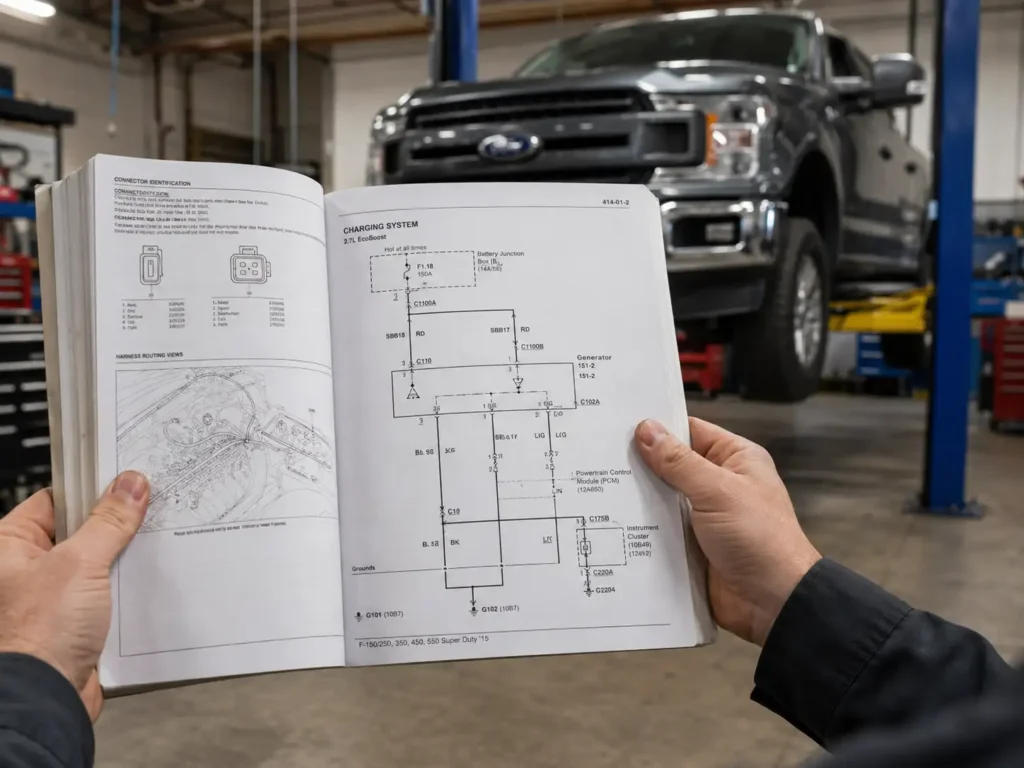
Ford’s wiring color conventions shifted significantly with the introduction of FPDM technology in the mid-2000s and CAN-bus architecture in the 2015+ F-150. Understanding the generational pattern prevents misdiagnosis.
On pre-1990 OBS trucks (F-150 through F-350, Bronco), Ford used the older single-number circuit system documented in the Motorcraft Service Bulletin 87-52. Tracers with dots (D) and hash marks (H) appear in those diagrams. The color assignments for high-use circuits like grounds (BK), battery feeds (RD/OR), and ignition (RD/LG) were largely stable from 1980 through the early 1990s.
From the 10th through 12th generation F-150 (1997–2014) and the same-era Super Duty, Ford introduced the FPDM and began adding CAN-bus modules across more trim levels. The circuit function letter system (A through Z) became standard across all Ford schematics during this period. Wire color-to-function assignments were more consistent, though trim-level options (like power running boards or adaptive cruise control) introduced wires that only appear on equipped trucks.
On 2015+ F-150 and current Super Duty, the Ford Transmission Identification Chart era of full CAN-bus integration means many circuits carry data signals rather than simple switched power. A wire that looks like a power feed by color may actually be a pulse-width-modulated (PWM) signal.
On these trucks, connector pin position is the primary identifier. Wire color is a starting point for narrowing down the circuit; it is not the final word. Always cross-reference the connector view in the applicable Ford EVTM from motorcraftservice.com before testing.
Ford System-Specific Wiring Color Guides
For system-specific wire color guides, use the links below — each covers connector pinouts, color codes, and diagnostic steps for that circuit.
- Ford fuel pump wire color codes — power feed, ground, sender signal, and FPDM wires by generation
- Ford radio and stereo wiring harness color codes — EIA vs. Ford OEM audio harness colors with connector pinouts
- Ford tail light wiring color code — rear lighting circuit colors for F-150, F-250, and trailer wiring
- Ford headlight wire color code — high beam, low beam, and dimmer switch circuit colors
- Ford ignition switch wiring color code — battery, run, accessory, and start terminal wire colors by generation
Frequently Asked Questions About Ford Wiring Color Codes
What does BK mean on a Ford wiring diagram?
BK is Ford’s abbreviation for Black. It is the standard ground wire color used throughout all F-150, F-250, and Super Duty models. A BK wire connects to the vehicle chassis or body to complete the circuit. When a tracer is added, the notation becomes BK/LG, BK/O, or similar.
What color is the Ford ground wire?
Solid Black (BK) is the universal Ford ground wire color across all modern truck and SUV models. Two common variants also appear in F-Series trucks: Black/Light Green (BK/LG) on sensor and module grounds, and Black/Orange (BK/O) on some 1990s–2000s applications. Always verify with a multimeter before assuming ground identity based on color alone.
How do I read a Ford wire color code with a tracer?
The base color comes first, followed by a slash and the tracer color abbreviation. BK/LG means a Black wire with a Light Green stripe. On older Ford service bulletins, a “D” after the tracer code means dots, and “H” means hash marks. Modern Ford EVTMs dropped the D and H suffixes and standardized on stripe notation only.
Are Ford wiring color codes the same across all models?
No. Core circuits like grounds (BK) and battery feeds (RD/OR) are consistent, but sensor signal wires and module-specific circuits vary by model year, engine, and trim level. The 2015+ F-150 and Super Duty on CAN-bus architecture introduced additional variation. Always use the EVTM specific to your truck’s model year from motorcraftservice.com.
Where can I find the official Ford wiring diagram for my truck?
Ford publishes model-year-specific EVTMs (Electrical and Vacuum Troubleshooting Manuals) through motorcraftservice.com. One-day and one-year subscriptions are available. The EVTM includes full schematics, connector pinout views, component location diagrams, and circuit voltage specifications for every system on your truck.
Read Any Ford Wiring Diagram With Confidence
The Ford wiring color code chart system works in two layers: the wire color abbreviation identifies the physical wire, and the circuit function letter identifies what that wire does. Together, they let you decode any Ford wiring diagram without guessing. The complete abbreviation table above covers all 16 OEM codes used across F-150, F-250, Ranger, Bronco, and Explorer platforms. The circuit function letter table covers all active letters from A through Z.
On 2015+ trucks with full CAN-bus integration, treat wire color as a starting point only. Connector pin position is the more reliable identifier on module-heavy circuits. For model-year-specific connector pinouts and full schematics, motorcraftservice.com offers single-day access to Ford’s full EVTM library — it is the most accurate source for any ford wiring color code verification before you cut or splice.




3 Comments