Ford F150 Gear Ratio Chart by Year and Axle Code 2026

A Ford F150 gear ratio chart helps you match your truck’s axle code to its actual rear axle ratio. That ratio affects towing strength, launch feel, highway RPM, fuel economy, and how the truck responds after larger tires.
For most late-model F-150 trucks, the common factory ratios are 3.15, 3.31, 3.55, 3.73, and 4.10 on Raptor-specific configurations. Older trucks may use different limited-slip codes, so the safest method is to check the AXLE code on the door label and match it to the correct model-year towing guide.

Prime for Young Adults — 6 Months Free
Students and 18–24s get six months of Prime free, then half price.
Start 6 Months Free As an Amazon Associate I earn from qualifying purchases.
This guide gives you the verified F-150 axle codes, explains what each ratio means, and shows how to choose the right setup for towing, daily driving, or larger tires.
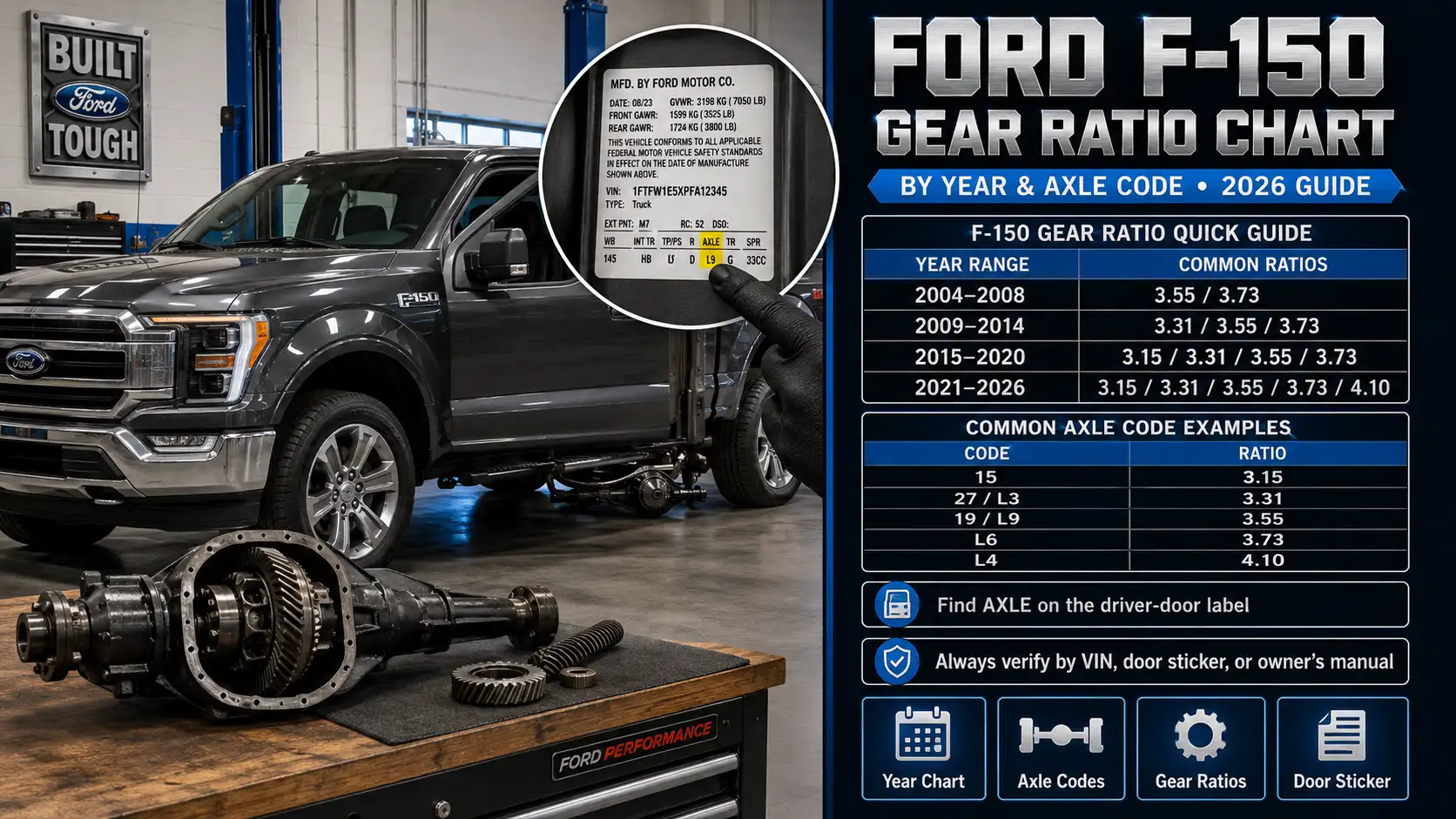
Ford F150 Gear Ratio Infographic
Use your driver door AXLE code to identify the rear axle ratio. Then match that ratio to how you actually use the truck, whether that means daily driving, regular towing, or larger tires.
How To Identify Your Ratio
Open The Driver Door
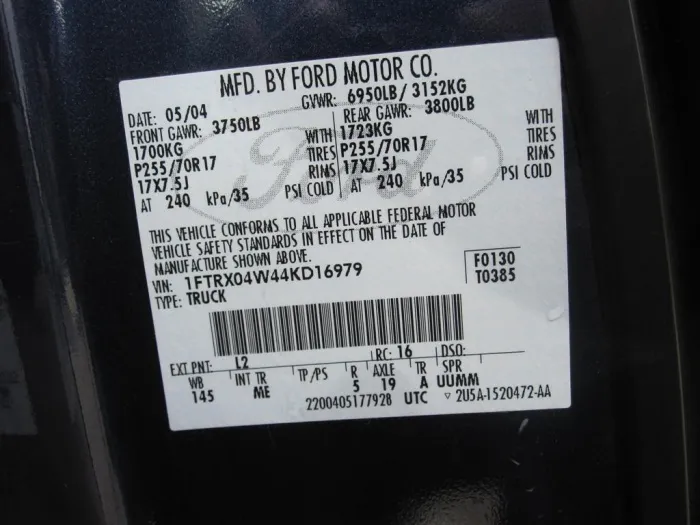
Find the factory Safety Compliance Certification Label on the driver-side door area.
Read The AXLE Code
Look for the two-character code printed under the field labeled AXLE.
Match It To The Chart
Use the code with the correct model-year Ford towing guide to confirm the actual gear ratio.
What The Common F150 Ratios Mean
Best For Highway Use
This is the most relaxed ratio of the group.
- Lower cruising RPM
- Good for commuting
- Best with light towing
Best For Daily Driving
A common F-150 setup for owners who tow occasionally.
- Balanced highway feel
- Light trailer friendly
- Good everyday choice
Best All Around Ratio
This is the strongest middle-ground option for many owners.
- Better pull than 3.31
- Good for mixed use
- Regular towing capable
Best For Towing
Best when you pull heavier trailers or run larger tires.

Audible — Listen Free for 30 Days
One free credit a month and thousands of titles included.
Listen Free for 30 Days As an Amazon Associate I earn from qualifying purchases.- Stronger low-speed pull
- Helpful with 35-inch tires
- May reduce MPG slightly
Quick Lookup Table
| Axle Code | Ratio | Axle Type | Best Use |
|---|---|---|---|
| 15 | 3.15 | Open | Highway driving and light-duty use |
| 27 / L3 | 3.31 | Open / Electronic Locking | Daily driving and occasional towing |
| 19 / L9 | 3.55 | Open / Electronic Locking | Balanced use and regular towing |
| 26 / L6 | 3.73 | Open / Electronic Locking | Heavier towing and larger tires |
| L4 | 4.10 | Electronic Locking | Raptor or specialty off-road setups |
How To Find Your F150 Axle Code
Recommended Best Deal Products


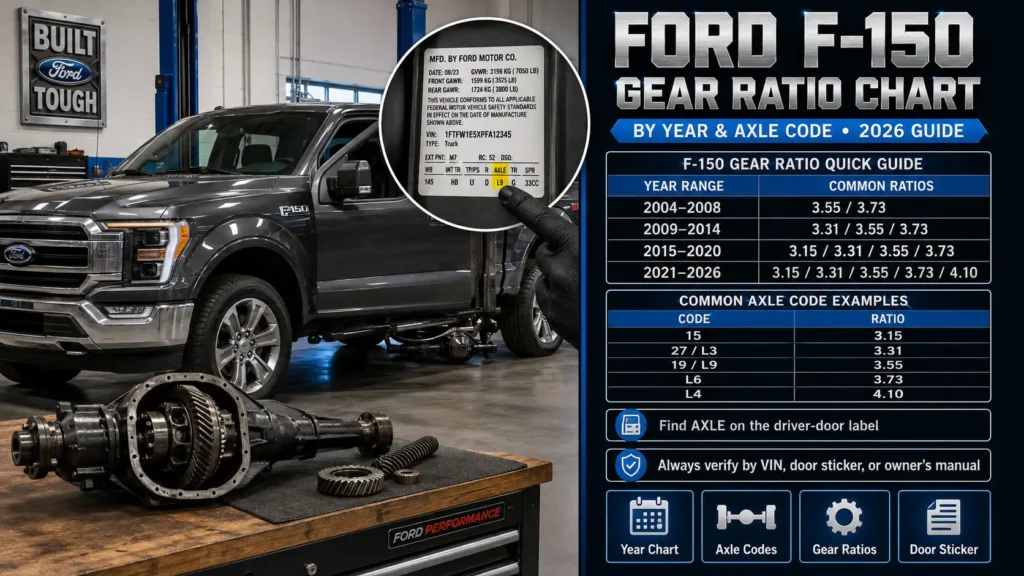
The axle code is printed on the Safety Compliance Certification Label on the driver-side door area. Ford places it on the left front door lock facing or door latch post pillar, depending on the model year.
Use these steps before checking any chart:
- Open the driver-side door.
- Look for the factory Safety Compliance Certification Label.
- Find the word AXLE below the barcode.
- Read the two-character code under AXLE.
- Match that code to the Ford towing guide for your model year.
Ford’s official support guidance says to locate the two-digit axle code first, then use the towing guide to find the matching axle ratio. That matters because the same F-150 trim can be sold with different axle ratios.
Older trucks can have missing, damaged, repainted, or replaced door labels. If the label is unreadable, check the original window sticker, dealer build sheet, differential tag, or Ford service data before buying parts.
Once you have the two-digit code, the chart below tells you what ratio your truck uses.
Ford F150 Gear Ratio Chart By Axle Code
Use this chart after checking the AXLE code on your door sticker. The table separates late-model electronic locking codes from older limited-slip codes because Ford changed the F-150 axle code format over time.
For broader Ford axle identification beyond the F-150, use the Ford axle code chart as the next reference.
| Model Years | Axle Code | Gear Ratio | Axle Type | Notes |
|---|---|---|---|---|
| 2023 to 2026 | 15 | 3.15 | Non-limited slip | Economy-focused highway ratio |
| 2023 to 2026 | 27 | 3.31 | Non-limited slip | Common daily-driver ratio |
| 2023 to 2026 | L3 | 3.31 | Electronic locking | Daily use with better traction |
| 2023 to 2026 | 19 | 3.55 | Non-limited slip | Balanced towing and daily use |
| 2023 to 2026 | L9 | 3.55 | Electronic locking | Common tow-friendly setup |
| 2023 to 2026 | 26 | 3.73 | Non-limited slip | Towing and heavier-duty use |
| 2023 to 2026 | L6 | 3.73 | Electronic locking | Stronger low-speed pull |
| 2023 to 2026 | L4 | 4.10 | Electronic locking | Raptor and specialty use |
| 2015 to 2018 | 15 | 3.15 | Non-limited slip | Verified in Ford towing guides |
| 2015 to 2018 | L5 | 3.15 | Electronic locking | Available on select configurations |
| 2015 to 2018 | 27 | 3.31 | Non-limited slip | Common light-duty ratio |
| 2015 to 2018 | L3 | 3.31 | Electronic locking | More traction than open axle |
| 2015 to 2018 | 19 | 3.55 | Non-limited slip | Balanced ratio |
| 2015 to 2018 | L9 | 3.55 | Electronic locking | Useful for towing and traction |
| 2015 to 2018 | 26 | 3.73 | Non-limited slip | Stronger towing ratio |
| 2015 to 2018 | L6 | 3.73 | Electronic locking | Common heavy tow choice |
| 2018 | L4 | 4.10 | Electronic locking | Raptor-focused ratio |
| 2011 | 15 | 3.15 | Non-limited slip | Verified in 2011 Ford guide |
| 2011 | A5 | 3.15 | Limited slip | Older limited-slip code |
| 2011 | 27 | 3.31 | Non-limited slip | Verified in 2011 Ford guide |
| 2011 | 19 | 3.55 | Non-limited slip | Verified in 2011 Ford guide |
| 2011 | H9 | 3.55 | Limited slip | Older limited-slip code |
| 2011 | 26 | 3.73 | Non-limited slip | Verified in 2011 Ford guide |
| 2011 | B6 | 3.73 | Limited slip | Older limited-slip code |
| 2011 | L6 | 3.73 | Electronic locking | Electronic-locking code |
| 2011 | L4 | 4.10 | Electronic locking | Specialty use |
The most reliable rule is simple: match your truck’s model year to the towing guide from that same year. A 2026 L9 code and a 2011 H9 code both point to 3.55-type setups, but they do not describe the same axle technology.
The number itself matters because each ratio changes how your F-150 feels under load.
What 3.15, 3.31, 3.55, And 3.73 Ratios Mean
Recommended Best Deal Products


A higher numerical gear ratio gives stronger torque multiplication at the axle. A lower numerical ratio usually cruises with less engine speed at highway pace.
Audible Premium Plus — Annual Membership
12 audiobook credits up front, plus the full Audible catalogue.
See Annual Plans As an Amazon Associate I earn from qualifying purchases.That does not mean one ratio is always better. The best F-150 gear ratio depends on your engine, transmission, tire size, payload, trailer weight, and how often you tow.
3.15 And 3.31 For Daily Driving
The 3.15 and 3.31 ratios are best for unloaded driving, commuting, and light towing. They help the truck feel more relaxed at highway speed, especially with modern 10-speed automatic transmissions.
A 3.31 F-150 can still tow well when properly equipped. But it is not the first choice for owners who regularly pull heavy campers, enclosed trailers, or work equipment.
3.55 For Balanced Use
The 3.55 ratio is the middle ground for many F-150 owners. It gives better low-speed pull than 3.31 without feeling as aggressive as 3.73.
For mixed driving, weekend trailers, light work use, and normal highway driving, 3.55 is often the safest all-around choice.
3.73 For Towing And Larger Tires
The 3.73 ratio is better when the truck tows often, runs heavier loads, or uses larger tires. It helps the engine get the truck moving with less strain at low speed.
The tradeoff is that highway RPM and fuel use can be higher than a lower numerical ratio, especially on older trucks with fewer transmission gears.
That tradeoff becomes clearer when you compare 3.31, 3.55, and 3.73 side by side.
3.31 Vs 3.55 Vs 3.73 For Towing
For towing, 3.55 is the best middle choice for many F-150 owners, while 3.73 is better for heavier trailers, larger tires, and stronger low-speed pull. A 3.31 ratio works well for daily driving and lighter trailers.
| Ratio | Best Use | Towing Feel | Main Tradeoff |
|---|---|---|---|
| 3.31 | Daily driving and light towing | Smooth and relaxed | Less low-speed pull than 3.55 or 3.73 |
| 3.55 | Mixed driving and regular towing | Balanced | Not as relaxed as 3.31 on highway |
| 3.73 | Heavier towing and larger tires | Strongest pull of the three | May use more fuel at speed |
Do not choose an F-150 for towing by axle ratio alone. Ford towing charts also use engine, cab, wheelbase, drivetrain, GCWR, payload, tow package, and hitch rating.
Before choosing a truck for a camper or work trailer, compare the ratio with the full Ford F-150 towing capacity chart.
Gear ratio is only one part of the tow rating, so the next step is matching it to your exact truck configuration.
How Gear Ratio Affects MPG And Highway RPM
Recommended Best Deal Products


Gear ratio affects MPG most clearly at highway speed and under load. A lower numerical ratio such as 3.15 or 3.31 generally lets the truck cruise with less axle multiplication.
A higher numerical ratio such as 3.73 helps the truck pull harder from a stop, but it can raise engine speed in comparable driving conditions. That can reduce fuel economy, especially when towing or driving fast.
Modern F-150 trucks soften this tradeoff with the 10-speed automatic transmission. The wider gear spread helps a 3.55 or 3.73 truck cruise more efficiently than older trucks with fewer gears.
Avoid exact MPG promises. Tire size, load, wind, trailer shape, terrain, speed, and driving style can change fuel economy more than the axle ratio alone.
Tire size is the other reason many F-150 owners start thinking about gear ratio.
What Ratio Works Best With Larger Tires
Larger tires change the effective gearing even if the axle gears stay the same. A taller tire travels farther per wheel rotation, which makes the truck feel like it has a lower numerical axle ratio.
That is why a 3.31 F-150 can feel softer after moving to 34-inch or 35-inch tires. The engine has to work harder to get the same launch feel.
For mild tire upgrades, 3.55 is usually a better starting point than 3.31. For 35-inch tires, regular towing, or off-road use, 3.73 becomes more attractive.
A 4.10 ratio can make sense for certain Raptor or specialty builds, but it is not the standard answer for every F-150. It depends on transmission, tire size, axle type, and how the truck is used.
If you are changing wheels at the same time, check the Ford bolt pattern chart before ordering parts.
Before spending money on gears, verify what axle is already under the truck.
How To Verify F150 Gear Ratio Before Buying
Do not buy an F-150 for towing based on trim name alone. XLT, Lariat, FX4, and tow package labels do not always tell you the exact axle ratio.
Use this buyer checklist:
- Check the AXLE code on the driver-side certification label.
- Match that code to the Ford towing guide for the same model year.
- Ask for the original window sticker if the seller has it.
- Ask a Ford dealer to confirm the build data from the VIN.
- Inspect the differential tag if the door label is missing.
- Compare axle ratio with payload, GCWR, engine, cab, wheelbase, and drivetrain.
A test drive can hint at gearing, but it is not proof. Tire size, transmission behavior, throttle mapping, and engine tune can make two trucks feel different even with the same axle ratio.
The safest approach is to match the axle code, engine, cab, drivetrain, and payload label before deciding.
Quick F150 Gear Ratio Recommendations
For most F-150 owners, the right ratio depends on how often the truck tows. Use this decision table as a quick starting point.
| Your Use Case | Best Ratio Choice | Why It Fits |
|---|---|---|
| Mostly highway and daily driving | 3.31 | Relaxed cruising and good daily manners |
| Daily driving with occasional towing | 3.55 | Best balance for most owners |
| Regular camper or utility trailer towing | 3.55 or 3.73 | Better pull than 3.31 |
| Larger tires near 35 inches | 3.73 | Helps recover lost effective gearing |
| Raptor or specialty off-road setup | 4.10 where equipped | Strong low-speed response |
| Used F-150 purchase | Verify by AXLE code | Trim name is not enough |
If you are unsure, choose the truck with the correct tow rating first. Axle ratio supports towing, but payload and GCWR decide whether the truck is actually rated for the job.
With the ratio decoded, the final step is using it correctly instead of treating it as the whole tow rating.
What To Remember Before Choosing A Ratio
The Ford F150 gear ratio chart is the fastest way to decode your axle, but it is only the starting point. Your truck’s real towing ability also depends on engine, drivetrain, cab, wheelbase, payload, hitch rating, and required tow equipment.
For daily driving, 3.31 is usually the comfortable choice. For a mix of commuting and towing, 3.55 is the safest middle ground. For frequent towing or larger tires, 3.73 is usually the stronger setup.
Before buying parts or choosing a used truck, read the AXLE code first. Then match that code to the correct Ford towing guide for your model year.
FAQ
What Gear Ratio Does My Ford F150 Have
Your Ford F-150 gear ratio is identified by the AXLE code on the driver-side Safety Compliance Certification Label. Find the two-character code under AXLE, then match it to the Ford towing guide for your model year.
Is 3.31 Or 3.55 Better For An F150
A 3.31 ratio is better for mostly daily driving and lighter towing. A 3.55 ratio is better if you tow more often or want stronger low-speed response without moving to 3.73.
Is 3.73 Good For Towing With An F150
Yes, 3.73 is a strong F-150 towing ratio when the truck is properly equipped. It improves low-speed pull compared with 3.31, but tow rating still depends on engine, payload, GCWR, cab, wheelbase, and tow package.
Can I Find My F150 Gear Ratio By VIN
A Ford dealer or build-sheet lookup can often confirm the gear ratio from the VIN. For a quick physical check, the door label AXLE code is usually faster if the label is still present and readable.
Does Gear Ratio Change Towing Capacity
Gear ratio can affect towing capacity, but it does not decide the rating by itself. Ford towing charts combine axle ratio with engine, drivetrain, cab, wheelbase, payload, GCWR, and required towing equipment.
What Is The Best F150 Gear Ratio For 35 Inch Tires
For many F-150 builds with 35-inch tires, 3.73 is a better choice than 3.31 because taller tires reduce effective gearing. If the truck also tows regularly, verify axle strength, payload, and transmission behavior before regearing.