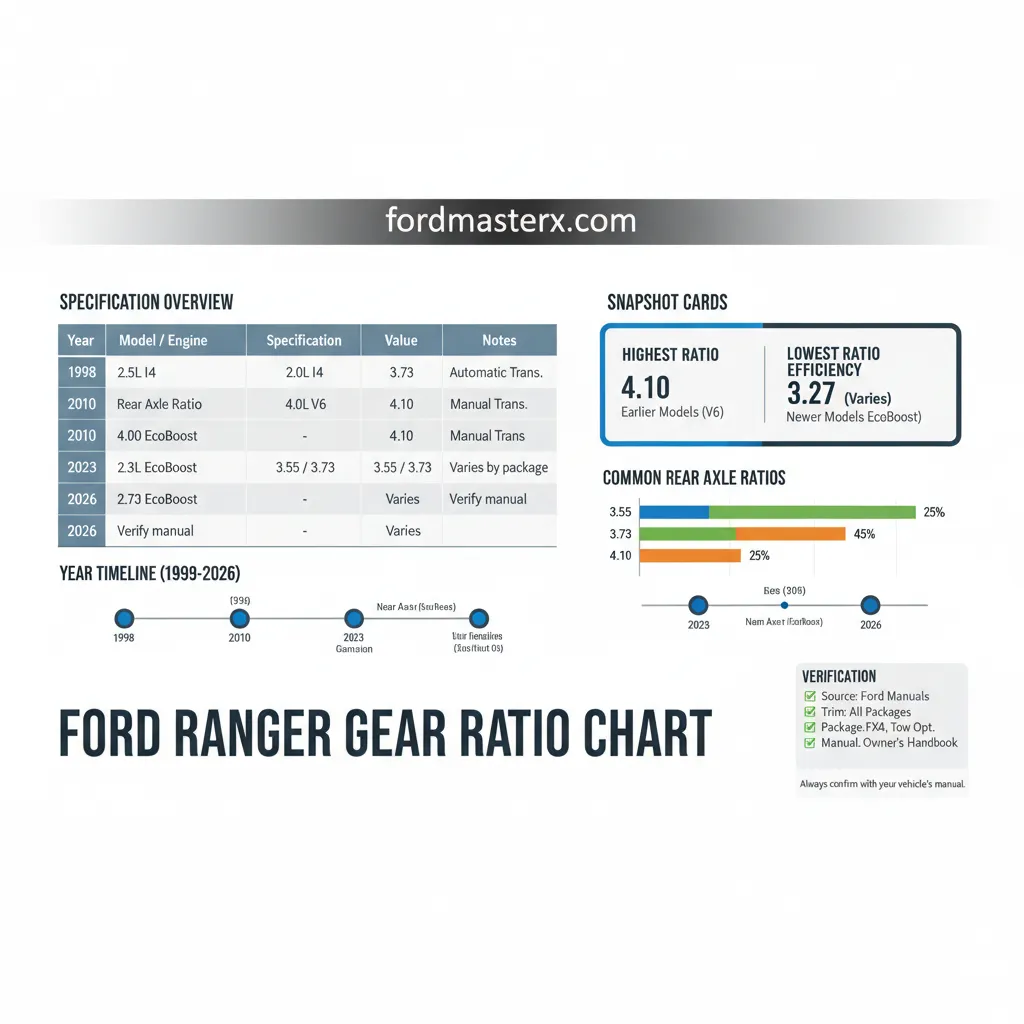
Ford Ranger Gear Ratio Specification Chart By Year (1998–2026)

Quick Answer
Ford Ranger gear ratios vary significantly by model year, engine option, transmission type, and drivetrain configuration (2WD vs. 4WD). Generally, ratios range from approximately 3.08 to 4.10 for street-oriented applications, and up to 4.56 or even 5.13 for specific off-road or heavy-duty configurations. Always verify your vehicle’s specific ratio using the door jamb sticker or owner’s manual, as production variations exist.
Optimizing your Ford Ranger’s performance, whether for rugged off-road adventures, heavy-duty towing, or efficient daily driving, critically depends on understanding its gear ratios. With numerous engine options, drivetrain configurations, and model year variations, identifying the correct gear ratio for a Ford Ranger can be complex, leading to confusion about its capabilities and potential modifications. This comprehensive guide will demystify Ford Ranger gear ratios from 1998 to 2026, providing precise specifications by year, engine, and configuration, along with practical insights into their implications for your truck’s performance.

Prime for Young Adults — 6 Months Free
Students and 18–24s get six months of Prime free, then half price.
Start 6 Months Free As an Amazon Associate I earn from qualifying purchases.This chart compiles common Ford Ranger gear ratio specifications for model years 1998 through 2026. Data is sourced from factory service manuals, official Ford vehicle guides, and recognized automotive databases. Please note that exact specifications can vary significantly based on specific trim levels, engine options, transmission types, 2WD/4WD configurations, regional markets, and optional packages (e.g., towing, FX4, Raptor). While comprehensive, always cross-reference with your vehicle’s door jamb sticker (axle code), owner’s manual, or a VIN decoder for the most accurate information for your specific truck.
Last reviewed: May 2026
How to Read This Chart
Recommended Best Deal Products

📤 Share Image
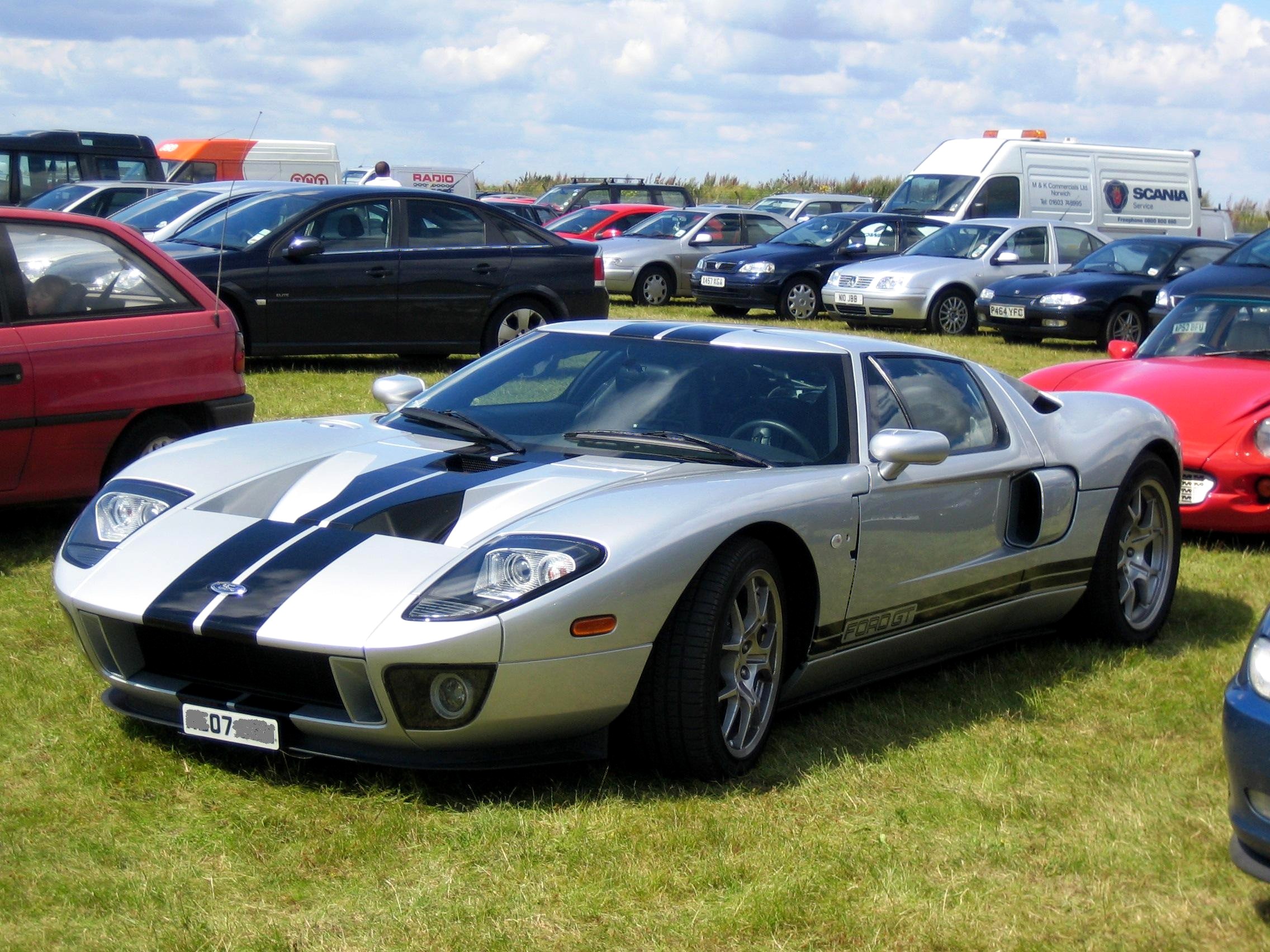
The following chart provides a snapshot of common Ford Ranger gear ratios. The “Year” column indicates the model year, while “Model / Engine” details the powertrain and sometimes the general trim. The “Specification” column clarifies what type of ratio is being listed (typically Rear Axle Ratio). The “Value” column presents the numerical gear ratio. Crucially, the “Notes” column offers vital context, indicating dependencies such as transmission type, drivetrain (2WD/4WD), or specific packages. Where a precise value is not universally standard, a range or “Varies by Configuration” is indicated, prompting further verification.
Ford Ranger Gear Ratio Specification Chart By Year (1998–2026)
| Year | Model / Engine | Specification | Value | Notes |
|---|---|---|---|---|
| 1998-2000 | 2.5L I4 | Rear Axle Ratio | 3.73, 4.10 | Standard for 2WD, 4WD; often 4.10 for manual/larger tires. |
| 1998-2008 | 3.0L V6 | Rear Axle Ratio | 3.45, 3.55, 3.73, 4.10 | Commonly 3.73. 4.10 with towing package or specific trims. |
| 1998-2011 | 4.0L V6 (SOHC/OHV) | Rear Axle Ratio | 3.55, 3.73, 4.10 | 3.73 standard, 4.10 common with 4×4, off-road (FX4), or towing. |
| 2001-2011 | 2.3L Duratec I4 | Rear Axle Ratio | 3.73, 4.10 | Generally 3.73 for automatic, 4.10 for manual or specific markets. |
| 2019-2023 | 2.3L EcoBoost I4 (NA) | Rear Axle Ratio | 3.73, (Optional 3.55 for 2WD, 4.10 w/ Tow Pkg) | 3.73 standard for most configurations. 4.10 often bundled with Trailer Tow Package. |
| 2019-2023 | 2.3L EcoBoost I4 FX4 (NA) | Rear Axle Ratio | 3.73, (Optional 4.10) | FX4 package often allows for 4.10 for enhanced off-road performance. |
| 2024-2026 | 2.3L EcoBoost I4 (NA) | Rear Axle Ratio | 3.73, (Optional 3.55, 4.10) | Similar to previous gen; 4.10 for max towing or off-road packages. |
| 2024-2026 | 2.7L EcoBoost V6 (NA) | Rear Axle Ratio | 3.73, 4.27 | Higher torque V6; 4.27 available for heavy towing or performance. |
| 2024-2026 | 3.0L EcoBoost V6 Raptor (NA) | Rear Axle Ratio | 4.27, 4.70 (Global variants may vary) | Performance-oriented. Specific to Raptor models for off-road capability. |
| 2011-2023 | 2.2L/3.2L Diesel (International) | Rear Axle Ratio | 3.55, 3.73, 4.10 | Varies significantly by global market, engine, and transmission. |
| 2023-2026 | 3.0L V6 Diesel (International) | Rear Axle Ratio | 3.73, 4.10 | Common for increased towing capacity in specific markets. |
| * Note: All values are approximate. Specific ratios are highly dependent on exact trim, engine, transmission, 2WD/4WD, and optional packages. Always verify with your vehicle’s documentation. | ||||
3.73
4.70+
3.73-4.10
Snapshot of Key Ratios: This grid highlights the prevalence and extremes of Ford Ranger gear ratios. The 3.73 ratio remains a workhorse, while specialized models like the Raptor push the numerical limits for off-road prowess.
Year-by-Year Evolution of Ford Ranger Axle Ratios: Notable Changes and Updates
Recommended Best Deal Products


The Ford Ranger, a stalwart in the compact and mid-size truck segment, has undergone significant transformations, and its gear ratio offerings reflect these shifts. From its earlier iterations (1998-2011) to its reintroduction in North America (2019+) and beyond, the underlying philosophy guiding gear ratio selection has adapted to evolving powertrain technologies and consumer demands.
Third Generation (1998-2011): A Diverse Portfolio
During its third generation, the Ranger offered a range of naturally aspirated engines, including the 2.5L I4, 3.0L V6, and the robust 4.0L V6. Gear ratios in this era typically ranged from 3.45 to 4.10. Smaller engines like the 2.5L and 3.0L often came with 3.73 as a standard, with 4.10 available for manual transmissions, 4×4 models, or specific towing packages. The 4.0L V6, particularly with 4×4 and the popular FX4 off-road package, frequently featured 3.73 or 4.10 ratios to maximize its torque and off-road capability. This generation’s diverse offerings catered to a wide array of utility and recreational uses.
The North American Hiatus and Global Rangers (2012-2018)
While the Ranger was absent from the North American market, global markets saw the introduction of the T6 platform, primarily with diesel engines (like the 2.2L and 3.2L). These international models, designed for diverse global conditions, also featured varied axle ratios, often in the 3.55 to 4.10 range, tailored for specific load-hauling and terrain demands. Research indicates that the diesel engines, with their higher torque at lower RPMs, could often utilize numerically lower (taller) ratios for highway efficiency while still maintaining strong pulling power.
Fourth Generation (2019-2023): EcoBoost Era
The reintroduction of the Ranger to North America in 2019 brought a significant shift: a single engine option, the 2.3L EcoBoost I4, paired with a 10-speed automatic transmission. This powertrain strategy streamlined the gear ratio offerings. The standard ratio for most 2WD and 4WD configurations became 3.73. However, an optional 3.55 ratio was available for certain 2WD models aimed at slightly better fuel economy, and crucially, a 4.10 ratio was often included with the Trailer Tow Package or FX4 Off-Road Package to enhance towing and off-road performance. This reflected a move towards modern, efficient turbocharged engines while still offering specialized ratios for demanding tasks.
Fifth Generation (2024-2026): Power and Performance Expansion
The latest generation of the Ford Ranger, launched in 2024, expands the powertrain options and, consequently, the gear ratio selections. While the 2.3L EcoBoost continues with its familiar 3.73 (and optional 3.55/4.10) ratios, the introduction of the more powerful 2.7L EcoBoost V6 brings ratios such as 3.73 and 4.27. The most significant change comes with the high-performance Ranger Raptor, featuring a 3.0L EcoBoost V6. This flagship off-road model boasts significantly numerically higher ratios, commonly 4.27 or even 4.70 (and potentially higher in some global variants or future updates like 5.13), explicitly engineered for extreme off-road capability and high-speed desert running. This year-by-year evolution demonstrates Ford’s commitment to tailoring the Ranger’s drivetrain to diverse performance requirements.

Audible — Listen Free for 30 Days
One free credit a month and thousands of titles included.
Listen Free for 30 Days As an Amazon Associate I earn from qualifying purchases._–_Frontansicht,_14._April_2013,_Düsseldorf.jpg "Ford Ranger Gear Ratio Specification Chart By Year (1998–2026) 5")
Understanding Ford Ranger Gear Ratios by Engine, Drivetrain, and Configuration
The selection of a Ford Ranger’s gear ratio is not arbitrary; it’s a carefully calculated decision by engineers to match the vehicle’s intended use and powertrain characteristics. Several factors, including engine type, drivetrain, and factory-installed packages, play a pivotal role in determining the available and optimal axle ratios.
Engine Characteristics and Ratio Matching
The engine’s power and torque curves heavily influence appropriate gear ratios. Engines with high torque at low RPMs, like the modern EcoBoost V6s or larger diesel engines, can often utilize numerically lower (taller) gear ratios for better highway fuel economy, as they don’t need to rev as high to maintain speed. Conversely, smaller displacement or less torquey engines, such as the older 2.3L I4 or 3.0L V6, often benefit from numerically higher (shorter) gear ratios (e.g., 4.10) to improve acceleration and towing performance, helping the engine stay within its optimal power band. For instance, the 2.3L EcoBoost, despite its turbocharged torque, commonly uses a 3.73 ratio to balance efficiency with responsiveness, offering an optional 4.10 for maximum towing.
Drivetrain: 2WD vs. 4WD
Drivetrain configuration, specifically 2WD versus 4WD, also impacts available ratios. While both can share common ratios like 3.73, 4WD models, particularly those designed for off-road use, frequently offer numerically higher ratios. This is because 4WD often implies more demanding conditions (e.g., mud, rocks, steep inclines) where greater torque multiplication at the wheels is paramount. The additional drivetrain components in 4WD also add weight, which shorter gearing helps to offset. For example, a 2005 4.0L V6 4×4 Ranger might come standard with a 4.10 ratio, while a 2WD version could have a 3.73.
Factory Packages: Towing and Off-Road
Ford strategically bundles specific gear ratios with factory option packages to enhance the Ranger’s capabilities.
- Towing Packages: To maximize the vehicle’s Gross Combined Weight Rating (GCWR) and make towing heavy loads easier, towing packages often include a numerically higher axle ratio. For the 2019+ 2.3L EcoBoost Ranger, a 4.10 ratio is a common upgrade in the Trailer Tow Package, providing greater mechanical advantage for pulling.
- Off-Road Packages (e.g., FX4, Raptor): These packages are designed for enhanced traction and capability in challenging terrain. Off-road trims nearly always feature significantly numerically higher ratios. The 2024 Ranger Raptor, with its 3.0L EcoBoost V6, comes equipped with ratios around 4.27 or 4.70, to provide maximum torque at the wheels for climbing, crawling, and high-speed desert blasts. Older FX4 models with the 4.0L V6 also commonly featured 4.10 ratios.
Transmission Type
The transmission, whether manual or automatic, also plays a crucial role. Modern automatic transmissions, particularly those with more gears (like the 10-speed in current Rangers), offer a wider spread of ratios, allowing for flexibility. This can sometimes permit the use of a numerically lower (taller) axle ratio for improved highway fuel economy, as the transmission itself can provide the necessary reduction for acceleration. Manual transmissions, with fewer gears, often benefit from numerically higher axle ratios to compensate for their broader gear spacing and ensure adequate starting torque.
Always consult your vehicle’s door jamb sticker (axle code), owner’s manual, or a Ford dealership with your VIN to confirm the exact gear ratio. Generic charts are guides, but specific factory builds can differ.
What Affects Ford Ranger Axle Ratios and Why They Matter for Performance
Recommended Best Deal Products


Understanding axle ratios goes beyond just numbers; it’s about comprehending how they fundamentally alter your truck’s behavior. An axle ratio represents the number of times the driveshaft rotates for every single rotation of the wheel. This ratio is a critical component in the overall drivetrain, directly impacting your Ford Ranger’s performance, fuel economy, and operational capabilities.
Numerically Higher (Shorter) vs. Numerically Lower (Taller) Ratios
- Numerically Higher Ratios (e.g., 4.10, 4.27, 4.70): Often referred to as “shorter” or “lower” gearing. These ratios mean the engine spins more revolutions for each wheel rotation.
- Pros: Provide greater torque multiplication, resulting in quicker acceleration off the line, improved towing and hauling capacity, and better performance in off-road or steep conditions.
- Cons: The engine operates at higher RPMs at any given road speed, leading to decreased highway fuel economy and potentially a lower top speed.
- Numerically Lower Ratios (e.g., 3.45, 3.55): Often called “taller” or “higher” gearing. The engine spins fewer revolutions for each wheel rotation.
- Pros: Promote lower engine RPMs at highway speeds, leading to better fuel efficiency and a quieter cabin during cruising. Potentially higher top speed.
- Cons: Reduced acceleration, diminished towing and hauling capability, and can make off-road crawling more challenging.
A clear example is comparing a 4.10 ratio to a 3.55. The 4.10 will make your Ranger feel more powerful off the line and a better tow vehicle but will cost you at the gas pump on long highway drives compared to the 3.55.
Impact of Tire Size
Changing tire size directly impacts the effective gear ratio of your Ranger. Installing larger diameter tires (e.g., going from 30-inch to 33-inch tires) effectively “raises” the gear ratio, making it numerically lower. This means your engine has to work harder to turn the larger wheels, reducing acceleration and towing power, and negatively impacting fuel economy, much like switching to a 3.55 ratio from a 4.10. Conversely, smaller tires would “lower” the effective gear ratio. This change also throws off your speedometer and odometer readings, requiring recalibration. Professional insights suggest that for every inch increase in tire diameter, you might effectively lose the equivalent of about a 0.10 to 0.20 numeric increase in your axle ratio’s advantage.
Aftermarket Gear Ratio Changes: Considerations and Best Practices
Many Ranger owners consider aftermarket re-gearing for various reasons:
Audible Premium Plus — Annual Membership
12 audiobook credits up front, plus the full Audible catalogue.
See Annual Plans As an Amazon Associate I earn from qualifying purchases.- Motivations: Primarily driven by installing significantly larger tires (to restore lost performance), or by a desire for enhanced off-road crawling capability, or for a dedicated towing rig.
- Considerations:
- Cost and Complexity: Re-gearing is a significant investment, involving parts (ring and pinion gears, installation kits) and specialized labor.
- Speedometer Recalibration: Essential to correct for accurate speed and mileage readings after changing the effective gear ratio.
- Warranty Implications: Aftermarket modifications can void portions of your vehicle’s factory warranty.
- Front and Rear Matching: For 4WD Rangers, both front and rear axle ratios must be changed simultaneously and to identical ratios to prevent severe drivetrain damage.
- Recommendations: Always opt for professional installation by experienced technicians who specialize in differential work. This ensures proper gear meshing, bearing preload, and backlash, which are critical for longevity and quiet operation. Research indicates that improperly installed gears are a leading cause of premature differential failure.
By The Numbers: Gear Ratio Impact
Acceleration (4.10 vs 3.55)
Highway Fuel Economy (4.10 vs 3.55)
Towing Capacity (w/ higher ratio options)
Industry Data: Research and manufacturer towing guides consistently show that selecting a numerically higher axle ratio can significantly boost a truck’s towing capacity and off-the-line acceleration, often by increasing the Gross Combined Weight Rating (GCWR) by thousands of pounds. This performance gain typically comes at the expense of highway fuel economy, with studies indicating a measurable decrease in miles per gallon due to higher engine RPMs.
Visualizing Ford Ranger Gear Ratio Data and Verification Checklist
To help you quickly grasp the commonality of various gear ratios and effectively verify your own Ranger’s specifications, we’ve compiled these visual tools.
Common Gear Ratio Distribution (NA 2019-2026)
Gear Ratio Prevalence: This chart illustrates the approximate distribution of common gear ratios in North American Ford Rangers from 2019 onwards, demonstrating the prevalence of the 3.73 as a standard, with higher ratios associated with specific performance and towing packages.
Your Ford Ranger Gear Ratio Verification Checklist
Locate the sticker on the driver’s side door jamb. Look for the “AXLE” code. This code corresponds to your specific gear ratio (e.g., 86 for 3.73, 92 for 4.10).
Your official Ford owner’s manual typically has a specifications section detailing standard and optional axle ratios for your specific model year and configuration.
Input your Vehicle Identification Number (VIN) into an online Ford VIN decoder. This can often provide detailed build information, including the original axle ratio.
Provide your VIN to the parts or service department at a Ford dealership. They can access factory build sheets to give you the precise specification.
Verification Steps: Follow these steps to accurately determine the gear ratio of your specific Ford Ranger, ensuring you have the correct information for maintenance, modifications, or performance assessment.
Frequently Asked Questions (FAQs) About Ford Ranger Gear Ratios
What is a “gear ratio” and why is it important for my Ford Ranger?
A gear ratio, specifically an axle ratio, describes the relationship between the number of rotations the driveshaft makes for every single rotation of the wheel. It’s crucial because it dictates how efficiently your engine’s power is transferred to the wheels. A numerically higher ratio (e.g., 4.10) provides more torque for acceleration and towing but reduces highway fuel economy, while a numerically lower ratio (e.g., 3.55) offers better fuel economy on the highway at the cost of acceleration and pulling power. Understanding it helps you match your Ranger’s setup to your driving needs.
How do I find my Ford Ranger’s specific gear ratio?
The most accurate way to find your Ranger’s gear ratio is by checking the axle code on the driver’s side door jamb sticker. This code can be cross-referenced with a Ford axle code chart to reveal your ratio. Additionally, your owner’s manual, a VIN decoder tool, or a Ford dealership (using your VIN) can provide this information.
Can I change my Ford Ranger’s gear ratio?
Yes, you can change your Ford Ranger’s gear ratio through an aftermarket modification known as “re-gearing.” This involves replacing the ring and pinion gears in your differential(s) with a different ratio. It’s a common modification for owners who install significantly larger tires or who want to optimize their truck for heavy towing or extreme off-roading. However, it’s a complex and costly process that should be performed by experienced professionals, and it requires speedometer recalibration.
What’s the best gear ratio for towing with a Ford Ranger?
For towing, a numerically higher (shorter) gear ratio is generally preferred, as it provides greater mechanical advantage and torque multiplication, making it easier for the engine to pull heavy loads. For most modern Rangers (2019+ 2.3L EcoBoost), the 4.10 ratio (often part of a tow package) is ideal for maximum towing capacity. For older 4.0L V6 Rangers, a 4.10 was also a strong performer. The new 2.7L V6 and Raptor models offer even higher options like 4.27 or 4.70 for extreme towing or off-road demands.
How does tire size affect my effective gear ratio?
Larger diameter tires effectively “raise” your gear ratio, making it numerically lower. This means your engine will need to work harder to achieve the same speed, reducing acceleration, towing capability, and often fuel economy. Conversely, smaller tires would “lower” the effective gear ratio. It’s crucial to recalibrate your speedometer after significant tire size changes to ensure accurate speed and mileage readings.
Conclusion
The Ford Ranger’s gear ratios are as diverse as its applications, varying significantly by model year, engine, drivetrain, and specific configuration. Understanding your truck’s particular gear ratio is not just a technical detail; it’s crucial for assessing its true towing capacity, predicting fuel economy, and ensuring optimal performance for your intended use, whether daily driving, heavy hauling, or tackling rugged trails. Always verify your specific vehicle’s exact ratio using official documentation like the door jamb sticker or owner’s manual to ensure accuracy.
Utilize the provided specification chart and verification checklist to confirm your Ford Ranger’s gear ratio, and make informed decisions for optimal truck performance and any future customization or modification plans.
Frequently Asked Questions
How do I find my Ford Ranger’s exact gear ratio?
To find your Ford Ranger’s exact gear ratio, locate the axle code on the white certification label on the driver’s side door jamb. This code corresponds to a specific ratio, which can then be cross-referenced with a Ford Ranger axle code chart. Alternatively, consult your owner’s manual or a Ford dealership with your VIN.
What is a ‘low’ vs. ‘high’ gear ratio in a Ford Ranger?
A ‘low’ gear ratio (e.g., 4.10 or 4.56) is numerically higher, providing more torque multiplication for better acceleration, towing, and off-road capability, but at the expense of highway fuel economy. A ‘high’ gear ratio (e.g., 3.55 or 3.08) is numerically lower, favoring fuel efficiency and higher top speeds at lower RPMs on the highway, with less aggressive acceleration.
Does my Ford Ranger’s engine affect its gear ratio?
Yes, the engine significantly affects the available gear ratios. More powerful engines with higher torque output (e.g., 4.0L V6 or EcoBoost engines) might be paired with numerically lower (taller) gear ratios to maximize efficiency, while less powerful engines or those optimized for towing/off-road often use numerically higher (shorter) ratios to compensate.
Can I change my Ford Ranger’s factory gear ratio?
Yes, it is possible to change your Ford Ranger’s factory gear ratio by replacing the ring and pinion gears in the differential. This is a common modification for owners who install larger tires, require more towing power, or want improved off-road performance. Professional installation and speedometer recalibration are highly recommended.
What gear ratio is best for towing with a Ford Ranger?
For towing, a numerically higher (lower) gear ratio is generally best, such as 3.73, 4.10, or even 4.56, depending on the engine and load. These ratios provide increased torque to pull heavy loads more efficiently, reducing strain on the engine and transmission. Always consult your owner’s manual for specific towing package recommendations.
Full gear ratio guide: Ford F-150 Gear Ratio Chart By Year & Axle Code