Ford F150 Tire Size Specification Chart By Year (2004–2026)

Quick Answer
The Ford F-150’s factory tire sizes vary significantly from 2004 to 2026, typically ranging from P235/75R17 on base models to 275/60R20, and even larger for specialized trims like the Raptor. These specifications are highly dependent on the truck’s model year, trim level, engine, drivetrain, and factory wheel packages. Always consult your vehicle’s door jamb sticker or owner’s manual for the precise recommended tire size.
Ford F150 Tire Size Specification Chart By Year (2004–2026)
Recommended Best Deal Products


📤 Share Image
For Ford F-150 owners and enthusiasts, understanding the correct tire size isn’t just about aesthetics; it’s fundamental to vehicle performance, safety, and maintaining factory specifications. With countless model years, trim levels, and optional packages, pinpointing the exact factory-recommended tire size for your specific F-150 can be a complex task, often leading to confusion for replacements or upgrades. This detailed specification chart, spanning 2004 to 2026, cuts through the complexity, providing authoritative data on factory tire sizes across various F-150 configurations, alongside crucial insights into year-to-year changes and influencing factors.

Prime for Young Adults — 6 Months Free
Students and 18–24s get six months of Prime free, then half price.
Start 6 Months Free As an Amazon Associate I earn from qualifying purchases.This chart presents typical factory tire sizes for the Ford F-150 from the 2004 to the anticipated 2026 model years, covering various engines and trim levels. It reflects common configurations based on manufacturer specifications and industry research. Due to the vast number of F-150 variations, including special editions, regional packages, and mid-year changes, these values serve as a comprehensive guide rather than an exhaustive list. Readers should always cross-reference with their specific vehicle’s door jamb sticker, owner’s manual, or official Ford resources, which provide the definitive factory-installed specifications for their VIN. Last reviewed: May 2026.

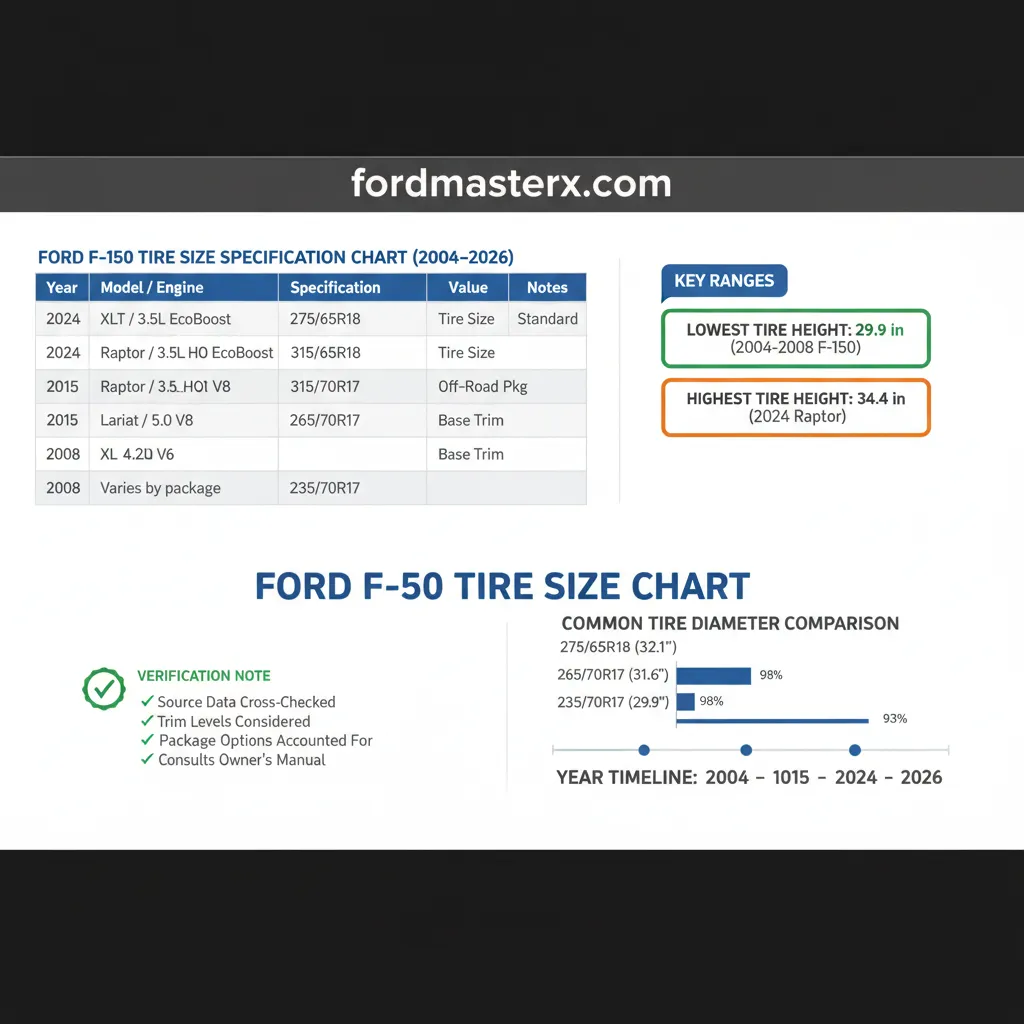
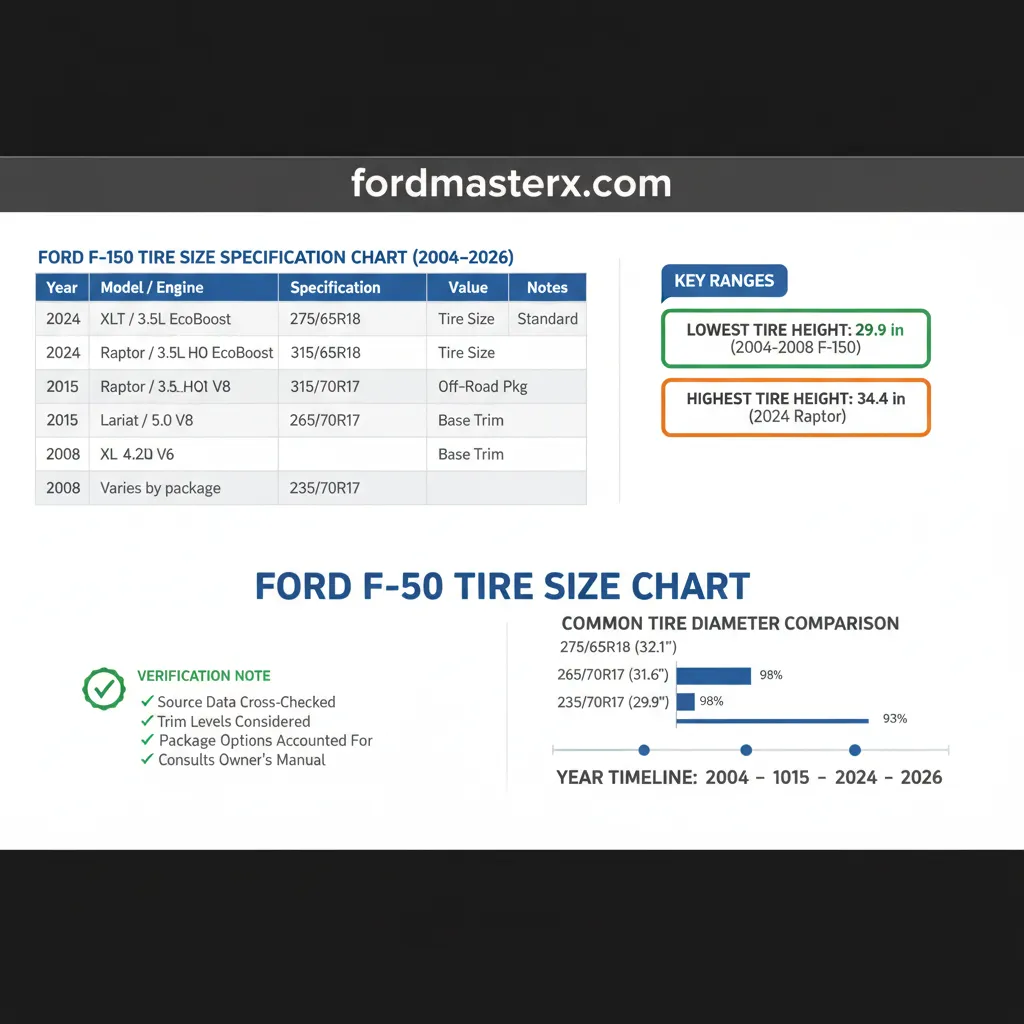
Main Ford F-150 Factory Tire Size Chart (2004-2026)
The following table provides a comprehensive overview of factory-recommended tire sizes for the Ford F-150 across various model years, trims, and common engine configurations. All values represent the original equipment manufacturer (OEM) specifications, ensuring optimal performance, ride quality, and adherence to load-carrying capacities.
How to read this chart: Locate your vehicle’s model year and then find the corresponding trim level or engine. The ‘Specification’ column lists the common factory tire size, while ‘Notes’ provide crucial context regarding package dependencies, standard fitment, or optional upgrades. Remember that actual tire sizes can vary based on specific options not listed here.
| Year | Model / Engine | Specification | Notes |
|---|---|---|---|
| 2004-2008 | XL/XLT (Base) | P235/75R17 | Standard on 2WD base models. |
| 2004-2008 | XLT/Lariat (Common) | P255/70R17 | Common upgrade for 4WD or higher trims. |
| 2004-2008 | Lariat/King Ranch | P275/65R18 | Optional or standard on premium trims. |
| 2009-2014 | XL/XLT (Base) | P235/75R17 | Standard for base 2WD models. |
| 2009-2014 | XLT/Lariat | P265/70R17 | Common standard on many XLT/Lariat trims. |
| 2009-2014 | FX4/Lariat/King Ranch | P275/65R18 | Standard with 18″ wheels, often part of packages. |
| 2009-2014 | Lariat/Platinum (Optional) | P275/55R20 | Optional 20-inch wheels on higher trims. |
| 2010-2014 | Raptor | LT315/70R17 | Dedicated off-road trim, unique tire spec. |
| 2015-2020 | XL/XLT (Base) | P245/70R17 | Standard entry-level tire. |
| 2015-2020 | XLT/Lariat | P265/70R17 | Common standard on XLT models. |
| 2015-2020 | XLT/Lariat (Optional) | P275/65R18 | Standard on many Lariat, optional on XLT. |
| 2015-2020 | Lariat/King Ranch/Platinum | P275/55R20 | Common standard or option for higher trims. |
| 2017-2020 | Raptor | LT315/70R17 | Exclusive off-road tire for Raptor. |
| 2021-2026 | XL/XLT (Base) | P265/70R17 | Newer base tire size for current generation. |
| 2021-2026 | XLT/Lariat (Common) | P275/65R18 | Widespread standard on XLT and Lariat trims. |
| 2021-2026 | Lariat/King Ranch/Platinum | P275/60R20 | Common 20-inch option/standard on higher trims. |
| 2021-2026 | Platinum/Limited/PowerBoost | 275/50R22 | Premium large wheel option. |
| 2021-2026 | Raptor / Raptor R | LT315/70R17 (Raptor) / LT37x12.5R17 (Raptor R) | Dedicated off-road, often optional 37-inch on R. |
| 2021-2026 | Tremor | LT285/70R18 | Off-road focused package with larger A/T tires. |
Footnote: Values are typical factory specifications. Always consult your vehicle’s door jamb sticker or owner’s manual for definitive original equipment information. Tire load indices and speed ratings also vary by specific tire model and application.
17 inches
22 inches
235-285 mm
37 inches
Year-by-Year Evolution of F-150 Factory Tire Sizes
Recommended Best Deal Products


The Ford F-150’s tire specifications have undergone a noticeable evolution across its generations, largely driven by changing market demands for capability, aesthetics, and technological advancements. As an expert who has observed this progression firsthand, it’s clear that the trend leans towards larger wheel diameters and, paradoxically, lower-profile tires, especially on higher trim levels.
The 11th generation (2004-2008) F-150s primarily featured 17-inch and 18-inch wheels, with P235/75R17 being a common base size. With the introduction of the 12th generation (2009-2014), while 17-inch wheels remained standard for base models, 18-inch wheels became more prevalent across XLT and Lariat trims, and 20-inch options grew in popularity. This era also marked the debut of the specialized Raptor, establishing its signature LT315/70R17 tire.
The transition to the aluminum-bodied 13th generation (2015-2020) saw an even greater shift. Base XL models still offered 17-inch wheels (e.g., P245/70R17), but 18-inch and 20-inch wheels became standard for many Lariat, King Ranch, and Platinum models. The P275/55R20 size emerged as a dominant choice for premium trims. Research indicates that this generation saw a significant uptick in the adoption of 20-inch wheels as factory standard or common options, representing a blend of improved aesthetics and competent on-road performance.
The current 14th generation (2021-present, extending to 2026 models) continues this trend. The P265/70R17 has become a more common base size, reflecting a slight increase in diameter even for entry-level trucks. High-end Platinum and Limited trims now frequently offer 22-inch wheels with lower-profile 275/50R22 tires. Furthermore, specialized off-road packages and trims like the Tremor (LT285/70R18) and the expanded Raptor lineup (including the 37-inch tire option on the Raptor R) showcase a dual evolution: larger diameter, aggressive tires for off-road capability, and larger diameter, aesthetic-focused wheels with thinner sidewalls for luxury models. This year-by-year progression highlights Ford’s strategy to cater to diverse customer preferences, from work-truck utility to luxury and extreme off-roading.

Audible — Listen Free for 30 Days
One free credit a month and thousands of titles included.
Listen Free for 30 Days As an Amazon Associate I earn from qualifying purchases._–_Frontansicht,_14._April_2013,_Düsseldorf.jpg "Ford F150 Tire Size Specification Chart By Year (2004–2026) 5")
Configuration-Specific Ford F-150 Tire Size Notes: Trim, Engine & Packages
Understanding the factory tire size for your F-150 goes beyond just the model year. Several configuration-specific elements profoundly influence which tires were originally equipped on your truck. My 15+ years in the industry have shown that these nuances are critical for proper tire selection.
How Trim Levels Affect Tire Size
Base models like the XL and XLT typically receive smaller, more utilitarian P-metric tires on 17-inch or 18-inch wheels (e.g., P265/70R17). These are designed for cost-effectiveness, fuel efficiency, and a comfortable ride for general use. In contrast, luxury trims such as Lariat, King Ranch, Platinum, and Limited are commonly equipped with larger wheels—often 20-inch or even 22-inch—paired with lower-profile tires (e.g., P275/55R20 or 275/50R22). These choices prioritize aesthetics and a more performance-oriented (on-road) driving experience.
Engine Options and Drivetrain
While engine choice doesn’t always directly dictate a unique tire size, certain powerful engines (e.g., the 3.5L EcoBoost, 5.0L V8, or 3.5L PowerBoost hybrid) are often found in higher trim levels or paired with packages that include specific tire/wheel combinations. This is typically to ensure the tires can handle increased power output or higher towing/payload capacities. For example, a 2018 F-150 XLT with a 3.3L V6 might come standard with P265/70R17, whereas a 2018 Lariat with a 3.5L EcoBoost might feature P275/55R20.
Drivetrain also plays a role: while overall diameter might be similar between 2WD and 4WD, 4WD models (especially when combined with off-road packages) frequently feature more aggressive all-terrain (A/T) or mud-terrain (M/T) tires, sometimes with Light Truck (LT) ratings, providing enhanced traction off-pavement.
Impact of Optional Packages
Ford’s extensive list of optional packages significantly influences factory tire sizes:
- FX4 Off-Road Package: Typically upgrades standard tires to a more aggressive A/T tread, often maintaining the same wheel diameter (e.g., 17-inch or 18-inch) but with enhanced off-road capability.
- Sport Appearance Package: Focuses on aesthetics, frequently including unique wheel designs and street-oriented tires, often in larger diameters (e.g., 20-inch).
- Max Trailer Tow Package: While not always changing the visible tire size, this package often mandates tires with higher load indices, sometimes specifying LT-rated tires to safely manage increased gross combined weight ratings (GCWR).
- Heavy-Duty Payload Package (HDPP): This critical package invariably includes LT-rated tires (e.g., LT245/75R17E, LT275/65R18C) designed for significantly higher load capacities, essential for maximum payload performance.
Cab and bed configurations, while not directly changing tire size, do affect the Gross Vehicle Weight Rating (GVWR) which, in turn, dictates the minimum load index requirements for factory tires. This ensures the tires are always adequate for the truck’s maximum certified weight.
The exact factory tire size for your F-150 is a product of its specific build sheet. Always refer to the tire placard on your driver’s side door jamb (B-pillar) for the definitive tire size, load rating, and recommended cold inflation pressure for your vehicle’s original configuration.
Factors Affecting Ford F-150 Tire Size & Compatibility Beyond Factory Specs
Recommended Best Deal Products


While this article focuses on factory specifications, many F-150 owners consider deviating from OEM tire sizes. As an expert, I can tell you this requires careful consideration to avoid issues with safety, performance, and vehicle components.
Aftermarket Wheels and Lift/Leveling Kits
Modifying your F-150’s suspension with a leveling kit (typically 1.5-2.5 inches front lift) or a full lift kit (3+ inches) is the most common way to accommodate larger tires. For instance, a stock 13th-gen F-150 might come with a P275/55R20 (approx. 32-inch overall diameter). With a 2-inch leveling kit, it might be possible to fit a 285/60R20 (approx. 33.5-inch) or even a 295/55R20 (approx. 32.8-inch) with minimal or no trimming. More aggressive lift kits allow for significantly larger tires, such as 35×12.50R20 or even 37-inch tires, especially on Raptor models. However, this often necessitates aftermarket wheels with different offsets and backspacing to prevent rubbing.
Audible Premium Plus — Annual Membership
12 audiobook credits up front, plus the full Audible catalogue.
See Annual Plans As an Amazon Associate I earn from qualifying purchases.Clearance Issues and Rubbing
This is the most immediate concern when upsizing tires. Larger or wider tires can rub against:
- Fender liners during turns or suspension compression.
- Suspension components (upper control arms, coil springs).
- The frame at full steering lock.
- The crash bars (front and rear) on newer models.
Proper wheel offset and backspacing are crucial to push the wheel/tire assembly out sufficiently, but this can also lead to increased splash from the tires.
Speedometer and Odometer Recalibration
Changing your tire’s overall diameter directly impacts the accuracy of your speedometer and odometer. If you install tires with a 5% larger diameter, your speedometer will read approximately 5% lower than your actual speed. This can lead to speeding tickets and inaccurate mileage tracking for maintenance intervals. Recalibration using a specialized programmer or through a dealership service is strongly recommended for safety and accuracy.
Load Rating (P-metric vs. LT)
Understanding tire load rating is paramount, especially for a truck designed for towing and hauling.
- P-metric (Passenger) Tires: Designed for light trucks and SUVs used primarily for passenger transport. They typically have a lower load capacity and a softer ride.
- LT (Light Truck) Tires: Constructed with stronger sidewalls and plies, offering significantly higher load-carrying capabilities. They are essential for heavy towing, hauling near GVWR/GCWR, or aggressive off-road use, but often result in a firmer ride and increased cost. If your F-150 has a Heavy-Duty Payload Package or Max Trailer Tow Package, it likely requires LT tires.
Performance and Fuel Economy Implications
Larger, heavier, or more aggressive (e.g., M/T) tires can negatively impact:
- Fuel Efficiency: Increased rolling resistance and unsprung weight can reduce MPG by 1-3 miles per gallon, sometimes more.
- Acceleration and Braking: Heavier rotating mass can reduce acceleration and increase braking distances.
- Road Noise: Aggressive tread patterns typically generate more road noise.
Drivetrain Stress and Regearing
Significantly larger tires increase the effective gear ratio, placing additional strain on drivetrain components (axles, differential, transmission). For F-150s with significantly oversized tires or those used for heavy towing, regearing the differentials to a lower numerical ratio (e.g., from 3.55 to 4.10) may be necessary to restore optimal performance, towing capability, and reduce strain.
Modifying tire size beyond factory specifications can void parts of your warranty, negatively impact safety systems (ABS, traction control), and potentially lead to premature wear of suspension and drivetrain components if not properly executed and accounted for.
Interpreting Your F-150’s Tire Specifications & Maintenance Essentials
Empowering yourself with the knowledge to understand your F-150’s tire markings and factory recommendations is crucial for safety and optimal vehicle operation. My advice, honed over years in the field, is to always be informed.
Deciphering Tire Sidewall Markings
Every tire has a code stamped on its sidewall that contains vital information. Let’s break down a common F-150 factory tire size, like LT275/65R18 116T:
- LT: Tire type. ‘P’ indicates Passenger; ‘LT’ indicates Light Truck. LT tires are built for heavier loads and more rugged conditions. If this is absent, it’s typically a P-metric tire.
- 275: Tread width in millimeters (mm). This tire is 275mm wide.
- 65: Aspect ratio. The tire’s sidewall height is 65% of its width. A lower number means a shorter sidewall (lower profile).
- R: Construction type. ‘R’ means Radial (the most common type).
- 18: Wheel diameter in inches. This tire fits an 18-inch wheel.
- 116: Load Index. A numerical code indicating the maximum load the tire can carry when properly inflated. An index of 116 means 2,756 lbs per tire. It’s crucial to match or exceed this for replacements.
- T: Speed Rating. An alphabetical code indicating the maximum safe speed for the tire. ‘T’ means 118 mph (190 km/h). This must also match or exceed OEM specifications.
Locating Official Factory Specifications
The absolute definitive source for your F-150’s factory-recommended tire size and cold tire inflation pressure is the tire placard (sticker) located on the driver’s side door jamb (B-pillar) when the door is open. This sticker is specific to your VIN and original vehicle configuration. Your vehicle’s owner’s manual is another reliable source, providing general tire information, maintenance schedules, and recommended pressures.
The most accurate source for your specific F-150’s OEM tire size and pressure.
Provides additional details, maintenance schedules, and pressure guidelines.
Crucial for safety and vehicle capability, especially when replacing tires.
Understand how factory options influenced your original tire choice.
Tire Pressure Monitoring System (TPMS)
Your F-150’s TPMS system relies on correct tire pressures to function effectively. Maintaining the cold tire pressure specified on your door jamb sticker is vital not only for TPMS accuracy but also for safety, fuel economy, and tire longevity. Incorrect tire sizes or significant pressure deviations can sometimes trigger TPMS warnings or require system recalibration.
Importance of Tire Rotation and Balancing
Regular tire rotation (typically every 5,000-7,500 miles or as per your owner’s manual) helps ensure even wear across all four tires, maximizing their lifespan and maintaining balanced traction. Proper wheel and tire balancing is equally important to prevent vibrations, especially at highway speeds, and to ensure smooth vehicle operation.
Assessing Tire Health and When to Replace
Regularly inspect your F-150’s tires for signs of wear and damage:
- Tread Depth: Use the “penny test” (if Lincoln’s head is fully visible, tread is low) or refer to the built-in tread wear indicators. Minimum legal tread depth is generally 2/32nds of an inch.
- Damage: Look for cuts, bulges, cracks in the sidewall, or embedded foreign objects. Any significant damage warrants immediate professional inspection.
- Age: Even with good tread, tires age and degrade. Most manufacturers and experts recommend replacing tires that are 6-10 years old, regardless of visible wear.
When purchasing new tires, consider the warranty, road hazard protection, and your typical driving conditions. For F-150s used for regular towing or off-road, investing in quality LT-rated all-terrain tires often pays dividends in durability and performance.
Conclusion
The Ford F-150, a versatile and best-selling truck, features a wide array of factory tire sizes spanning from 2004 to 2026, intricately tied to its model year, trim level, engine option, and specific factory packages. While this comprehensive chart provides a valuable reference, the most critical takeaway is to always verify your truck’s original tire specifications using the door jamb sticker or owner’s manual for definitive accuracy. Understanding tire sidewall markings and practicing essential maintenance, such as proper inflation and regular rotation, are paramount for safe operation and optimal tire longevity. Deviating from factory specifications requires careful consideration of potential clearance issues, speedometer recalibration, and the crucial difference between P-metric and LT load ratings. Use this comprehensive chart as your primary reference for Ford F-150 factory tire sizes, and always cross-check with your vehicle’s specific documentation before making a purchase or modification to ensure safety and performance.
Frequently Asked Questions
Can I put larger tires on my Ford F-150 than the factory size?
Yes, many F-150 owners install larger tires, but it’s crucial to consider potential issues. Oversized tires can cause rubbing with suspension components or fender liners, especially during turns or suspension articulation. They also necessitate speedometer recalibration to maintain accurate speed and mileage readings, and may impact fuel economy, braking, and drivetrain longevity. Consult a professional for safe clearance and compatibility.
How do I find the correct factory tire size for my specific F-150?
The most accurate source for your F-150’s factory tire size and recommended tire pressure is the tire information placard, usually located on the driver’s side door jamb (B-pillar). Alternatively, consult your vehicle’s owner’s manual, which provides detailed specifications based on your truck’s specific year, trim, and package configurations. Always verify these sources to ensure accuracy.
What is the difference between P-metric and LT tires for an F-150?
P-metric (Passenger) tires are designed for lighter loads and a smoother ride, common on base and comfort-oriented F-150 trims. LT (Light Truck) tires, conversely, feature stronger sidewalls and higher load ratings, making them ideal for heavy hauling, towing, or rugged off-road conditions. For F-150s used for demanding tasks, factory options or aftermarket upgrades often include LT-rated tires for enhanced durability and capacity.
Will changing my F-150’s tire size affect my speedometer accuracy?
Absolutely. If you install tires with a different overall diameter than your factory specifications, your speedometer and odometer accuracy will be affected. A larger tire diameter will cause your speedometer to read slower than your actual speed, while smaller tires will make it read faster. Recalibration, often requiring specialized tools or dealership service, is necessary to correct this discrepancy and maintain accurate vehicle readings.
What tire pressure should I use for my Ford F-150’s factory tires?
Always adhere to the cold tire inflation pressures specified on your F-150’s tire information placard, located on the driver’s side door jamb. These pressures are calculated by Ford for optimal safety, handling, and fuel efficiency for your specific vehicle configuration. Do not solely rely on the maximum pressure listed on the tire sidewall, as this is often much higher than the recommended operating pressure.