Ford EV Battery Warranty: 2026 Coverage and Claim Rules

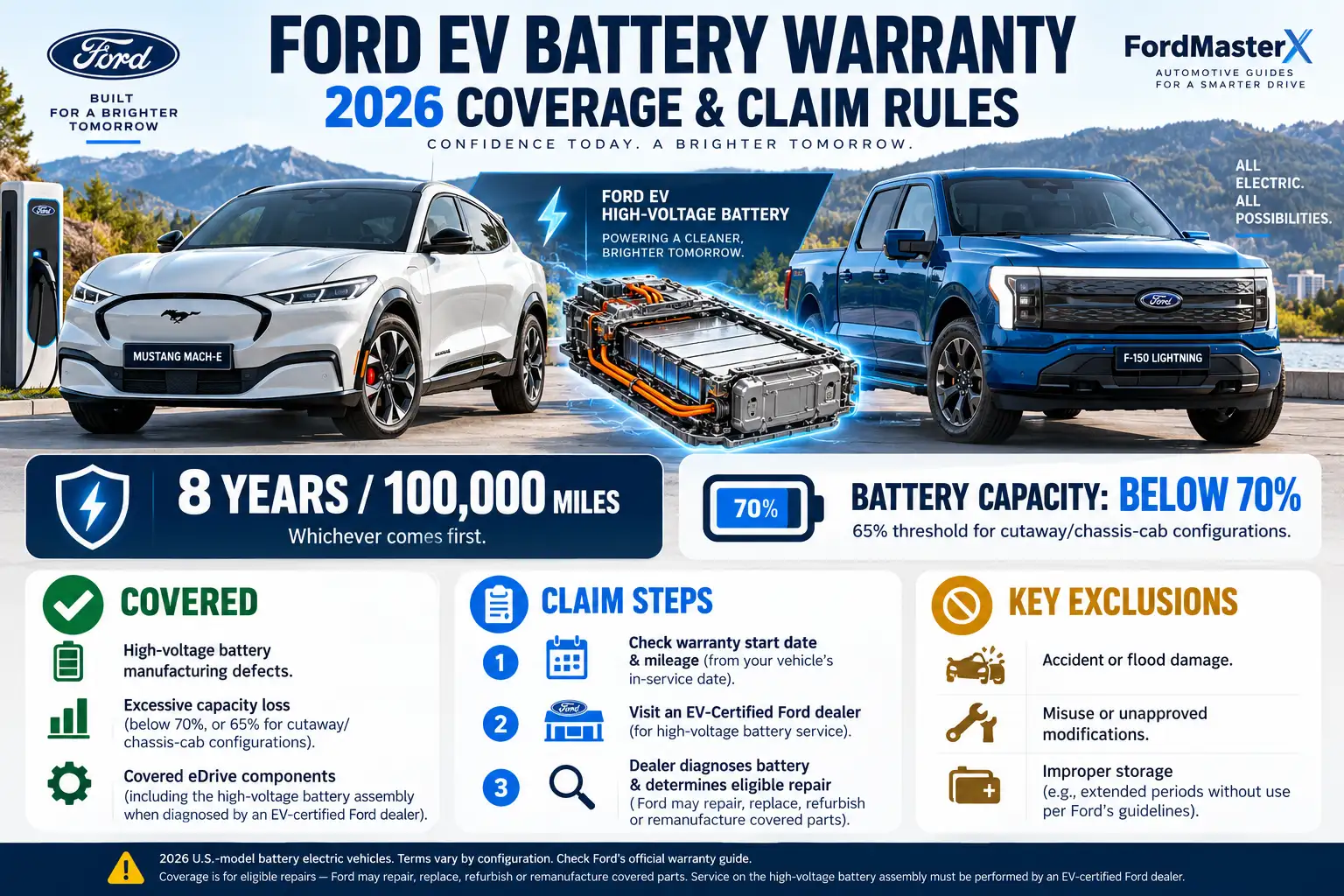
The Ford EV battery warranty generally covers the high-voltage battery and specified electric-drive components for 8 years or 100,000 miles, whichever comes first, under Ford’s 2026 U.S. Battery Electric Vehicle Warranty Guide. It also covers excessive battery capacity loss when Ford confirms that capacity has fallen below the applicable threshold.


But eight years of ownership does not guarantee a free battery replacement. Eligibility depends on vehicle age, mileage, configuration, and diagnosis. This article follows Ford’s 2026 U.S. Battery Electric Vehicle Warranty Guide; check the guide for your model year.
Is Your Ford EV Battery Covered?
A quick reference for F-150 Lightning, Mustang Mach-E, and E-Transit owners.
Key Factory Warranty Limits
Capacity thresholds are not the dashboard state-of-charge percentage. Ford determines battery capacity using its approved method.
Your 5-Step Warranty Service Path
Identify VIN
Record the model year, original start date, and odometer.
Verify Coverage
Check whether the original battery warranty is still active.
Save Symptoms
Document warnings, charging concerns, and dates.
Book EV Service
Request diagnosis at an EV Certified Ford dealer.
Get Decision
Request findings and the warranty decision in writing.
Important: Excluded damage, time or mileage limits, and the confirmed cause affect eligibility. An entire new battery pack is not guaranteed.
Basis: Ford 2026 U.S. Battery Electric Vehicle Warranty Guide. Check the warranty guide for your vehicle’s actual model year and market.
What Determines Ford EV Battery Warranty Eligibility
Four details determine your warranty path.
Your Ford EV Model
The 2026 U.S. guide covers the Mustang Mach-E, F-150 Lightning, and E-Transit. Cutaway and chassis-cab configurations have a different capacity threshold.
Original Warranty Start Date
Ford generally starts the warranty on the date the new EV is delivered or first placed into service, whichever happens first. A dealer demonstrator may have started its clock before retail sale. Qualifying California deliveries have a separate start-date rule.
Age and Current Mileage
The battery component warranty ends when either eight years have passed or the odometer reaches 100,000 miles. A seven-year-old Lightning at 101,000 miles has normally passed the mileage limit.
Ford’s broader factory warranty coverage is different: several non-battery systems have shorter warranty periods.
The Battery Problem Itself
Defects, capacity loss, and excluded damage follow different rules. A warning message alone cannot establish which category applies. The dealer must identify the fault and assess its cause.
If Your Ford EV Battery Has a Defect
If a covered high-voltage battery or eDrive component fails because of a defect in factory-supplied materials or workmanship during the applicable period, Ford’s New Vehicle Limited Warranty provides for an authorized repair without charge, subject to its terms.
The 2026 electric-vehicle component list includes:
| Covered System | Examples in Ford’s Warranty Guide |
|---|---|
| High-voltage energy storage | High-voltage battery assembly |
| Battery control and distribution | Bussed Electrical Center and Battery Energy Control Module |
| Power conversion and charging | On-board charger, inverter system controller, DC/DC converter |
| Electric propulsion | eDrive |
Not every electrical part receives eight years of protection.
Ford may use new, remanufactured, or refurbished parts instead of replacing the whole pack with a new one. Refurbished components must meet Ford’s standards.
Other drivetrain parts can have shorter terms. See our Ford powertrain warranty coverage breakdown for the separate five-year powertrain rules.
High-voltage battery warranty repairs require an EV Certified Ford dealership. If a dealer cannot confirm the covered failed component, ask for the diagnostic findings rather than assuming the entire battery assembly has failed.
When Ford EV Battery Capacity Falls Below 70 Percent
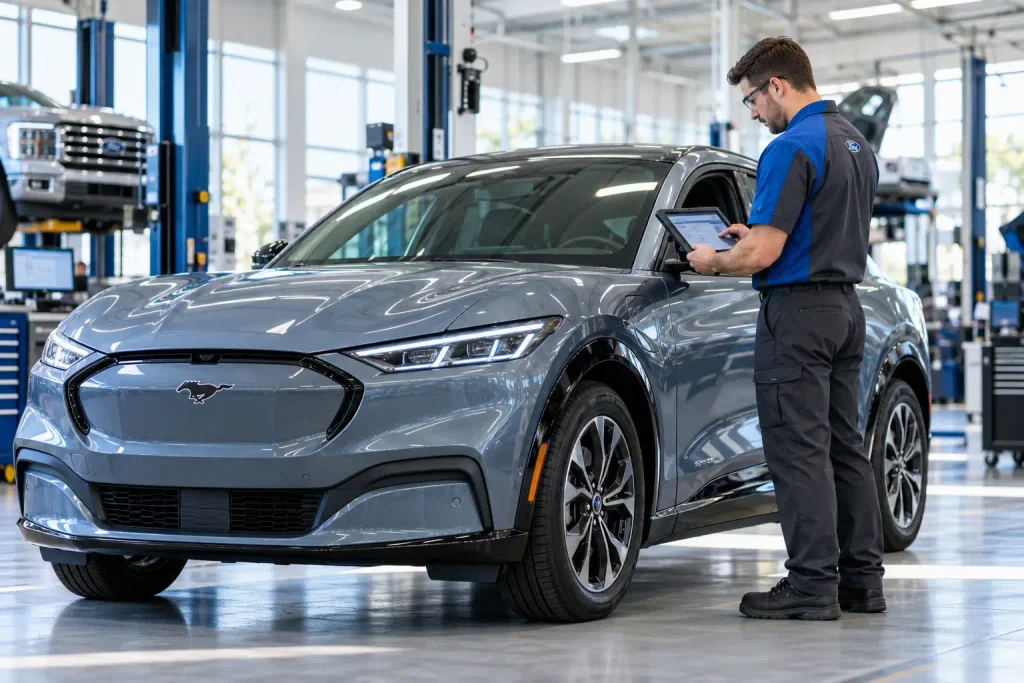
Gradual battery degradation is normal. Ford’s 2026 guide nevertheless provides specific protection against excessive high-voltage battery capacity loss for eight years or 100,000 miles.
The Standard 70 Percent Rule
For the usual passenger EV configuration, capacity loss is considered excessive when an EV Certified Ford dealer determines the battery has less than 70% of its beginning-of-life capacity remaining.
Less than matters: an exact 70% reading does not qualify under the excessive-loss threshold. Ford decides which corrective repairs are necessary.
The 65 Percent Exception
The same 2026 guide specifies a less-than-65% threshold for cutaway or chassis-cab configurations. Confirm the actual configuration rather than assuming every E-Transit uses 65%.


Battery Capacity Is Not State of Charge
70% charge measures state of charge, not remaining battery health. Estimated range changes with temperature, speed, and driving conditions.
For example, 69 units remaining from an original 100 is 69% capacity. This hypothetical calculation is not a Ford-approved measurement.
Who Measures Battery Health
Ford determines the measurement method and repair. Request an EV Certified dealer evaluation instead of relying on a dashboard estimate.
Exclusions also matter.
If Ford EV Battery Damage Falls Under an Exclusion
Damage from excluded causes may not qualify, even for listed components.
Collision and Flood Damage
The warranty excludes damage caused by accidents, collisions, and immersion or flooding of the high-voltage battery assembly. Crash or flood damage is not ordinary degradation.
Misuse and Incompatible Charging
Ford lists abuse and misuse, racing, overloading, use as a permanent stationary power source, and incompatible charging devices or methods among possible excluded causes. Compatible DC fast charging is not listed as automatically voiding warranty coverage.
Unauthorized High Voltage Work
Battery-pack or high-voltage-wiring modifications and repairs performed by unauthorized personnel can create exclusions. An aftermarket accessory does not automatically cancel unrelated warranty coverage. Modification-caused damage may be excluded.
Never attempt high-voltage battery repairs yourself.
Low Charge and Improper Storage
Ford specifically lists leaving the high-voltage battery fully discharged or near zero charge for more than 14 days and improper storage that damages the battery. Its guide also names failure to address battery warning indications or complete Ford Power-Up updates within a reasonable period, typically 30 days, among excluded damage causes.
Follow storage instructions and ask which exclusion applies if Ford denies a claim.
When the Ford EV Battery Warranty Has Expired
The standard battery component coverage ends at the first of two limits: eight years from the original warranty start date or 100,000 miles. Either limit ends coverage.
If that happens, a new defect normally falls outside this original factory coverage. A costly failure does not extend the original term.
A recall, customer satisfaction program, or purchased service contract may still apply. Ask Ford to check your VIN and diagnosed component.
Resale does not restart that clock.
If You Bought a Used Mach-E or Lightning
Ford’s 2026 warranty guide expressly states that an owner who purchases a previously owned 2026-model Ford EV is eligible for any remaining factory warranty coverage. Resale does not create a new eight-year warranty.
For example, a Mach-E first placed in service in 2023 does not restart coverage when resold in 2026.
What EV Certified Adds
A Ford Blue Advantage EV Certified used EV may also have its own limited warranty. Ford’s EV Certified warranty terms specify:
| EV Certified Coverage | Term or Condition |
|---|---|
| Comprehensive Limited Warranty | 12 months or 12,000 miles from the later of eligible factory-warranty expiration or EV Certified purchase |
| BaseCARE EV Limited Warranty | 8 years or 100,000 miles from the original new-vehicle warranty start date |
| Standard deductible under that limited warranty | $100 per repair visit |
| Repair under remaining factory warranty | $0 standard deductible per repair visit |
BaseCARE EV does not restart the original eight-year clock. Check your own contract and covered-parts list.
How Lightning, Mach-E, and E-Transit Coverage Compares
Ford’s 2026 guide covers three EV model families, with a configuration-specific capacity exception.
| Ford EV Model | 2026 EV Component Term | Capacity Loss Rule |
|---|---|---|
| Mustang Mach-E | 8 years or 100,000 miles | Below 70% |
| F-150 Lightning | 8 years or 100,000 miles | Below 70% |
| E-Transit | 8 years or 100,000 miles | Below 70% in ordinary configuration; below 65% if cutaway or chassis cab |
The 65% figure is tied to configuration, not automatically to the E-Transit name. Use the correct model-year and country guide for other vehicles.
Which Ford EV Battery Warranty Claims May Qualify
Use this matrix to identify your next action, not to replace Ford’s diagnosis.
| Your Situation | Likely Warranty Position | What to Do Next |
|---|---|---|
| Covered manufacturing defect within eight years and 100,000 miles | Potentially covered | Request EV Certified dealer diagnosis |
| Ford-verified capacity below the applicable 70% or 65% threshold | Potential excessive-loss claim | Request covered corrective evaluation |
| Estimated range has dropped but capacity is unverified | Claim not established | Request official capacity measurement |
| Capacity is at or above the relevant threshold without another defect | Excessive-loss threshold not met | Diagnose any separate symptoms |
| Damage resulted from a listed exclusion | Specific repair may be excluded | Ask for the written reason |
| Either original time or mileage limit has passed | Standard component coverage expired | Check separate programs or contracts |
| Used Ford EV with remaining original coverage | Coverage can continue | Confirm original start date and odometer |
Have battery warnings diagnosed promptly.
How to Request Ford EV Battery Warranty Service
Start with the VIN, symptoms, and an EV Certified dealership.
Step 1 Check VIN and Mileage
Record the 17-character VIN, the exact odometer reading, the vehicle’s model year, and the original in-service or delivery date if you know it.
Step 2 Verify Warranty Coverage
Use Ford’s official warranty lookup to check vehicle-specific information. For an owner-friendly walkthrough, our guide explains how to check Ford warranty status by VIN.
Ask the dealer to clarify an uncertain start date.
Step 3 Document Battery Symptoms
Note warning messages, dates, charging problems, unexpected reductions in available power, and any service history that could help diagnosis.
An app reading is not Ford’s warranty test.
Step 4 Choose an EV Certified Dealer
Use Ford’s dealer locator and confirm the selected location has EV Certified service capability for high-voltage battery repairs. Describe the symptoms and concern.
Ask in advance whether any diagnostic charge could apply if Ford determines the concern is not covered. The guide does not set a nationwide diagnostic fee.
Step 5 Obtain the Warranty Decision
Ask for the diagnosed component, battery capacity result if a capacity claim was evaluated, the applicable warranty term, and the dealer’s coverage decision. If the claim is denied, request the specific exclusion or limit relied upon.
Ford chooses the covered repair; a new complete pack is not guaranteed.


When Ford EV Owners Should Escalate a Claim
If the service advisor cannot explain the warranty decision, request the repair order and speak with the service manager or dealership customer relations manager. Provide the VIN, diagnostic findings, maintenance documentation, and any relevant warranty correspondence.
If unresolved, contact the Ford Customer Relationship Center at 1-800-392-3673 with your claim details.
The guide also describes BBB AUTO LINE for applicable U.S. disputes. Legal requirements vary by claim and jurisdiction.
Focus on the diagnosis, warranty term, and documented exclusion.
What Ford EV Owners Should Check Before Claiming
The Ford EV battery warranty is valuable because the 2026 U.S. guide protects qualifying high-voltage battery and eDrive components for eight years or 100,000 miles. It also provides a separate path for Ford-verified excessive battery capacity loss below the applicable threshold.
Defects, excessive degradation, and excluded damage follow different paths. Used owners must check the original start date.
Verify VIN-specific coverage, document symptoms, and request an EV Certified dealer evaluation before paying for major work. If a claim is rejected, obtain the precise reason in writing and compare it with the warranty guide for your model year. That documentation gives you a clear basis for requesting clarification or further review.
Ford EV Battery Warranty Questions Owners Ask Most
How Long Is Ford EV Battery Warranty?
Under Ford’s 2026 U.S. BEV guide, the high-voltage battery and specified electric-drive components are covered for 8 years or 100,000 miles, whichever comes first. The clock generally begins when the vehicle is first delivered or placed into service. Check the guide matching your model year.
Will Ford Replace a Degraded Battery?
Ford covers necessary corrective component repair or replacement when its authorized assessment confirms excessive capacity loss below the applicable threshold during the coverage period. Ford decides the repair method; a brand-new complete battery pack is not guaranteed. Cutaway or chassis-cab configurations have a separate below-65% threshold in the 2026 guide.
Do Lightning and Mach-E Warranties Match?
The 2026 U.S. guide assigns both vehicles the same 8-year/100,000-mile Electric Vehicle Component coverage and the ordinary below-70% capacity rule. Always use the correct model-year warranty guide when checking an older vehicle, because this summary is based on the 2026 terms.
Does Ford EV Battery Warranty Transfer?
Yes. Ford states that buyers of previously owned 2026-model EVs can receive any remaining original factory coverage. The original start date and mileage limit do not reset when ownership changes. An EV Certified used vehicle may also have separate limited-warranty coverage.
Does Fast Charging Void Ford Warranty?
Compatible DC fast charging is not itself identified as an automatic warranty-voiding event in Ford’s 2026 exclusion list. The guide does exclude damage caused by incompatible charging devices or methods. Follow your owner’s manual and have any suspected charging-related damage diagnosed before making coverage assumptions.
Will Ford Install a New Battery?
Not necessarily. Ford may authorize a new, factory-remanufactured, or factory-refurbished component, depending on the qualifying fault and its repair decision. Coverage means Ford will address the eligible condition under the warranty terms, not that every successful claim receives an entirely new battery pack.