Ford Escape Years To Avoid: 2026 Worst Models Years & Common Problems

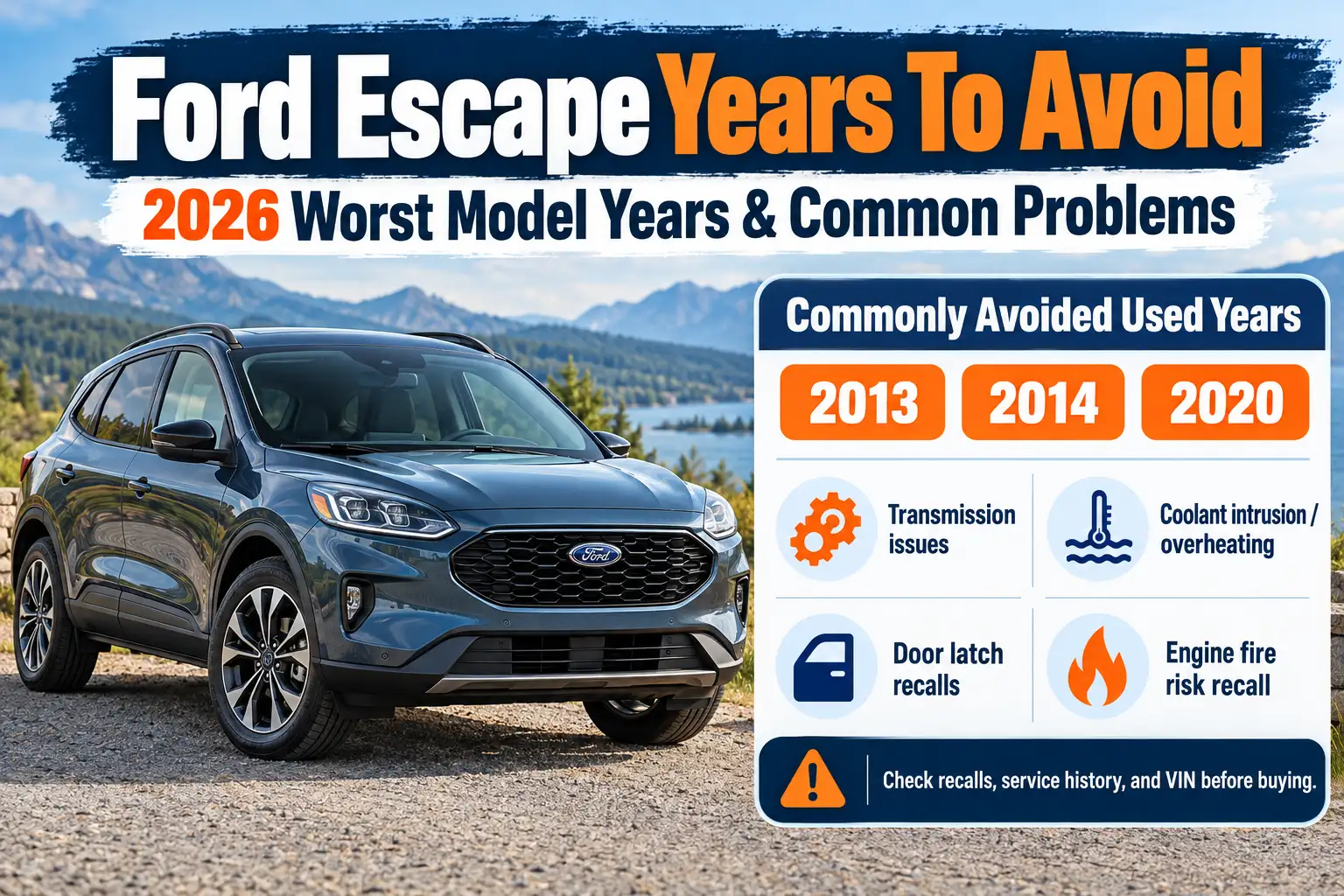
The Ford Escape years to avoid most carefully are 2013–2014 models with the 1.6L EcoBoost, certain 2017–2019 models with the 1.5L or 2.0L EcoBoost, and older Escapes with unresolved steering problems. Some 2020–2022 1.5L models also need a specific fuel-injector recall check before purchase.

Not every Escape from those years is defective. Engine, build date, and repair records change the verdict.
Here is how to identify the risk and decide whether a particular used Escape deserves your money.
FORDMASTERX / USED SUV BUYER GUIDE
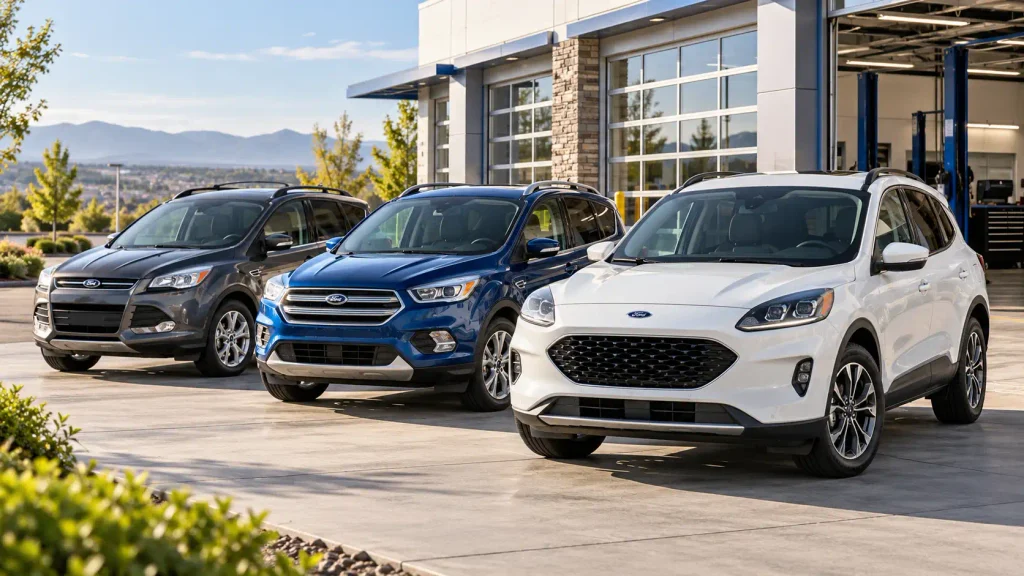
Which years need caution? Match the model year with its engine, then verify the VIN and repair history.
Electric power steering
Certain vehicles covered by Ford recall 14S05.
Verify recall work and steering assist.
1.6L EcoBoost
Engine overheating and fire-related recall concerns.
Require convincing repair evidence.
1.5L EcoBoost
Coolant intrusion concern · TSB 20-2100. Certain builds through Apr 8, 2019.
Check symptoms and engine repairs.
2.0L EcoBoost
Separate coolant intrusion concern · TSB 19-2346. Certain builds through May 16, 2019.
Verify long-block repair history.
1.5L three-cylinder
Fuel-injector safety recall 25S76 on certain VINs.
Confirm current recall remedy.
2.5L naturally aspirated
Not covered by the two EcoBoost coolant-intrusion TSBs above.
Still inspect engine and transmission.
Newer Escape models
Less long-term reliability history is available.
Check warranty, recalls and condition.
What Determines Which Ford Escape Years to Avoid
Four details matter more than a model-year blacklist: engine type, build date, documented repairs, and current condition. They explain why two identical-looking Escapes can carry different risks.
The 2017 refresh replaced the 1.6L EcoBoost with a 1.5L four-cylinder; the 2020 redesign brought a different 1.5L three-cylinder. These engines have different known concerns.
If a service bulletin matches its engine and build date, investigate the symptoms. If a safety recall is open, confirm the remedy. Unexplained coolant loss outweighs attractive cosmetics.
The older second-generation models present a separate concern involving electric power steering.
Why 2008 to 2011 Escape Steering Needs Attention
Certain 2008–2011 Ford Escapes were included in Ford safety recall 14S05, also identified as NHTSA campaign 14V-284. The concern involved an electric power steering torque-sensor fault that could cause the system to stop providing power assistance. Steering would remain mechanically connected but become harder, especially at low speeds.
Depending on fault codes, Ford called for software updates or steering-component replacement. Coverage is VIN-specific.
If you are considering a 2008 or 2009 Escape, treat steering history as a priority. Confirm recall 14S05 completion and safely test steering assistance. Check 2010–2011 vehicles too.
Check for structural rust, leaks, and transmission faults. A cheap Escape with unsafe corrosion is no bargain.
The next generation introduced more serious engine-related buying concerns.
Why 2013 and 2014 Escape Engines Raise Concerns
The 2013 and 2014 Escape are high-caution used purchases, especially with the 1.6L EcoBoost. Both recall history and powertrain complaints merit scrutiny.
The 2013 Engine Overheating Risk
Ford recall 13S12, NHTSA campaign 13V-583, covered certain 2013 Escapes with the 1.6L engine. Localized cylinder-head overheating could lead to cracking and oil leakage, potentially allowing oil to contact hot engine components. Ford modified shielding, cooling, and engine-control systems.
Another earlier campaign, 12S41, addressed coolant leaks and overheating in certain 2013 1.6L vehicles. Neither recall proves that every engine fails.
The 2014 Cooling System Concern
Recall 17S09, NHTSA campaign 17V-209, included certain 2014 Escapes with 1.6L GTDI engines. Insufficient coolant could allow the cylinder head to overheat, crack, and leak oil. Ford’s recall remedy included a coolant-level sensor and supporting hardware and software.
Confirm recall repairs and investigate unexplained coolant loss. For understanding the layout of this generation’s cooling components, our 2014 Ford Escape coolant hose diagram covers the main hose routes and engine-specific differences. A diagram cannot replace diagnosis.
Transmission Problems Buyers Should Check
Transmission complaints further complicate these years. CarComplaints rates 2014 as its worst Escape model year overall, with transmission problems an important contributor. That rating is not a measured failure probability.
Watch for slipping, harsh shifts, or delayed engagement. Our buying verdict: favor another example if a 2013–2014 1.6L Escape lacks convincing recall and mechanical repair records. The 2.5L or early 2.0L configurations still need inspection, but they should not automatically inherit every 1.6L-specific warning.
Later Escapes have a different engine issue that makes build dates particularly important.
When 2017 to 2019 Escape Engines Require Extra Caution
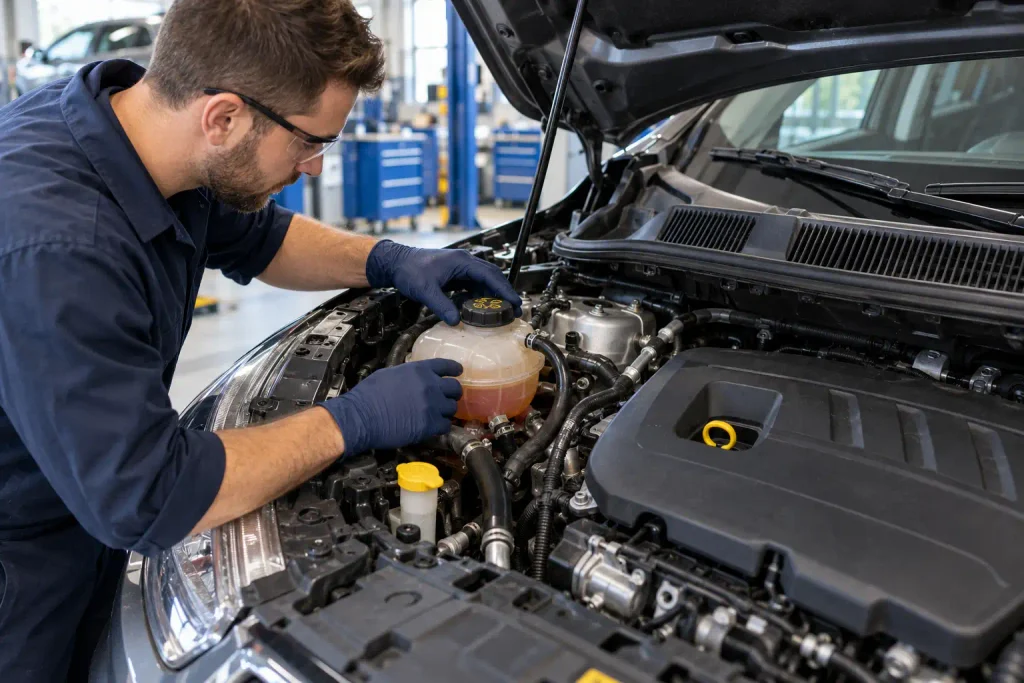
The 2017–2019 Ford Escape is not one uniform reliability category. Certain 1.5L and 2.0L EcoBoost engines have documented coolant-intrusion concerns. The 2.5L is outside these two bulletin applications.
The 1.5L EcoBoost Coolant Intrusion Problem
Ford’s technical service bulletin 20-2100 applies to certain 2017–2019 Escapes equipped with the 1.5L EcoBoost and built on or before April 8, 2019. The bulletin describes low coolant, white exhaust smoke, rough running, and possible misfire codes such as P0300 through P0304 when coolant enters a cylinder.
For vehicles meeting the bulletin’s diagnostic criteria, Ford specifies replacing the engine short block and head gasket. A coolant top-off cannot resolve this diagnosed defect.
Buying decision: Do not buy a symptomatic engine without professional diagnosis. Request invoices proving any claimed repairs.
The 2.0L EcoBoost Coolant Intrusion Problem
Ford’s separate technical service bulletin 19-2346 addresses certain 2017–2019 Escapes with the 2.0L EcoBoost built on or before May 16, 2019. It describes similar coolant-in-cylinder symptoms and specifies long-block engine replacement for vehicles that meet its conditions.
These two bulletins should not be mixed up. TSB 20-2100 concerns the 1.5L, while TSB 19-2346 concerns the 2.0L. These are not recalls, and bulletin coverage does not prove failure.
How Engine Repair Records Affect Your Decision
Demand an engine-replacement invoice and independent confirmation that the replacement addressed the concern.
When repair history is missing, a 2.5L Escape from the same era may offer a simpler alternative. The 2020 redesign, however, brings a different recall question.
Which 2020 to 2022 Escape Models Need Recall Checks
Some 2020–2022 Ford Escapes equipped with the 1.5L three-cylinder engine are covered by the fuel-injector safety campaign 25S76, NHTSA recall 25V-467. It is not the 2017–2019 1.5L four-cylinder.
According to the NHTSA recall report for campaign 25V-467, Ford identified 355,227 potentially affected Escape vehicles. A fuel injector may crack and leak gasoline into the engine compartment. If fuel contacts a sufficiently hot surface, it can increase fire risk.
Possible signs include fuel odor or underhood smoke. If you suspect leakage, stop driving and seek qualified assistance.
Buying decision: For a 2020–2022 Escape 1.5L, check the VIN with Ford and NHTSA, then obtain dealer confirmation of the current recall remedy and whether it has been completed. An older software-update receipt may not satisfy the current recall requirements.
Coverage is VIN-specific; inclusion does not mean the injector has cracked.
Once you know what to check, you can evaluate alternatives more intelligently.
Which Older Ford Escape Years Are Worth Considering
No used Escape year is risk-free, but some combinations deserve consideration.
2012 Escape: It is outside the 2008–2011 recall 14S05 coverage, but rust, transmission condition, and maintenance remain critical. Do not interpret its exclusion from that specific recall as a clean bill of health.
2015–2018 Escape with the 2.5L engine: The naturally aspirated four-cylinder offers a simpler starting point. It avoids the specific 2017–2019 1.5L and 2.0L coolant-intrusion bulletin applications discussed above. It is not immune to other engine, transmission, or age-related problems.
2019 Escape with the 2.5L engine: Consider it after the same mechanical checks. The 2019 model year should not be rejected merely because some 1.5L or 2.0L vehicles fall within Ford’s earlier production-date bulletins.
Verify service records and fluids with our Ford Escape oil capacity chart by year and engine. Oil-service documentation helps assess ownership habits, but it cannot prove that an engine has no hidden defect.
For any candidate, prioritize a documented service history and an independent inspection over a few thousand fewer miles on the odometer. Newer Escapes also require careful interpretation of reliability data.
How to Judge 2023 and Newer Escape Reliability
A 2023 or newer Escape may have warranty coverage and less wear, but long-term reliability data is limited. A low complaint total alone does not prove superior durability.
Review the powertrain, recalls, warranty, and records. Have a qualified technician inspect hybrid systems.
Do not place a 2023–2026 Escape on a permanent best-years list based only on limited early ownership data. The same vehicle-specific buying checks still apply.
How to Inspect a Used Escape Before Buying
A good pre-purchase inspection tests the exact risks associated with the model you are considering. Use these five checks before committing to an older Escape or a newer vehicle with a recall history.
- Check the complete VIN for open recalls. Use the NHTSA recall lookup and ask a Ford dealer to review the VIN in Ford’s service system. Keep in mind that the consumer lookup emphasizes open safety recalls and is not a complete lifetime repair history.
- Identify the engine and manufacturing date. Match the VIN, doorjamb label, window sticker, and vehicle records. Our guide to reading a Ford VIN explains where the model-year and engine identifiers appear. Do not guess engine size from trim badges alone.
- Request invoices for major work. For a 2017–2019 EcoBoost, look for documentation showing whether an engine short block or long block was replaced. For recall work, ask for the campaign number, completion date, and dealer record.
- Test the cooling system and engine. Start the engine cold if possible. Check coolant level before startup, observe exhaust behavior, listen for misfires, and have a mechanic investigate coolant loss. Do not open a hot cooling-system cap. A shop can conduct appropriate pressure testing and diagnostics.
- Drive it and inspect the structure. Check acceleration, gear changes, steering assistance, brake behavior, suspension noises, and underbody corrosion. An independent inspection should include a diagnostic scan and a lift inspection when practical.
Get a written defect report and repair estimate. Both beat a generic reliability score.
The resulting decision can be condensed into a short comparison.
Which Ford Escape Should You Buy or Avoid
Use this matrix as a purchase-screening guide, not a claim that every Escape in a listed year is defective. Documented repairs and inspection results can change the verdict.
| Model Years | Main Concern | Buying Decision |
|---|---|---|
| 2008–2011, affected VINs | Electric power steering recall 14S05 | Inspect steering and verify recall completion |
| 2013–2014 with 1.6L | Overheating and engine-fire-related recalls | Prefer alternatives without strong repair evidence |
| 2017–2019 with 1.5L | Coolant intrusion on certain build dates | Avoid symptomatic examples; verify major repairs |
| 2017–2019 with 2.0L | Separate coolant-intrusion bulletin | Inspect closely and confirm repair history |
| 2020–2022 with 1.5L | Fuel-injector recall 25S76 on certain VINs | Verify campaign status and required remedy |
| 2015–2019 with 2.5L | General age, transmission, and maintenance risks | Worth considering after inspection |
| 2023 and newer | Less long-term reliability history | Consider with VIN, warranty, and inspection checks |
For a straightforward used purchase, start by shopping well-documented 2.5L examples, rather than assuming the newest or most powerful Escape is automatically the safest choice.
There are also conditions that should end the negotiation altogether.
When Should You Walk Away From a Used Escape
Walk away if the seller refuses an independent inspection, cannot explain a major engine replacement, or dismisses unexplained coolant loss as normal. Persistent cold-start misfires, visible signs of coolant contamination, serious transmission slipping, or structural corrosion need diagnosis before you agree to buy.
An open recall may be repairable. Confirm the remedy with Ford first.
A low price cannot offset an unexplained safety defect.
Which Ford Escape Years Make the Most Sense
The most concerning Ford Escape years to avoid involve specific configurations, not every Escape built in a particular calendar year. The 2013–2014 1.6L EcoBoost deserves strong caution because of its documented overheating recalls. Some 2017–2019 1.5L and 2.0L EcoBoost engines require careful coolant-intrusion checks, while certain 2020–2022 1.5L Escapes need fuel-injector recall verification.
For a potentially simpler older used option, investigate a well-maintained 2015–2019 Escape with the 2.5L engine. A properly inspected 2012 can also be considered if you accept the age-related risks.
Before making an offer, confirm the engine, check the VIN, review repair invoices, and pay for an independent inspection. That is a sounder buying decision than relying on model-year rankings alone.
What Do Buyers Ask About Ford Escape Reliability
What Is the Worst Year for a Ford Escape?
CarComplaints identifies 2014 as the worst Escape model year based on its complaint and severity criteria, while 2008 has more complaints in its database. For a buyer, a 2013 or 2014 Escape with the 1.6L EcoBoost is especially concerning without documented recall repairs and a thorough mechanical inspection.
Which Ford Escape Engine Has the Most Problems?
There is no defensible single failure-rate winner across every Escape generation and engine. The 2013–2014 1.6L EcoBoost has documented overheating-related safety recalls, while certain 2017–2019 1.5L and 2.0L EcoBoost engines have Ford bulletins addressing coolant intrusion. Judge the specific engine and production date before buying.
Is the 2018 Ford Escape a Good Used SUV?
It can be, but the engine matters. A 2018 Escape with the 2.5L naturally aspirated engine is worth considering after inspection; the 1.5L and 2.0L EcoBoost versions warrant checks for coolant loss, cold-start roughness, and relevant engine repairs. A clean inspection is more valuable than an attractive trim package.
What Is the Most Reliable Used Ford Escape Year?
No single model year is guaranteed to be the most reliable. If you want an older third-generation Escape, 2015–2019 models equipped with the 2.5L engine are reasonable candidates because they avoid the specific EcoBoost coolant-intrusion bulletins discussed here. Compare individual vehicles by maintenance history, condition, and inspection results.
Should I Buy a Ford Escape With 100,000 Miles?
A Ford Escape with 100,000 miles can be worth considering if it has consistent service records, no serious active symptoms, and a satisfactory independent inspection. Pay particular attention to cooling-system performance, transmission shifts, steering behavior, and structural rust. Decline the purchase if expensive unresolved defects outweigh the asking-price advantage.