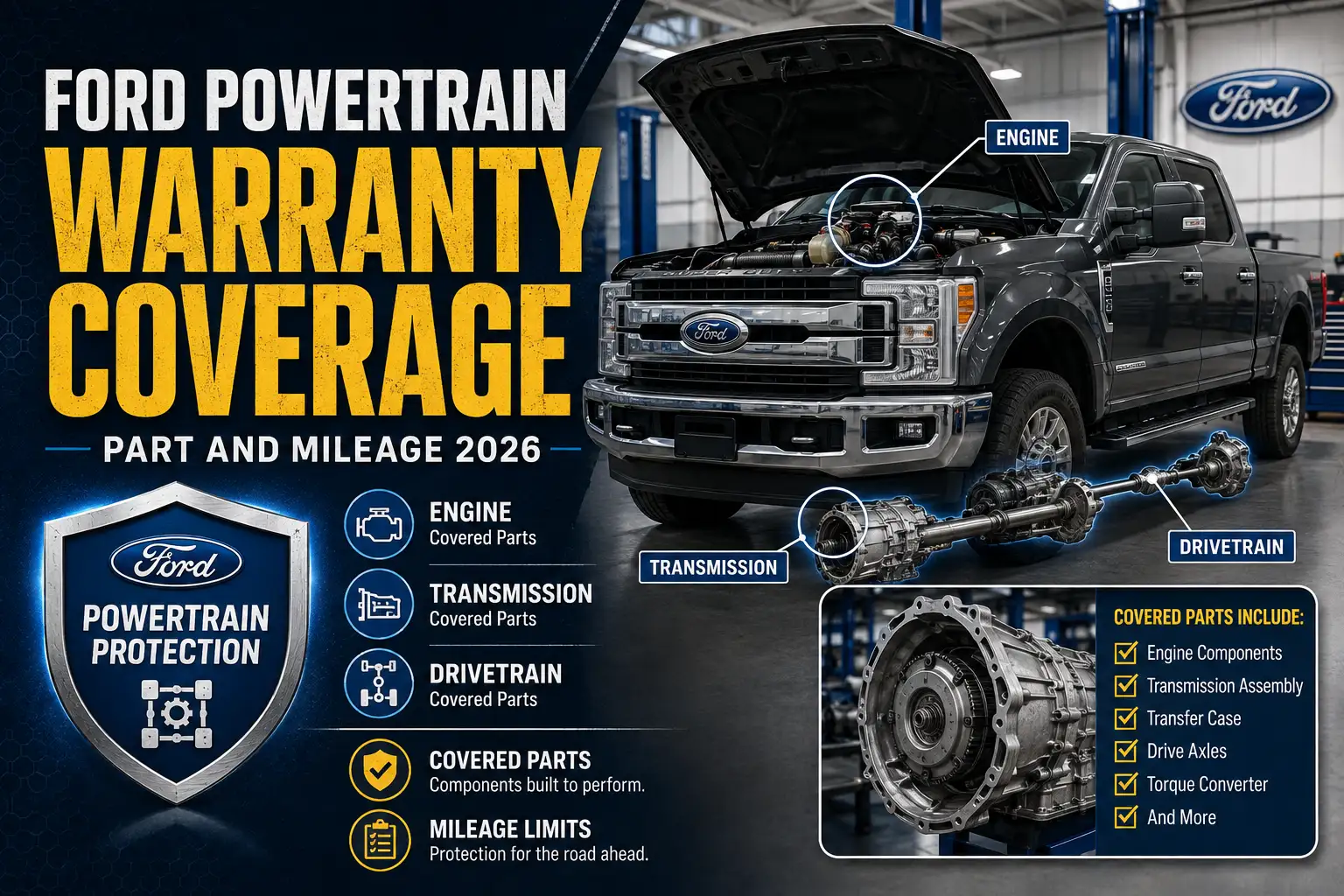
Ford Powertrain Warranty Coverage: Part and Mileage 2026

Ford powertrain warranty coverage is generally 5 years or 60,000 miles, whichever comes first, for 2026 Ford cars and light trucks covered by the standard U.S. New Vehicle Limited Warranty. It protects specified engine, transmission, front-drive, rear-drive, and four-wheel-drive components against qualifying defects.
The 60,000-mile number alone does not tell you whether Ford should pay for a repair. Your warranty start date, current mileage, failed component, powertrain type, maintenance history, and cause of failure all matter.

Prime for Young Adults — 6 Months Free
Students and 18–24s get six months of Prime free, then half price.
Start 6 Months Free As an Amazon Associate I earn from qualifying purchases.
For a wider explanation of Ford’s bumper-to-bumper, corrosion, emissions, and other factory warranties, see our Ford factory warranty coverage. Here, we are staying focused on the powertrain.
Ford Powertrain Warranty Eligibility Check
Follow these five checks before assuming a major engine, transmission, or drivetrain repair is outside factory coverage.
Check the Warranty Start Date
Use the original delivery or first in-service date. The model year alone does not determine how much factory warranty remains.
Compare Age and Mileage
Coverage ends when either the time limit or mileage limit is reached first.
Standard 60K Diesel 100K Hybrid or EV 100KIdentify the Failed Component
Match the diagnosed part, not just the symptom. Examples include a torque converter, turbocharger, water pump, transfer case, driveshaft, or internal engine component.
Match the Part to Ford Coverage
Confirm that the component appears under the applicable standard powertrain, diesel, hybrid, electric, emissions, or other Ford warranty category.
Check Why the Part Failed
A listed component can still be excluded when the damage resulted from an excluded condition rather than a qualifying material or workmanship defect.
The correct coverage period is active, the failed component is listed, and no excluded cause appears responsible. Request a Ford warranty diagnosis.
The mileage limit has passed, the failed part is not clearly listed, or the cause may fall under an exclusion. Check VIN-specific coverage before authorizing a paid repair.
- Improper or contaminated fluids
- Missing required maintenance
- Collision-related damage
- Deep-water ingestion
- Racing or overloading
- Modification-caused damage
What Determines Ford Powertrain Warranty Coverage in 2026
Recommended Best Deal Products


Five checks determine whether a powertrain repair is likely to fall under Ford’s factory warranty.
Warranty Start Date
Ford defines the warranty start date as the day you take delivery of the new Ford or the day it was first put into service, whichever happened first. A dealer demonstrator can therefore have a warranty clock that started before a retail customer bought it.
For qualifying California retail sales, Ford includes a separate rule stating that the warranty start date and mileage do not begin before delivery to the customer.
Current Odometer Mileage
Ford uses both time and mileage limits. Whichever limit occurs first ends the applicable coverage.
For the standard powertrain warranty, that means:

Audible — Listen Free for 30 Days
One free credit a month and thousands of titles included.
Listen Free for 30 Days As an Amazon Associate I earn from qualifying purchases.- 5 years or 60,000 miles for standard powertrain components
- 5 years or 100,000 miles for specified diesel engine components
- 8 years or 100,000 miles for qualifying hybrid and electric unique components
Ford lists these periods in its 2026 warranty coverage chart.
A four-year-old F-150 with 62,000 miles has normally passed its standard powertrain mileage limit. A six-year-old truck with only 40,000 miles has normally passed the time limit.
Failed Powertrain Component
The actual failed part matters more than the symptom.
A transmission that slips does not tell Ford which component failed. Diagnosis may identify an internal transmission component, torque converter, sensor, fluid-related problem, or another cause.
The same rule applies to engine noise, coolant loss, driveline vibration, and 4WD problems.
Type of Ford Powertrain
Gasoline, diesel, hybrid, and electric drivetrains do not all use one identical coverage list.
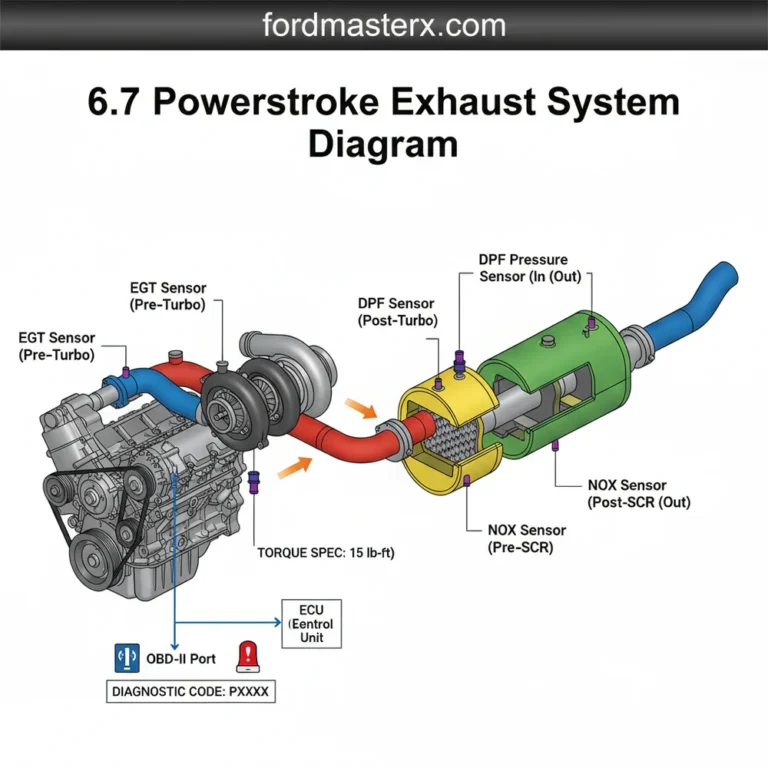
A 6.7L Power Stroke, for example, has specified diesel engine components that can remain covered beyond the normal 60,000-mile powertrain limit.
Hybrid models also have separate electrical drivetrain coverage for qualifying components.
Cause of the Failure
Ford’s warranty protects against qualifying defects in factory-supplied materials or workmanship. It does not serve as insurance against every way a powertrain component can fail.
Damage linked to contaminated fluids, water ingestion, collision, overloading, racing, certain modifications, or poor maintenance may fall outside the factory warranty.
Audible Premium Plus — Annual Membership
12 audiobook credits up front, plus the full Audible catalogue.
See Annual Plans As an Amazon Associate I earn from qualifying purchases.Once these five variables are clear, you can check whether the failed part actually appears on Ford’s powertrain list.
What Parts Ford Powertrain Coverage Includes for 5 Years
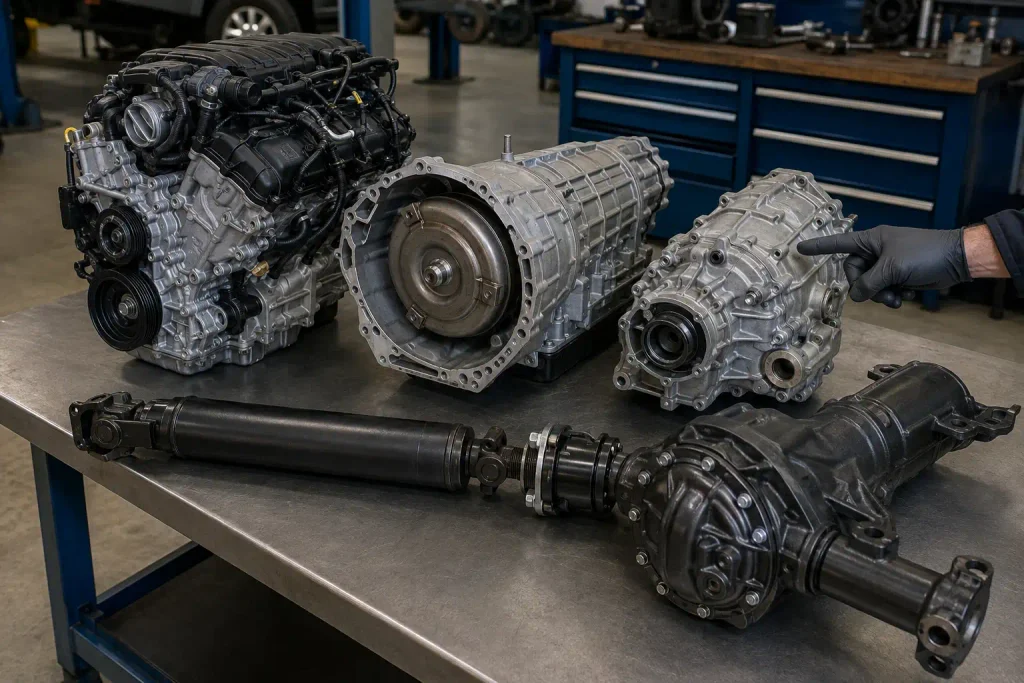
Ford’s standard powertrain protection covers far more than the engine block and transmission case.
For 2026 covered models, Ford specifically lists major engine, transmission, front-wheel-drive, and rear-wheel-drive components under its 5-year/60,000-mile powertrain period.
| System | Examples Ford Lists as Covered |
|---|---|
| Engine | Internal lubricated parts, cylinder block, cylinder heads, PCM, engine mounts |
| Fuel and Air | Electrical fuel pump, injection pump, intake and exhaust manifolds |
| Timing | Timing chain cover, timing chain, gears or belt |
| Lubrication | Oil pan, oil pump, seals and gaskets |
| Cooling | Thermostat, thermostat housing, water pump |
| Forced Induction | Factory turbocharger or supercharger unit |
| Transmission | Internal parts, clutch cover, torque converter, transmission case |
| Transfer Case | Transfer case and its internal parts |
| Front Drive | Axle shafts, bearings, support bracket, CV and universal joints |
| Rear Drive | Axle shafts, bearings, drive axle housing, driveshaft, universal and CV joints |
The exact list matters because an owner may assume a component is excluded when Ford actually places it inside powertrain coverage.
Engine Parts Ford Covers
Ford’s 2026 list includes the cylinder block, cylinder heads, internal lubricated engine parts, flywheel, oil pump, oil pan, manifolds, timing components, valve covers, water pump, engine thermostat, seals, and gaskets.
Ford also lists the powertrain control module, commonly called the PCM, within the engine portion of its powertrain coverage.
Transmission Parts Ford Covers
The transmission portion includes internal parts, transmission case, mounts, seals and gaskets, clutch cover where applicable, and the torque converter.
Ford also specifically includes the transfer case and its internal parts, which is especially relevant to F-150 and Super Duty 4WD owners.
AWD and 4WD Parts Ford Covers
Ford lists axle shafts, bearings, driveshaft components, axle housings, seals, universal joints, and constant velocity joints within the applicable front-drive and rear-drive categories.
Coverage still depends on why the part failed. A listed driveshaft damaged by a collision is different from the same component failing because of a qualifying factory defect.
That distinction becomes even more important on Power Stroke trucks because selected diesel components have a longer mileage limit.
How Ford Power Stroke Diesel Coverage Reaches 100,000 Miles
Recommended Best Deal Products

Power Stroke owners have an important exception to the standard 60,000-mile rule.
Ford’s 2026 warranty chart provides 5 years or 100,000 miles, whichever occurs first, for specified diesel engine coverage.
Ford’s listed diesel components include:
- Cylinder block
- Cylinder heads
- Internal engine parts
- Intake and exhaust manifolds
- Timing gear
- Harmonic balancer
- Valve covers
- Oil pan and oil pump
- Water pump
- High-pressure fuel lines
- Gaskets and seals
- Glow plugs
- Turbocharger
- Two-stage turbocharger assembly
- Turbocharger actuator
- Powertrain control module
- High-pressure fuel injection pump
- Fuel injectors
- Injection pressure sensor
- Fuel rail pressure sensor
- Exhaust back-pressure sensor
- Manifold pressure sensor
- Intake air temperature sensor
- Crankshaft position sensor
- Camshaft position sensor
Ford documents these parts within the diesel engine extended-coverage list.
This creates an important decision point.
If your Power Stroke truck is between 60,001 and 100,000 miles, do not assume every factory warranty has expired. Identify the failed part and check whether it belongs to Ford’s diesel engine coverage.
The 100,000-mile diesel warranty does not automatically extend every transmission, axle, transfer-case, suspension, or electrical component to 100,000 miles.
If the problem involves a different system, its own warranty period controls the claim.
How Ford Hybrid Coverage Reaches 100,000 Miles
Ford provides a separate warranty for qualifying electrical drivetrain components on its hybrid and plug-in hybrid models.
The 2026 warranty guide lists 8 years or 100,000 miles, whichever comes first, for Hybrid and Electric Vehicle Unique Component coverage.
Depending on the Ford model, the listed electrical drivetrain components can include:
- High-voltage battery
- High-voltage battery connector
- Battery Energy Control Module
- Onboard charger
- Inverter System Controller
- DC/DC converter
- Hybrid continuously variable transmission
- Electric driveline motor
- Transmission range sensor
Ford states that the exact electrical drivetrain components vary by model.
That means you should not assume every electrical part on a PowerBoost F-150, Maverick Hybrid, Escape Hybrid, or plug-in hybrid gets eight years of coverage.
High Voltage Battery Capacity Loss
Ford separates a battery defect from gradual capacity reduction.
Its 2026 warranty guide says normal high-voltage battery capacity loss caused by time and use is considered wear and is not covered under the general New Vehicle Limited Warranty provision described in that guide.
Pure battery-electric Ford models can use model-specific EV warranty documents and terms. Check the warranty guide tied to the VIN before applying hybrid warranty language to an F-150 Lightning or Mustang Mach-E.
The next question is just as important as the component list: what caused the failure?
What Can Void Ford Powertrain Coverage for a Repair
A component can appear on Ford’s covered list and still produce a denied claim if the damage resulted from an excluded condition.
Ford’s 2026 warranty guide identifies several types of damage that are outside normal New Vehicle Limited Warranty protection.
Missing Required Maintenance
Ford places responsibility for scheduled maintenance on the owner.
The company states that failing to perform maintenance specified in the Owner’s Manual can invalidate warranty coverage on parts affected by that lack of maintenance. Ford also instructs owners to retain receipts for completed maintenance.
That wording matters.
Missing maintenance does not mean every unrelated component on your truck instantly loses warranty protection. The issue is whether inadequate maintenance affected the failed part.
Oil-change records can therefore become important during an internal engine warranty claim.
Incorrect Fuel or Fluids
Ford excludes damage caused by contaminated or improper fuel and fluids.
For example, putting the wrong fluid into a transmission and damaging internal parts is not the same as an internal transmission component developing a covered manufacturing defect.
Keep service invoices showing what fluids were installed and when.
Abuse and Water Damage
Ford’s 2026 exclusions include damage associated with conditions such as:
- Collision or objects striking the truck
- Fire
- Contaminated fuel or fluid
- Driving through water deep enough for components to ingest water
- Overloading
- Racing
- Certain forms of misuse
A covered engine component damaged by water ingestion can therefore fall outside normal factory warranty protection.
Aftermarket Modifications
Ford lists alterations and modifications among conditions that can create warranty exclusions when they cause damage.
Its examples include lift kits, oversized tires, performance-enhancing powertrain components, performance software, and chips. Ford also states that damage to a Ford component caused by the failure of an aftermarket part is not covered.
That does not mean installing any aftermarket accessory automatically erases every remaining factory warranty.
The practical question is whether the modification or aftermarket component caused the failure being claimed.
F-150 owners considering suspension changes can also review how leveling kits affect an F-150 before changing ride height, tire size, or related components.
Now you can combine the warranty clock, component list, and exclusions into one quick eligibility check.
How to Check Ford Powertrain Coverage in 5 Steps
You can narrow most Ford powertrain warranty questions down with five checks.
1. Find Your Warranty Start Date
Start with the truck’s original warranty start date, not simply the model year.
Ford says this is generally the delivery date or the first date the Ford was put into service, whichever occurred first.
2. Check Your Current Mileage
Compare the truck’s mileage and age against the applicable coverage:
| Coverage Type | Time | Mileage |
|---|---|---|
| Standard Powertrain | 5 years | 60,000 miles |
| Specified Diesel Engine | 5 years | 100,000 miles |
| Qualifying Hybrid Electrical Drivetrain | 8 years | 100,000 miles |
Whichever limit occurs first controls coverage.
3. Identify the Failed Part
Get the problem diagnosed far enough to identify the component.
“Transmission problem” is too broad. “Torque converter failure” gives you a component that can be checked against Ford’s actual warranty list.
4. Match the Part to Ford Coverage
Compare the diagnosed component with the applicable powertrain, diesel, hybrid, emissions, or other warranty category.
For VIN-specific details, use our guide to check your Ford warranty status before authorizing a customer-pay repair.
5. Check the Cause and Maintenance Records
Ask whether the failure appears to involve a factory defect or an excluded cause.
Gather:
- Maintenance invoices
- Oil and fluid service records
- Repair orders
- Diagnostic reports
- Modification records
- Current odometer reading
- VIN
Ford states that covered warranty repairs are performed without charge during the applicable coverage period unless the warranty guide specifies otherwise.
Use this quick decision table before contacting the dealer.
| Your Situation | Likely Next Step |
|---|---|
| Under 5 years and 60K with listed powertrain part | Request warranty diagnosis |
| Gas Ford over 60K | Standard powertrain coverage likely expired |
| Diesel under 5 years and 100K | Check diesel-specific component list |
| Hybrid under 8 years and 100K | Check unique electrical drivetrain coverage |
| Failure linked to collision or water ingestion | Factory coverage may not apply |
| Modified truck | Determine whether modification caused the failure |
| Incomplete maintenance history | Gather available service documentation |
Ford makes the final coverage determination based on the VIN, diagnosis, applicable warranty, and cause of failure.
Ford Powertrain Warranty vs Ford Protect PowertrainCARE
Ford’s factory powertrain warranty and Ford Protect PowertrainCARE are different types of coverage.
The factory warranty comes with an eligible new Ford and covers qualifying factory defects during its stated period. Ford Protect is a separately purchased extended service plan designed to provide selected repair coverage beyond or alongside applicable factory coverage.
Ford’s current fleet plan information lists 29 covered components under gas and diesel PowertrainCARE.
| Feature | Factory Powertrain Warranty | PowertrainCARE |
|---|---|---|
| Included with eligible new Ford | Yes | No |
| Standard coverage | 5 years or 60K | Purchased plan term |
| Main purpose | Qualifying factory defects | Covered repairs under service contract |
| Component structure | Ford factory powertrain list | 29 PowertrainCARE components |
| Deductible | No charge for covered warranty repair unless stated otherwise | Depends on purchased plan |
Ford Protect plan availability, mileage limits, eligibility, and deductibles can change by plan and customer type. Check the current contract before purchasing or relying on extended coverage.
When Ford Should Cover Your Powertrain Repair
Your Ford is most likely eligible for a powertrain warranty repair when the time, mileage, failed component, and cause all fall within the applicable Ford warranty terms.
For most standard covered powertrain components, the key limit is 5 years or 60,000 miles. Specified diesel engine components can receive 5 years or 100,000 miles, while qualifying hybrid electrical drivetrain components can receive 8 years or 100,000 miles.
Before paying for a major engine, transmission, turbo, transfer-case, or driveline repair, check your VIN-specific warranty status and ask the dealer to document why the repair is covered or excluded.
That gives you a much stronger answer than relying on mileage alone.
6 Ford Powertrain Warranty Questions Owners Ask
Does Ford’s Powertrain Warranty Cover the Transmission?
Yes, qualifying transmission components are included within Ford’s powertrain warranty. Ford’s 2026 list includes internal transmission parts, the transmission case, mounts, seals and gaskets, torque converter, clutch cover where applicable, and transfer case components.
Coverage still depends on the warranty period and cause of failure.
Does Ford’s Powertrain Warranty Cover a Turbo?
Yes, Ford lists a factory turbocharger or supercharger unit within standard powertrain coverage.
Ford also lists the turbocharger and certain related turbo components under its extended diesel-engine coverage for qualifying diesel models.
Does Ford’s Powertrain Warranty Cover the Water Pump?
Yes, Ford lists the water pump among covered engine components under its 2026 powertrain warranty.
The claim can still be excluded if the damage resulted from a condition that the warranty does not cover.
Does Ford Powertrain Coverage Transfer to a Used Owner?
Remaining factory warranty coverage can continue with a previously owned Ford. Ford’s 2026 guide explicitly states that a buyer of a previously owned 2026-model Ford is eligible for any remaining warranty coverage.
The original warranty clock does not restart when the truck changes owners.
Does a Lift Kit Void Ford’s Powertrain Warranty?
A lift kit does not automatically mean every factory warranty disappears. Ford says damage caused by alterations, modifications, aftermarket components, or related failures may be excluded from coverage.
The relationship between the modification and failed component is therefore critical.
What Happens After Ford’s 60,000 Mile Warranty Ends?
Standard 5-year/60,000-mile powertrain coverage normally ends once either limit is exceeded. Some diesel, hybrid, emissions, recall, special adjustment, or Ford Protect coverage may still apply depending on the truck and failed component.
Ford emissions protection operates under separate rules, so check our Ford emissions warranty coverage when an emissions-related component is involved.
Full warranty overview: Ford Factory Warranty 2026: What’s Covered + How Long It Lasts