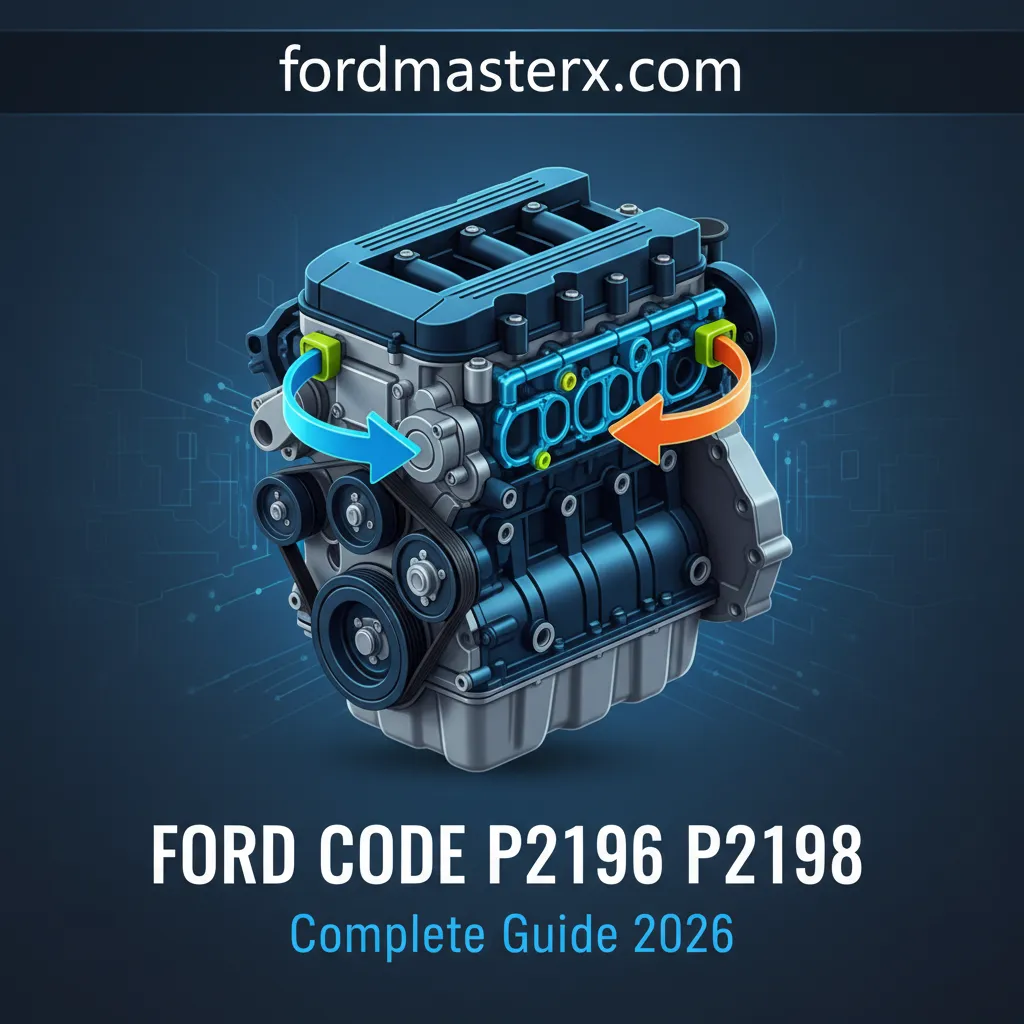
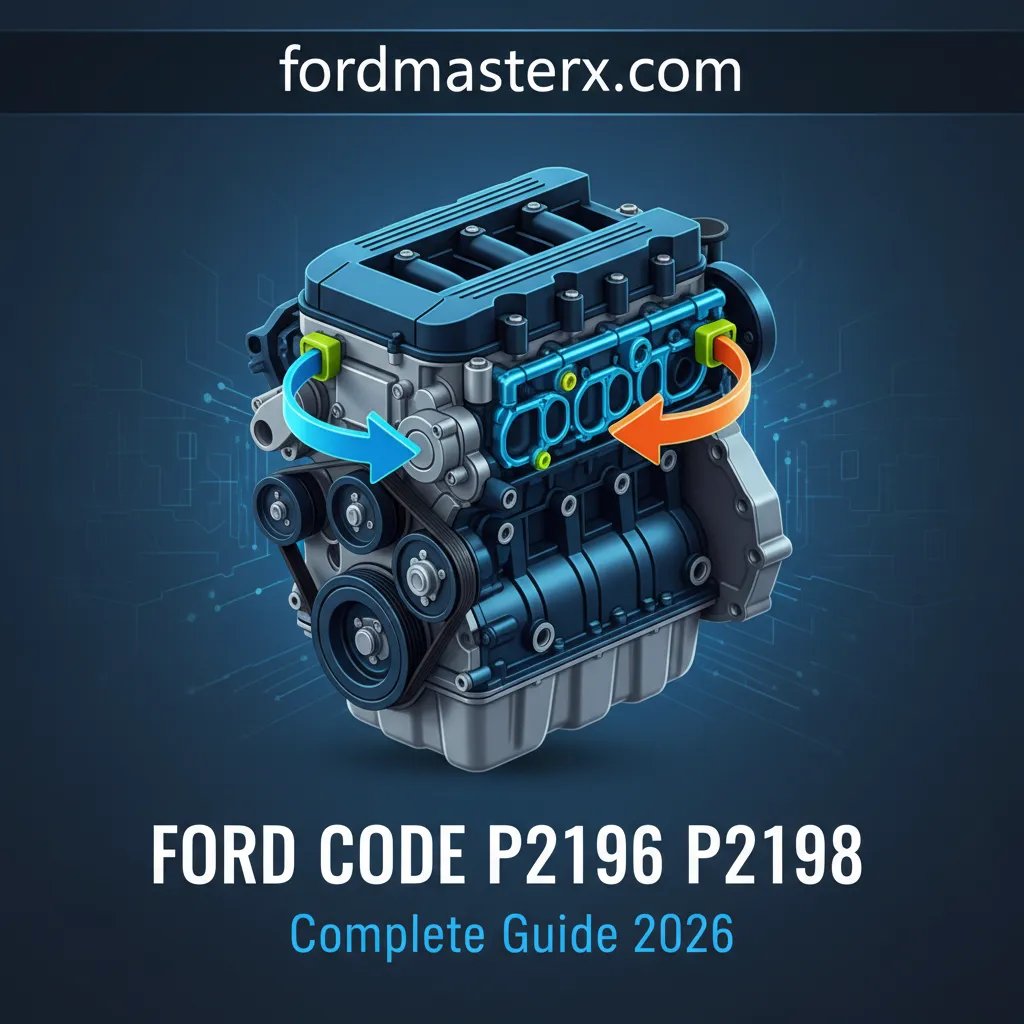
Ford Code P2196 P2198: Complete Guide 2026

Is your Ford’s Check Engine Light illuminated with codes P2196 or P2198? These specific diagnostic trouble codes signal a critical issue related to your engine’s fuel-air mixture. A ‘stuck rich’ condition can lead to significant problems, from decreased fuel economy and poor performance to expensive catalytic converter damage, causing understandable concern for vehicle owners. This comprehensive guide for 2026 will meticulously break down the meaning of Ford P2196 and P2198, detail expert diagnostic approaches, and provide a professional, step-by-step resolution process, ensuring your Ford operates reliably and efficiently.

Understanding Ford Diagnostic Trouble Codes P2196 and P2198: Rich Condition Explained
📤 Share Image
Ford diagnostic trouble codes (DTCs) P2196 and P2198 are critical indicators within the On-Board Diagnostics II (OBD-II) framework, signaling a specific issue with your engine’s air/fuel ratio. Specifically, P2196 refers to “O2 Sensor Signal Stuck Rich, Bank 1 Sensor 1,” while P2198 indicates “O2 Sensor Signal Stuck Rich, Bank 2 Sensor 1.” These codes point to the upstream oxygen sensors, often called pre-catalytic converter sensors, on Bank 1 and Bank 2, respectively.
The term ‘stuck rich’ means that the Powertrain Control Module (PCM) is receiving a consistent signal from these O2 sensors that suggests an abundance of fuel in the exhaust gases. For a narrowband oxygen sensor, this typically translates to a voltage reading that remains consistently above 0.9 volts, rather than fluctuating as it should during normal closed-loop operation. The upstream O2 sensors are paramount for air/fuel ratio monitoring, providing real-time feedback to the PCM to make immediate adjustments to fuel injection.
It’s crucial to understand that a ‘stuck rich’ signal doesn’t always mean the engine is genuinely running rich. It can also signify a fault with the sensor itself, sending an inaccurate reading. However, if the condition is genuine, it signifies that the engine is burning too much fuel relative to the amount of air, leading to incomplete combustion. This can manifest in various ways, such as a Ford F-150 EcoBoost experiencing significantly decreased fuel economy, or a Ford Explorer V6 exhibiting rough idling, hesitation during acceleration, and potentially emitting black smoke from the exhaust. In almost all cases, a persistent Check Engine Light (CEL) will be illuminated on the dashboard, signaling the need for immediate, professional attention to maintain the vehicle’s quality and reliability.

Diagnosing the Root Causes of Ford P2196 and P2198: A Professional Assessment
Diagnosing the root cause of Ford codes P2196 and P2198 requires a systematic, expert approach. These codes, while pointing to a rich condition, can stem from a variety of interconnected systems. A trusted technician will consider the following potential culprits:
Fuel System Malfunctions
A common cause of rich conditions, especially in modern Ford engines, involves the fuel system. Leaking fuel injectors, particularly prevalent in GDI (Gasoline Direct Injection) engines, can continuously dump excess fuel into the combustion chambers. This is a frequent culprit for an F-150 experiencing P2196/P2198 on both banks. An excessive fuel pressure, often due to a faulty fuel pressure regulator, can also force more fuel than necessary into the engine. Additionally, a compromised canister purge valve (allowing fuel vapors to continuously enter the intake manifold) can enrich the mixture beyond calibration.
Air Induction System Issues
The engine’s ability to accurately measure incoming air is critical. A dirty or faulty Mass Air Flow (MAF) sensor can misreport airflow, leading the PCM to inject too much fuel. For instance, a Ford Ranger’s MAF sensor might fail due to contamination from an aftermarket air filter, leading to rich running. Conversely, an often-overlooked factor is an unmetered air leak (vacuum leak) downstream of the MAF. While seemingly contradictory, a vacuum leak can allow unmetered air in, but if the O2 sensor is reading rich, it usually means the PCM is trying to compensate for what it perceives as a lean condition (which a MAF sensor would see if actual airflow was low due to an exhaust leak before the sensor, not after) and is over-fueling, or a large vacuum leak can cause poor combustion leading to unburnt fuel. A clogged air filter, by restricting air intake, can also contribute to a rich mixture.
Oxygen Sensor / Exhaust System Problems
Sometimes, the messenger is the problem. A contaminated or failing upstream O2 sensor itself can provide an inaccurate ‘rich’ reading, even if the air/fuel ratio is correct. Silicone-based sealants or antifreeze leaks can contaminate these sensors. Alternatively, an exhaust leak before the upstream O2 sensor can pull in ambient air, causing the sensor to falsely read a lean condition, prompting the PCM to enrich the fuel mixture unnecessarily, thus creating a true rich condition that the sensor then reports as rich.
Ignition System & Engine Mechanical Issues
Problems with combustion can also lead to rich codes. Misfires, often caused by worn spark plugs or faulty ignition coils, result in unburnt fuel being expelled into the exhaust, which the O2 sensor interprets as a rich condition. Low engine compression or incorrect engine timing can similarly lead to incomplete combustion. Any component affecting the engine’s ability to efficiently burn fuel can contribute to P2196/P2198.
PCM (Powertrain Control Module) Faults
While less common, an ECM/PCM failure or incorrect software calibration can lead to erroneous fuel trim commands. Such issues might require advanced diagnostics using factory-level scan tools like Ford IDS.

Audible — Listen Free for 30 Days
One free credit a month and thousands of titles included.
Listen Free for 30 Days As an Amazon Associate I earn from qualifying purchases.By The Numbers: Key Diagnostic Data
Typical O2 Sensor Voltage (Rich)
Long Term Fuel Trim (LTFT) for Rich Condition
Common Fuel Pressure (Port Injection)
MAF Reading at Idle
Step-by-Step Resolution for Ford P2196 and P2198 Codes: A Structured Repair Process
📋
Step-by-Step Guide
Begin with a meticulous visual inspection of the engine bay for any obvious issues like fuel leaks, damaged wiring, or disconnected vacuum hoses. Connect a reliable OBD-II scan tool to retrieve freeze frame data, current DTCs, and crucially, monitor live data streams. Pay close attention to O2 sensor voltage, fuel trims (STFT/LTFT), MAF readings, and engine RPM. Freeze frame data provides a snapshot of engine conditions when the code was set, offering valuable information for a truly professional diagnosis.
Observe the upstream O2 sensor readings for both banks. A genuinely rich condition will show consistently high voltage (e.g., 0.8V – 1.0V) with minimal fluctuation. If the sensor is stuck high and doesn’t fluctuate at all, the sensor itself may be faulty or contaminated. Perform a ‘propane test’ (introducing propane into the intake) to force a rich condition, or a ‘vacuum leak test’ (creating a momentary lean condition by introducing a controlled vacuum leak) and observe the sensor’s response. A healthy sensor should react quickly to these induced changes.
Conduct a fuel pressure test to ensure it matches factory specifications (e.g., 40-70 psi for many port-injected systems; significantly higher for GDI). Check for leaking fuel injectors by performing a cylinder balance test or by observing fuel trim changes when individual cylinders are momentarily disabled. Inspect the fuel pressure regulator for proper operation and diaphragm leaks, which can allow fuel into the vacuum line. Test the purge valve (EVAP solenoid) for leaks or being stuck open, which would allow continuous fuel vapor into the intake, causing a rich condition. Ensure the resistance testing parameters for fuel injectors are within specification to confirm their electrical health.
Clean the MAF sensor with approved MAF cleaner (never use carburetor cleaner) and re-evaluate its readings. A MAF reading of 2-5 g/s at idle is a common baseline, but check specific service information for your Ford model. Perform a smoke test to identify vacuum leaks in the intake manifold gaskets, vacuum lines, and PCV (Positive Crankcase Ventilation) system components (hoses, valve). A DIY smoke test using a cigar or a professional smoke machine can reveal leaks that cause unmetered air and confuse the PCM, leading it to overcompensate.
Inspect spark plugs for fouling, which often presents as carbon deposits, a clear sign of a rich running condition. Ensure spark plug gaps are correct and their overall condition is good. Check for exhaust leaks before the upstream O2 sensors. Even a pinhole leak can pull in ambient air due to exhaust pulsations, causing the O2 sensor to falsely read lean, prompting the PCM to add fuel, thus leading to a true rich condition that then triggers P2196/P2198.
Audible Premium Plus — Annual Membership
12 audiobook credits up front, plus the full Audible catalogue.
See Annual Plans As an Amazon Associate I earn from qualifying purchases.After completing repairs, clear all diagnostic trouble codes using your scan tool. Perform an extended test drive under various driving conditions—city, highway, idle—to confirm the fix. Monitor live data, particularly fuel trims, to ensure they return to acceptable ranges (typically within +/- 5-10%). This allows the PCM to relearn fuel trims and confirm the issue is truly resolved, providing reliable information about the repair’s quality.
When dealing with GDI engines, leaking fuel injectors are a surprisingly common cause for rich conditions on both banks. A professional leak-down test or simply observing live fuel trim data after disabling individual injectors can often pinpoint the culprit efficiently. Don’t overlook the impact of carbon buildup on GDI injectors, which can worsen their spray pattern and lead to richness.
Advanced Troubleshooting: When P2196 and P2198 Codes Persist on Your Ford
Even after a thorough and systematic diagnostic process, P2196 and P2198 can sometimes persist. This indicates a more complex underlying issue or an overlooked detail, demanding advanced troubleshooting and potentially professional intervention. When facing such stubborn codes, consider these additional steps:
Comprehensive Wiring and Connector Inspection
A visual inspection isn’t always enough. Thoroughly check the entire wiring harness for the upstream O2 sensors, MAF sensor, and fuel injectors. Look for subtle signs of chafing, corrosion, or open circuits, especially where harnesses bend or are exposed to heat/moisture. Verify terminal tension and integrity at all connectors. A common scenario for persistent Ford Fusion P2196/P2198 might be a corroded connector on the O2 sensor harness, causing intermittent signal drops or erroneous readings. Always check for proper sensor reference voltage (e.g., 5V for many Ford sensors) and ground integrity at the sensor connectors.
PCM/ECM Software and Hardware Analysis
Investigate whether there are any relevant Technical Service Bulletins (TSBs) or software updates from Ford specifically addressing P2196/P2198 for your vehicle model and year. Ford regularly releases updates to optimize engine performance and address known DTCs. In rare instances, the PCM itself may be faulty. This requires professional diagnostics using specialized tools like Ford Integrated Diagnostic Software (IDS), which can perform deep-level module testing and reprogramming. An instance where a PCM reflash corrected an intermittent rich condition is not uncommon.
Exhaust System Backpressure and Catalytic Converter Assessment
While a rich condition often causes catalytic converter damage, a partially restricted catalytic converter can indirectly affect O2 sensor readings by altering exhaust flow and creating backpressure. This can lead to unburnt fuel and trigger rich codes. Check for excessive exhaust backpressure using a pressure gauge at the upstream O2 sensor port. A healthy catalytic converter should have minimal backpressure at idle and higher RPMs.
Consider Professional Diagnostic Services
If, after diligently following all diagnostic and repair steps, the P2196 and P2198 codes still persist, it is highly advisable to seek assistance from a certified Ford technician or a reputable independent specialist. These professionals are equipped with advanced diagnostic tools, access to up-to-date service information, and the deep, trusted expertise required to tackle complex, unresolved issues. Their professional assessment can save time, money, and prevent further damage to your vehicle, ensuring its long-term reliability.
Ignoring Ford codes P2196 and P2198 can lead to severe and costly damage, most notably to the catalytic converters. A continuously rich condition will overheat and destroy the catalytic converter, which is an extremely expensive component to replace. Prompt and accurate diagnosis is critical to prevent cascading failures.
Ford codes P2196 and P2198 indicate an upstream oxygen sensor detecting a consistently rich exhaust condition on Bank 1 and Bank 2, respectively. Common causes range from faulty fuel injectors and MAF sensor issues to vacuum leaks and O2 sensor malfunctions. A structured diagnostic approach, utilizing scan tool data and systematic component testing, is crucial for accurate resolution. Persistent codes warrant advanced troubleshooting and professional diagnostic intervention to prevent further engine complications. Addressing Ford P2196 and P2198 promptly with a reliable, professional diagnosis is paramount. Utilize this guide to perform a thorough inspection, and do not hesitate to consult a trusted automotive expert for complex or unresolved issues to ensure the longevity and performance of your vehicle.
Frequently Asked Questions
What are the common symptoms of Ford codes P2196 and P2198?
Symptoms often include a persistent illuminated Check Engine Light, noticeable decrease in fuel economy, a strong fuel smell from the exhaust, rough idling, engine hesitation during acceleration, and potentially black smoke exiting the exhaust pipe. These indicate an engine running overly rich, impacting performance and emissions.
Can I drive with Ford codes P2196 and P2198 active?
While your Ford may still run, driving with P2196 and P2198 is not recommended. A prolonged rich condition can significantly damage expensive components like the catalytic converter due to unburnt fuel overheating it. It also leads to poor fuel efficiency and increased emissions, warranting immediate professional attention.
Are Ford codes P2196 and P2198 serious?
Yes, P2196 and P2198 are serious. They signify a fundamental issue with the engine’s air-fuel ratio management. If unaddressed, this condition can lead to premature failure of the catalytic converter, significant engine wear, reduced power output, and substantial increases in fuel consumption and harmful emissions.
How much does it cost to fix Ford codes P2196 or P2198?
The cost to fix P2196 or P2198 varies widely based on the root cause. A simple MAF sensor cleaning might be minimal, while replacing a faulty oxygen sensor could range from $150-$350 per sensor. If the issue stems from leaking fuel injectors or a catalytic converter, costs can escalate significantly, potentially exceeding $1000-$2000.
Why do I have both P2196 and P2198 simultaneously?
Having both P2196 and P2198 indicates a rich condition affecting both engine banks simultaneously. This often points to a common cause impacting the entire engine, such as a faulty Mass Air Flow (MAF) sensor, excessive fuel pressure affecting all injectors, or a widespread vacuum leak impacting the intake manifold.