P1000-Ff Code Ford: Complete Guide 2026

P1000-Ff Code Ford: Complete Guide 2026
Encountering a P1000-FF code on your Ford vehicle can be perplexing, often appearing without a ‘Check Engine’ light or obvious symptoms. Many Ford owners misinterpret this code as a serious malfunction, leading to unnecessary worry or costly diagnostic services, when in fact, it’s merely an informational status indicating incomplete self-diagnostics. This expert guide will demystify the Ford P1000-FF code, providing you with professional knowledge on its true meaning, how to accurately diagnose its presence, and a detailed, reliable procedure to clear it by successfully completing all OBD-II readiness monitors for 2026 and beyond.

Understanding the Ford P1000-FF Code: What It Means and Its Operational Context
Recommended Best Deal Products


The Ford P1000-FF code often causes confusion among vehicle owners because, unlike most diagnostic trouble codes (DTCs), it does not indicate a system malfunction. Instead, it serves as a critical informational status within the vehicle’s On-Board Diagnostics II (OBD-II) system. The OBD-II standard, universally implemented in 1996 for all light-duty vehicles sold in the U.S., mandates specific readiness monitors designed to continuously verify the integrity and efficiency of the vehicle’s emission control systems. The P1000-FF code, specific to Ford vehicles, signifies that one or more of these crucial readiness monitors have not yet completed their diagnostic self-tests.
This code typically appears after events that reset the Powertrain Control Module (PCM) memory. Common scenarios include a battery disconnection, which erases the PCM’s learned parameters and readiness monitor status. Similarly, if a mechanic or owner uses an OBD-II scanner to clear existing DTCs—even a minor one—the P1000-FF code will likely set immediately, indicating the system is starting its self-check process from scratch. Recent emissions-related repairs, such as an O2 sensor replacement or catalytic converter service, will also necessitate monitor completion, leading to a temporary P1000-FF.
Consider a scenario where a Ford F-150 owner recently replaced their battery to address starting issues. Upon reconnecting, the vehicle might drive perfectly fine, but an OBD-II scan will reveal the P1000-FF code. Another example is a Ford Focus that had its check engine light cleared due to a minor evaporative emission (EVAP) leak. While the original fault is gone, the P1000-FF appears, signaling that the EVAP monitor (and others) need to re-run their diagnostic checks.
The implications of the P1000-FF code are most significant for vehicle inspections, particularly state emissions testing. Regulatory bodies generally require a vehicle to have all (or a specific number, typically 6-8) of its readiness monitors in a ‘complete’ or ‘ready’ state to pass inspection. A vehicle with a P1000-FF code indicates one or more monitors are ‘not ready’, leading to an automatic failure of the emissions test. For general vehicle operation, the P1000-FF itself doesn’t cause driving issues or illuminated warning lights; it’s purely a status indicator that the emission system’s self-diagnostics are still in progress, ensuring reliable environmental compliance.
By The Numbers
Year OBD-II Standard Implemented
Monitors Required for Inspection

Diagnosing the P1000-FF Code in Ford Vehicles: Initial Assessment and Diagnostic Tools
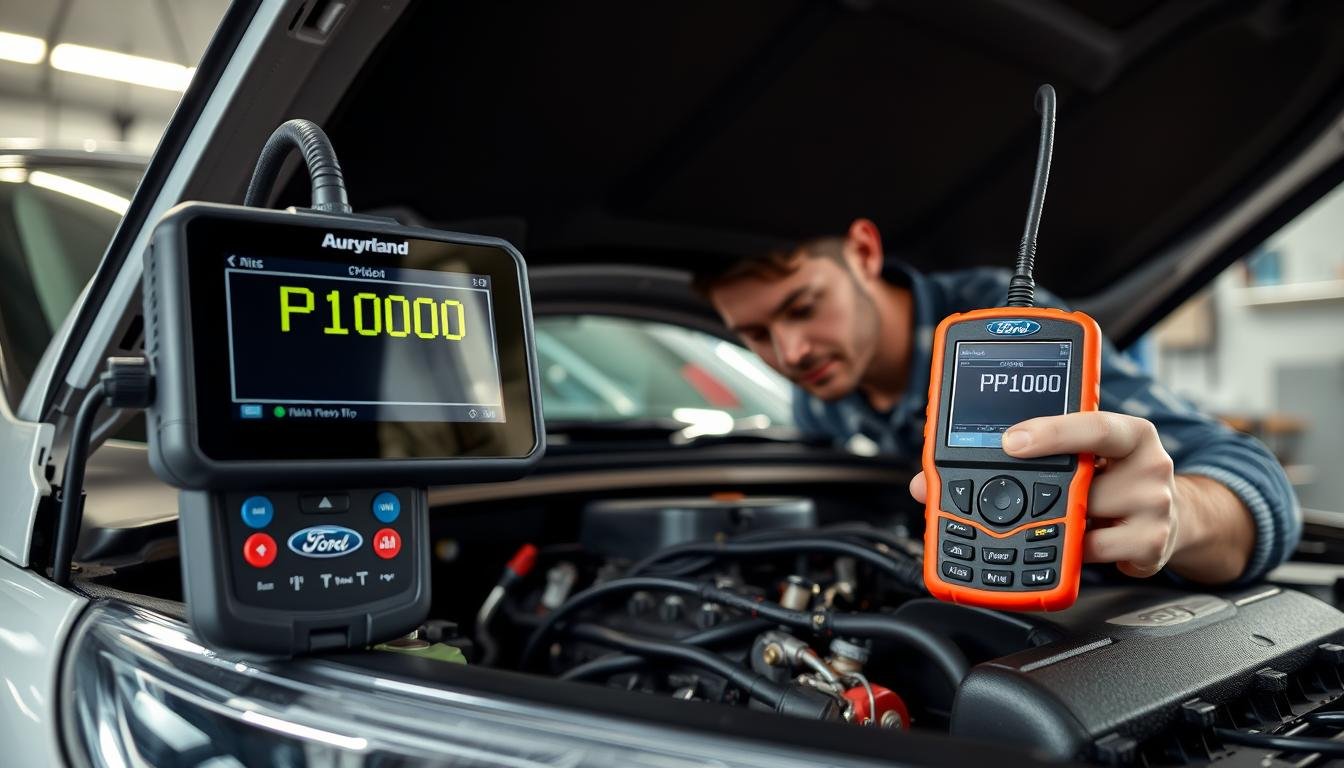
When confronted with a P1000-FF code, the initial assessment is crucial to ensure you’re not masking a deeper technical fault. The first and most fundamental step is to utilize an OBD-II scanner. While any basic scanner can confirm the presence of the P1000-FF code, a more advanced tool can display the status of individual readiness monitors. For instance, using a professional-grade scanner like an Autel Maxicom or even a consumer-friendly option like BlueDriver, you can navigate to the ‘Readiness Status’ or ‘I/M Readiness’ menu. This will show which specific monitors (e.g., O2 Sensor, Catalyst, EVAP, EGR, Secondary Air, Heated O2 Sensor) are marked as ‘complete’ or ‘not ready’. For a Ford Explorer, this screen would clearly show if the Catalyst monitor is still pending, directly contributing to the P1000-FF.
Next, it’s imperative to identify any additional pending or active Diagnostic Trouble Codes (DTCs). The P1000-FF code, by itself, is benign. However, if a P0420 (Catalyst System Efficiency Below Threshold) or P0133 (O2 Sensor Circuit Slow Response) is also present, it indicates an underlying problem that is actively preventing the associated readiness monitor from completing. For example, if a Ford Ranger owner finds a P0420 alongside the P1000-FF, it’s clear the issue extends beyond just monitor readiness and points to a potential problem with the catalytic converter or its upstream components. No amount of driving will clear the P1000-FF until the underlying fault is addressed and its DTC is cleared, after which the monitors will need to re-run.
Another important step is to verify recent vehicle maintenance history. A recent battery replacement, a PCM reset, or emissions-related repairs are primary triggers for the P1000-FF. Knowing this context helps distinguish between a P1000-FF that will clear with a simple drive cycle and one that suggests a deeper technical fault. Research indicates that most consumer-grade OBD-II scanners can display readiness monitor status, providing sufficient detail for initial assessment. However, professional diagnostics tools often offer more detailed insights into specific monitor completion criteria and live data streams, which can be invaluable in complex cases. Unfortunately, up to 20% of vehicles entering emissions testing may initially fail due to incomplete readiness monitors, underscoring the importance of proper diagnosis and monitor completion.

Clearing the Ford P1000-FF Code: Step-by-Step Ford Drive Cycle Procedure
Recommended Best Deal Products


Successfully clearing the Ford P1000-FF code primarily involves performing a specific Ford drive cycle procedure. This procedure is designed to create the precise operating conditions necessary for all OBD-II readiness monitors to run their self-diagnostic tests and achieve a ‘complete’ status. Adherence to these steps is critical for a reliable outcome.
📋
Ford P1000-FF Drive Cycle Procedure

Audible — Listen Free for 30 Days
One free credit a month and thousands of titles included.
Listen Free for 30 Days As an Amazon Associate I earn from qualifying purchases.Ensure the vehicle has sat for at least 8 hours with the engine off (cold soak). Start the engine without touching the accelerator. Let it idle in Park for 2-3 minutes. This allows the O2 sensor heaters and secondary air injection system (if equipped) monitors to run, along with initial fuel system checks.
Drive the vehicle at a steady speed of 40-60 mph (65-95 km/h) for approximately 5-10 minutes. This portion of the cycle helps complete the catalyst efficiency monitor and other continuous monitors like misfire detection. Avoid rapid acceleration or deceleration; maintain consistent throttle input.
From highway speed, gently decelerate to around 20 mph (30 km/h) without braking if safe to do so. Then, accelerate back up to 40-60 mph. Repeat this sequence 2-3 times. This variation in speed helps the Oxygen sensor monitor and EGR (Exhaust Gas Recirculation) monitor complete their tests.
Follow with 5-10 minutes of stop-and-go city driving. This involves accelerating from a stop, cruising at moderate speeds (20-35 mph / 30-55 km/h), and coming to a complete stop. This phase is crucial for the EVAP (Evaporative Emission Control System) monitor, although it often requires specific conditions to run.
After completing the driving, allow the vehicle to idle in Park for another 2 minutes. This can help finalize any pending checks. Throughout this process, avoid aggressive driving, hard braking, or heavy acceleration. The key is smooth, consistent operation.
It is important to remember that a typical Ford drive cycle can take 15-30 minutes of varied driving, but some monitors, especially the EVAP monitor, are notoriously slow to complete. The EVAP system specifically requires the fuel level to be between 1/4 and 3/4 full and often needs overnight cold soaks to run its diagnostic tests effectively. Monitoring readiness status with an OBD-II scanner throughout the drive cycle is essential to confirm when each monitor transitions from ‘not ready’ to ‘complete’. Research indicates that up to 70% of P1000 codes can be cleared with one successful, carefully executed drive cycle. If after one attempt not all monitors are ready, repeat the cycle the next day, ensuring another cold soak period, until all are complete.
Audible Premium Plus — Annual Membership
12 audiobook credits up front, plus the full Audible catalogue.
See Annual Plans As an Amazon Associate I earn from qualifying purchases.For the EVAP monitor to run, ensure your Ford’s fuel tank is between 1/4 and 3/4 full. Too empty or too full can prevent this specific monitor from initiating its self-test, potentially prolonging the P1000-FF code.
What If the Ford P1000-FF Code Persists? Advanced Troubleshooting and Underlying Issues
Recommended Best Deal Products


While a carefully performed drive cycle clears the P1000-FF code for most Ford vehicles, there are instances where the code stubbornly persists. This indicates a more complex underlying issue that is actively preventing one or more readiness monitors from completing their tests. In such cases, advanced troubleshooting beyond simple driving is necessary to identify and rectify the root cause.
The first step in advanced troubleshooting is to diligently identify any other active or pending DTCs that might be preventing specific readiness monitors from completing. As an industry expert, I’ve seen countless times where a seemingly innocuous P1000-FF masks a genuine problem. For example, if a Ford Escape repeatedly fails the O2 sensor readiness monitor despite multiple drive cycles, further inspection will likely reveal a DTC such as P0133 (O2 Sensor Circuit Slow Response) or P0171 (System Too Lean). These codes directly point to a failing O2 sensor or a vacuum leak, which must be repaired before the O2 monitor can complete. A study found that approximately 15% of persistent P1000 codes are directly linked to an active fault preventing monitor completion.
Common component failures that frequently impede monitor readiness include:
- O2 Sensors: Faulty oxygen sensors are a frequent culprit. O2 sensor issues account for roughly 25% of emission-related DTCs and directly impact the O2 sensor and catalyst monitors.
- Catalytic Converters: A failing catalytic converter (often indicated by a P0420 or P0430 code) will prevent the catalyst monitor from completing.
- EGR Valves: A stuck or malfunctioning EGR valve can prevent the EGR monitor from passing its self-test.
- EVAP System Components: Leaks in the evaporative emission system, a faulty purge valve, or a defective vent valve can keep the EVAP monitor from running.
- Thermostat/Engine Coolant Temperature (ECT) Sensor: An engine that doesn’t reach or maintain optimal operating temperature due to a stuck-open thermostat or a faulty ECT sensor can prevent various monitors from running, as many require specific engine temperatures.
Beyond physical component failures, Powertrain Control Module (PCM) software issues or calibration errors can also prevent monitor execution. A Ford Mustang with an aftermarket performance tune, for instance, might struggle to complete readiness monitors because the non-standard PCM calibration may alter the parameters needed for monitor completion. In some rare cases, a PCM reflash or even replacement by a professional technician might be the only solution. This is a more costly repair, averaging $800-$1500.
If, after diligent efforts and verifying no other obvious DTCs, the P1000-FF persists, it’s time to seek professional diagnostic assistance from a certified Ford technician. These experts have access to factory-specific diagnostic tools (like Ford’s IDS system), extensive technical service bulletins (TSBs), and the nuanced understanding required for advanced analysis. They can perform circuit tests, monitor live data streams more comprehensively, and pinpoint elusive issues that generic scanners might miss, ensuring your Ford is both reliable and emissions-compliant.
Do not attempt to clear the P1000-FF code by disconnecting the battery or using a scanner if other active DTCs are present. This will only temporarily remove the P1000-FF while the underlying issue remains, potentially causing more severe damage or leading to repeated emissions test failures.
The P1000-FF code, while not a direct fault, is a reliable indicator of your Ford’s OBD-II readiness status, crucial for emissions compliance. Accurate diagnosis involves confirming the code and checking for other underlying DTCs with a quality OBD-II scanner. Following the specific Ford drive cycle procedure is the primary method to clear the P1000-FF code and complete all readiness tests. Ensure your Ford is fully prepared for any inspection or simply operating optimally by understanding and properly addressing the P1000-FF code. If the code persists after multiple drive cycle attempts, consult a trusted, professional Ford technician for a comprehensive diagnostic assessment to maintain your vehicle’s peak quality and performance.
Frequently Asked Questions
Is the Ford P1000-FF code a serious issue that needs immediate repair?
No, the P1000-FF code is not a fault code indicating a malfunction. It simply means your Ford’s OBD-II readiness monitors, which verify emission system functionality, have not completed their self-tests. While not requiring immediate repair, it must be cleared to pass emissions inspections in applicable regions, requiring a specific drive cycle.
How long does it typically take to clear the Ford P1000-FF code?
Clearing the P1000-FF code by completing the readiness monitors usually takes one or more successful drive cycles. A single drive cycle can range from 15 to 30 minutes of varied driving conditions (highway, city, idle). However, some monitors, like EVAP, might require specific ambient conditions or multiple cycles over a few days to set.
Can I drive my Ford vehicle with a P1000-FF code present?
Yes, driving your Ford with a P1000-FF code is generally safe as it doesn’t indicate a mechanical fault or impact performance. In fact, driving is necessary to complete the readiness monitors. The primary concern is that your vehicle will fail an emissions test or state inspection until the code is cleared and all monitors are ‘ready’.
What if the Ford P1000-FF code keeps coming back after I complete the drive cycle?
If the P1000-FF code persists, it suggests an underlying issue is preventing one or more specific readiness monitors from completing. This often points to another active or pending Diagnostic Trouble Code (DTC) for a faulty component, such as an O2 sensor or catalytic converter. A professional diagnostic scan is recommended to identify the root cause.
Does disconnecting the battery clear the P1000-FF code on my Ford?
Disconnecting the battery will momentarily clear the P1000-FF code along with any other stored DTCs and reset the readiness monitors to an ‘incomplete’ state. This action is one of the common reasons the P1000 code initially appears, as all monitors must then be re-run and completed through a drive cycle for the P1000 to clear permanently.