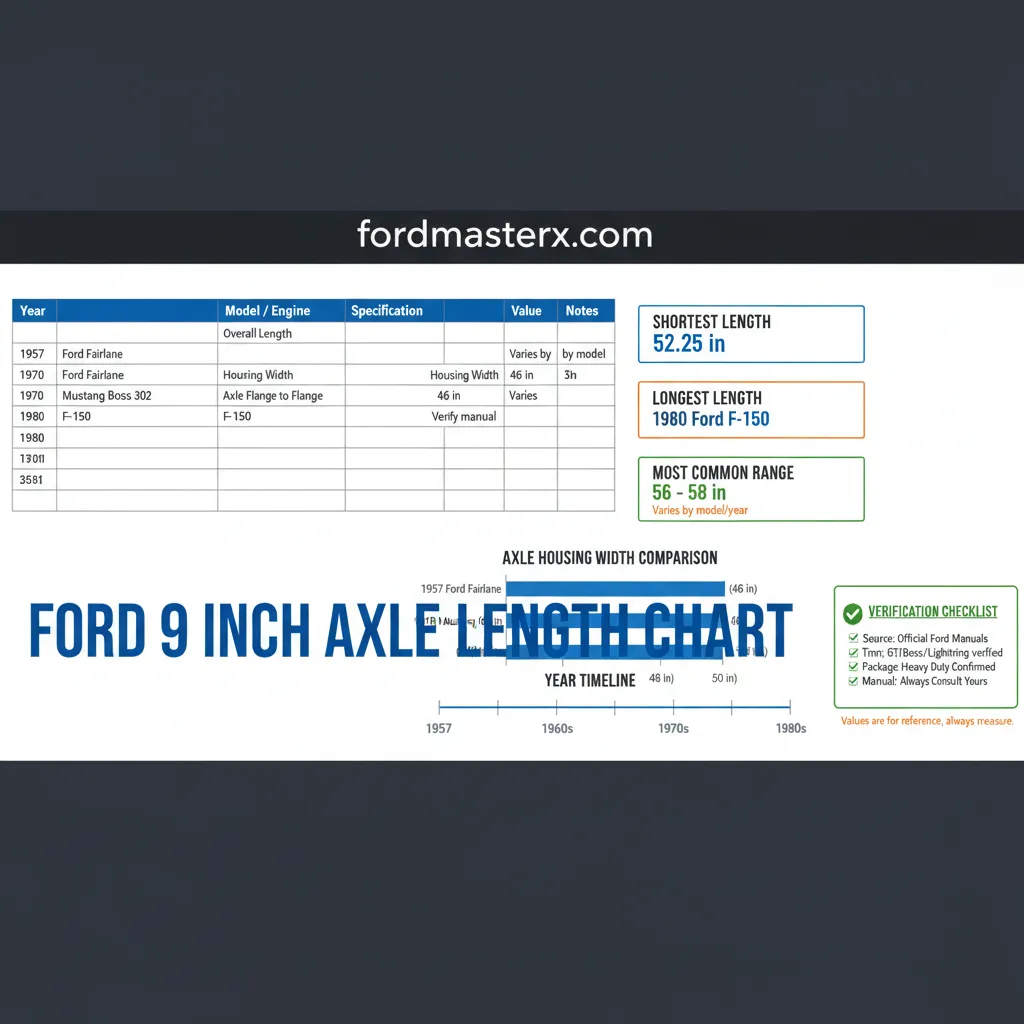
Ford 9 Inch Axle Length Specification Chart By Year

Quick Answer
Ford 9-inch axle lengths vary significantly, typically ranging from approximately 50 to 65 inches (flange-to-flange) over its production lifespan. These dimensions are highly dependent on the vehicle’s model year, specific car or truck application, original engine option, and chassis configuration. Always consult factory manuals or perform physical measurements for precise verification.
The Ford 9-inch axle is legendary in automotive circles for its robust design, unparalleled strength, and remarkable adaptability, making it a perennial favorite for both classic restorations and high-performance custom builds. However, with decades of production across a vast array of vehicles, identifying the correct axle length for a specific project or replacement can be a significant challenge for enthusiasts and builders alike. This detailed content blueprint provides a comprehensive Ford 9-inch axle length specification chart, outlining year-by-year and configuration-specific dimensions, along with critical insights into the factors that influence these measurements, ensuring you find the precise axle for your needs.

Prime for Young Adults — 6 Months Free
Students and 18–24s get six months of Prime free, then half price.
Start 6 Months Free As an Amazon Associate I earn from qualifying purchases.This chart compiles common Ford 9-inch axle lengths from its introduction in 1957 through its widespread factory use up to 1986. Data covers various Ford cars, trucks, and vans, focusing on general production models. Exact dimensions can vary by specific trim, engine option, brake configuration (drum vs. disc), and factory tolerances. Readers should always cross-reference these specifications with their vehicle’s factory service manual, VIN-specific information, or direct physical measurement for critical applications. This data serves as a comprehensive guide but is not a substitute for verification. Last reviewed: May 2026.
Understanding Ford 9 Inch Axle Lengths: Key Specifications Chart
Recommended Best Deal Products


📤 Share Image
The Ford 9-inch axle’s widespread use across a broad spectrum of vehicles means its dimensions, particularly the crucial flange-to-flange (or wheel mounting surface to wheel mounting surface, WMS-to-WMS) measurement, exhibit considerable variation. This primary data table organizes some of the most common factory Ford 9-inch axle lengths by year and application, providing a critical reference point for enthusiasts and builders. These measurements are approximate and represent typical factory specifications; always measure your specific component before ordering parts or beginning modifications.
| Year Range | Model / Application | Specification | Value (Inches, WMS-to-WMS) | Notes |
|---|---|---|---|---|
| 1957-1959 | Ford Passenger Cars (Full-size) | Axle Length | Approx. 57.25-58.5 | Early full-size sedan applications. Pinion often offset. |
| 1960-1965 | Ford Falcon / Comet / Ranchero | Axle Length | Approx. 58 | Common narrow car application. Often referred to as “small bearing.” |
| 1964-1966 | Ford Mustang / Fairlane | Axle Length | Approx. 58 | Often with small bearing housing ends. |
| 1967-1970 | Ford Mustang / Cougar | Axle Length | Approx. 59.25 | Wider track to accommodate larger tires and suspension changes. |
| 1967-1971 | Ford Fairlane / Torino / Cyclone | Axle Length | Approx. 59.25-61 | Varied by engine option and specific trim. Usually 59.25″ or 61″. |
| 1968-1976 | Ford Galaxie / LTD (Full-size) | Axle Length | Approx. 61-62 | Wider passenger car applications. |
| 1970-1977 | Ford Maverick / Comet | Axle Length | Approx. 56.5 | One of the narrowest common 9-inch applications, popular for swaps. |
| 1973-1979 | Ford F-100 / F-150 2WD | Axle Length | Approx. 61.25 | Common truck axle, often with 2.375″ pinion offset. |
| 1973-1979 | Ford F-100 / F-150 4WD | Axle Length | Approx. 63-65 | Wider track for 4×4 stability and larger tires. Specifics vary by year. |
| 1978-1986 | Ford Bronco (Full-size) | Axle Length | Approx. 65 | Typically a very wide truck application, commonly a 31-spline axle. |
| 1968-1979 | Ford Econoline Van | Axle Length | Approx. 68-70 | Among the widest factory 9-inch axles due to full-size van application. |
| Various | Aftermarket / Custom | Axle Length | Varies | Any custom width is possible; always specify WMS-to-WMS. |
|
Footnote 1: All measurements are approximate flange-to-flange (WMS-to-WMS). Exact values can vary due to factory tolerances, brake drum/rotor thickness, or aftermarket component changes. Footnote 2: Pinion offset (distance from housing center to pinion centerline) also varies. Common offsets include centered, 1.875″, and 2.375″. This specification is critical for driveshaft alignment. Footnote 3: Always confirm dimensions with a physical measurement or factory service manual for your specific vehicle before purchase or modification. | ||||
How to read this chart: The “Year Range” indicates the approximate production period for that axle configuration. “Model / Application” specifies the primary vehicle type. “Specification” confirms we are measuring “Axle Length” (which means WMS-to-WMS). The “Value” column provides the approximate length in inches. The “Notes” column offers critical contextual information regarding variations, typical characteristics, or important caveats. Remember, these are general guidelines.

HTML Data Visualization: Quick Reference Snapshot for Ford 9 Inch Axle Dimensions
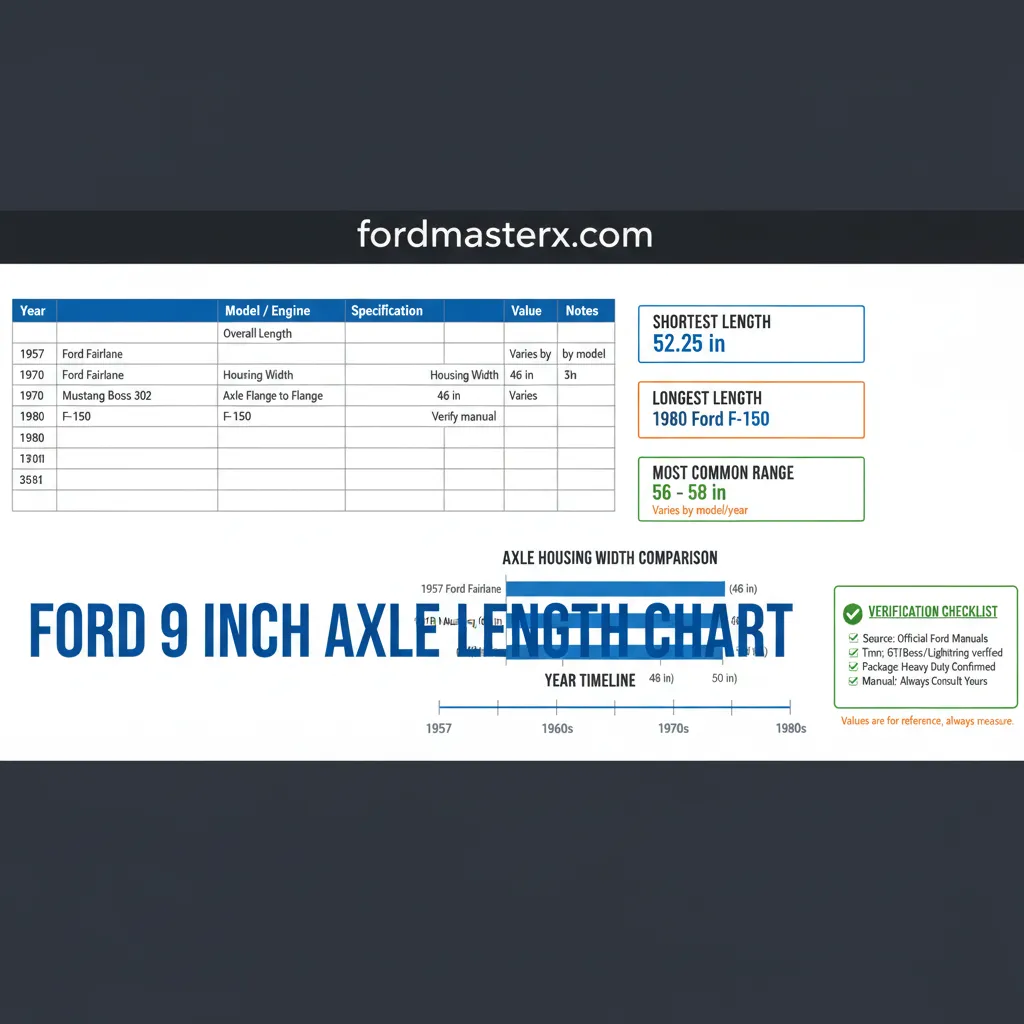
To provide a quick visual summary and emphasize key data points, we’ve compiled snapshots of the most common Ford 9-inch axle dimensions. These visuals highlight the range and comparative differences across various applications, along with a crucial checklist for verification.
Shortest Common Length
~56.5 Inches
(Maverick/Comet)
Longest Common Length
~70 Inches
(Econoline Van)
Most Popular Range
~58-61 Inches
(Classic Cars)
Comparative Axle Lengths (Selected Models)
Visual comparison of common Ford 9-inch axle flange-to-flange measurements.

Audible — Listen Free for 30 Days
One free credit a month and thousands of titles included.
Listen Free for 30 Days As an Amazon Associate I earn from qualifying purchases.
Year-by-Year Changes in Ford 9-Inch Axle Specifications (1957-1986)
Recommended Best Deal Products


The Ford 9-inch axle enjoyed a remarkable production run from its introduction in 1957 until 1986, adapting to the evolving landscape of automotive design. Its longevity meant constant, albeit often subtle, adjustments to its specifications. Early 9-inch axles, primarily found in full-size passenger cars and light trucks, often featured lengths around 57 to 58.5 inches. These units were robust but designed for narrower vehicle tracks of the era.
As the 1960s progressed and the muscle car era dawned, vehicle track widths increased significantly to improve handling, accommodate wider tires, and create a more aggressive stance. This led to the proliferation of the 59.25-inch axle, which became a staple in many performance-oriented Mustangs, Fairlanes, and Torinos from 1967 onward. Concurrently, full-size Ford models like the Galaxie and LTD often received axles in the 61-inch range. The engine option also played a role; while not directly changing the housing width, larger engines sometimes coincided with wider tracks to handle increased power and weight, leading to specific axle lengths for those models.
Truck and van applications consistently featured wider axles, reflecting their wider frames, higher payload capacities, and different suspension geometries. F-Series trucks, for instance, saw lengths extending from 61.25 inches to upwards of 65 inches, particularly in 4×4 configurations. Econoline vans pushed this even further, sometimes utilizing axles in the 68-70 inch range. Pinion offset, which dictates the driveshaft angle and clearance, also varied by application, from centered to 2.375 inches or more off-center, a detail crucial for custom builds.
Predominantly narrower axles (~57-58″) for compact and early intermediate cars like Falcon/Mustang.
Significant increase in widths (~59.25-61″) for muscle cars and larger sedans (Mustang, Fairlane, Galaxie).
9-inch phased out of most cars, primarily found in trucks & vans with wider axles (~61-70″).
_–_Frontansicht,_14._April_2013,_Düsseldorf.jpg "Ford 9 Inch Axle Length Specification Chart By Year 5")
Configuration-Specific Ford 9-Inch Axle Lengths: Cars, Trucks, and Vans
The Ford 9-inch axle’s incredible versatility is best illustrated by its presence across Ford’s entire vehicle lineup for nearly three decades. Understanding the typical lengths associated with different vehicle types is crucial for correct identification and application.
Passenger Car Axles
- Compact Cars (Maverick, Comet): These vehicles often featured the narrowest common 9-inch axles, typically around 56.5 inches WMS-to-WMS. Their compact nature meant a tight overall width, making these axles highly sought after for custom projects requiring a narrow rear end.
- Early Mustangs, Falcons, Rancheros: The initial wave of popular small Fords frequently used axles around 58 inches WMS-to-WMS. These are classic examples and were often equipped with what is known as “small bearing” housing ends.
- Later Mustangs, Fairlanes, Torinos, Cougars: As Ford’s muscle cars grew in stature and performance, axle widths expanded. Many models from 1967-1971 can be found with axles around 59.25 inches WMS-to-WMS, with some Fairlane/Torino models reaching 61 inches, especially with big block engine options that often corresponded to wider chassis designs. These usually featured “large bearing” housing ends.
- Full-Size Cars (Galaxie, LTD): These larger sedans and coupes typically used wider axles, often in the 61 to 62-inch WMS-to-WMS range, complementing their broader chassis.
Truck and Van Axles
- F-Series Pickups (F-100/F-150): Truck axles are generally wider to support greater loads and provide stability. Two-wheel-drive F-Series trucks from the 1970s often had axles around 61.25 inches WMS-to-WMS. Four-wheel-drive versions, built for more demanding conditions and accommodating wider tires, commonly ranged from 63 to 65 inches WMS-to-WMS.
- Bronco (Full-size): The full-size Broncos from 1978-1986 typically utilized wide 9-inch axles, often around 65 inches WMS-to-WMS, frequently paired with 31-spline axles for added strength.
- Econoline Vans: These commercial vehicles required the widest stance for stability and cargo capacity. Econoline 9-inch axles can be found in lengths from 68 to 70 inches WMS-to-WMS, making them among the broadest factory options.
Beyond overall length, Ford 9-inch axles came with different housing ends: “small bearing” (2.835″ bolt pattern) or “large bearing” (3.150″ or 3.562″ bolt pattern). This detail affects axle shaft bearings, brake backing plates, and ultimately, component compatibility, even if the WMS-to-WMS length is identical. Always confirm your housing end type, as it’s a critical part of the axle’s configuration.
What Affects Ford 9-Inch Axle Length Numbers and Selection
Selecting the correct Ford 9-inch axle length is paramount for vehicle aesthetics, performance, and safety. Several interdependent factors influence the required length, and understanding these is key to making an informed decision, especially for custom builds or replacements.
Audible Premium Plus — Annual Membership
12 audiobook credits up front, plus the full Audible catalogue.
See Annual Plans As an Amazon Associate I earn from qualifying purchases.- Vehicle Track Width: This is the fundamental determinant. The track width of a vehicle (the distance between the centerlines of the two wheels on the same axle) directly dictates the necessary axle WMS-to-WMS measurement. Wider vehicle bodies, like those on full-size trucks or larger performance cars, necessitate longer axles to ensure the wheels fit properly within the fenders and maintain stability.
- Suspension Geometry: The type of rear suspension (leaf spring, coil spring, four-link) influences not just the overall track width but also the location of critical mounting points on the axle housing (spring perches, control arm mounts). While not directly impacting WMS-to-WMS, it’s a vital consideration for axle swaps.
- Wheel Backspacing and Offset: The amount of backspacing (distance from the mounting surface to the wheel’s inner edge) and offset (distance from the mounting surface to the wheel’s centerline) on your wheels significantly impacts how far the tire protrudes from or tucks into the fender. A change in wheel backspacing can effectively make an axle appear “too long” or “too short” for the fender clearance, even if the WMS-to-WMS measurement remains constant.
- Tire Clearance: Proper clearance between the tire and the fender lip, inner fender, or frame is crucial. Upgrading to wider tires often necessitates a different axle length or wheel combination to prevent rubbing, particularly during suspension travel.
- Pinion Offset: The 9-inch axle is unique in often having a non-centered pinion. Matching the axle’s pinion offset to the vehicle’s driveshaft and transmission centerline is critical for proper driveline angles, reducing vibrations, and preventing premature wear. Common offsets are centered, 1.875 inches, and 2.375 inches. Incorrect offset can lead to significant drivetrain issues.
- Brake Systems: Aftermarket brake conversions, particularly from drum to disc brakes, can slightly alter the effective WMS-to-WMS measurement. While the axle housing itself doesn’t change, the thickness of disc brake hats or the design of caliper brackets can push the wheel mounting surface outward by a small but measurable amount.
When sourcing or building a custom Ford 9-inch axle, always perform precise measurements. The most critical measurement is from wheel mounting surface to wheel mounting surface (WMS-to-WMS). This involves measuring the distance from the outermost point where the wheel bolts to one side of the axle, to the corresponding point on the other side. This accounts for the housing, axle shafts, and brake hats, providing the true width for wheel fitment.
Frequently Asked Questions About Ford 9-Inch Axle Lengths
What is the most common Ford 9-inch axle length?
The most common Ford 9-inch axle lengths found in classic Ford cars typically fall into the 58-inch to 61-inch WMS-to-WMS range, with 58 inches (early Mustang/Falcon) and 59.25 inches (later Mustang/Fairlane) being particularly prevalent in popular applications.
How do I measure a Ford 9-inch axle’s length?
The standard and most accurate method is to measure from the wheel mounting surface (WMS) on one side to the wheel mounting surface (WMS) on the other side. This measurement includes the housing, axle shafts, and the portion of the brake hub that contributes to the overall width. Use a long, rigid straightedge and a tape measure for best results.
Can I use a truck 9-inch axle in a car?
Yes, but with careful planning. Truck 9-inch axles are generally much wider (61-70 inches) than car axles. You would need to ensure that the added width fits under your car’s fenders, often requiring significant body modifications or the use of custom wheels with extreme backspacing. Additionally, spring perch locations and pinion offset may need modification to match your car’s chassis.
Does the Ford 9-inch axle have different pinion offsets?
Yes, Ford 9-inch axles come with various pinion offsets, which is the distance from the centerline of the axle housing to the centerline of the pinion. Common offsets include centered, 1.875 inches, and 2.375 inches. Matching the correct pinion offset to your driveshaft and transmission is crucial for proper driveline alignment and to prevent vibrations.
Ford 9-inch axle lengths vary widely (approximately 56.5-70 inches) depending on the original vehicle model and year, showcasing its adaptability across passenger cars, trucks, and vans. Key factors influencing this length include the vehicle’s track width, specific engine option, suspension design, and even brake configurations. Accurate measurement (WMS-to-WMS) and meticulous verification with factory manuals are absolutely crucial for successful projects, preventing costly fitment issues.
Utilize this comprehensive chart and guidance to confidently identify the Ford 9-inch axle length suitable for your classic Ford restoration or custom build, always verifying critical dimensions against your specific vehicle before making any commitment to purchase or modification.
Frequently Asked Questions
What is the most common Ford 9-inch axle length for classic muscle cars?
For classic Ford muscle cars like the Mustang and Fairlane from the late 1960s, common 9-inch axle lengths typically range from 58 to 61 inches (flange-to-flange). The 58-inch length is often associated with early Mustangs, while 59.25-inch and 61-inch widths appeared in later models and wider-bodied cars such as the Fairlane and Torino. Always verify for specific model years and trims.
How do I measure a Ford 9-inch axle to determine its length?
To accurately measure a Ford 9-inch axle’s length, measure the distance from the outermost surface of one wheel mounting flange to the outermost surface of the other wheel mounting flange. This is known as the ‘wheel mounting surface to wheel mounting surface’ (WMS-to-WMS) measurement. Ensure the axle is assembled with hubs or rotors attached, as brake components can affect this dimension.
Did all Ford 9-inch axles have the same pinion offset?
No, Ford 9-inch axles did not all have the same pinion offset. While many are often considered ‘centered’ (or very close), some applications, particularly certain trucks or vans, featured off-center pinions to accommodate driveshaft angles, fuel tank clearance, or other chassis components. It’s crucial to check the pinion offset for your specific application, especially when custom building.
Are Ford 9-inch truck axles wider than car axles?
Generally, yes, Ford 9-inch axles found in trucks (e.g., F-Series) and vans (Econoline) tend to be significantly wider than those found in passenger cars. Truck frames and body designs typically required a wider track width for stability and load-carrying capacity, leading to axle lengths often ranging from 61 inches up to 65 inches or more, compared to the 56-61 inch range common in cars.
Can I shorten a Ford 9-inch axle to fit my custom project?
Yes, a Ford 9-inch axle can be professionally shortened to fit a custom project. This process typically involves cutting the axle housing, resplining the axle shafts (or purchasing custom shafts), and relocating the spring perches. It requires specialized tools and expertise to ensure proper alignment and safety, making it a common modification for hot rods and custom builds.