Ford 7.3 Powerstroke Injector Size Chart: Stock Codes and Upgrade Stages by Year 2026

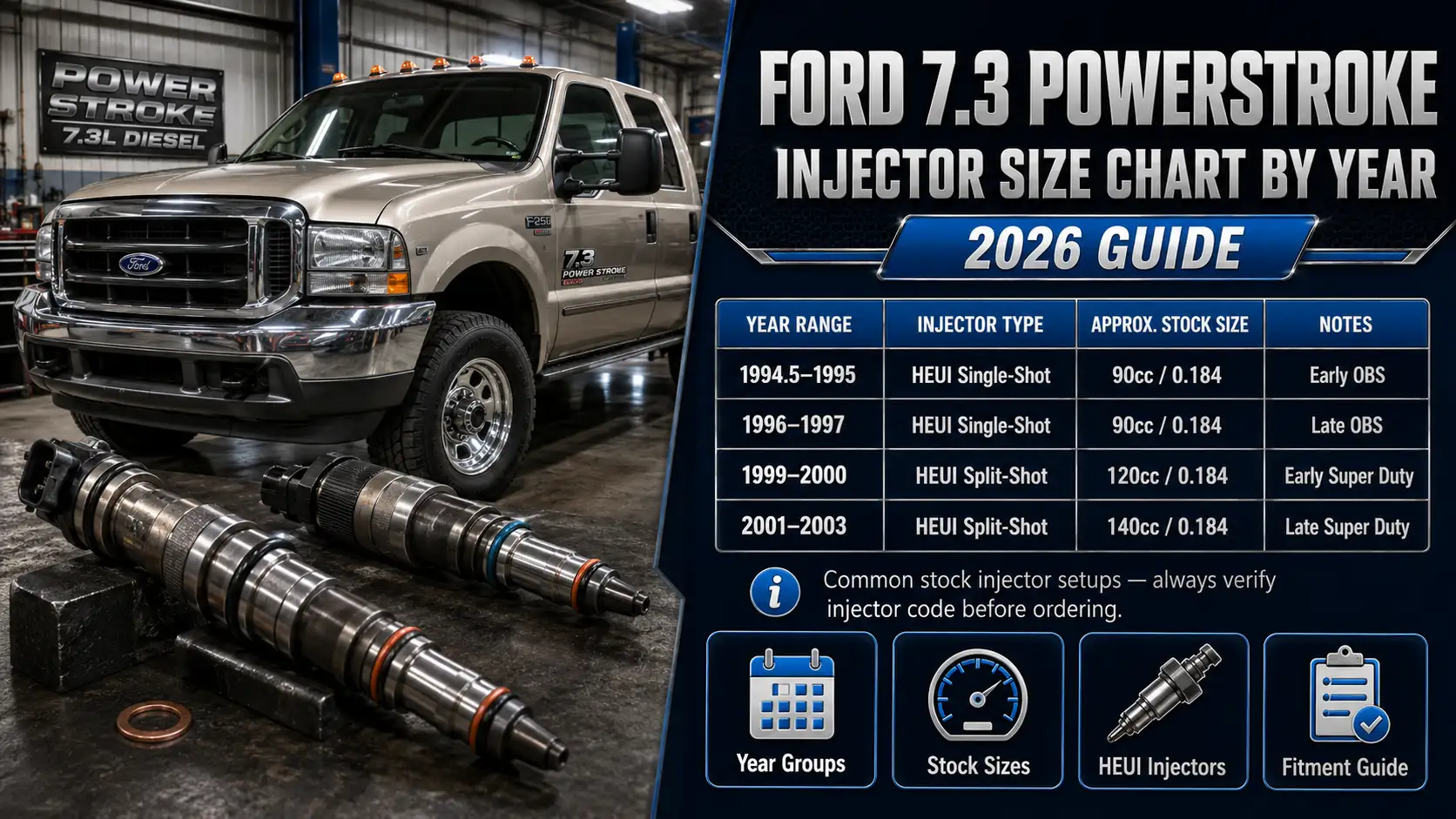
The 7.3 Powerstroke injector size chart your truck needs depends on the year it was built. OBS and Super Duty trucks left the factory with completely different injector codes and CC flow rates. A 1996 F-250 runs AA injectors at 90cc. A 2001 F-350 runs AD injectors at 135–140cc. Those are not interchangeable builds.
This article covers both tables you need. The first maps stock injector codes by year so you can confirm what came in your truck before ordering replacements. The second lays out every performance upgrade stage from 160cc through 238cc, with nozzle percentages, best use cases, and HPOP requirements.

Prime for Young Adults — 6 Months Free
Students and 18–24s get six months of Prime free, then half price.
Start 6 Months Free As an Amazon Associate I earn from qualifying purchases.The chart below starts with stock injector codes, then maps out every performance upgrade stage up to 238cc.
7.3 Powerstroke injector size chart — stock codes by year and aftermarket upgrade stages from 160cc to 238cc
Recommended Best Deal Products


FordMasterX reference guide
7.3 Powerstroke injector size chart
Stock injector codes by year
OBS
1994 – 1997
AA
90cc · Single shot
Non-CA trucksTransition

Audible — Listen Free for 30 Days
One free credit a month and thousands of titles included.
Listen Free for 30 Days As an Amazon Associate I earn from qualifying purchases.1997 CA + Early ’99
AB
130cc · Split shot
CA emissionsSuper Duty
Late 1999 – 2003
AD
135–140cc · Split shot
Cyl. 1–7TSB Fix
Late 1999 – 2003
AE
Audible Premium Plus — Annual Membership
12 audiobook credits up front, plus the full Audible catalogue.
See Annual Plans As an Amazon Associate I earn from qualifying purchases.135–140cc · Long lead
Cyl. #8 onlyAftermarket upgrade stages
Stage 1
160–180cc
Stock nozzle (0%)
Stage 1.5
180cc
30% over stock
Stage 2
180cc
80–100% over stock
Stage 3 Hybrid
205–238cc
30–100% over stock
CC flow comparison — stock vs. aftermarket
How the 7.3 Powerstroke HEUI Injector System Works
The 7.3 Powerstroke uses a HEUI (Hydraulic Electronic Unit Injector) fuel system — one of the most distinct diesel injection designs ever put in a Ford truck. Unlike common rail systems, HEUI injectors do not rely on a high-pressure fuel rail to fire. Instead, the HPOP (High Pressure Oil Pump) pressurizes engine oil and uses that oil pressure to actuate each injector mechanically.
The two numbers that define every 7.3 injector are CC flow and nozzle percentage. CC flow is the total volume of fuel the injector delivers per injection cycle. Nozzle percentage describes how much larger the tip opening is compared to factory — which controls how fast that fuel exits into the cylinder.
Both numbers matter together. A 238cc injector with a 30% nozzle behaves very differently from a 238cc injector with a 100% nozzle, even though the total fuel volume is the same. Larger CC means more fuel per cycle. Larger nozzle means faster delivery but less precise atomization.
One more factor ties directly to the HPOP: larger injectors demand more high-pressure oil to fire reliably. That is why Stage 2 A-code injectors with 100% nozzles are known to cause ICP (Injection Control Pressure) pressure drop issues on the stock HPOP. The pump simply cannot keep up. You can read more about the 7.3 Powerstroke ICP sensor diagnostics and location to understand how that pressure is monitored.
7.3 Powerstroke Stock Injector Size by Year and Code
Recommended Best Deal Products


| Model Year | Injector Code | CC Flow Rate | Shot Type | Generation Note |
|---|---|---|---|---|
| 1994–1997 | AA Alliant: AP63800AA Ford: F4TZ-9VE527-AARM | 90cc | Single Shot | OBS Non-California trucks |
| 1997 (CA only) + Early 1999 | AB Alliant: AP63801AB Ford: F61Z-9VE527-BRM | 130cc | Split Shot | CA / Transition CA emissions + nationwide early 1999 |
| Late 1999–2003 | AD Alliant: AP63803AD Motorcraft: CMR-7-RM Ford: F81Z-9E527-CRM | 135–140cc | Split Shot | Super Duty Standard Super Duty injector (cylinders 1–7) |
| Late 1999–2003 | AE Alliant: AP63804AE Motorcraft: CMR-8-RM | 135–140cc | Split Shot (Long Lead) | TSB Fix Cylinder #8 only — per TSB 03-21-39 |
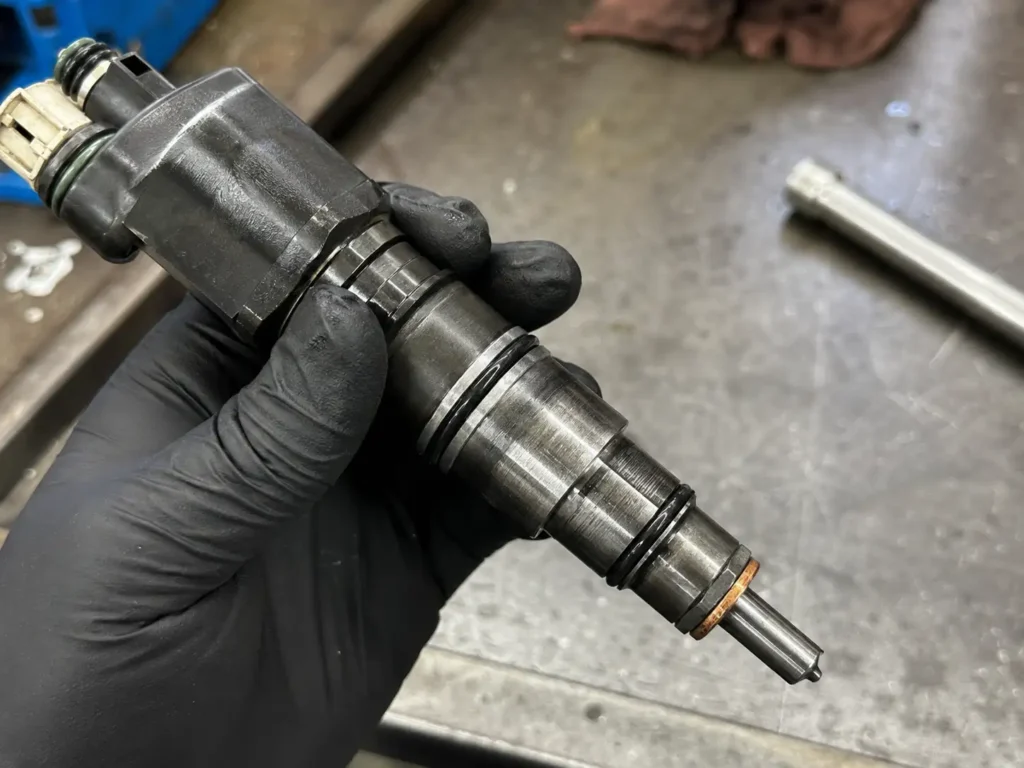
A note on the AE injector: Most complete replacement sets for 1999–2003 trucks include seven AD injectors and one AE in position #8. The AE uses a “long lead” design that delays the injection event slightly in cylinder #8, which runs hotter and sees more air entrainment in the fuel than the other seven cylinders. Ford issued TSB 03-21-39 specifically to address the cold-start cackle or knock this causes. If your truck cackles at startup, check whether your #8 cylinder still has the correct AE injector installed.
A note on the 1997 split-shot transition: California trucks started receiving AB (split-shot) injectors a year before the rest of the country due to state emissions requirements. Nationwide trucks did not get split-shot injectors until the early 1999 Super Duty platform launch. There is no 1998 model year 7.3 Powerstroke — Ford jumped directly from 1997 OBS to 1999 Super Duty with the platform change.
Once you know your stock baseline, the upgrade stage chart below shows exactly what each injector size adds in fuel delivery and power.
7.3 Powerstroke Aftermarket Injector Sizes by Stage
Aftermarket 7.3 Powerstroke injectors are sized by CC flow and nozzle percentage — both numbers matter for how the injector performs.| Stage | CC Flow | Nozzle % Over Stock | Design | Best Use Case | HPOP Upgrade Required? |
|---|---|---|---|---|---|
| Stage 1 | 160cc or 180cc | Stock nozzle (0%) | Single Shot | Daily driver, light-to-moderate towing, fuel economy priority | No — stock HPOP supports this |
| Stage 1.5 | 180cc | 30% over stock | Single Shot | Towing + moderate power increase, low smoke | Recommended at 180cc with supporting mods |
| Stage 2 | 180cc | 80% or 100% over stock | Single Shot | Performance builds, heavy towing, tuned trucks | Yes — 100% nozzle A-codes are oil-hungry on stock HPOP |
| Stage 3 Hybrid | 205cc or 238cc | 30%–100% nozzle options | Hybrid | Max performance, competition pulls, heavily modified builds | Yes — requires Adrenaline HPOP or equivalent + upgraded fuel system |
The 180cc/30% Stage 1.5 is the most widely recommended upgrade for 1999–2003 Super Duty owners across the powerstroke.org and ford-trucks.com communities. It delivers a meaningful power increase over the stock 135–140cc AD injectors while keeping smoke and oil demand manageable on trucks running a stock or lightly modified HPOP.
OBS owners with 1994–1997 trucks gain far more dramatically at Stage 1 than Super Duty owners do. Their stock AA injectors flow only 90cc — so even 160cc Stage 1 injectors nearly double fuel delivery. The stock AA injectors for the 94–97 OBS Powerstroke flow approximately 90cc of fuel. Stage 1.5 injectors can reach up to 180cc, which can more than double fuel flow and increase total horsepower up to 380 hp from a stock ceiling of around 235 hp with performance tuning alone.
Before locking in a stage, you need to know whether your HPOP can support the oil demand — that determines which sizes are safe on your current build.
Which 7.3 Injector Sizes Require an HPOP Upgrade
Recommended Best Deal Products


Injector size is only half the equation. The HPOP has to be able to supply enough high-pressure oil to fire those injectors reliably. Choosing injectors your HPOP cannot support is one of the most common and expensive mistakes 7.3 owners make.
The full HEUI system diagram is worth reviewing before upgrading — the 7.3 Powerstroke High Pressure Oil Pump diagram and system guide breaks down how oil pressure flows from the pump through the rails to each injector.
Stock HPOP Support Range
The stock 7.3 HPOP uses a 15-degree swash plate design. It can support Stage 1 injectors at 160cc or 180cc with a stock nozzle without issue. Stage 1.5 injectors at 180cc/30% are generally manageable on the stock pump but benefit from an HPOP upgrade as other supporting mods are added.
When To Upgrade the HPOP
Stage 2 A-code injectors with 80% or 100% nozzles push the stock HPOP beyond its reliable oil delivery range. Community data from powerstroke.org threads consistently reports ICP pressure instability with 180cc/100% A-code injectors on a stock pump. The P1211 fault code (ICP Not Controllable — Pressure Above/Below Desired) is the specific code that fires when the HPOP cannot keep pace.
The DieselSite Billet Adrenaline HPOP (part number ADRB73 for 1996–2003 trucks, ADRB95 for 1994–1995) is designed specifically to address the P1211 code and the injector oil starvation that occurs when running larger injectors on a stock pump. Current pricing starts at $1,299.
Stage 3 Hybrid injectors at 205cc or 238cc require the Adrenaline HPOP or a comparable high-volume pump plus a custom tuner chip regardless of nozzle size. A performance tuner — PHP Hydra, SCT X4, or Edge CTS3 — is non-negotiable with any aftermarket injector stage. The PCM must be recalibrated for the new fuel delivery profile or the truck will run rich, smoke excessively, and never realize the injectors’ potential.
5 Signs Your 7.3 Powerstroke Injectors Are Failing
Most 7.3 Powerstroke injectors do not fail all at once — they degrade over time and show warning signs before a full misfire appears.
- Cold-start cackle or knock. A rattling, knocking sound on cold startup that clears after a minute of running often points to a leaking or weak injector — or a missing AE injector in the #8 position. This is the exact symptom TSB 03-21-39 was written to address.
- Extended crank time or hard starting. The 7.3 HEUI system depends on adequate oil pressure to begin injection. When injectors leak down or the HPOP is weak, the engine cranks longer before oil pressure builds enough to fire. If cold starts take more than 3–4 seconds of cranking, have the ICP and HPOP tested before assuming the injectors are the only problem.
- Excessive black smoke under load. Some smoke on a diesel is normal during a hard pull, but steady rolling coal under moderate throttle typically means injectors are over-fueling due to a stuck-open nozzle or worn plunger barrel. Blue-white smoke at idle signals a different problem — oil being injected — which can indicate a cracked injector body.
- Power loss under tow or at WOT. A truck that pulls strong at light throttle but falls flat when you put your foot into it at highway speeds often has one or more injectors that cannot keep up with demand. Contribution testing with a scan tool isolates which cylinder is dropping.
- ICP fault codes — P1211 or P1280. The 7.3 Powerstroke has several injector-specific fault codes including P1209 (Injection Control System Pressure Peak Fault), P1210 (Injection Control Pressure Above Expected Level), P1211 (ICP Not Controllable — Pressure Above/Below Desired), and P1212 (ICP Voltage Not at Expected Level). P1280 is also specific to the 7.3 and points to ICP sensor circuit voltage out of range, which can accompany injector degradation.
If you are seeing two or more of these symptoms together, pull injector contribution data with a scan tool before committing to a replacement set. A single dead injector can mimic many of the symptoms above.
Choosing the Right 7.3 Powerstroke Injector for Your Build
The 7.3 Powerstroke injector size chart process is straightforward once you know your truck. Identify your stock code first — AA for OBS 1994–1997 trucks, AD for Super Duty 1999–2003. That tells you your fuel delivery baseline before you spend anything.
From there, the 180cc/30% Stage 1.5 is the community-validated sweet spot for most daily drivers and towing builds on 1999–2003 trucks. It works on a stock HPOP, requires a tuner chip, and delivers a genuine power increase without the oil-demand problems of 100% nozzle A-codes.
A tuner is non-negotiable at every stage. Without one, the PCM cannot account for the extra fuel and the truck will not perform as the injectors are capable of. For the best current injector sets across all stages and brands, see our full guide to the best injectors for the 7.3 Powerstroke.
Common Questions About 7.3 Powerstroke Injector Sizes
What size injectors does a stock 7.3 Powerstroke have?
It depends on the year. OBS trucks from 1994 to 1997 came with AA injectors flowing 90cc. Super Duty trucks from late 1999 through 2003 came with AD injectors flowing 135–140cc. California trucks and early 1999 models used AB injectors at 130cc.
What is the difference between 7.3 Powerstroke AA and AD injectors?
AA injectors are single-shot units flowing 90cc, used in 1994–1997 OBS trucks. AD injectors are split-shot units flowing 135–140cc, used in late 1999–2003 Super Duty trucks. The split-shot design fires a small pilot charge before the main injection event to reduce noise and emissions, but sacrifices some throttle response compared to single-shot operation.
Can I run Stage 2 injectors on a stock HPOP?
Stage 2 injectors with 80% nozzles are borderline on a stock HPOP. Stage 2 with 100% nozzles on A-code bodies are consistently reported to cause ICP pressure problems on the stock pump. The DieselSite Adrenaline HPOP (ADRB73) is the widely used solution starting at $1,299.
Do 7.3 Powerstroke injectors need a tuner?
Yes. Any aftermarket injector — Stage 1 through Stage 3 Hybrid — requires a performance chip or tuner to recalibrate the PCM for the increased fuel delivery. Running upgraded injectors without a tune causes excessive smoke, poor fuel economy, and prevents the injectors from reaching their rated power output.
How much do 7.3 Powerstroke injector replacements cost?
A full set of 8 stock replacement AD injectors (Alliant Power AP63803AD) runs approximately $2,499 for OEM new units. Aftermarket Stage 1 sets start around $1,275–$1,575 for a set of 8 depending on supplier and CC option. Stage 3 Hybrid sets start around $2,075 and up depending on CC and nozzle specification.