
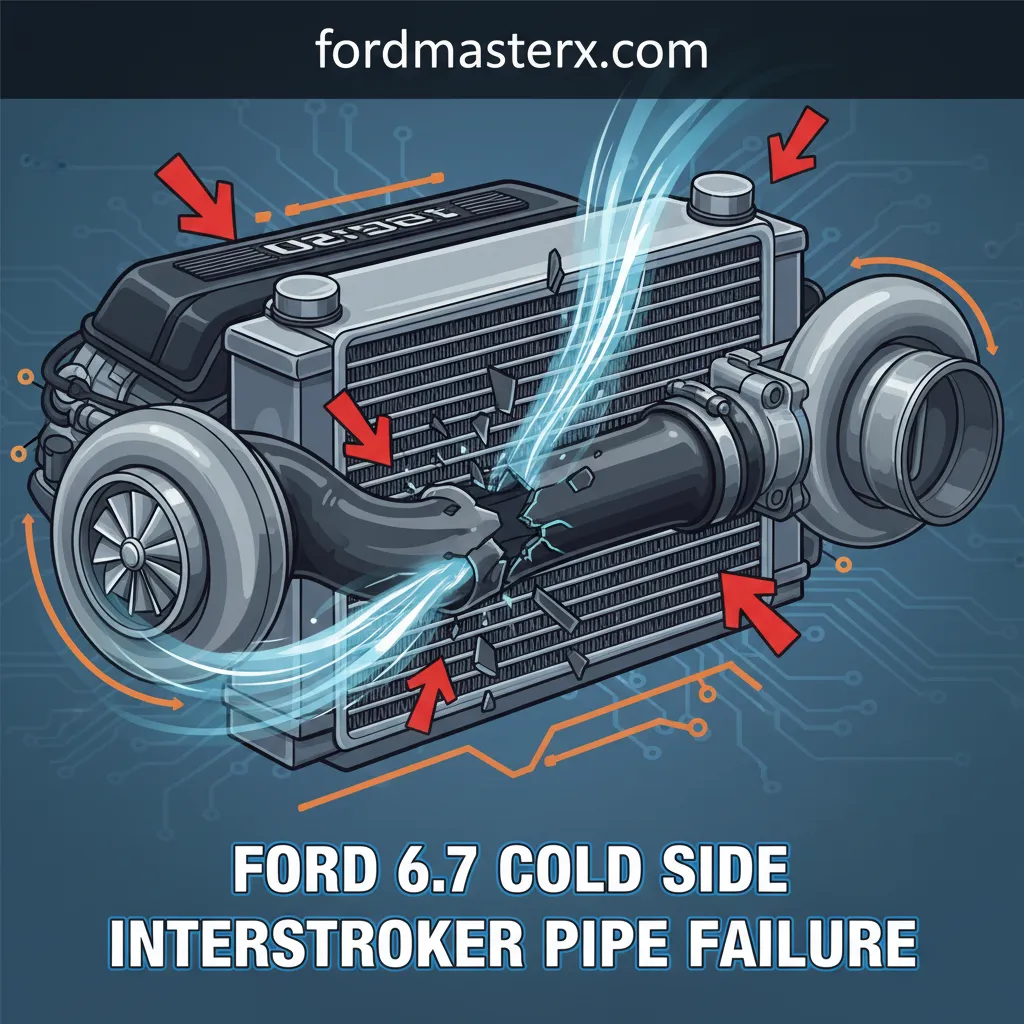
Ford 6.7 Cold Side Intercooler Pipe Failure: Causes, Diagnostic Symptoms, And Permanent Upgrades

For owners of the Ford 6.7L Power Stroke, the question is often not “if” the cold side intercooler pipe will fail, but “when.” Despite the massive torque and legendary reliability of the Ford Super Duty platform, the factory-installed plastic charge air cooler (CAC) pipe remains a notorious weak point. This component can leave drivers stranded on the shoulder of a highway or cause significant internal engine damage during a sudden high-pressure rupture. This comprehensive guide provides an expert analysis of why these failures occur, how to diagnose them before they become catastrophic, and the professional-grade aftermarket upgrades that offer a reliable, permanent solution for your trusted workhorse.
The Engineering Behind Ford 6.7 Cold Side Intercooler Pipe Failure
📤 Share Image
To understand why the factory pipe fails, one must look at the material science and environmental stresses present under the hood of a Super Duty. The OEM Charge Air Cooler (CAC) pipe is constructed from a thin-walled, heat-pressed composite plastic. While this material is cost-effective and lightweight, it is fundamentally ill-suited for the rigorous duty cycles of a modern diesel engine. The 6.7L Power Stroke utilizes a sophisticated Variable Geometry Turbocharger (VGT) capable of producing immense boost pressures instantly.
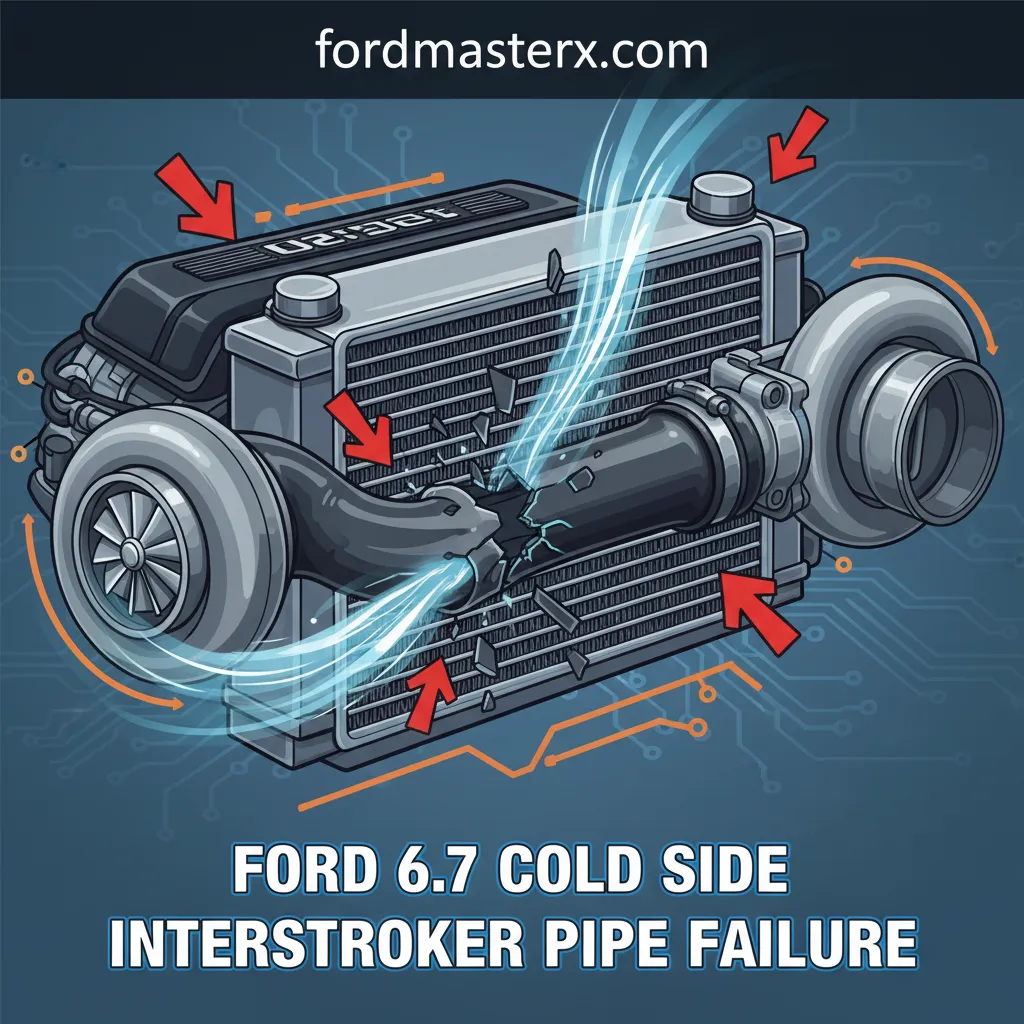
Thermal cycling is the primary silent killer. Every time the engine reaches operating temperature and subsequently cools down, the plastic pipe expands and contracts. Over thousands of miles, this constant movement weakens the structural integrity of the composite material, making it brittle. In a professional diagnostic setting, we often see these pipes fail precisely where the plastic is molded into complex shapes, such as the throttle body connection or the tight bend radius near the radiator.
The Crankcase Ventilation (CCV) system on the 6.7L Power Stroke vents oil vapor back into the intake. This oil saturates the internal lining of the cold side boots, causing the rubber and plastic interface to degrade chemically, which significantly accelerates the likelihood of a “blow-off” or rupture under load.
Consider a 2015 F-250 towing a 12,000lb fifth-wheel trailer. As the driver begins a steep grade climb, the PCM commands maximum boost. At this moment, pressures can exceed 30 PSI. While the factory plastic pipe is technically rated for 35-40 PSI when new, heat soak can reduce its structural threshold by 25% after just 50,000 miles. The result is a sudden, violent burst that leaves the driver without power in a dangerous location.
.jpg "Ford 6.7 Cold Side Intercooler Pipe Failure: Causes, Diagnostic Symptoms, And Permanent Upgrades 3")
Identifying Symptoms and Diagnostic Trouble Codes for Boost Leaks
Identifying a failing or ruptured intercooler pipe requires a mix of auditory, digital, and visual expert diagnostics. The most common indicator is a loud “pop”—often compared to a gunshot or a balloon bursting—followed immediately by a prominent hissing sound from the engine bay. This is the sound of pressurized air escaping the induction system instead of entering the cylinders.
From a digital standpoint, the vehicle’s On-Board Diagnostics (OBD-II) system will quickly flag the issue. The most common code is P0299: Turbocharger/Supercharger Underboost. When the PCM detects that the manifold absolute pressure (MAP) does not match the desired boost levels, it triggers a “Limp Mode.” In this state, the engine’s RPM and torque are severely limited to prevent further damage, often resulting in a 40-60% loss in effective engine torque.
Diagnostic Indicators
Underboost DTC
Critical EGT Peak
Torque Reduction
Physically, a driver will notice a surge in Exhaust Gas Temperatures (EGTs), often exceeding 1,400 degrees Fahrenheit, because the engine is running “rich”—too much fuel and not enough air. This imbalance manifests as thick black smoke from the tailpipe. A comprehensive visual inspection should focus on the quick-disconnect spring clip at the throttle body; look for hairline fractures in the plastic or an oily residue that suggests air and vapor are weeping through a crack before a total failure occurs.

Catastrophic Risks Associated with Delayed Pipe Replacement
Many owners mistakenly believe that a cracked intercooler pipe is merely a performance nuisance. In reality, it is a ticking time bomb for the entire 6.7L powertrain. One of the most severe risks is debris ingestion. When the plastic pipe shatters under high boost, shards of reinforced nylon can be sucked directly into the intake manifold. These fragments can lodge in valves or cause scoring on cylinder walls, potentially necessitating a full engine rebuild costing upwards of $15,000.
Furthermore, a sudden loss of boost pressure causes the turbocharger to enter an “overspeed” condition. Because there is no backpressure to resist the turbine’s rotation, the turbo spins well beyond its designed RPM limit as the PCM tries to compensate for the leak. This leads to bearing failure and, in extreme cases, the compressor wheel exploding. We have documented numerous case studies where a $100 plastic pipe failure resulted in a $2,500 secondary turbocharger replacement.
Driving with a boost leak creates excessive soot due to incomplete combustion. This soot will rapidly clog your Diesel Particulate Filter (DPF), forcing frequent, incomplete stationary regenerations that can permanently damage the expensive aftertreatment system.
Long-term wear on the Variable Geometry Turbo (VGT) vanes is another concern. The inconsistent backpressure and temperature spikes caused by a persistent hairline leak lead to carbon packing in the vane mechanism, eventually requiring the turbo to be pulled and cleaned or replaced entirely. The risk of being stranded with a heavy load on a remote grade makes a professional, proactive replacement a mandatory insurance policy for serious truck owners.
Trusted Aftermarket Solutions: Moving from Plastic to Aluminum
To achieve a complete and permanent fix, the factory plastic must be replaced with 6061 Mandrel-Bent Aluminum. Unlike plastic, aluminum does not fatigue under thermal cycling and offers vastly superior heat dissipation. Professional-grade aftermarket kits are tested to withstand over 100 PSI, more than triple the peak operating pressure of a stock 6.7 Power Stroke, ensuring that the pipe will never be the weakest link in your induction system again.
Aramid Reinforcement
High-quality kits use multi-layered silicone boots reinforced with Aramid fibers to prevent expansion and bursting under high heat.
CNC Adapters
Precision-machined quick-disconnect adapters ensure an OEM-style fit while replacing the fragile plastic locking mechanism.
When evaluating trusted brands like Mishimoto or Sinister Diesel, look for kits that include heavy-duty T-bolt clamps. Unlike the factory constant-tension worm gear clamps, T-bolt clamps provide uniform sealing pressure around the entire circumference of the boot. This is critical for preventing “boot blow-off,” a common issue with budget-tier replacements found on auction sites. A true “permanent fix” often involves bypassing the factory spring-clip connection entirely in favor of a traditional silicone boot and bead-rolled aluminum interface, which provides a much more secure mechanical bond.
Professional Installation Guidelines for Cold Side Upgrades
Installing a comprehensive intercooler pipe upgrade is a task most capable owners can handle, but it requires a professional eye for detail to ensure long-term reliability. The most critical step is surface preparation. Improperly cleaned surfaces are the leading cause of boot “blow-off” in 90% of DIY aftermarket pipe installations. Any trace of oil from the CCV system will act as a lubricant, allowing the boot to slide off under pressure.
📋
Installation Checklist
Use a high-quality brake cleaner to wipe down the throttle body inlet and intercooler outlet. They must be bone-dry before the silicone boots are applied.
Tighten T-bolt clamps to exactly 35-45 inch-pounds. Over-tightening can crush the aluminum pipe, while under-tightening leads to boost leaks.
Once the pipe is seated, verify clearances. Aluminum pipes are rigid and do not flex like plastic; ensure there is at least a half-inch of clearance between the pipe and the power steering reservoir or battery tray. Vibration rubbing can lead to a hole in the pipe over several months of driving. Finally, always perform a post-installation boost leak test. Using a soapy water solution on the joints while the engine is under a simulated load (or using a professional smoke machine) will confirm a 100% airtight seal. Once confirmed, use a scanning tool to clear any stored P0299 codes and reset the fuel trim parameters to ensure the PCM optimizes the air-to-fuel ratio for the newly restored boost levels.
The factory plastic cold side pipe on the 6.7L Power Stroke is fundamentally flawed due to heat-induced fatigue and pressure limitations. However, by proactively identifying symptoms like hissing sounds and P0299 codes, you can prevent catastrophic turbocharger and engine damage. Upgrading to a mandrel-bent aluminum pipe with reinforced silicone boots is the only reliable, expert-recommended method to ensure long-term performance. Do not wait for a roadside emergency; inspect your 6.7 Power Stroke’s intercooler pipe today and consider a professional aluminum upgrade to ensure your truck remains as reliable as the job demands.
Frequently Asked Questions
At what mileage does the Ford 6.7 cold side pipe usually fail?
While failures can occur at any time, most expert technicians observe ruptures between 50,000 and 80,000 miles. However, trucks used for heavy towing or those operating in high-heat climates may see failures as early as 30,000 miles due to increased thermal stress on the plastic composite.
Can I drive my truck after the intercooler pipe has burst?
Driving with a burst pipe is highly discouraged. Without boost pressure, the engine will experience extremely high exhaust gas temperatures and a rich fuel condition, which can clog the DPF and potentially lead to turbocharger overspeed. It is best to have the vehicle towed or repaired on-site.
Why did Ford use plastic for the intercooler pipe instead of metal?
Automotive manufacturers often utilize plastic composites to reduce production costs and shave vehicle weight. While sufficient for standard commuting, these materials often fail to meet the long-term durability requirements of high-torque diesel applications that see consistent high boost and extreme temperature fluctuations.
Is an aftermarket aluminum pipe difficult to install?
For a professional or an experienced DIYer, the installation is straightforward and typically takes 1-2 hours. The process involves removing the factory air box and the quick-disconnect clips. The primary challenge is ensuring a clean, oil-free surface for the new silicone boots to grip.
Will an aftermarket intercooler pipe void my Ford warranty?
Under the Magnuson-Moss Warranty Act, a manufacturer cannot void your entire warranty due to an aftermarket part unless they can prove that the specific part caused a failure. Since an aluminum pipe is a reliability upgrade that prevents damage, it is generally accepted, but always consult with your trusted service advisor.