
F150 vs F250 vs F350 vs F450 vs F550: 2026 Full Comparison Guide

F150 vs F250 vs F350 vs F450 vs F550: which Ford truck should you buy? The short answer is that the F-150 fits most owners, the F-250 and F-350 fit serious towing, and the F-450 and F-550 exist for trailers and work bodies the lighter trucks cannot legally carry.
Ford builds one truck family in five sizes. The numbers climb with the work, but so do the price, the fuel bill, and the size. Buying too small leaves you over your ratings, and buying too big wastes money every day.


This guide compares the whole lineup the same way: towing, payload, class, engines, and who each truck is for. Every maximum figure comes from Ford, and every figure is dated so you can check it against your model year.
The Short Answer in 7 Facts


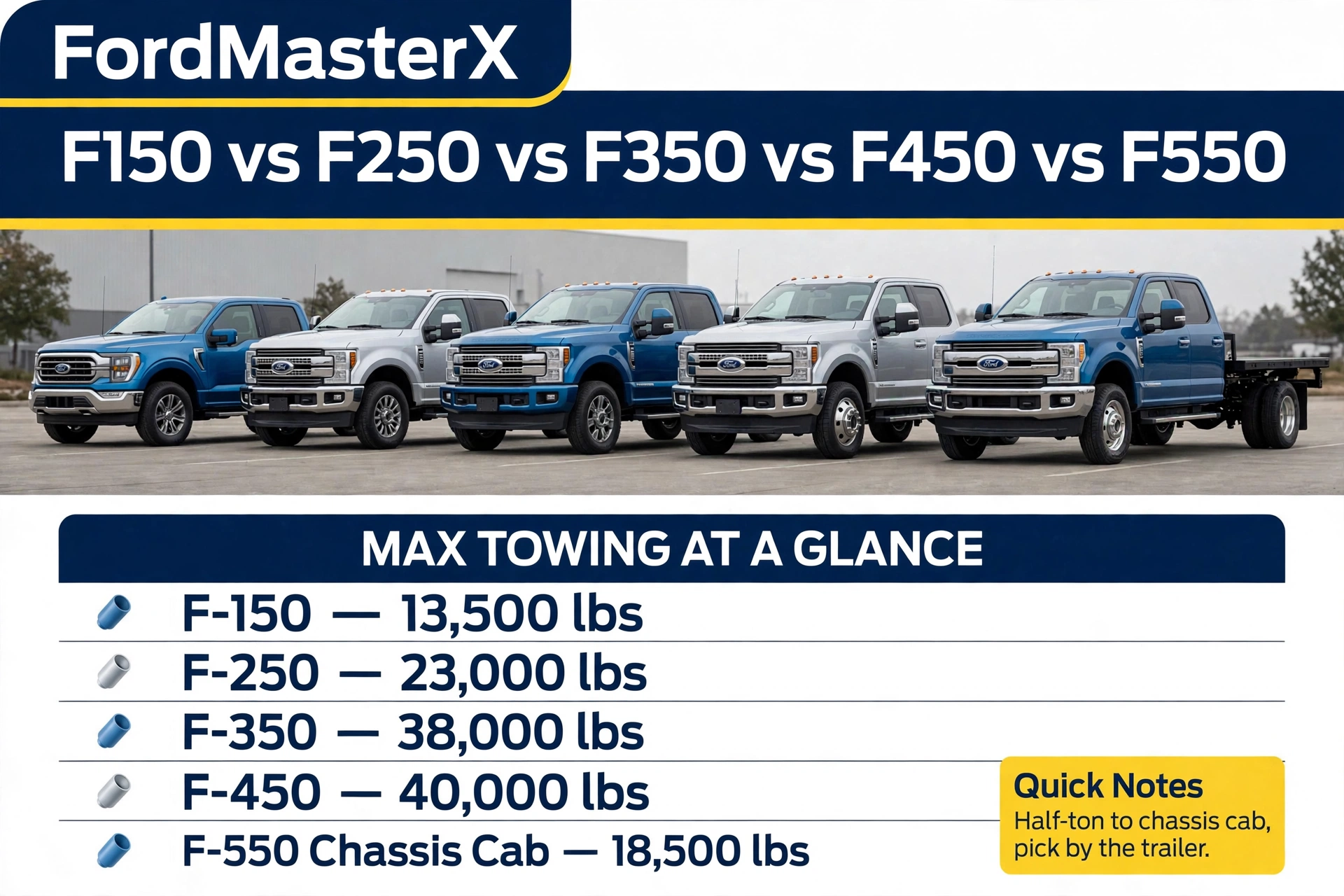
Seven facts settle most of the comparison. The table holds them, and the infographic below gives the same facts to save or share.
| Fact | What it means for you |
|---|---|
| Biggest jump | Towing rises 70% from the F-150 to the F-250 |
| Top tower | F-450 at 40,000 lbs, the highest in the lineup |
| Payload king | F-350 pickup at up to 8,000 lbs, gas engine |
| Class split | F-150 is light-duty; F-250 and up are Super Duty |
| Chassis cab | F-550 is a work platform, not a pickup |
| Same engines | Super Duty trucks share gas and diesel engines |
| Buy rule | Pick the smallest truck that covers your heaviest trailer |
F150 vs F250 vs F350 vs F450 vs F550: Max Towing at a Glance
Maximum available towing when properly equipped, from the Ford F-Series FAQ. Figures are for the 2027 Super Duty pickups and the 2026 F-150 unless noted.
| Truck | Class | Max towing | Best for |
|---|---|---|---|
| F-150 | Half-ton, light-duty | 13,500 lbs | Daily driving and light trailers |
| F-250 Super Duty | Three-quarter-ton | 23,000 lbs (gooseneck) | Heavy trailers and work-plus-tow use |
| F-350 Super Duty | One-ton | 38,000 lbs (gooseneck) | Fifth-wheel and gooseneck hauling |
| F-450 Super Duty | One-ton-plus, DRW | 40,000 lbs (gooseneck) | The biggest gooseneck trailers |
| F-550 Chassis Cab | Class 5 chassis cab | 18,500 lbs conventional | Dump, utility, and ambulance upfits |
Direct answer: Buy the smallest truck that covers your heaviest trailer with margin. The F-150 covers most owners, and the F-350 covers most fifth-wheels. The F-450 and F-550 exist for trailers and bodies the lighter trucks cannot legally carry.
Sources: Ford F-Series FAQ (ford.com) for F-150, F-250, F-350, and F-450 maximum towing; Ford fleet specification sheet for the 2026 F-550 chassis cab (18,500 lbs conventional towing, 19,500 lbs GVWR). All maximums need the right engine, axle, and tow package, and they drop with cab size, four-wheel drive, and options.
The chart above is the short version. The rest of this guide explains why the numbers jump the way they do, and which truck matches your trailer and your daily life.
How the F-Series Lineup Is Organized
Ford splits the F-Series into two families. The F-150 is the light-duty half-ton truck, and everything from the F-250 up is a Super Duty. That split dates to 1999, when Ford separated the heavy-duty trucks from the F-150 line.
The old ton labels still describe the classes. The F-150 is the half-ton, the F-250 is the three-quarter-ton, and the F-350 is the one-ton. The F-450 sits above the one-ton class, and the F-550 is a Class 5 medium-duty chassis cab.
Each step up brings a stronger frame, bigger brakes, heavier axles, and higher weight ratings. The trucks also get taller, wider, and harder to park. A crew cab F-450 dually is a very different daily driver from a regular cab F-150.
The F-450 and F-550 are not just bigger F-350s. The F-450 pickup comes only with dual rear wheels, a wide-track front axle, and the diesel engine. The F-550 does not come with a factory pickup bed at all.
Most buyers only need to compare three trucks. The F-150, F-250, and F-350 cover nearly every personal and small-business job. The F-450 and F-550 matter when the trailer or the work body crosses a legal weight limit.



F-150 vs F-250 vs F-350 vs F-450 vs F-550 Towing Compared
Towing is the number that decides this comparison for most buyers. The gaps between the trucks are large, and they grow with each step up the lineup.
Ford lists the maximum available towing for the 2027 Super Duty pickups and the 2026 F-150 as follows, in the Ford F-Series FAQ. Every figure needs the right engine, axle ratio, and tow package, and every figure falls when you add cab size, four-wheel drive, and options.
| Truck | Max towing | Configuration that earns it |
|---|---|---|
| F-150 | 13,500 lbs | Tow/Haul Package, Max Tow Axle |
| F-250 Super Duty | 23,000 lbs (gooseneck) | 2027 XL Regular Cab 4×2, 6.7L High-Output diesel, Trailer Tow Package |
| F-350 Super Duty | 38,000 lbs (gooseneck) | 2027 XL Regular Cab 4×2, DRW, 4.10 axle, 6.7L High-Output diesel |
| F-450 Super Duty | 40,000 lbs (gooseneck) | 2027 XL Regular Cab 4×2, DRW, 6.7L High-Output diesel, High-Capacity Gooseneck Tow Package |
| F-550 Chassis Cab | 18,500 lbs conventional | 2026 chassis cab, 6.7L diesel, 4.30 axle |
The F-150 to F-250 jump is the biggest percentage step in the lineup. Towing rises from 13,500 lbs to 23,000 lbs, a gain of 9,500 lbs, or about 70 percent. That single step moves you from travel trailers and boat trailers into large fifth-wheels and equipment trailers.
The F-250 to F-350 jump is even larger in raw pounds. Towing rises from 23,000 lbs to 38,000 lbs, but only in the dual-rear-wheel configuration with the 4.10 axle and the high-output diesel.
A single-rear-wheel F-350 tows far less than 38,000 lbs, so the headline number needs its fine print.
Those are gooseneck figures. The conventional maxima are lower: 22,000 lbs on the F-250, 28,000 lbs on the dual-rear-wheel F-350, and 30,000 lbs on the F-450.
The F-450 adds only 2,000 lbs over the F-350. Its real advantage is not the headline number. It is the wider front axle, the standard dual rear wheels, and the stability that comes with them on a heavy gooseneck trailer.
The F-550 looks weak on this table, and that is a trap.
Its 18,500 lbs is a conventional towing figure for a chassis cab that carries its load on its back, not behind it. Its gooseneck ratings run higher than its conventional figure, and its real job is payload and upfits, not trailer towing.
Older model years tow less than these figures. The F-150 reached 14,000 lbs in some earlier years, and the F-350 gooseneck rating was 35,750 lbs before the current generation. Always check the tow guide for your exact year, cab, axle, and engine before you buy.
Our F-150 towing capacity chart breaks the half-ton numbers down by engine and cab. Our F-250 towing capacity chart does the same for the three-quarter-ton truck.
Payload and GVWR Compared
Payload decides what you can carry in the bed and on the hitch. It is the number buyers forget, and it is the number that gets exceeded first. A trailer’s tongue weight counts against payload, so towing and payload are one budget, not two.
Ford lists the 2026 F-150 maximum payload at 2,440 lbs when properly configured. The PowerBoost hybrid version tops out lower, at 2,045 lbs. The hybrid battery and motor add weight that comes straight out of payload.
The 2026 Super Duty maximum payload is 8,000 lbs with the gas engine and 6,952 lbs with the diesel. The 8,000 lbs figure belongs to the F-350 with the Gas Heavy-Duty Payload Package, in a regular cab, two-wheel-drive, dual-rear-wheel configuration.
Diesel engines are heavier, so diesel trucks always give up some payload to gas trucks.
The F-550 chassis cab plays a different game. Its fleet specification sheet lists a maximum payload of 12,770 lbs and a gross vehicle weight rating of up to 19,500 lbs.
That payload is the body, the equipment, and the cargo together, and it is why fleets choose the F-550 for dump bodies and service bodies.
| Truck | Max payload | GVWR class |
|---|---|---|
| F-150 | 2,440 lbs | Under 8,500 lbs |
| F-250 Super Duty | Below the Super Duty maximum | Over 8,500 lbs |
| F-350 Super Duty | 8,000 lbs (gas) | Over 8,500 lbs |
| F-450 Super Duty | Below the F-350 gas maximum | Over 8,500 lbs |
| F-550 Chassis Cab | 12,770 lbs | Up to 19,500 lbs |
The table hides one honest fact. Ford publishes the Super Duty payload maximum for the range, not a separate maximum for the F-250 and the F-450. The F-250 sits below the F-350 on payload, and the F-450 gives up payload to its heavier axles and standard diesel engine.
Check the doorjamb label on the exact truck you buy. That label gives the real payload for that truck, with its cab, bed, engine, and options. No chart beats it, and no dealer estimate replaces it.
Our F-150 payload capacity chart shows how cab size and engine change the half-ton number. A crew cab four-wheel-drive truck can lose several hundred pounds of payload against the regular cab two-wheel-drive truck that earns the maximum.
Engines Across the Lineup
The F-150 and the Super Duty trucks share almost no engines. The half-ton runs on smaller gas engines and one hybrid, while the Super Duty runs on big gas V8s and the Power Stroke diesel.
The 2026 F-150 engine list is wide, as the 2026 F-150 specifications show. It runs from the 2.7 liter EcoBoost V6 through the 5.0 liter V8, the 3.5 liter EcoBoost V6, the 3.5 liter PowerBoost full hybrid V6, and the high-output 3.5 liter EcoBoost V6.
The Raptor R adds the high-output supercharged 5.2 liter V8.
The Super Duty engine list is short and heavy. The standard gas engine is the 6.8 liter V8 at 405 horsepower. The upgrade gas engine is the 7.3 liter Godzilla V8 at 430 horsepower and 485 lb-ft of torque, per Ford’s 2026 Super Duty technical specifications.
The diesel choice is the 6.7 liter Power Stroke V8. The standard version makes 475 horsepower, and the high-output version makes 500 horsepower. Ford-published torque figures are 1,050 lb-ft for the standard diesel and 1,200 lb-ft for the high-output version.
| Truck | Engine choices | What the engines are for |
|---|---|---|
| F-150 | 2.7L EcoBoost V6, 5.0L V8, 3.5L EcoBoost V6, 3.5L PowerBoost hybrid, 5.2L supercharged V8 | Daily driving, fuel economy, and speed |
| F-250 Super Duty | 6.8L gas V8, 7.3L gas V8, 6.7L Power Stroke diesel | Work towing with a gas or diesel choice |
| F-350 Super Duty | 6.8L gas V8, 7.3L gas V8, 6.7L Power Stroke diesel | Heavy towing, gas or diesel |
| F-450 Super Duty | 6.7L Power Stroke diesel only | Maximum gooseneck towing |
| F-550 Chassis Cab | 7.3L gas V8 (335 hp), 6.7L Power Stroke diesel (330 hp) | Commercial upfits and fleet work |
Chassis-cab engines are detuned versus the pickups: the 7.3L makes 335 horsepower and the 6.7L diesel 330 horsepower in the F-550, well below the pickup figures. Every Super Duty engine pairs with the 10-speed TorqShift automatic.
The F-150 also uses a 10-speed automatic, except for the hybrid, which uses a hybrid electronic 10-speed transmission. No manual transmission is offered anywhere in the lineup.
Gas versus diesel is the real engine decision on the Super Duty trucks. The 7.3 liter gas V8 costs less to buy and less to maintain, and it tows well for most owners.
The diesel costs more up front, needs diesel exhaust fluid, and tows heavier trailers with less effort.
The F-150 PowerBoost hybrid deserves a note. It tows up to 12,400 lbs (4×2), less than the 13,500 lbs maximum of the gas trucks.
It also brings Pro Power Onboard, which turns the truck into a generator at a job site or a campsite. That feature alone sells the hybrid to many buyers.
F-150 vs F-250: Half-Ton vs Three-Quarter-Ton
The F-150 against the F-250 is the comparison most buyers actually make. One is a daily driver that tows, and the other is a work truck that can be a daily driver.
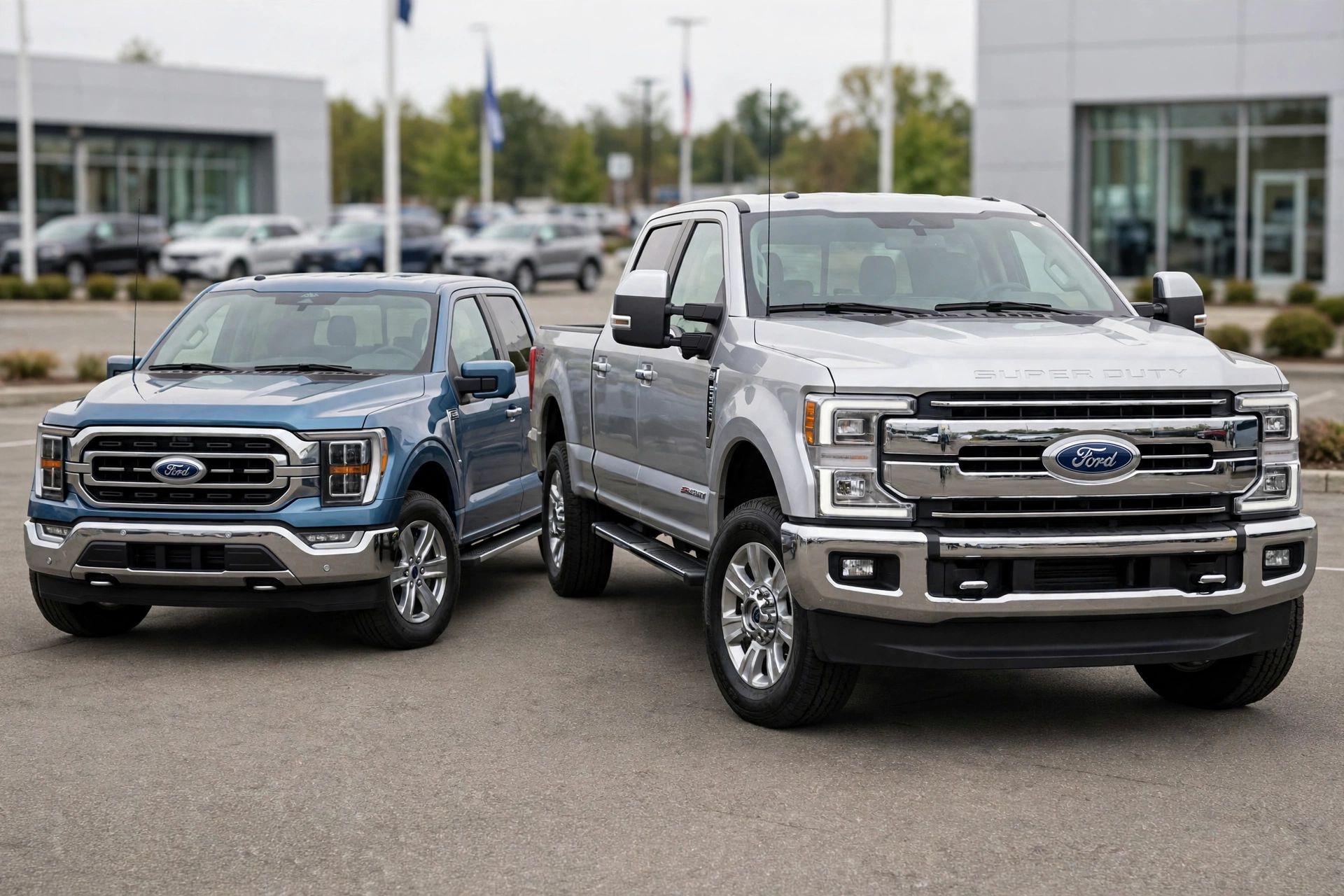
The size difference is visible the moment the two trucks park side by side. The F-250 sits taller, rides on a heavier frame, and carries bigger brakes and axles. The F-150 feels like a large car by comparison, and it drives like one too.
The F-150 wins on daily use. It rides softer, parks easier, uses less fuel, and costs less to buy and insure. Its 13,500 lbs maximum towing covers travel trailers, boat trailers, and car haulers for most owners.
The F-250 wins the moment the trailer gets heavy. Its 23,000 lbs maximum gooseneck towing (22,100 lbs fifth-wheel) covers large fifth-wheels and equipment trailers the F-150 cannot legally pull. Its frame and brakes are built for that weight, not just rated for it.
The F-250 also wins on durability under load. A half-ton truck towing near its limit works hard every mile. A three-quarter-ton truck towing the same trailer works well inside its limits, and that shows in brakes, transmission temperatures, and long-term wear.
Choose the F-150 when the truck is your daily driver and the trailer is occasional. Choose the F-250 when the trailer is the reason you own the truck, or when the trailer weighs more than about 10,000 lbs loaded.
F-150: Who It Is For
The F-150 is the right truck for most buyers. It is the best-selling truck in America for a reason, and that reason is range. It covers commuting, family duty, weekend projects, and light towing in one vehicle.
The F-150 suits buyers who tow less than 10,000 lbs. That covers most travel trailers, boat trailers, utility trailers, and car haulers. Its maximum of 13,500 lbs leaves room for a loaded trailer with gear, water, and fuel.
It also suits buyers who care about comfort and technology. The F-150 offers a quiet cabin, a strong infotainment system, and the most trim choices, from the work XL to the luxury Limited and the King Ranch.
The King Ranch interior shows how far the half-ton reaches into luxury territory.
The F-150 is the wrong truck for heavy fifth-wheels and gooseneck trailers. Its payload runs out before its towing rating does, and a fifth-wheel pin weight of 2,000 lbs or more eats most of its 2,440 lbs maximum payload. That leaves little room for passengers and cargo.
F-250: Who It Is For
The F-250 is the right truck for buyers who tow heavy and drive daily. It is the smallest Super Duty, and it is the most popular one for owners who need real towing without stepping up to a dually.
The F-250 suits travel trailer and fifth-wheel owners in the 12,000 to 18,000 lbs range. Its 23,000 lbs maximum towing leaves a comfortable margin, and its payload handles the pin weight of a mid-size fifth-wheel.
It also suits contractors who tow equipment trailers and carry tools at the same time.
The gas engines make sense on the F-250 for many buyers. The 7.3 liter Godzilla V8 tows well and avoids diesel maintenance costs. The diesel makes sense when the trailer is heavy, the miles are long, or the truck tows nearly every day.
The F-250 is the wrong truck for the biggest fifth-wheels. A large toy hauler or a full-size fifth-wheel with a pin weight over 3,000 lbs pushes past what a single-rear-wheel F-250 carries comfortably. That job belongs to the F-350.
Tires matter as much as the badge when you step up to Super Duty weight. Our F-250 tire size chart lists the stock sizes by year and trim, so you can check load ratings before you buy.
F-350: Who It Is For
The F-350 is the right truck for the biggest trailers most owners will ever tow. It is the one-ton truck, and it is where single-rear-wheel and dual-rear-wheel choices both exist. That choice changes the truck more than any option package does.
The single-rear-wheel F-350 suits large fifth-wheel owners who still want a truck that fits in a driveway and a parking space. It tows and carries far more than the F-250, and it looks nearly identical to it from the outside.
The dual-rear-wheel F-350 suits gooseneck and fifth-wheel owners who need maximum stability. The extra rear tires spread the load, resist sway, and carry the pin weight of the heaviest recreational trailers. Its 38,000 lbs maximum towing needs the dual rear wheels, the 4.10 axle, and the high-output diesel.
The F-350 is the wrong truck for buyers who rarely tow. It rides stiffer than the F-250 when empty, costs more to buy and run, and its size makes daily driving harder. Buy it for the trailer, not for the badge.
F-450: The Gooseneck King
The F-450 is the right truck for the heaviest gooseneck trailers on the road. It tows up to 40,000 lbs when properly equipped, and it is the only pickup in the lineup built around that job from the factory.
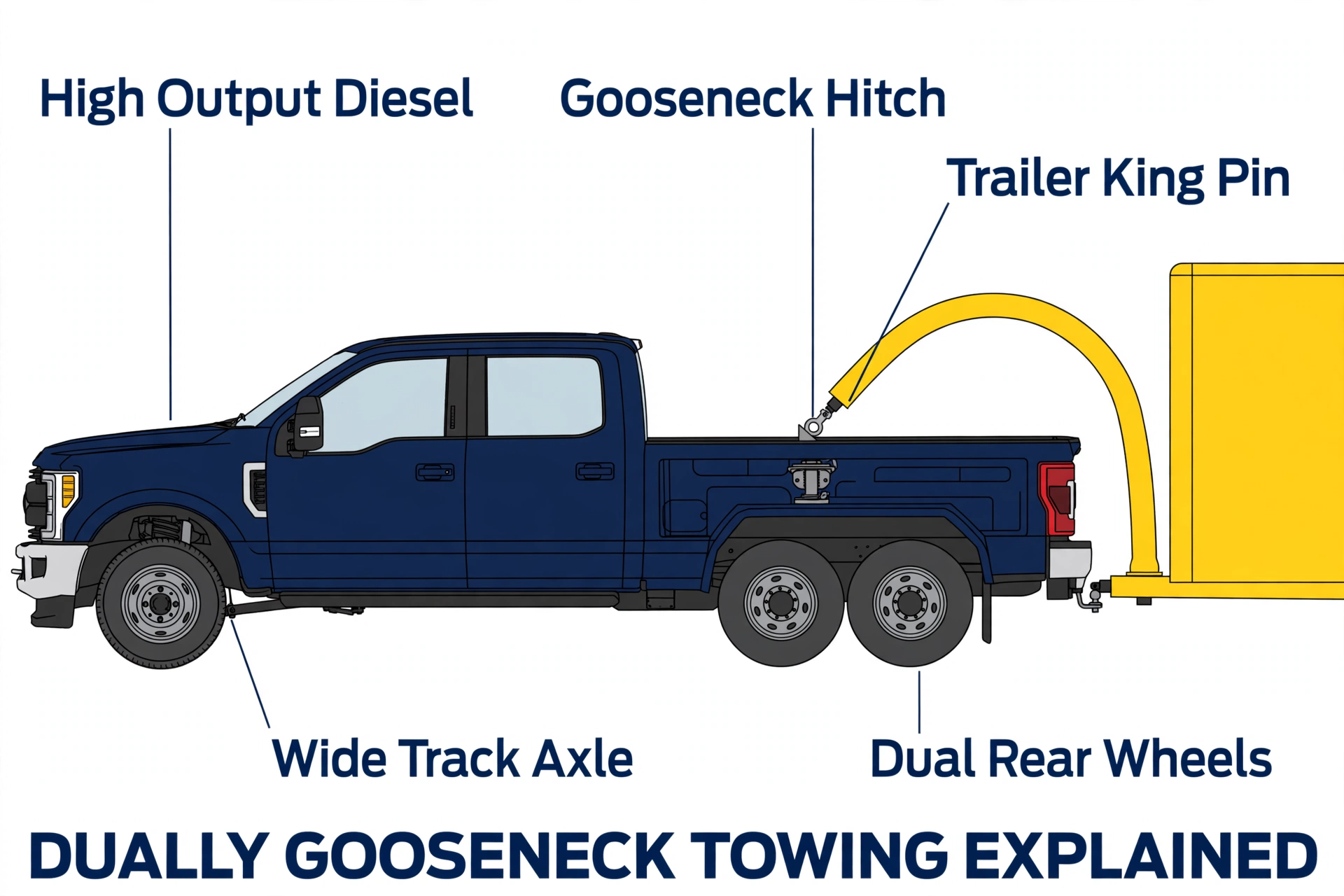
The F-450 comes only as a dual-rear-wheel pickup with the 6.7 liter Power Stroke diesel. There is no gas engine and no single-rear-wheel version. Ford builds it for one job, and it does that job better than any other pickup.
Its advantage is the wide-track front axle. The front track is wider than the F-350, which gives the F-450 a tighter turning circle despite its size. That matters when you back a 40-foot gooseneck into a tight space.
The F-450 also brings bigger brakes, a stronger frame, and a higher gross combined weight rating than the F-350. The 2,000 lbs towing advantage over the F-350 understates the difference, because the F-450 carries its load with more stability and more braking margin.
The F-450 is the wrong truck for most buyers. It is expensive, wide, thirsty, and hard to park.
Its dual rear wheels catch curbs, and its turning advantage does not make it a small truck. Buy it only when your trailer truly needs it.
Our F-450 towing capacity guide breaks the numbers down by year and configuration. Our F-350 vs F-450 comparison covers the two trucks head to head, including the axle and turning differences.
F-550: The Chassis Cab Workhorse
The F-550 is the right truck for businesses, not for personal use. It is a Class 5 chassis cab with a gross vehicle weight rating of up to 19,500 lbs, and it arrives without a bed so an upfitter can fit the body the job needs.
The F-550 suits dump trucks, utility bodies, flatbeds, rollback tow trucks, and ambulance upfits. Its 12,770 lbs maximum payload carries the body, the equipment, and the cargo together.
Dealer chassis cab guides list the same capability ladder, with the F-550 at the top of the Super Duty chassis cab range.
The F-550 also suits buyers who need a truck that stays under commercial driver license limits. A solo F-550 under 26,001 lbs combined weight often needs no commercial license, though a heavy trailer can change that.
Check your state rules before you buy, because the limits depend on the trailer as well as the truck.
The F-550 is the wrong truck for personal towing. Its chassis cab ride is stiff and its fuel economy is poor. A private buyer who wants a big pickup should buy the F-450 instead.
Most F-550s are sold to fleets and upfitters. Private buyers see them as completed trucks, often with a flatbed or a service body already fitted. Buying one used means checking the upfit as carefully as the truck, because the body is half the vehicle.
SRW vs DRW: The Choice That Changes Everything
Single rear wheel and dual rear wheel is the most important choice in the Super Duty lineup. It changes towing, payload, stability, width, and daily driving more than any engine or trim choice does.
Single rear wheel means one tire on each side of the rear axle. Dual rear wheel means two tires on each side, four across the rear. The dually carries more weight, resists sway better, and keeps going when one rear tire fails.
The F-250 comes only with single rear wheels. The F-350 offers both, and the F-450 comes only with dual rear wheels.
The F-550 chassis cab is also a dual-rear-wheel truck. That pattern tells you where Ford thinks the dually matters.
Choose single rear wheel when you want a truck that fits normal parking spaces and garages. Choose dual rear wheel when your fifth-wheel or gooseneck pin weight passes about 3,000 lbs, or when trailer sway has ever scared you. The extra tires are cheap insurance at that weight.
Our guide to what SRW means on a Ford truck explains the single-rear-wheel setup in full. It also covers the tire and wheel differences that catch new dually owners by surprise.
Which Truck for Your Trailer
Match the truck to the trailer, not to the neighbor. Start with the loaded trailer weight, add the tongue or pin weight to the payload budget, and leave at least 10 percent of margin on both numbers.
| Loaded trailer weight | Best truck | Why |
|---|---|---|
| Under 8,000 lbs | F-150 | Comfortable daily driver with towing to spare |
| 8,000 to 12,000 lbs | F-150 or F-250 | F-150 at its limit, F-250 with margin |
| 12,000 to 18,000 lbs | F-250 | Strong frame and brakes for the weight |
| 18,000 to 25,000 lbs | F-350 | One-ton payload and dual-rear-wheel option |
| 25,000 to 38,000 lbs | F-350 DRW or F-450 | Gooseneck stability and maximum ratings |
| Over 38,000 lbs | F-450 | The only pickup rated to 40,000 lbs |
| Work body, not a trailer | F-550 chassis cab | Payload and upfit capacity |
Weigh your trailer loaded before you trust any number in this table. Brochure dry weights leave out water, fuel, food, and gear, and a trailer that weighs 12,000 lbs on paper often weighs 14,000 lbs on the road. A scale ticket beats a brochure every time.
Check the payload budget next. A fifth-wheel with a 3,000 lbs pin weight needs a truck with at least 3,000 lbs of payload after passengers and cargo. Many F-150s and some F-250s fail that test even when their towing rating looks fine.
Think about how often you tow. A truck that tows once a month can sit near its limits. A truck that tows every week should sit well inside them, because brakes, tires, and transmissions wear faster at the edge.
6 F-Series Questions Buyers Ask
What Is the Biggest Ford Truck


The F-450 is the biggest Ford pickup, and the F-550 chassis cab is the biggest truck in the F-Series family.
The F-450 tows the most at 40,000 lbs, and the F-550 carries the most with a gross vehicle weight rating of up to 19,500 lbs. Ford also builds the F-600 and larger medium-duty trucks, but those sit outside the pickup lineup this guide compares.
Is the F-250 Enough for a Fifth-Wheel
Yes, for most fifth-wheels. The F-250 tows up to 23,000 lbs, which covers fifth-wheels up to about 18,000 lbs loaded with margin.
Check the pin weight against the truck’s payload first, because pin weight runs out before towing capacity on many fifth-wheel setups. Move to the F-350 when the pin weight passes 3,000 lbs.
Can an F-150 Tow a Fifth-Wheel
Yes, a small one. The F-150 tows up to 13,500 lbs, and some half-ton fifth-wheels weigh under 10,000 lbs loaded.
The pin weight is the limit, because a fifth-wheel pin of 2,000 lbs eats most of the F-150’s 2,440 lbs maximum payload. Most buyers who tow a fifth-wheel regularly are happier in an F-250.
What Is the Difference Between the F-350 and F-450
The F-450 is a dual-rear-wheel, diesel-only pickup with a wide-track front axle, bigger brakes, and a 40,000 lbs towing maximum.
The F-350 offers single or dual rear wheels, gas or diesel engines, and a 38,000 lbs maximum. The F-450 turns tighter and tows heavier goosenecks, while the F-350 is cheaper, narrower, and easier to live with daily.
Do I Need a CDL for an F-450 or F-550
Usually not for personal use, but it depends on the combined weight. Federal rules need a commercial license at 26,001 lbs combined gross vehicle weight rating for commercial use.
A solo F-550 under that limit often needs no commercial license, while the same truck with a heavy trailer can cross it. Check your state rules, because states apply the limits differently.
Which F-Series Truck Holds Its Value Best
Super Duty diesels tend to hold value well, and the F-250 with the 6.7 liter Power Stroke is a popular choice for resale. The F-150 holds value well too, especially in popular trims like the XLT and Lariat.
The F-550 holds value as a work truck, but its buyer pool is small, so it sells slower than the pickups.
Our Final Verdict on the F-Series Lineup
F150 vs F250 vs F350 vs F450 vs F550 comes down to one question: what is the heaviest thing you will tow or carry? Answer that honestly, add a margin, and the truck picks itself.
Most buyers should buy the F-150. It tows 13,500 lbs, carries 2,440 lbs, and drives like a comfortable daily vehicle. It is the cheapest truck here to buy, run, and park.
Buy the F-250 when the trailer passes 10,000 lbs loaded or when you tow every week. Buy the F-350 when the fifth-wheel or gooseneck passes 18,000 lbs or the pin weight passes 3,000 lbs.
Buy the F-450 when the gooseneck is the biggest thing on the road. Buy the F-550 when the job needs a body, not a bed.
Weigh the trailer, read the doorjamb label, and leave a margin on both numbers. The right Ford truck is the smallest one that covers your heaviest load with room to spare.