
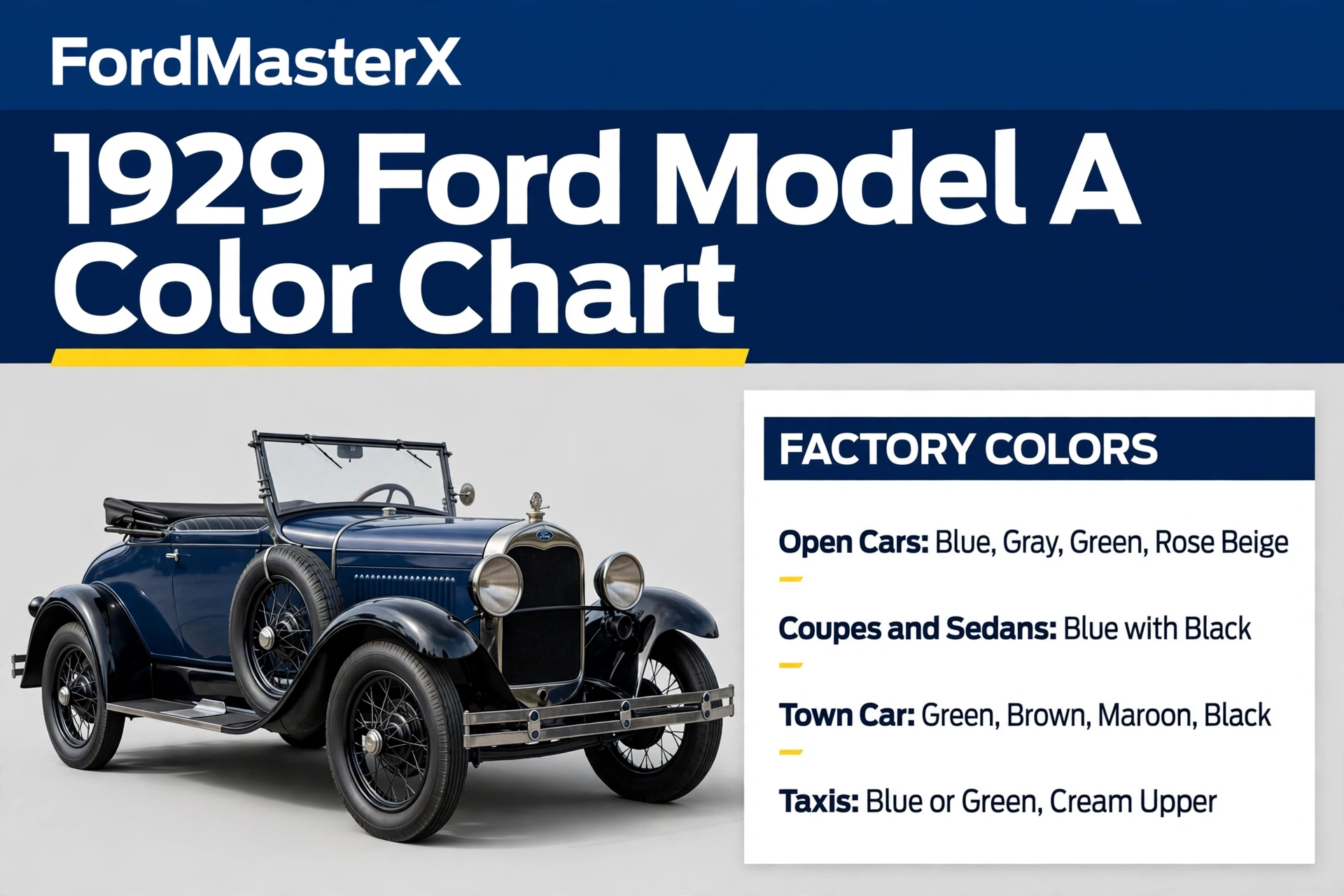
1929 Ford Model A Color Chart 2026 Complete Factory Guide

The 1929 Ford Model A color chart gives a different answer for each body style. Open cars came in blue, gray, green, and rose beige, while closed cars used two-tone blue with black or solid green, grey, or rose beige.
That split is the whole point of this chart. A 1929 color is only correct when it matches the body style it came on, the belt and molding color, and the pinstripe color. A right color on the wrong body still fails a judging sheet.


This guide gives you the factory chart first, then open and closed cars, the named colors, commercial and taxi colors, how to verify original paint, the mistakes that fail judging, and how to match these colors with modern paint. FordMasterX covers Ford colors across the decades.
Use it before you buy paint, before you judge a restoration, or before you pay for a car that claims a factory-correct finish.
The Short Answer in 5 Facts


Five facts answer most questions about the 1929 Ford Model A color chart. The table below holds them, and the infographic after it gives you the same facts to save or share.
| Fact | What it means for you |
|---|---|
| Open cars | Phaeton and Roadster came in blue, gray, green, and rose beige |
| Closed cars | Coupe, Tudor, and Fordor used blue with black or solid green, grey, or rose beige |
| Town Car | Green, brown, maroon, and black only |
| Taxis | Blue or green with cream-colored upper bodies |
| Stripe rule | Body, belt, and stripe colors were a factory set, not a free choice |
1929 Color Chart at a Glance
Factory colors by body style, from period records.
| Body style | Body color | Belt, molding, and stripe |
|---|---|---|
| Open cars, Phaeton and Roadster | Blue, gray, green, rose beige | See factory combos below |
| Coupe, Tudor, Fordor | Blue with black, or solid green, grey, rose beige | Two-tone belt and molding |
| Town Car | Green, brown, maroon, black | Chauffeur body, dark tones only |
| Taxi | Blue or green | Cream-colored upper body |
| Open car combo 1 | Arabian Sand, Dark | Copra Drab belt and molding, French Gray stripe |
| Open car combo 2 | Dawn Gray, Dark | Gunmetal Blue belt and molding, French Gray stripe |
| Open car combo 3 | Gunmetal Blue | Dawn Gray, Dark belt and molding, Straw stripe |
Direct answer: A 1929 Model A open car came in blue, gray, green, or rose beige. Closed cars used two-tone blue with black or solid green, grey, or rose beige, and the body, belt, and stripe colors were a factory set.
Sources: It Still Runs paint and finish guide for a Model A Ford; Kevin’s Autos original Model A colors. Color names are factory names from period records. Named shades such as Andalusite Blue and Kewanee Green appear in the glossary section below.
The chart above is the short version. The rest of this guide gives you the full chart by body style, the named colors behind those plain color words, and the checks that prove a finish is factory correct.
Start with the body style of your car. Every color decision after that follows from it.
1929 Ford Model A Color Chart by Body Style
Ford did not offer one color list for the whole 1929 range. Each body style had its own set of colors, and the sets did not mix. The chart below is the full version of the short answer above.
The It Still Runs paint and finish guide for a Model A Ford lists the 1929 colors by body style. It is the clearest single source for the year, and the chart below follows its groupings exactly.
Read the chart by row, not by color name alone. A color that is correct on a Roadster may be wrong on a Town Car, and a two-tone that is correct on a Tudor may be wrong on a Coupe.
| Body style | Body colors | Belt and molding | Stripe |
|---|---|---|---|
| Phaeton | Blue, gray, green, rose beige | See factory combos | French Gray or Straw |
| Roadster | Blue, gray, green, rose beige | See factory combos | French Gray or Straw |
| Coupe | Blue with black, or solid green, grey, rose beige | Contrasting belt and molding | Matching stripe |
| Tudor sedan | Blue with black, or solid green, grey, rose beige | Contrasting belt and molding | Matching stripe |
| Fordor sedan | Blue with black, or solid green, grey, rose beige | Contrasting belt and molding | Matching stripe |
| Town Car | Green, brown, maroon, black | Dark belt and molding | Matching stripe |
| Taxi | Blue or green | Cream-colored upper body | Matching stripe |
Two details in that chart catch first-time restorers. First, grey and gray are the same color family in these records, spelled both ways by different sources. Second, the Town Car had no blue and no rose beige in its set, so a blue Town Car is not factory correct even when the blue itself is a real 1929 color.
The taxi row is easy to miss, and it matters for buyers. A 1929 taxi used blue or green on the lower body with a cream-colored upper body. That cream upper is the mark of a taxi, not a repaint choice.


Our Ford paint code list covers modern Ford paint codes and how to read them. The 1929 Model A had no paint code plate like a modern Ford, so the chart above is the record you match against, not a code on the car.
Keep the chart beside you while you read the rest of this guide. Each section below adds the named shades and the checks that turn these plain color words into a verifiable finish.
Open Cars and Closed Cars in 1929
Open cars and closed cars followed different color logic in 1929. Open cars used single body colors with a belt, molding, and stripe set. Closed cars used two-tone schemes or solid colors with a contrasting belt.
The factory data for 1928 and 1929 open cars gives three exact combos. Kevin’s Autos original Model A colors page lists them from factory records, and the table below repeats them without change.
| Body color | Belt, quarter, and sill molding | Stripe color |
|---|---|---|
| Arabian Sand, Dark | Copra Drab | French Gray |
| Dawn Gray, Dark | Gunmetal Blue | French Gray |
| Gunmetal Blue | Dawn Gray, Dark | Straw |
Those three rows are the heart of the open-car chart. They show how Ford paired colors, and they show that the stripe color depended on the body and belt colors together. French Gray stripes go with the first two combos, while the Gunmetal Blue body takes a Straw stripe.
Closed cars worked the other way round. A Coupe, Tudor, or Fordor in blue used black as its second tone, while the same body in green, grey, or rose beige could be a solid color. The two-tone was a scheme, not a free mix of any two 1929 colors.
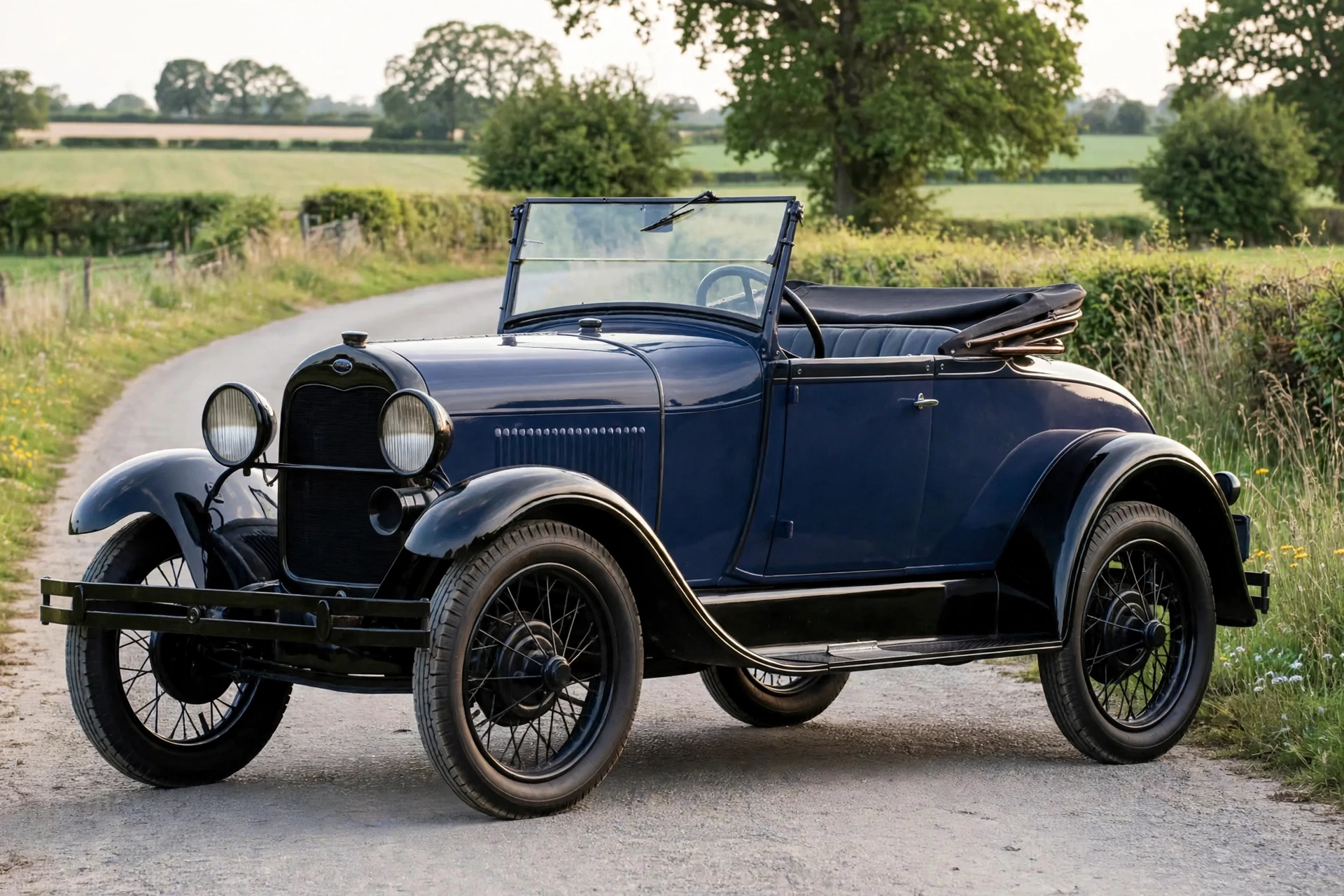
AI-generated illustration: a restored 1929 Ford Model A roadster in Andalusite Blue with black fenders and wire wheels on a country road.
The roadster in the photo shows the open-car look in Andalusite Blue. The deep blue body, black fenders, and wire wheels are the shape of a factory-correct 1929 open car.
One more open-car fact helps buyers. The Tudor sedan was the best-selling body style of the Model A run. Ford built 1,387,270 Standard Tudors across the run, per the FordMasterX guide to when the Model A was made.
Open cars are the cars collectors want most today. That demand is why so many open cars wear colors Ford never offered. Check the chart before you pay.
Two-Tone Combinations Ford Actually Built
Two-tone paint is where 1929 restorations go wrong most often. Owners pick two colors they like from the 1929 list. Ford built only certain pairs.
A wrong pair is easy for a judge to spot. The closed-car rule is simple. Blue bodies paired with black.
Green, grey, and rose beige bodies could be solid colors with a contrasting belt and molding. No other pairing appears in the 1929 records for these body styles.
The open-car sets are in the open-cars table above. They are the only factory sets recorded for 1928 and 1929 open cars. The Gunmetal Blue set shows why the stripe matters.
It takes a Straw stripe, not French Gray. A judge who knows the three sets will catch the swap, even when the car looks right at a glance.
| Combination | Body | Second tone or belt | Stripe | Body styles |
|---|---|---|---|---|
| Blue and black | Blue | Black | Matching | Coupe, Tudor, Fordor |
| Solid green | Green | Contrasting belt | Matching | Coupe, Tudor, Fordor |
| Solid grey | Grey | Contrasting belt | Matching | Coupe, Tudor, Fordor |
| Solid rose beige | Rose beige | Contrasting belt | Matching | Coupe, Tudor, Fordor |
Notice what is missing from that table. There is no green and black two-tone, no blue and green pair, and no rose beige and black pair for 1929 closed cars. Those pairs look plausible, but they are not in the factory record.
Our 2022 F-150 color chart shows how a modern Ford chart lists two-tone options by trim. The 1929 chart works the same way, with the body style as the trim. Match the pair to the body style first, then to the color names.
The 1929 Named Colors Glossary
The plain color words in the chart above hide the real 1929 names. Ford sold these colors under names like Andalusite Blue, Kewanee Green, and Copra Drab. A restorer needs the name, not just the color family.
The glossary below lists the named colors from the period records. Some names are tied to 1929 by a year-specific source. Others appear in the Cedar Creek Model A club newsletter and the Collector’s Originality Guide.
Those two sources list them as general 1928 to 1931 Model A names, with no per-name year given. The table says which is which. Use it to match a name you hear at a show.
| Color name | Color family | What the records show |
|---|---|---|
| Andalusite Blue | Deep blue | 1929 color, used 1928 to 1930 |
| Hessian Blue | Blue | Model A-era name, year to confirm |
| Niagara Blue | Blue | One of the four launch colors |
| Gunmetal Blue | Blue green | Open-car body and belt color |
| Kewanee Green | Green | Standard lower-body green on sedans, coupes, and trucks |
| Elkpoint Green | Green | Upper-body moldings |
| Apple Green | Green | Stripe color in the green package |
| Copra Drab | Tan brown drab | Belt and molding color |
| Chicle Drab | Drab | Model A-era name, year to confirm |
| Tacoma Cream | Cream | Model A-era name, year to confirm |
| French Gray | Gray | Stripe color |
| Rose Beige | Beige | Open and closed car body color |
| Dawn Gray | Gray | Open-car body and belt color |
| Arabian Sand | Sand beige | Open-car body color, one of the four launch colors |
Four names do not belong in a 1929 list. Lombard Blue and Ford Maroon arrived in mid-1930 for the Deluxe Roadster, per Hagerty. Aurora Red appears in Model A-era color lists, but no source ties it to 1929.
Thorne Brown appears in owner records as a 1931 color. Do not paint a 1929 car in any of these four names.
Kewanee Green was the standard lower-body green on sedans, coupes, and trucks. Elkpoint Green sat on the upper-body moldings, which is why the two greens often appear together on one car.
Niagara Blue, Arabian Sand, Dawn Gray, and Gunmetal Blue were the four standard colors at the 1928 launch. All four carried into 1929, which is why they anchor the open-car factory combos.
Do not treat every name in the glossary as a body color. Some names belong only to belts, moldings, or stripes. A car painted solid Apple Green would be wrong.
Our Ford interior color code chart covers the interior side of Ford color records. The 1929 Model A interior used its own trim colors. A full restoration checks those too, but the chart in this guide covers the exterior finish only.
Commercial and Taxi Colors for 1929
Commercial Model As had the narrowest color choice of any 1929 Ford. The range was limited until 1931, and most commercial trucks wore dark green. A bright red or yellow 1929 pickup is almost always a later repaint.
The Ford Barn commercial color thread for 1929 records what owners and judges found in the records. Commercial colors were limited to a small set. Gunmetal Blue and commercial drab were among them.
That thread also records a judging-standards point. Off the line, five colors were the known set for commercial use until 1931. A 1929 commercial vehicle in a color outside that set needs proof, not just a story.
Taxis were the exception to the dull commercial rule. A 1929 taxi used blue or green on the lower body with a cream-colored upper body. The cream upper is the taxi mark.
Three commercial details catch restorers out. First, commercial vehicles left the factory with a dull finish, not a buffed shine. A mirror-gloss commercial truck is wrong even in the right color.
Second, the pinstripe was optional on commercial vehicles, and a buyer paid extra for it, so a stripe is not proof of a factory finish. Third, black was not listed as a commercial vehicle color in the MAFCA Judging Standards, so an all-black 1929 commercial truck is not factory correct.
Gunmetal Blue causes the most confusion on commercial trucks. The name says blue, but owners in the Ford Barn thread report that it looks more green than blue in sunlight. One calls it a misnomer outright.
A Ditz-lac chip book from the period shows it as a darker blue. Sprayed panels can read as a light pea green in direct sun.
A chip book alone cannot settle the match. Spray a test panel and check it in sunlight before you paint the truck.
Most 1929 commercial trucks you see today are dark green. Rock Moss Green is the name owners mention most for pickups.
The thread documents it only through a 1930 Acme chip. It is a commonly used pickup color with no documented 1929 record. Check it against the Paint and Finish Guide before you commit to it.
How to Read a Paint Chip and Verify Original Paint
A paint chip is small, and small chips lie. A chip looks darker than the same color spread across a fender. A chip seen against a white page looks different from the same chip seen against the car.
Start with the MAFCA Paint and Finish Guide and the MAFCA Judging Standards. The Paint and Finish Guide holds the color chips and the body-style sets, while the Judging Standards hold the rules a show judge applies. Both books are the reference for a 1929 finish.
View each chip through a black sheet of paper with a hole cut to the size of the chip. The black surround stops the white page from washing out the color.
Painters in the Ford Barn thread recommend this method. Compare the chip in daylight, not under shop lights. The old lacquers shift in artificial light.
Check the car itself before you trust any chip. Look for original paint in places a repaint rarely reaches. Try under the dash rail, inside the door jambs, and behind trim pieces.
Grease and rust protect some of those spots, and the color under them is the closest thing to a factory sample you will find.
Spray a test panel before you paint the car. Take the paint reference code from the guide to a paint supplier and have a small amount mixed. Check that panel in direct sunlight and in shade, and compare it with the chip.
- Find the body style. Confirm the exact body style first, since the color set follows it.
- Match the full set. Write down the body, belt, molding, and stripe colors as one factory set.
- Check the guide. Compare the set with the MAFCA Paint and Finish Guide chips.
- Look for original paint. Check under trim, inside jambs, and behind the dash rail.
- Spray a test panel. Mix a small amount and check it in sunlight before you commit.
- Check the stripe. Confirm the stripe color and width against the guide, since stripes were often optional.
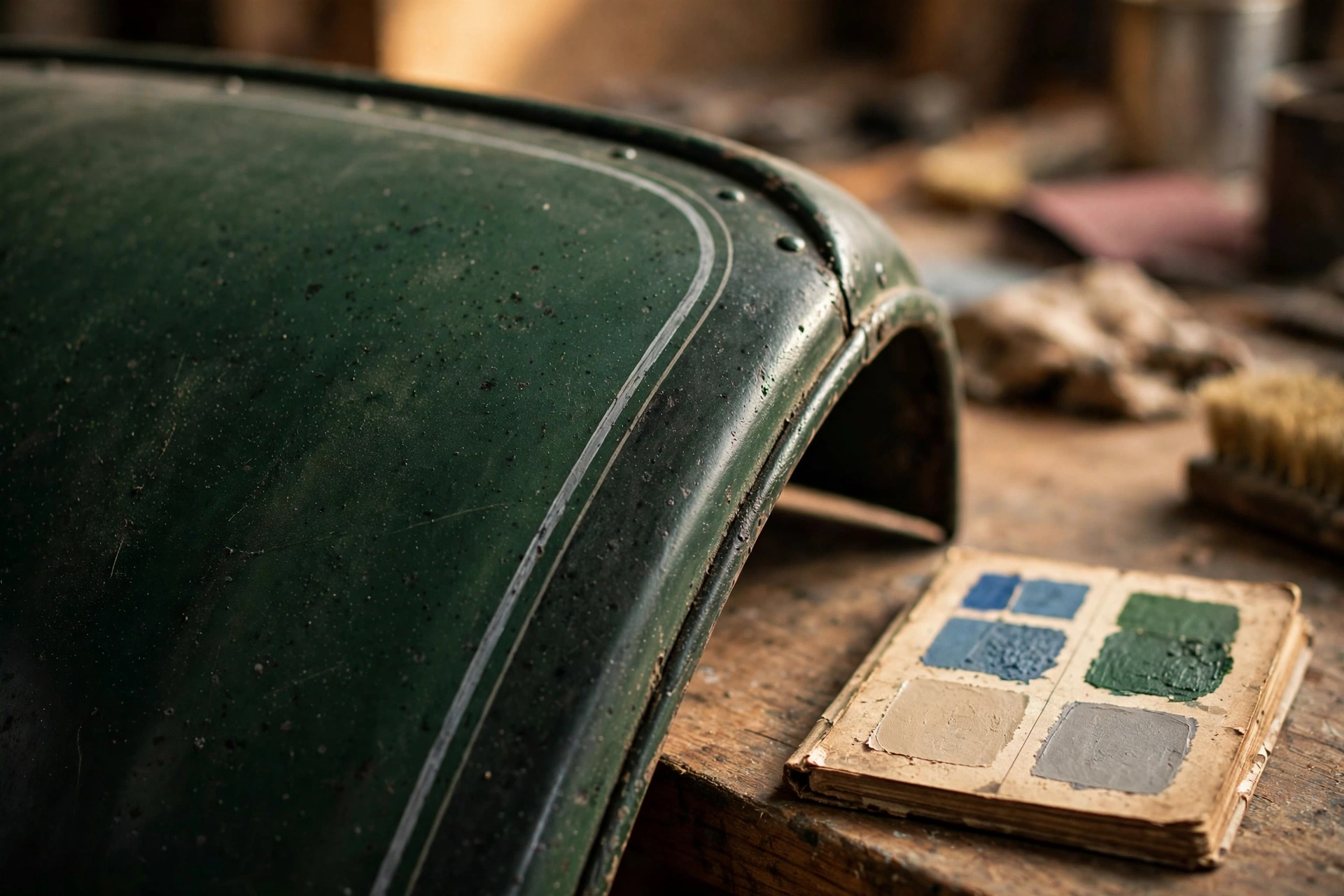
AI-generated illustration: a close-up of a French Gray pinstripe on a green 1929 Ford Model A fender beside a vintage paint chip chart.
Old paint has one more trap. The original lacquers have degraded over nearly a century, so surviving paint may not show the true original color. Trust the guide chips and a fresh spray-out over a faded panel.
5 Mistakes That Ruin a 1929 Restoration
Most 1929 color mistakes come from later years. Owners pick a color they saw on a 1930 or 1931 car. Then they paint a 1929 car with it.
The five mistakes below are the ones judges and buyers catch first.
Brewster Green on a 1929 Car


Brewster Green is a 1930 and 1931 color, not a 1929 color. It looks right on a Model A, but it fails a 1929 judging sheet. Check the year before you fall for the name.
Rubellite Red on a 1929 Car
Rubellite Red was introduced in 1930, and it was the only red of its time. A red 1929 Model A is not factory correct, even when the red is a real Model A color from a later year.
The same rule covers the named maroons. Ford Maroon arrived in mid-1930, and Aurora Red has no confirmed 1929 record. A 1929 car should wear neither name.
Gunmetal Gray Instead of Gunmetal Blue
Some sources list Gunmetal Gray among the popular Model A colors, while the factory table uses Gunmetal Blue. The two names describe the same factory color family. The confusion comes from the color itself, which reads as blue, gray, or green in different light.
Use the factory name Gunmetal Blue, and match it from a chip and a spray-out, not from the name alone.
A Two-Tone Pair Ford Never Built
A free mix of two 1929 colors is not a factory two-tone. Blue with black is the closed-car pair, and the three open-car sets in the open-cars table above are the only recorded open-car pairs. Any other pair needs proof from the guide, and a guess will fail judging.
A Buffed Shine on a Commercial Truck
Commercial Model As left the factory with a dull finish, not a buffed shine. A high-gloss commercial truck in the right color still fails the finish test. Keep the commercial finish dull, and keep the pinstripe optional, as the factory did.
Each of these mistakes is easy to avoid. Check the color name, the body style, and the year together in the guide before you order paint. A color that passes two of those three checks can still fail the third.
How to Match 1929 Colors With Modern Paint
Modern paint can match 1929 colors, but no modern paint is a 1929 paint. The factory used nitrocellulose lacquer. Modern paints use different chemistry, so a match is always visual, not the same product.
Start with the heritage formulas. PPG and Ditzler kept heritage formulas for these colors, and old Ditz-lac chip books from the 1940s and 1950s still show the period shades.
Dupont 151 is the code owners mention most for Gunmetal Blue. One owner in the Ford Barn thread had Dupont 151 mixed and sprayed it out against the Paint and Finish Guide chip.
The two came out close, with the guide chip reading more gray. That spray-out step is the method, not a one-off tip.
Scanning a chip can also work. One owner scanned a 1930 Acme chip for Rock Moss Green at a PPG supplier. The scan gave a near-perfect match to a modern Ford color.
A scan is only as good as the chip. Use the largest chip you can find, and check the result on a sprayed panel in sunlight.
Modern paint suppliers will sometimes suggest a close modern color. That can be a fair choice for a driver, but it is not a judging choice. A driver car in a close modern blue is fine, while a show car needs the heritage formula and the spray-out check.
The 1929 names work as labels, but the 1929 car has no code plate to check. The heritage formula and the guide chip are the proof instead.
Budget for the test panel. The first mix is rarely the final color, and a restorer who skips the test panel pays for the mistake across the whole car. A small test batch is the cheapest paint you will buy.
1929 Model A Facts That Shape the Color Story
The color chart makes more sense once you know the 1929 production story. Ford built the Model A from October 1927 to March 1932, and sold it as a 1928 to 1931 model. The year 1929 was the peak of the run.
The ClassicCarsArena 1929 Model A history records the production figures. US car production reached 1,507,132 in 1929, with 355,453 trucks on top. Ford passed Chevrolet again to take back first place in US sales.
The millionth Model A was built by February 4, 1929. The two millionth followed by July 24, 1929, just five months later.
The 1929 price list ran from 435 dollars for the Roadster to 1,200 dollars for the Town Car. The Tudor sedan sat at 500 dollars in the middle of the range.
The car itself was a 201 cu in L-head inline four-cylinder with 40 hp. It had a three-speed gearbox, four-wheel mechanical brakes, and a laminated safety-glass windshield. Top speed was about 65 mph.
Four standard colors were offered at launch: Niagara Blue, Arabian Sand, Dawn Gray, and Gunmetal Blue. Black was not one of them. That is a sharp break from the Model T years, when black was the only color for over a decade.
| Measure | 1929 figure | Why it matters for color |
|---|---|---|
| US cars built | 1,507,132 | Peak year, most 1929 colors survive in numbers |
| US trucks built | 355,453 | Commercial colors were a big share of output |
| Roadster price | 435 dollars | Cheapest open car in the range |
| Tudor price | 500 dollars | Most common body style across the run |
| Town Car price | 1,200 dollars | Dearest body, the narrowest color set |
| Town Car production | About 1,200 | Scarcest body, the narrowest color set |
| Launch colors | Four, no black | Color was a selling point from day one |
Our guide to when the Model A was made gives the full production dates. The short version is this. 1929 model-year production began in late 1928.
The 1,507,132 figure is a calendar-year US total, not a model-year count. A 1929 color chart is a model-year chart, so a car built in late 1928 can still wear 1929 colors.
That peak-year volume is good news for restorers. More 1929 cars were built than in any other Model A year. More original paint survives, and the color record for 1929 is the best documented of the four years.
Questions Owners Ask About 1929 Model A Colors
What Colors Came on 1929 Model As
Open cars came in blue, gray, green, and rose beige. Closed cars used blue with black or solid green, grey, or rose beige. Town Cars came in green, brown, maroon, and black, and taxis used blue or green with cream upper bodies.
What Is the Rarest Model A Color
No single 1929 color holds a clear rarest title in the records, since Ford did not publish color-by-color production counts. The Town Car colors are the scarcest in practice. About 1,200 Town Cars were built across the whole Model A run, per The Henry Ford and the ClassicCarsArena Town Car history.
Was Black a 1929 Model A Color
Black was a Town Car color in 1929. It was not a standard launch color, and it was not listed for commercial vehicles. A black 1929 Roadster or a black 1929 pickup is not factory correct, even though black Town Cars are.
How to Check Original 1929 Paint
Match the body, belt, and stripe colors as a set against the MAFCA Paint and Finish Guide. Look for original paint under trim and inside door jambs, then spray a test panel and check it in sunlight. The engine number, stamped on the frame, is the serial record to match.
Can Shops Mix 1929 Colors Today
Yes, from PPG and Ditzler heritage formulas or from a scanned period chip. Ask for a small test batch first, spray it on a panel, and check it in sunlight against the guide chip. The first mix is rarely the final color.
What Color Is Gunmetal Blue Really
Gunmetal Blue is a blue green that reads as blue, gray, or green in different light. The name confuses buyers, and some sources call it Gunmetal Gray, but the factory name is Gunmetal Blue. Match it from a chip and a spray-out, not from the name.
Our 11-digit VIN decoder guide for Ford explains how Ford serial numbers work across the years. A 1929 Model A predates the modern VIN system, so its engine number is the identifier that ties the car to its factory record.
Your 5 Step Check Before You Paint
The 1929 Ford Model A color chart is a body-style chart, not a free color list. Open cars came in blue, gray, green, and rose beige.
Closed cars used blue with black or solid green, grey, or rose beige. The Town Car and taxi each had their own narrow set.
Run the five step check before you paint. Confirm the body style. Match the body, belt, and stripe colors as one set.
Check the set against the MAFCA Paint and Finish Guide. Look for original paint on the car. Spray a test panel in sunlight.
That check takes a weekend. It can save you from painting a whole car the wrong color.
If the car passes, the finish will stand up to any judge. If it fails, you will know before the paint gun comes out.