
Is the Ford Taurus a Good Car? 2026 Honest Verdict Guide

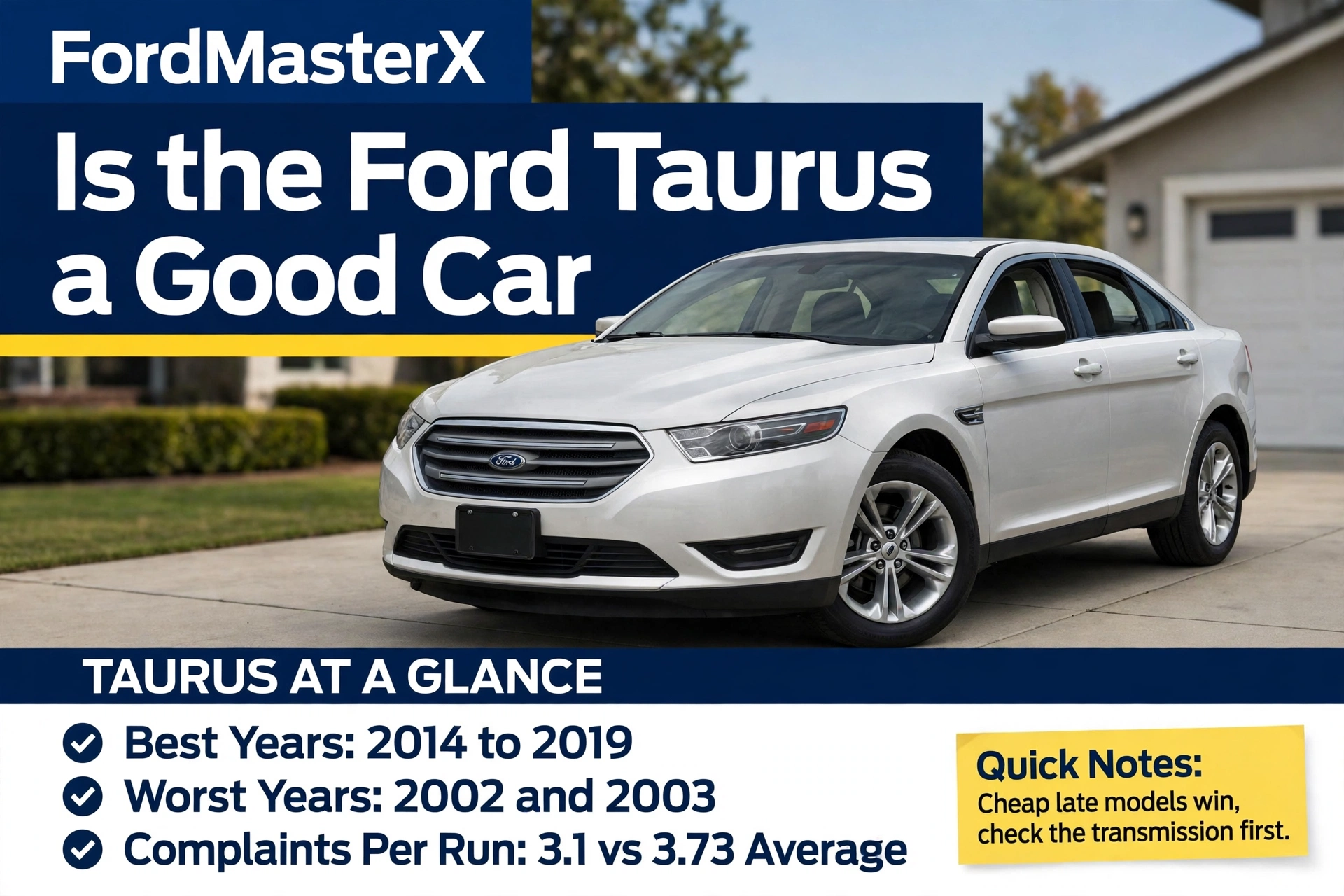
Is the Ford Taurus a good car? Yes, a late-model Taurus is a good cheap car. The 2014 through 2019 models are spacious and reliable, and they cost far less than rival full-size sedans.
The answer changes with the year. Early 2000s cars carry the worst complaint record in the nameplate, and one performance version can destroy its own engine. Ford sold the Taurus from 1986 through 2019, with a one-year break in 2007 when the nameplate was replaced by the Five Hundred, then ended it in the United States.

This guide gives the verdict by year, the complaint numbers behind it, and the checks that matter before you pay. Read it before you shop, and you will know which Taurus to buy and which one to walk past.
The Short Answer in 7 Facts


Seven facts answer most questions about the Taurus. The table holds them. The infographic below gives the same facts to save or share.
| Fact | What it means for you |
|---|---|
| Verdict | Late models win, early 2000s cars lose |
| Best years | 2014 through 2019, fewest owner complaints |
| Worst years | ForCar’s three years to walk away from: 2002, 2003, and 1999 |
| Complaint rate | 3.1 per production run vs 3.73 for the average car |
| Top failure | Suspension, 2,578 complaints at a typical age of 6.3 years |
| Warranty gap | Only 17.9 percent of failures fall inside the 3-year warranty |
| Biggest repair risk | P0420 catalyst code, reported repair cost $1,538 to $2,041 |
Ford Taurus Best vs Worst Years
Complaints per VIN production run, from NHTSA complaint data grouped by ForCar. Lower is better.
| Model year | Complaints per run | Total complaints | Verdict |
|---|---|---|---|
| 2019 | 1.38 | 18 | Best |
| 2018 | 1.46 | 51 | Best |
| 2017 | 1.48 | 43 | Best |
| 2016 | 1.83 | 86 | Best |
| 2014 | 3.16 | 221 | Best (CarGurus, by total complaints) |
| 2004 | 1.94 | 306 | Best older pick (ForCar, by rate) |
| 2003 | 3.76 | 1,014 | Avoid |
| 2002 | 4.25 | 1,208 | Avoid |
| 1999 | 3.92 | 658 | Avoid |
Direct answer: A late-model Taurus is a good cheap car. The 2014 to 2019 cars have the fewest owner complaints in the CarComplaints record. The 2002 and 2003 cars have the highest totals among 2000s models, so skip them.
Sources: ForCar Taurus reliability page, NHTSA complaints grouped by VIN production run; CarGurus Ford Taurus buying guide, CarComplaints data.
CarGurus ranks 2014 to 2019 best by total complaint count. ForCar ranks by complaints per production run, which is why its older-car picks differ. Newer cars have had less time to collect complaints, so read the two methods together.
The chart above is the short version. The rest of this guide explains the verdict year by year. It also shows what breaks, what it costs, and how to check a used car.
Is the Ford Taurus a Good Car
The Taurus earns a yes with a condition. Buy a late model and you get a big, comfortable sedan for small-car money. Buy an early 2000s car and you buy the worst complaint record Ford attached to the name.
The Taurus was once the best-selling car in America. It held that title from 1992 through 1996, and it shaped how family sedans looked for a decade. By the time Ford ended US sales after 2019, the car had fallen behind its rivals on technology and fuel economy.
That fall from the top is what makes the late cars cheap now. A 2017 or 2018 Taurus gives you full-size room and a proven V6 at a small-car price. The trade is dated infotainment and thirsty fuel economy next to newer rivals.
The car suits one buyer best. If you want the lowest price for a spacious, reliable sedan and you can live with older tech, the Taurus fits. If you want modern driver aids, strong resale value, or the best fuel economy, look at a newer rival instead.
Ford sedans share a pattern. The year and the gearbox decide the verdict more than the badge does. Our guide to whether the Ford Focus is a good car shows the same rule at work on the smaller Ford sedan.

Three facts set the Taurus apart from most used cars. First, the complaint rate sits below the average car.
Second, the best years are the cheapest years to own. Third, the worst years are easy to name and easy to skip.
Best Ford Taurus Years to Buy
The final five model years are the safe buy. CarGurus, using CarComplaints data, names 2014 through 2019 as the years with the fewest complaints. Those cars are late in the run, and Ford had fixed most of the early faults by then.
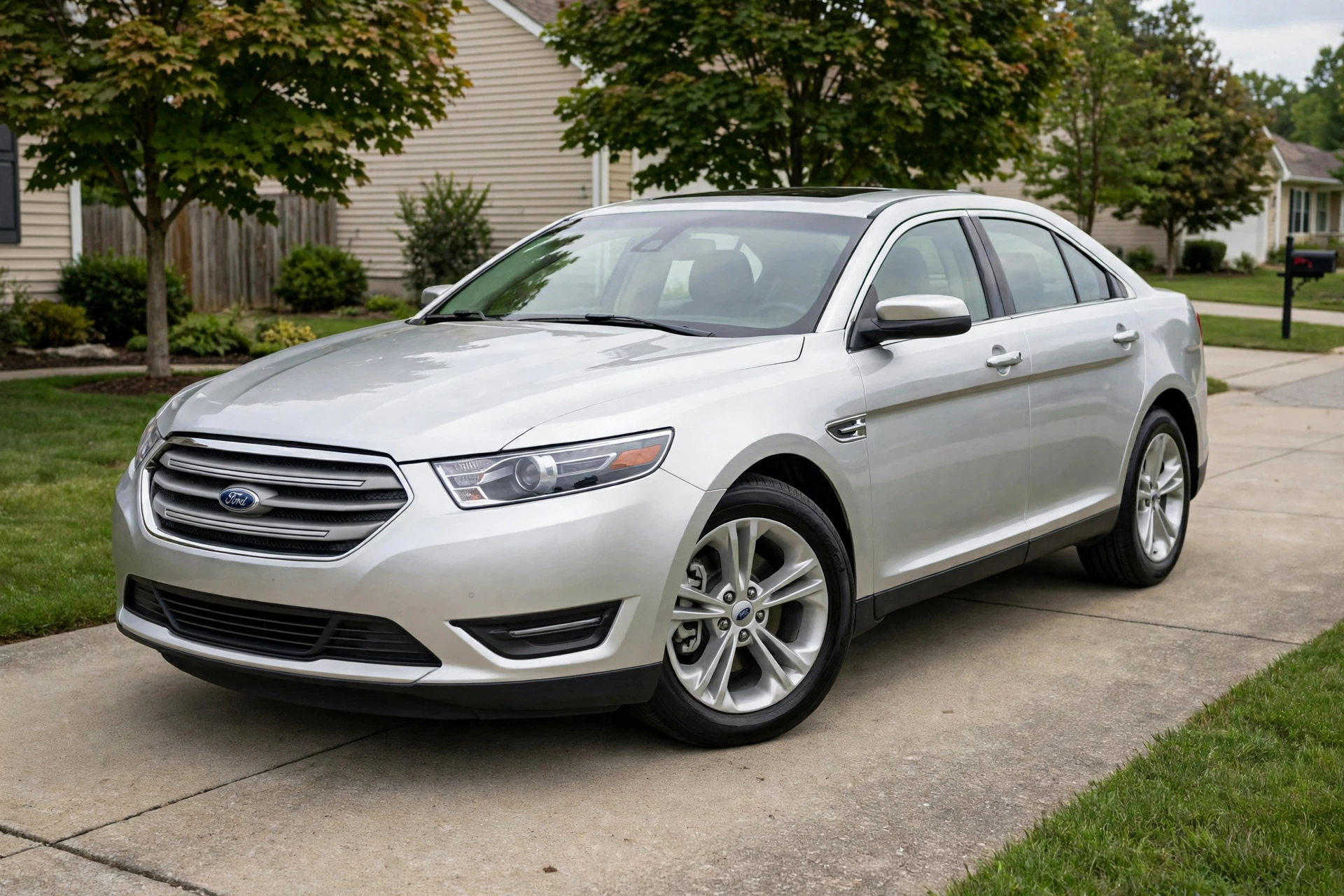
The 2017 and 2018 models lead the list. FIXD ranks the 2017 and 2018 Taurus as the best years. They score 6 out of 10 for reliability and 10 out of 10 for owner reliability.
NHTSA crash testing scores them 4.8 out of 5, close to perfect.
These two years also cost the least to keep. FIXD reports annual maintenance and repair of $250 to $500 for them. The 2018 car averages $250 a year, tied with the 2011 car for the lowest figure FIXD reports for any Taurus year.
The 2015 and 2016 models sit just behind them. FIXD scores them 3 to 6 out of 10 for reliability and 8 to 10 out of 10 for owner satisfaction. Their NHTSA crash score is also 4.8 out of 5, and neither year shows a high chance of major engine or transmission repairs.
The engines in the late cars are proven. The standard 3.5 liter V6 made 263 horsepower from 2010 through 2012, then 288 horsepower from 2013 on.
The 2.0 liter EcoBoost four cylinder joined the range for 2014. It gave the best fuel economy of any Taurus at 22 miles per gallon in the city, 31 on the highway, and 25 combined.
The 2013 refresh matters for buyers. Ford changed the grille and front fascia, updated the suspension, and improved the front seats. The standard V6 in that year returned 19 miles per gallon in the city, 28 on the highway, and 22 combined.
One late year needs a closer look. The 2011 Taurus scores only 1 out of 10 on the FIXD reliability scale, yet owners give it 10 out of 10.
FIXD builds its score from diagnostic trouble codes per year, weighted by mileage. A car that throws codes often scores low even when owners stay happy with it. Read the owner score with the FIXD score, not instead of it.
CarGurus sums up the late cars well. It writes that the 2014 to 2019 cars are “pretty boring cars, but if cheap and reliable transportation is paramount, then one of those model years may be a decent option.” The CarGurus Taurus buying guide names the final five model years as the best buy for a low price.
Buy a 2014 to 2019 Taurus with a clean inspection and full service records. That combination is the safest way into a full-size Ford sedan at a small-car price.
Worst Ford Taurus Years to Avoid
CarGurus calls the 2003 Taurus the worst year to buy. It drew 1,014 NHTSA complaints, behind 2002’s 1,208. The 2002 car drew 1,208 complaints at 4.25 complaints per production run.
The whole block from 2000 through 2005 stands out. CarGurus flags that entire stretch as complaint heavy, and the ForCar table agrees. The 2005 car drew 632 complaints at 5.85 per run, and the 2006 car drew 266 complaints at 5.54 per run.
The 1999 car belongs on the avoid list too. It drew 658 complaints at 3.92 per run, and ForCar names it with 2002 and 2003 as the three years to walk away from.
The transmission is the main reason to avoid these years. Any Taurus with the four-speed automatic is a reliability risk, and Ford used that gearbox from 1986 through 2006. CarGurus notes that Ford tried to fix it through its whole life, yet the four-speed never shook its poor reputation.
One performance version carries a worse fault. The 1996 to 1999 Taurus SHO used a 3.4 liter V8 that sounded fine when new.
Its camshafts can detach from their sprockets, and that failure can destroy the engine outright. Skip the third-generation SHO as a daily driver.
Later SHO cars are a different story. The 2010 to 2019 SHO used a twin-turbo 3.5 liter EcoBoost V6 with 365 horsepower and 350 pound-feet of torque to all four wheels. CarGurus calls it the most powerful and quickest SHO ever, and it can still be found with low mileage.
The 2012 to 2014 cars need care for a different reason. FIXD lists them among the worst years because repair costs run high.
The 2012 car averages $1,625 a year in maintenance and repair. That is the highest figure of any Taurus year, and it comes with a high chance of expensive engine and transmission work.
Year lists mislead when they ignore the gearbox, and Ford proves it twice. Our guide to what year Ford Focus to avoid shows the same lesson, where the transmission decides the verdict more than the year does.
Why Three Sources Disagree on Old Taurus Years
Two good sources give different best-year lists, and both are right. The difference is the method, not the data. Read the method first and the lists make sense together.
CarGurus ranks years by total complaint count. The 2014 to 2019 cars have the fewest complaints in the CarComplaints file, so they top its list. That method favors newer cars, which have had less time on the road to collect complaints.
ForCar ranks years by complaints per VIN production run. It groups complaints by VIN production run, the first 11 characters of the VIN, which identify the model, plant, and configuration, and divides the complaint count by the number of runs for that year. Its cleanest picks among older cars are 2004, 2001, and 2000.
The 2004 result shows why the two methods differ. The 2004 car drew 306 complaints, which looks high next to a 2019 car with 18.
Its rate of 1.94 per run is low, though, because the 2004 car drew only 306 complaints across 158 production runs. A low rate means the typical run had few complaints.
The 2002 and 2003 cars expose the other side of the same math. The 2003 car drew 1,014 complaints across 270 runs, and the 2002 car drew 1,208 across 284 runs. Both the total and the rate point the same way, so every method agrees those two years are bad.
FIXD adds a third lens, and it creates the one real clash. It lists the 2002 and 2003 cars among its best years, because owners rate them 8 and 9 out of 10.
Those cars also cost little to run. Its own reliability score for those years is 1 out of 10, the lowest possible.
Owner happiness and reliability are not the same thing. A $1,600 car that owners love can still break often, and a cheap repair bill can feel fine until a transmission fails.
Do not call 2002 and 2003 good years because owners like them. The complaint file says the opposite, and the complaint file is the stronger evidence.
ForCar states its own limit plainly. It leaves years newer than six out of its best-year ranking, because complaints keep arriving for years after a car is sold.
That is why its pick list looks old. CarGurus has no such limit, so its list looks new.
Use the three sources together. CarGurus tells you which years have the fewest complaints in total. ForCar tells you which older years were clean per production run.
FIXD tells you what owners think and what the repair bills look like. The ForCar Taurus reliability page shows the per-run table this section is built on.
What Breaks First on a Ford Taurus
The complaint file points to the same parts again and again. Suspension leads it, and the engine and powertrain follow close behind. Most failures arrive after the warranty has ended, so the bill lands on the owner.
| System | Complaints | Typical age |
|---|---|---|
| Suspension | 2,578 | 6.3 years |
| Engine and engine cooling | 2,209 | 5.2 years |
| Powertrain | 2,201 | 5.3 years |
| Vehicle speed control | 1,698 | 6.3 years |
| Electrical system | 1,210 | 5.3 years |
| Steering | 1,096 | 5.8 years |
| Service brakes | 979 | 4.7 years |
Suspension is the top failure, and it arrives late. Owners report it at a typical age of 6.3 years, past every factory warranty. Worn struts, bushings, and ball joints are commonly reported parts, and they show up as noise over bumps and uneven tire wear.
Engine and cooling failures come next at 5.2 years. The pattern covers leaks, overheating, and cooling parts that wear out with age. The 3.4 liter V8 SHO camshaft fault sits apart from this pattern, because it can kill the engine rather than wear it down.
Powertrain complaints arrive at 5.3 years, and the four-speed automatic drives most of them. The gearbox was used from 1986 through 2006, and it never earned a good reputation. The 2008 and 2009 cars got a conventional six-speed automatic instead.
P0420, catalyst system efficiency below threshold, is the code FIXD mentions most often. FIXD reports it on nearly every Taurus year group it covers. The fix can mean a new catalytic converter, and FIXD reports that repair at $1,538 to $2,041.
A P0420 code does not always mean the converter is dead.
Our guide to whether catalytic converters are covered under warranty explains the warranty terms. It also gives the check that separates a bad sensor from a dead converter.
Electrical faults are the fifth most common system, with 1,210 complaints at 5.3 years. Corroded connectors and aging wiring cause most of them. Our guide to the 2014 Ford Taurus fuse box diagram shows where the two power distribution centers sit and how to test a suspect circuit.
The warranty gap makes these failures expensive. Only 17.9 percent of reported failures fall inside the 3-year or 36,000-mile basic warranty.
Half of all complaints arrive by 5 years of age. The powertrain term covers only the engine and transmission, about 30 percent of the complaints here.
What a Used Taurus Costs to Own
A Taurus is cheap to buy and cheap to keep, as long as you buy the right years. The late cars cost the least per year, and the bad years cost the most. The table below uses Kelley Blue Book values and repair estimates as reported by FIXD.
| Model years | Reported value | Annual repair cost |
|---|---|---|
| 2017 to 2018 | $13,671 to $18,745 | $250 to $500 |
| 2015 to 2016 | $8,229 to $11,631 | $500 to $857 |
| 2012 to 2014 | $3,431 to $6,933 | $633 to $1,625 |
| 2011 | $5,668 | $250 |
| 2008 to 2010 | $2,918 to $3,571 | $750 to $1,500 |
| 2004 to 2007 | $1,855 to $2,480 | $500 to $1,150 |
| 2002 to 2003 | $1,610 to $1,749 | $625 to $875 |
The 2017 and 2018 cars are the dearest to buy and the cheapest to own. Their value reflects their age and their strong owner scores. At $250 a year in reported repair costs, the 2018 car ties with the 2011 car as the cheapest Taurus to maintain.
The 2015 and 2016 cars are the value pick. They sell for $8,229 to $11,631 in the reported values, with annual repair costs of $500 to $857. You give up two years of age against the 2017 cars and save several thousand dollars.
The 2012 car is the trap in the price list. It sells for as little as $3,431, yet it averages $1,625 a year in repairs. One engine or transmission repair can cost more than the car is worth, so the low price is not a bargain.
Fuel costs run higher than a midsize sedan. The standard V6 returns 19 miles per gallon in the city and 28 on the highway in the 2013 rating.
The 2.0 liter EcoBoost does better at 22 city and 31 highway. It is the only Taurus engine that tops 30 miles per gallon on the highway.
Warranty cover is mostly gone on every used Taurus. The basic term ran 3 years or 36,000 miles, and the powertrain term ran 5 years or 60,000 miles. A 2019 car sold in late 2018 is already past both terms, so budget for repairs from day one.
Our guide to what the Ford powertrain warranty covers lists the parts the factory term paid for. It also explains why most Taurus failures fall outside that term, because suspension and electrical parts were never powertrain parts.
Set aside a repair fund when you buy. A late-model car with $250 to $500 a year in reported costs needs a small fund. A 2012 to 2014 car needs a much larger one, and that difference should shape what you pay.
7 Checks Before You Buy a Taurus
Run these seven checks in order, and do not skip the test drive. A Taurus that passes all seven is a good car at a fair price. A Taurus that fails the first two is a car to walk away from.
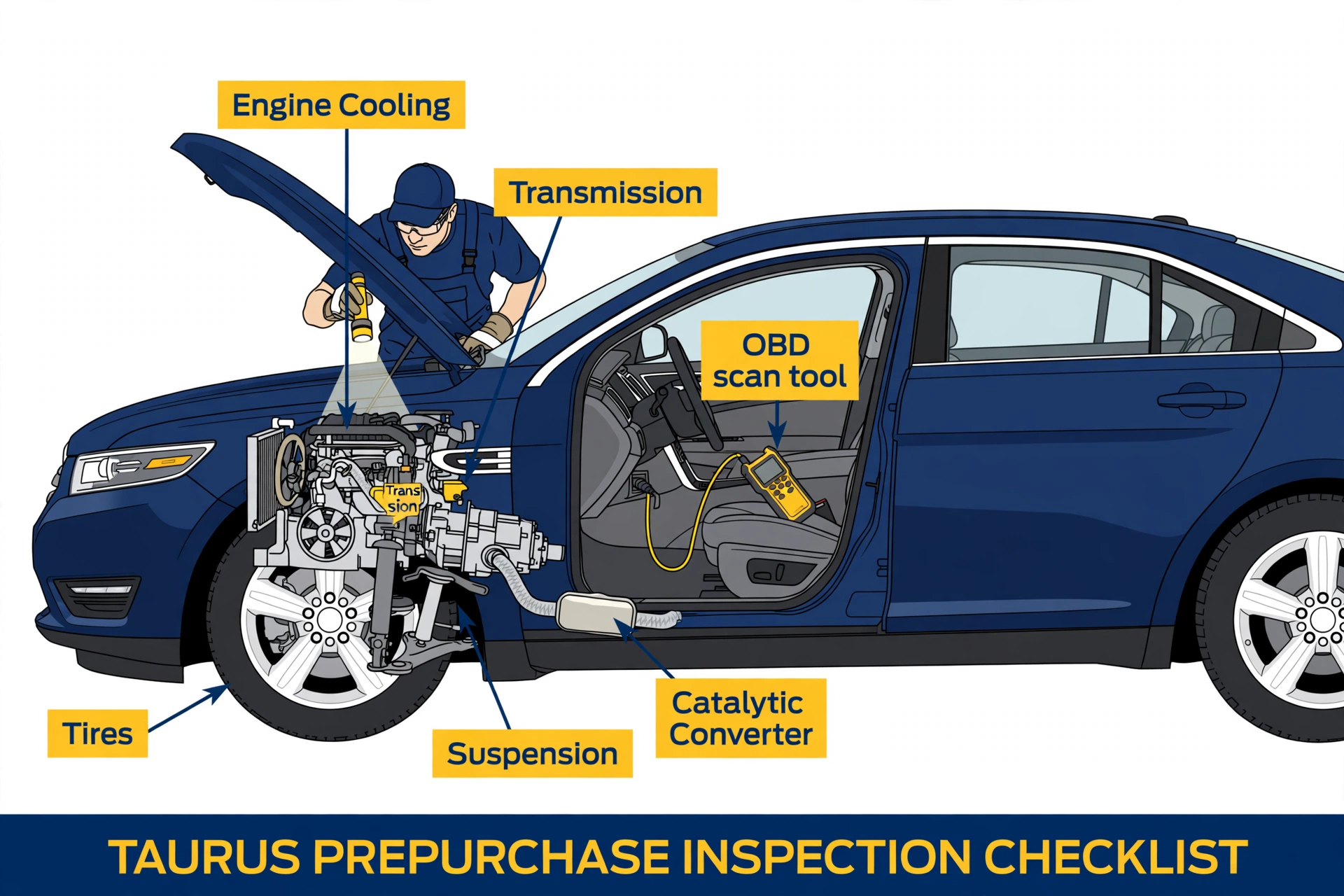
- Confirm the year and the gearbox. A 2002 or 2003 car is an avoid year whatever the price, and a 1986 to 2006 car with the four-speed automatic carries the transmission risk.
- Drive it cold, in slow traffic. Start from cold at parking-lot speeds with frequent stops, and treat slipping, harsh shifts, or a delay when you select drive as warning signs; a rough cold drive is a clear rejection.
- Scan for codes: a scan tool will show P0420 for catalyst efficiency, P1450 for fuel tank vacuum, and P0316 for startup misfires. A P0420 code needs a diagnosis before you pay, because it can mean a sensor or a converter.
- Check the suspension, the most reported Taurus failure at a typical age of 6.3 years. Listen for clunks over bumps, look for uneven tire wear, and push down on each corner to feel for worn struts.
- Check the VIN for open recalls and campaigns: the 2017 car shows three recalls and the 2018 car shows two in the FIXD record. The 2001 car shows eight recalls and ten investigations, so use the NHTSA recall lookup with the VIN before you pay.
- Inspect the cooling system and the tires: engine cooling is the second most reported failure system, so look for coolant leaks and check the temperature gauge on the test drive. Inspect the tires for age cracks, and walk away from a car that runs hot on a short drive.
- Pay for an independent pre-purchase inspection, and ask the shop to put the car on a lift to check the suspension, the exhaust, and the underbody for rust. The inspection costs far less than one converter replacement, and it gives you a written reason to negotiate or walk away.
6 Ford Taurus Questions Owners Ask
Is the Ford Taurus Reliable


Yes, the Taurus is more reliable than the average car by the complaint record. ForCar counts 3.1 complaints per production run against 3.73 for the average car. That average hides the year gap, so buy a 2014 to 2019 car and skip the 2002 and 2003 cars.
Best Year for the Ford Taurus
The 2017 and 2018 models are the best years to buy. They score 6 out of 10 for FIXD reliability, 10 out of 10 for owner reliability, and 4.8 out of 5 for NHTSA crash testing. They also tie for the least to maintain, at $250 to $500 a year in reported costs.
Years to Avoid
Avoid the 2002, 2003, and 1999 models. The 2003 car drew 1,014 complaints and the 2002 car drew 1,208, the two highest totals among 2000s models after 1993’s 1,253. Skip any 1986 to 2006 car with the four-speed automatic, and skip the 1996 to 1999 SHO with the 3.4 liter V8.
Used Taurus Cost
Reported Kelley Blue Book values from FIXD put a 2017 to 2018 Taurus at $13,671 to $18,745. A 2015 to 2016 car runs $8,229 to $11,631, and a 2012 to 2014 car runs $3,431 to $6,933. The cheapest cars are the 2002 and 2003 models at $1,610 to $1,749, and they are cheap for a reason.
Is the Taurus SHO Good
The late SHO is a good car, and the early SHO is not. The 2010 to 2019 SHO uses a 365 horsepower twin-turbo V6 with all-wheel drive, and owners rate those cars highly. The 1996 to 1999 SHO uses a 3.4 liter V8 whose camshafts can detach and destroy the engine, so skip it.
Taurus as a First Car
A late-model Taurus can work as a first car, with one condition. The 2014 to 2019 cars are safe, roomy, and cheap to run, and their 4.8 out of 5 crash score is strong. The 2.0 liter EcoBoost cars are the best pick for a new driver, because they use the least fuel in the range.
Our Final Verdict on the Ford Taurus
Is the Ford Taurus a good car? Yes, when you buy the right years. The 2014 through 2019 cars give you full-size comfort and a strong safety score.
Their repair costs run as low as $250 a year.
The wrong years erase that value. The 2002 and 2003 cars carry the worst complaint record in the nameplate, and the four-speed automatic behind them never earned trust. The 1996 to 1999 SHO can destroy its own engine, so it has no place on a shopping list.
Shop with the lists in this guide, run the seven checks, and pay for the inspection. A late-model Taurus that passes all three steps is one of the cheapest reliable cars you can buy today.