
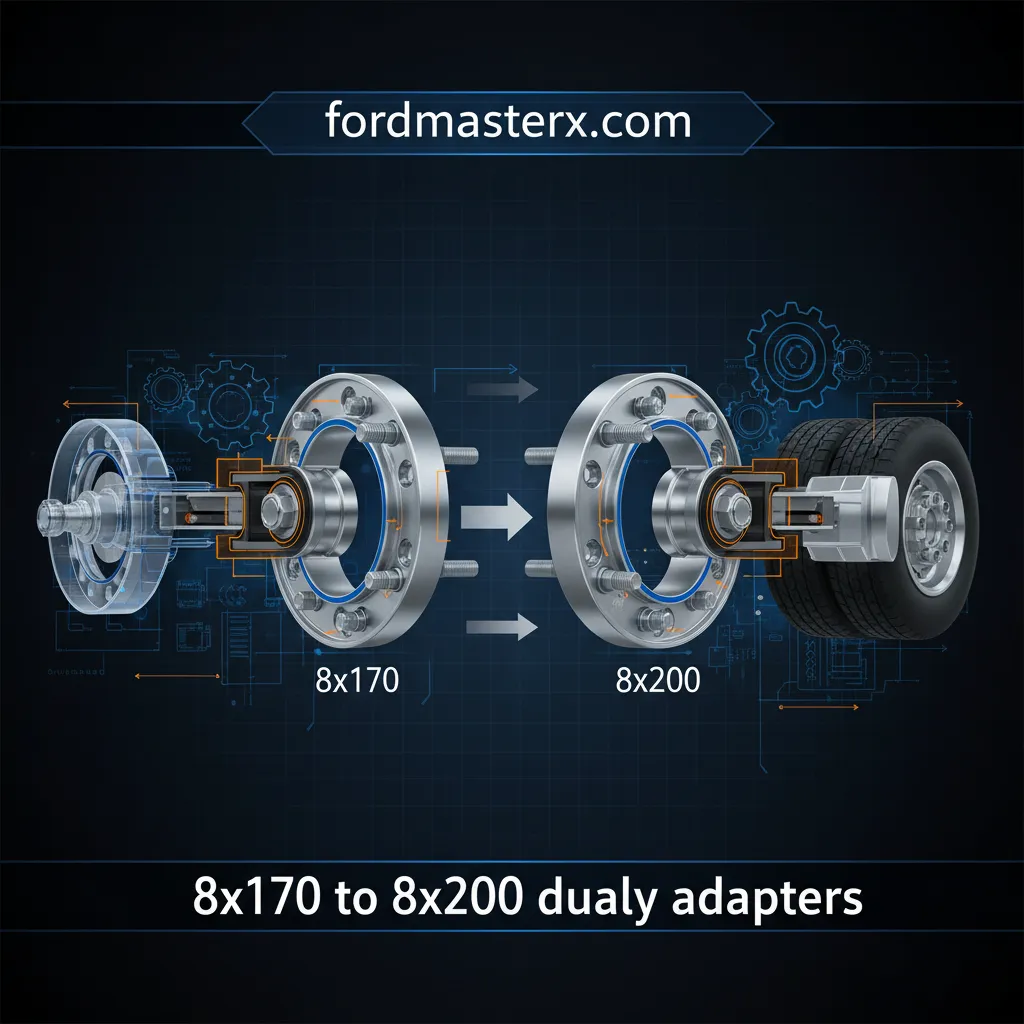
8X170 To 8X200 Dually Adapters: Engineering Specifications And Wheel Conversion Requirements

Upgrading an early-model Ford Super Duty to modern dually aesthetics requires more than just a wheel swap; it demands a precision-engineered transition of the bolt pattern itself. Owners of 1999-2004 Ford trucks often find themselves limited by the older 8x170mm pattern when they want to utilize the superior 8x200mm wheels found on newer, more robust dually models. This comprehensive guide provides a technical analysis of 8×170 to 8×200 dually adapters, covering material standards, hub-centricity requirements, and professional installation steps to ensure your conversion is both reliable and safe for heavy-duty towing.
Technical Mechanics of 8×170 to 8×200 Dually Adapters for Ford Super Duty Trucks
📤 Share Image
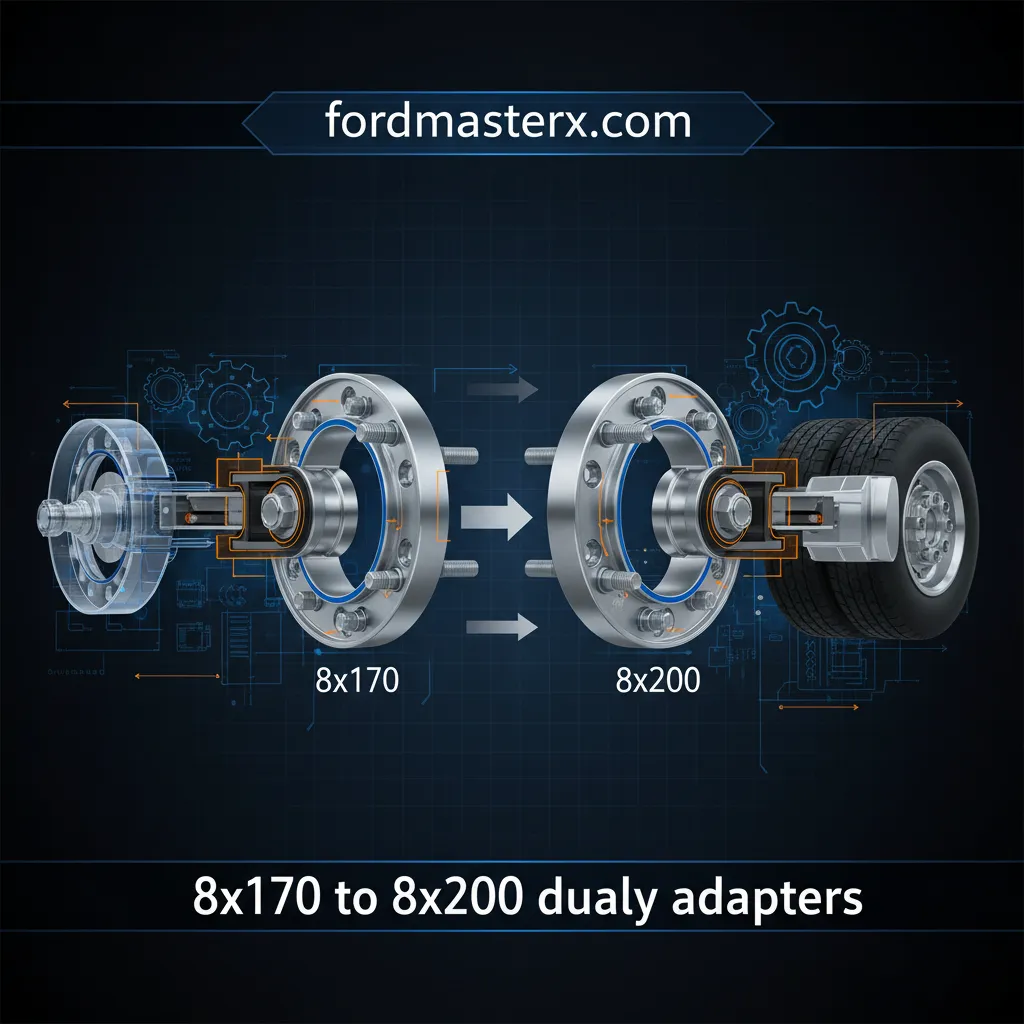
The transition from the 8x170mm bolt pattern to the 8x200mm pattern represents a significant shift in Ford’s heavy-duty chassis engineering. Between 1999 and 2004, the Ford F-250 and F-350 utilized the 8x170mm pattern, which translates to approximately 6.69 inches. In 2005, Ford moved to the 8x200mm (7.87 inches) pattern for its dually models to accommodate larger brake rotors and improve stability under increasing GVWR limits. This 1.18-inch diameter increase is not merely cosmetic; it changes the entire geometry of the wheel hub.
When an owner of a 2002 Ford F-350 attempts to mount 2015 OEM 17-inch dually wheels, they face a hardware mismatch. The 2015 wheels require the 8x200mm spacing. To bridge this gap, a 2-inch thick adapter plate is the industry standard. This thickness is critical because the factory M14x2.0 studs on the 8×170 hub typically protrude about 1.75 inches. A thinner adapter would require cutting the factory studs, which compromises the ability to revert to stock wheels and can weaken the stud integrity.
Hub-Centric Fitment and Bore Diameters
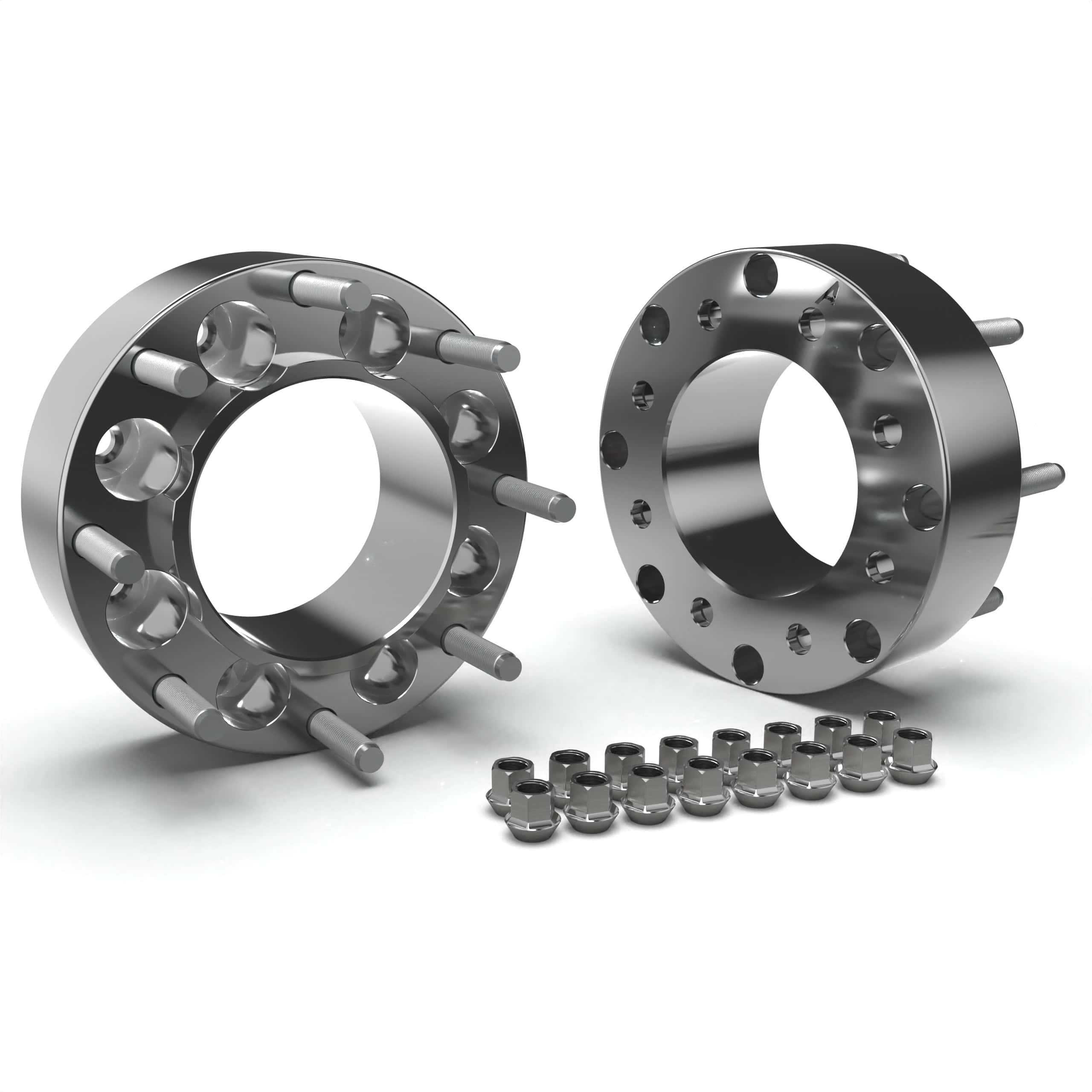
The role of the center-bore diameter is the most overlooked aspect of this conversion. For the 8x170mm hub, the bore is typically 124.9mm. However, the 8x200mm dually wheels often feature a 142mm bore. A professional-grade adapter must be dual-centric: it must fit snugly over the 124.9mm axle hub and feature a machined lip that matches the 142mm wheel bore. This ensures the weight of the truck is carried by the hub itself rather than the studs, providing reliable performance under max load conditions.
By The Numbers
Pattern Diameter Increase
Recommended Min Thickness
Standard 8×200 Bore
Quality Standards for Reliable Heavy-Duty Wheel Adapters
In the world of dually conversions, material science is the difference between a trusted setup and a catastrophic failure. Many budget-grade adapters are made from cast aluminum, which contains internal porosities and air pockets. Under the high-torque loads of a diesel engine and the lateral forces of a heavy trailer, cast adapters can crack. As an expert with years in the field, I only recommend forged 6061-T6 aircraft-grade aluminum.
Forged 6061-T6 aluminum offers a yield strength of approximately 40,000 psi. This is essential for trucks with a GVWR exceeding 10,000 lbs. While some manufacturers offer 1045 steel adapters, these add significant unsprung weight, which can negatively impact suspension harmonics and shock absorber longevity. For hot-shot trucking and heavy towing, the strength-to-weight ratio of forged T6-6061 is superior.
Hardware and Machining Precision
The adapter is only as strong as its studs. High-quality 8×170 to 8×200 kits use Grade 10.9 or Grade 12.9 wheel studs. These grades are designed to manage the immense shear forces exerted during hard braking and acceleration. Furthermore, precision CNC machining ensures the mating surfaces are perfectly flat within 0.001 inches. Any deviation in flatness creates a “spring” effect when the lug nuts are tightened, leading to high-speed vibrations and eventual loosening of the hardware.
Forged 6061-T6
Highest weight-to-strength ratio; prevents fatigue cracking in heavy-duty towing.
CNC Machined
Ensures runout of less than 0.001 inches to eliminate high-speed wheel wobble.
Professional Installation Procedures and Torque Specifications
The safety of a dually conversion is often determined by the installer’s attention to detail rather than the part itself. Before the adapter even touches the hub, the axle flange must be meticulously cleaned. Use a stiff wire brush to remove rust, scale, and debris. Any material caught between the hub and the adapter will cause axial play, leading to catastrophic stud failure.
📋
Installation Checklist
Clean the vehicle’s hub and the back of the adapter with a wire brush. Apply a thin layer of anti-seize ONLY to the hub pilot, not the stud threads.
Apply two drops of Loctite 271 (Red) to the vehicle’s studs. This prevents the adapter-to-hub nuts from backing off under thermal cycles.
Tighten nuts in a star pattern to 150-165 lb-ft. Re-torque after 25, 50, and 100 miles to ensure the assembly has seated properly.
Standard torque for M14x2.0 studs on Ford Super Duty trucks is 150-165 lb-ft. Because the adapter hides the inner nuts once the wheel is mounted, the use of a thread-locking compound is expert-recommended. Failure to re-torque the adapters at the specified intervals is the leading cause of hardware failure in dually conversions. When installing the wheels onto the adapter, ensure the inner dually wheel is seated flush against the adapter lip before tightening.
Drivability Impacts and Hub-Centric Engineering
There is a critical distinction between lug-centric and hub-centric adapters. Lug-centric designs rely on the clamping force of the studs to center the wheel. In a heavy-duty diesel application, where torque can exceed 800 lb-ft, lug-centric setups are prone to “death wobble” and sheared studs. Professional-grade adapters are always hub-centric. This design uses a center ring to transfer the vehicle’s weight directly to the axle housing, reducing the shear load on the wheel studs by up to 70%.
If you experience steering wheel feedback after installation, check the adapter runout. A hub-centric adapter with a tolerance of 0.001 inches should produce zero vibration. If vibration persists, verify that the factory studs are not making contact with the back of the wheel.
Beyond vibration, using 8×200 conversion spacers affects the vehicle’s scrub radius. By moving the wheels outward, you increase the leverage on wheel bearings and ball joints. While a 2-inch adapter is generally tolerated by Super Duty axles, owners should expect a slightly accelerated wear pattern on front-end components if the conversion is applied to the steer axle. In the rear, the massive bearings of the Sterling or Dana axles are more than capable of handling the offset shift.
Compliance and Load Rating Verification for Towing
Before purchasing an adapter kit, you must verify that its static load rating meets or exceeds the Gross Axle Weight Rating (GAWR) of your truck. For instance, a fifth-wheel trailer setup where the rear axle weight reaches 7,000 lbs requires each adapter to be rated for at least 3,500 lbs. Most high-quality 8-lug dually adapters are rated for a static load of 4,000 to 5,000 lbs per wheel, providing a 2x safety factor over the standard axle load.
✅ Pros
- Access to modern 8×200 wheel designs.
- Increased track width for towing stability.
- Maintains OEM-style hub-centric support.
- Allows for larger brake rotor clearance.
❌ Cons
- Requires frequent torque maintenance.
- Increases scrub radius and leverage.
- Adds unsprung weight to the drivetrain.
Modifying wheel geometry can impact insurance liability in the event of an accident. Always use adapters from ISO-certified manufacturers that stamp the load rating directly onto the adapter body. Document the installation for your records.
Selecting a reliable adapter also means looking for certification markers. Trusted manufacturers often laser-etch the batch number and material grade onto the adapter. This level of traceability is standard for professional-grade components used in commercial trucking. When the rear axle load is at its limit, you need the peace of mind that your conversion kit was engineered for those exact stresses.
In summary, selecting hub-centric 6061-T6 aluminum adapters ensures structural integrity under heavy GVWR loads. The transition from 8×170 to 8×200 requires precise attention to stud grade and torque maintenance to prevent hardware failure. A professional-grade conversion allows for the seamless integration of modern OEM and aftermarket wheels while maintaining axle safety standards. Consult with a certified drivetrain specialist to verify your axle measurements before purchasing your complete 8×170 to 8×200 conversion kit.
Frequently Asked Questions
Can I use 8×170 to 8×200 adapters on a single-rear-wheel (SRW) truck?
Yes, these adapters can be used to convert an SRW 8×170 hub to accept 8×200 dually wheels. However, you must account for the significant increase in track width. Professional installers recommend checking fender clearance and ensuring the adapter is thick enough to prevent the original studs from protruding past the adapter face, which would interfere with the new wheel’s mounting surface.
Why is hub-centric design critical for dually adapters?
Hub-centric adapters are engineered with a center bore that matches the vehicle’s hub exactly, along with a lip that matches the wheel’s bore. This allows the weight of the truck to rest on the hub rather than the studs. In heavy-duty dually applications, this prevents stud shear and eliminates the vibrations often associated with ‘lug-centric’ universal spacers, ensuring a reliable and professional fitment.
What thickness is standard for an 8×170 to 8×200 dually conversion?
The standard thickness for these adapters is typically 2 inches (50.8mm). This specific depth is required because the factory 8×170 studs are roughly 1.5 to 1.75 inches long. A 2-inch adapter provides enough clearance to fully enclose the original studs while offering a flat mounting surface for the new 8×200 wheels, ensuring the wheels sit flush against the adapter for maximum safety.
Will these adapters affect my truck’s towing capacity?
When using high-quality, forged 6061-T6 aluminum adapters with Grade 10.9 studs, your towing capacity should remain within OEM limits. However, because the adapters change the wheel offset, they can increase leverage on the wheel bearings. It is essential to choose trusted, expert-manufactured hardware and perform regular maintenance checks on your bearings to ensure long-term reliability while hauling heavy loads.
How often should I check the torque on my dually adapters?
Professional standards dictate that you should check the torque on the adapter-to-hub nuts after the first 25 to 50 miles of driving following installation. After the initial seating period, torque should be verified every 3,000 to 5,000 miles or before any significant long-distance haul. This prevents the hardware from loosening due to the thermal expansion and contraction cycles typical in heavy-duty diesel braking systems.