
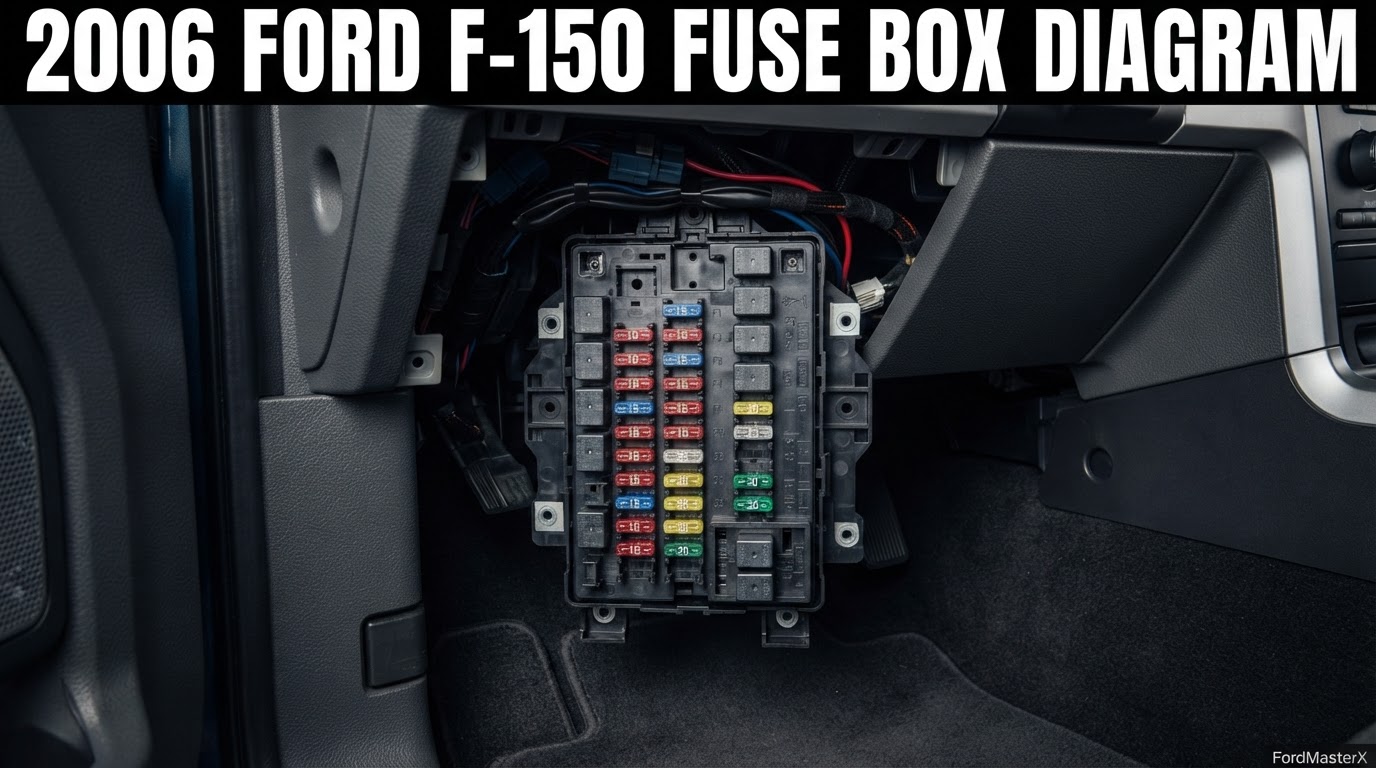
2006 Ford F-150 Fuse Box Diagram: Both Locations, Every Fuse, Full Charts

Your 2006 F-150 has one fuse panel inside the cab and one auxiliary relay box under the hood. The cab panel sits under the right side of the instrument panel, behind a removable trim cover. It holds every fuse from 1 to 42 plus the high-current cartridge fuses 101 to 118. The relay box lives in the engine compartment on the left fender.
Most pages online get one thing wrong about this truck, and it is the fuse people look up most. Skip to the cigar lighter section if that is why you are here.
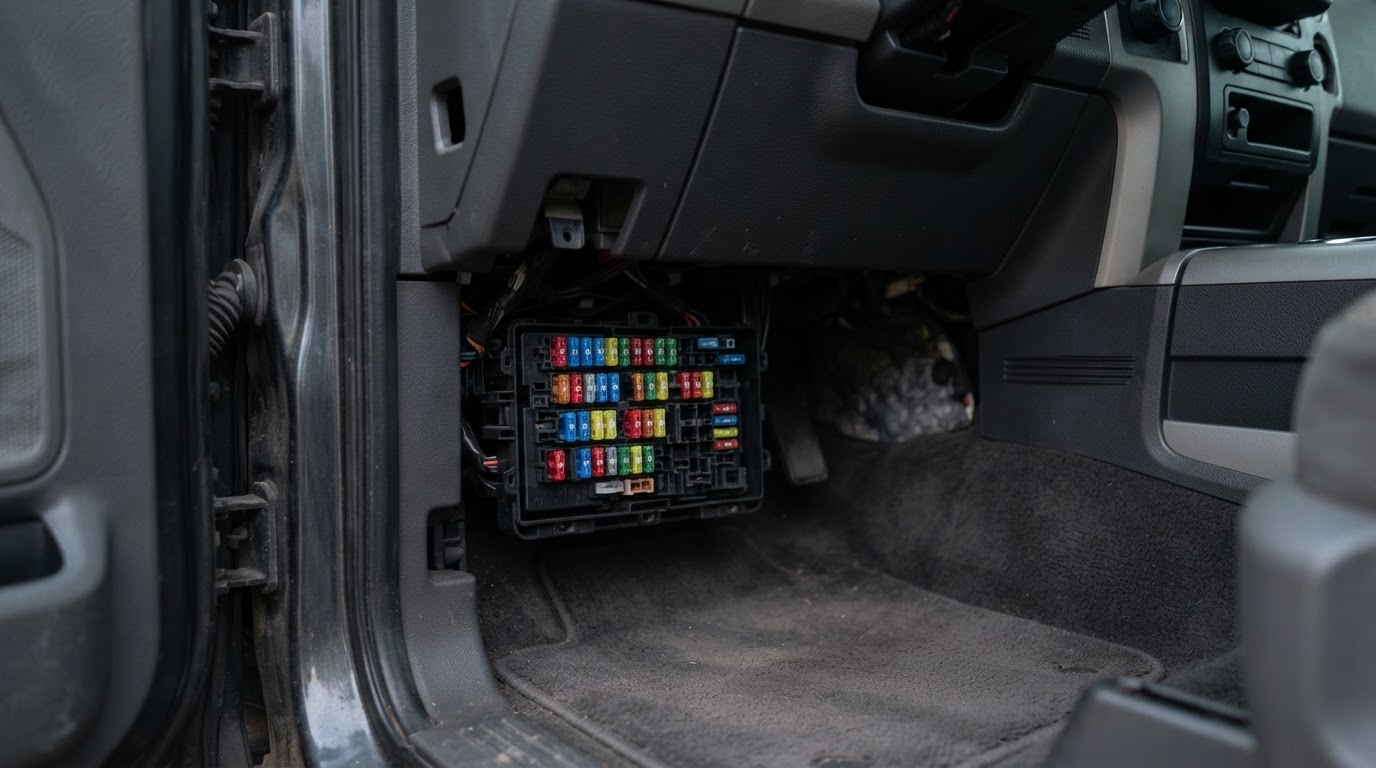
Where are the fuse boxes on a 2006 F-150?
Recommended Best Deal Products


There are two, and only one of them holds fuses you are likely to change.
Passenger compartment fuse panel. Under the right-hand side of the instrument panel, in the passenger footwell. Ford also calls this the Central Junction Box. Pull the trim panel off, then find the pull tab on the fuse box cover and lift the cover away. Everything numbered 1 through 42, 101 through 118, and 401 is in here.
Auxiliary relay box. In the engine compartment, on the left fender. It holds one 5A fuse, four relays and two diodes. Nothing in it fails often.
Worth knowing: this truck does not have a big under-hood fuse block the way many vehicles do. If a fuse blew, it is almost certainly in the cab panel. People spend twenty minutes searching the engine bay for a box that was never there.
Passenger compartment fuse chart: fuses 1 to 42
These are the standard mini fuses. Amperage ratings and circuits below.
| Fuse | Amps | Circuit protected |
|---|---|---|
| 1 | 10A | Run/accessory: wipers, instrument cluster, audio on XL and STX |
| 2 | 20A | Stop and turn lamps, ABS, trailer electric brake module, turn signal mirrors, CHMSL |
| 3 | 7.5A | Power mirrors, memory seats and pedals |
| 4 | 10A | DVD battery power, power fold mirror |
| 5 | 7.5A | Keep alive memory for PCM and climate control module |
| 6 | 15A | Parklamps, Body Security Module, instrument panel illumination |
| 7 | 5A | Radio start signal |
| 8 | 10A | Heated mirrors, switch indicator |
| 9 | 20A | Fuel pump relay, fuel injectors, injector sense |
| 10 | 20A | Trailer tow back-up lamp relay, trailer tow parklamp relay |
| 11 | 10A | A/C clutch, 4×4 solenoid |
| 12 | 5A | PCM relay coil |
| 13 | 10A | Climate control module power, flasher relay |
| 14 | 10A | Back-up lamp and DRL relay coil, A/C pressure switch, heated PCV on 5.4L, ABS |
| 15 | 5A | Overdrive cancel, cluster |
| 16 | 10A | Brake-shift interlock solenoid |
| 17 | 15A | Fog lamp relay |
| 18 | 10A | Electrochromatic mirror, heated seats, BSM, compass, reverse sensing |
| 19 | 10A | Restraints, meaning the airbag module |
| 20 | 10A | Battery feed for overhead power point |
| 21 | 15A | Cluster keep alive power |
| 22 | 10A | Delayed accessory power: audio, door lock switch and moonroof switch illumination |
| 23 | 10A | Right-hand low beam headlamp |
| 24 | 15A | Battery saver power for demand lamps |
| 25 | 10A | Left-hand low beam headlamp |
| 26 | 20A | Horn |
| 27 | 5A | Passenger airbag deactivation warning lamp, cluster airbag warning lamp |
| 28 | 5A | SecuriLock transceiver (PATS), PCM ignition monitor |
| 29 | 15A | PCM 4×4 power |
| 30 | 15A | PCM 4×4 power |
| 31 | 20A | Radio power |
| 32 | 15A | Vapor management valve, A/C clutch relay, canister vent, HEGO sensors, MAF sensor, variable cam timing |
| 33 | 15A | Shift solenoid, camshaft sensors, ignition coils |
| 34 | 15A | PCM power |
| 35 | 20A | High beam headlamps, cluster high beam indicator, DRL disable relay |
| 36 | 10A | Trailer tow right turn and stop lamps |
| 37 | 20A | Rear power point |
| 38 | 25A | Subwoofer power |
| 39 | 20A | Instrument panel power point |
| 40 | 20A | Low beam headlamps, DRL |
| 41 | 20A | Cigar lighter, diagnostic connector power |
| 42 | 10A | Trailer tow left turn and stop lamps |
Fuse assignments vary with trim and options. Your truck may not use every position listed.
High-current cartridge fuses: 101 to 118 and 401
Recommended Best Deal Products


These are the big flat cartridge fuses in the same panel. They protect motors, heaters and seats. They fail far less often than the mini fuses, and a blown one usually means a real fault rather than an overload.
| Fuse | Amps | Circuit protected |
|---|---|---|
| 101 | 30A | Starter solenoid |
| 102 | 20A | Ignition switch feed |
| 103 | 20A | ABS valves |
| 104 | – | Not used |
| 105 | 30A | Electric trailer brakes |
| 106 | 30A | Trailer tow battery charge |
| 107 | 30A | Power door locks (BSM) |
| 108 | 30A | Passenger power seat |
| 109 | 30A | Driver power seat, adjustable pedals, memory module |
| 110 | 20A | Not used on 2006, see the note below |
| 111 | 30A | 4×4 motor relays |
| 112 | 40A | ABS pump power |
| 113 | 30A | Wipers and washer pump |
| 114 | 40A | Heated backlite, heated mirror power |
| 115 | 20A | Moonroof |
| 116 | 30A | Blower motor |
| 117 | 20A | Not used on 2006, see the note below |
| 118 | 30A | Heated seats |
| 401 | 30A circuit breaker | Power windows, moonroof, power sliding backlite |
Position 401 is a resettable circuit breaker, not a fuse. If your windows died and came back a minute later, that breaker tripped and reset itself. Look for a binding window or a failing motor pulling too much current.
Which fuse controls the cigar lighter and 12V power points?
On a 2006 F-150 the cigar lighter is fuse 41, rated 20A. It shares that circuit with the diagnostic connector. The instrument panel power point is fuse 39, also 20A. The rear power point is fuse 37, 20A.
This is where most sites will send you wrong. Ford renumbered these circuits for the 2007 and 2008 trucks:
| Circuit | 2004 to 2006 | 2007 to 2008 |
|---|---|---|
| Cigar lighter, diagnostic connector | Fuse 41 (20A) | Fuse 110 (20A) |
| Instrument panel power point | Fuse 39 (20A) | Fuse 117 (20A) |
Several popular fuse chart sites publish only the later layout and mark 39 and 41 as “not used”. Auto Genius does exactly this, listing 39 and 41 as not used and putting the cigar lighter on 110. That is correct for a 2008 truck and wrong for yours. Fuse and Relay splits it by year properly, showing fuse 41 for 2004 to 2006 and fuse 110 for 2007 to 2008.
If your 12V outlet is dead and fuse 110 looks fine, you were reading the wrong chart. Check 41.
The label printed inside your own fuse box cover is the final authority. Trim, market and mid-year production changes all move things around, and the cover was printed for your specific truck.
Which fuse controls the radio?
Recommended Best Deal Products


Two fuses feed the radio, and knowing which one you lost tells you what to expect.
- Fuse 31, 20A: radio power. Blow this and the radio is completely dead. No display, no sound.
- Fuse 7, 5A: radio start signal. This one tells the radio to wake up with the ignition. Blow it and the radio may stay silent even though it still has power.
- Fuse 38, 25A: subwoofer power. Only relevant if your truck has the premium audio system. Bass gone but everything else working points here.
- Fuse 22, 10A: delayed accessory power. This is why your radio keeps playing after you shut the engine off until you open a door.
One source lists fuse 31 as 15A rather than 20A. Two others say 20A. Check the rating stamped on the fuse you pull out and match it, and never fit a higher amperage than the box cover specifies.
Which fuse controls the A/C and the blower?
The air conditioning system splits across three circuits, so “the A/C fuse” depends on the symptom.
| Symptom | Check this |
|---|---|
| Fan blows but air never gets cold | Fuse 11, 10A: A/C clutch |
| No air movement at any speed | Fuse 116, 30A: blower motor |
| Climate control panel completely dead | Fuse 13, 10A: climate control module power |
| Compressor cycles oddly, check engine light on | Fuse 32, 15A: A/C clutch relay and emissions sensors |
Fuse 116 is a 30A cartridge fuse, not a mini fuse. If the blower is dead on every speed, that is your first stop. If it only works on high, the fuse is fine and you are looking at a blower motor resistor instead.
What is in the auxiliary relay box on the left fender?
Very little, which is good news. This box holds:
- F03, 5A: clockspring illumination
- R01 and R02: 4×4 motor relays, counterclockwise and clockwise
- R03: DRL high beam disable relay
- R201: daytime running lamps relay
- R202: A/C clutch relay
- D01 and D02: diodes for the A/C clutch circuit
If your 4×4 will not shift electronically and fuse 111 is intact, R01 and R02 are the next suspects. Swapping relays between identical positions is a quick way to test one without buying parts.
How do you tell if a fuse is actually blown?
Pull it and look through the plastic window at the metal strip inside. An intact fuse has an unbroken S-shaped strip. A blown one has a visible gap, or the window is smoked dark brown or black.
Three things that catch people out:
- A hairline break is easy to miss. Hold the fuse up to a light. If you are not certain, test continuity with a multimeter set to ohms. Zero or near zero means good.
- Never guess the replacement rating. Match the number printed on the fuse and cross-check it against your box cover label. Fitting a 30A fuse where a 10A belongs lets the wiring become the fuse, and rewiring a truck costs vastly more than a fuse does.
- Cartridge fuses need a puller, not pliers. There is a small plastic fuse puller clipped inside the fuse box cover on most of these trucks. Pliers crack the housing.
One practical note before you go looking for a replacement. A mixed ATO/ATC fuse assortment kit costs less than a single fuse from a dealer parts counter and saves the second trip. Any brand meeting the ATO/ATC standard fits this panel.
Why does the same fuse keep blowing?
A fuse that blows once is usually a one-off surge. A fuse that blows again within days is telling you something is wrong upstream, and replacing it repeatedly is treating the alarm rather than the fire.
Work through it in this order:
- Unplug whatever you most recently added. Trailer wiring, a dash cam, an aftermarket stereo, a phone charger left in the 12V socket. Aftermarket accessories cause the large majority of repeat blows on these trucks.
- Look for chafed insulation where the harness moves. Door jambs, tailgate wiring and anything routed near the steering column flex thousands of times.
- Check for water intrusion. A wet connector shorts intermittently, which is why the fuse survives a dry week and dies in the rain.
- Consider the load itself. A power window motor drawing too much current because the glass is binding will keep tripping the 401 breaker. A failing blower motor will keep taking out fuse 116.
If a fuse blows the instant you push it in, there is a hard short on that circuit. Stop replacing fuses and trace the wiring.
2006 F-150 fuse quick reference
The fuses owners look up most, in one place.
| What you want | Fuse | Amps |
|---|---|---|
| Cigar lighter, 12V outlet | 41 | 20A |
| Instrument panel power point | 39 | 20A |
| Rear power point | 37 | 20A |
| Radio power | 31 | 20A |
| Subwoofer | 38 | 25A |
| Blower motor | 116 | 30A |
| A/C clutch | 11 | 10A |
| Fuel pump and injectors | 9 | 20A |
| Horn | 26 | 20A |
| Low beam headlamps | 40 | 20A |
| High beam headlamps | 35 | 20A |
| Wipers and washer pump | 113 | 30A |
| Power windows | 401 | 30A breaker |
| Power door locks | 107 | 30A |
| Heated seats | 118 | 30A |
| Trailer electric brakes | 105 | 30A |
| Starter solenoid | 101 | 30A |
For a broader look at Ford wiring standards, see our Ford wiring color code chart.

3 Comments