
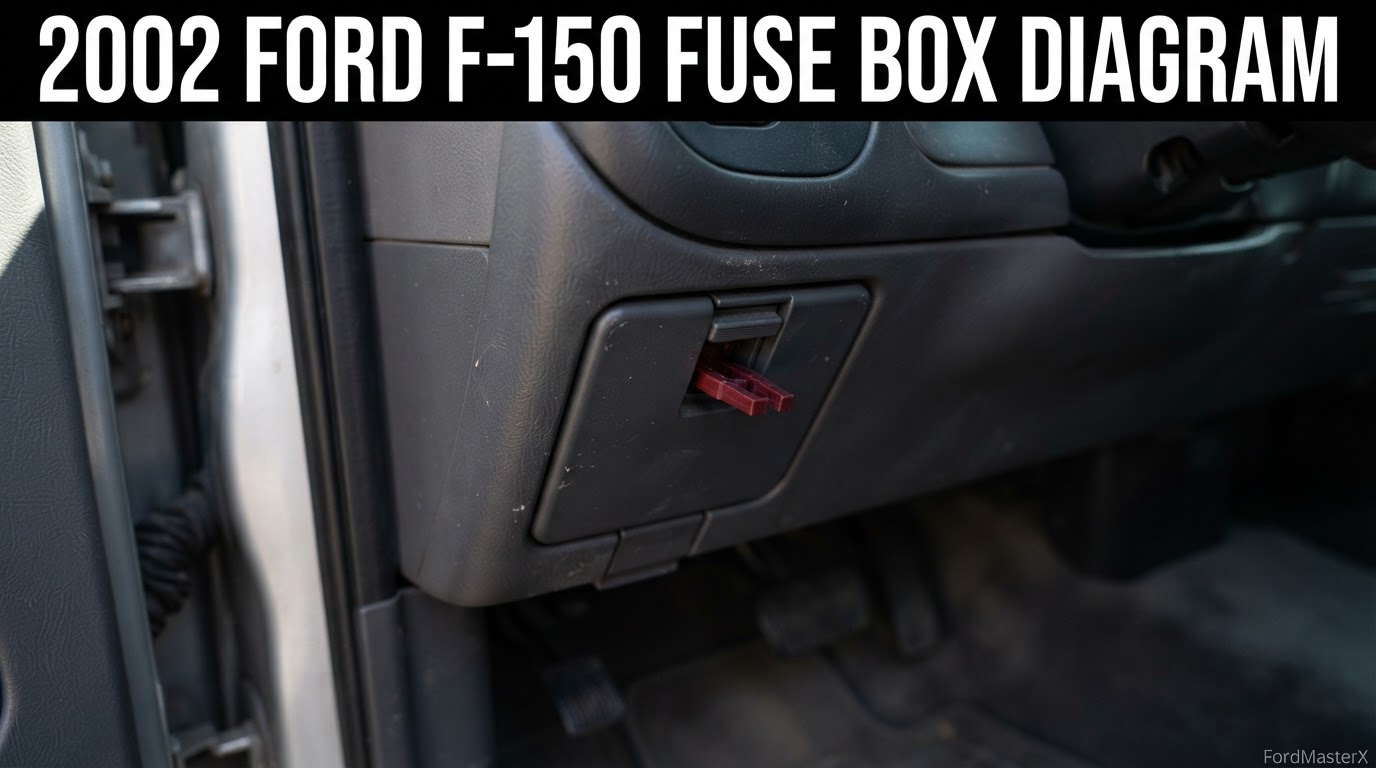
2002 Ford F-150 Fuse Box Diagram: Complete Fuse Charts

Your 2002 F-150 has two fuse boxes. The passenger compartment fuse panel sits below and to the left of the steering wheel, next to the brake pedal, behind a cover. The power distribution box is in the engine compartment on the left side. The cigar lighter is fuse 3, rated 20A, in the cab panel.
Where are the fuse boxes on a 2002 F-150?


Both boxes carry real fuses on this truck, not just relays.
Passenger compartment fuse panel. Below and to the left of the steering wheel, by the brake pedal, behind a removable cover. Driver side. This holds fuses 1 to 31 plus five relay positions.
Power distribution box. Engine compartment, left side, near the battery. It carries mini fuses 1 to 24, high current cartridge fuses 101 to 118, nine numbered relays, two diodes, and a circuit breaker at 601.
If you also own a newer F-150, do not carry a chart across model lines. On a 2004 to 2008 truck the cab panel moved to the right side of the instrument panel, and the cigar lighter fuse moved from position 3 to position 41. Our 2006 Ford F-150 fuse box diagram covers that later layout.
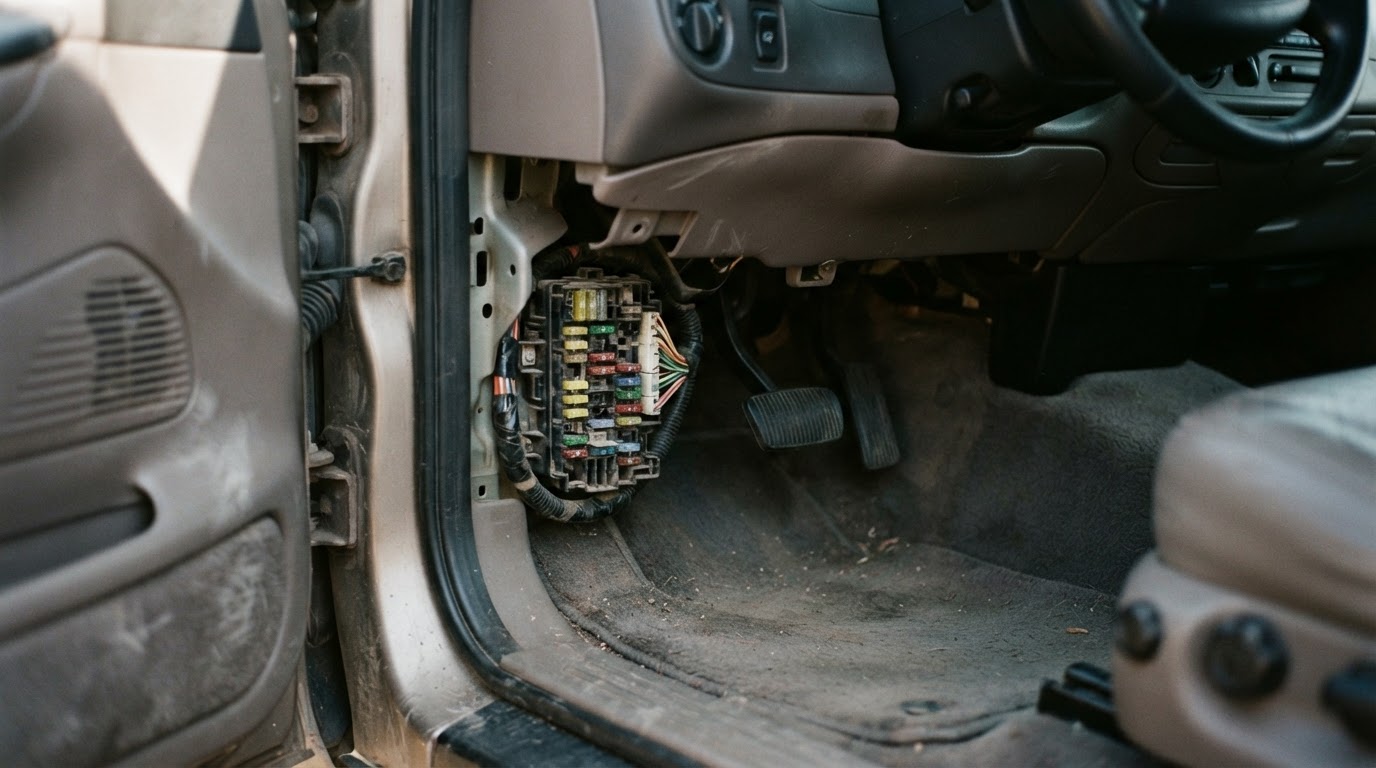
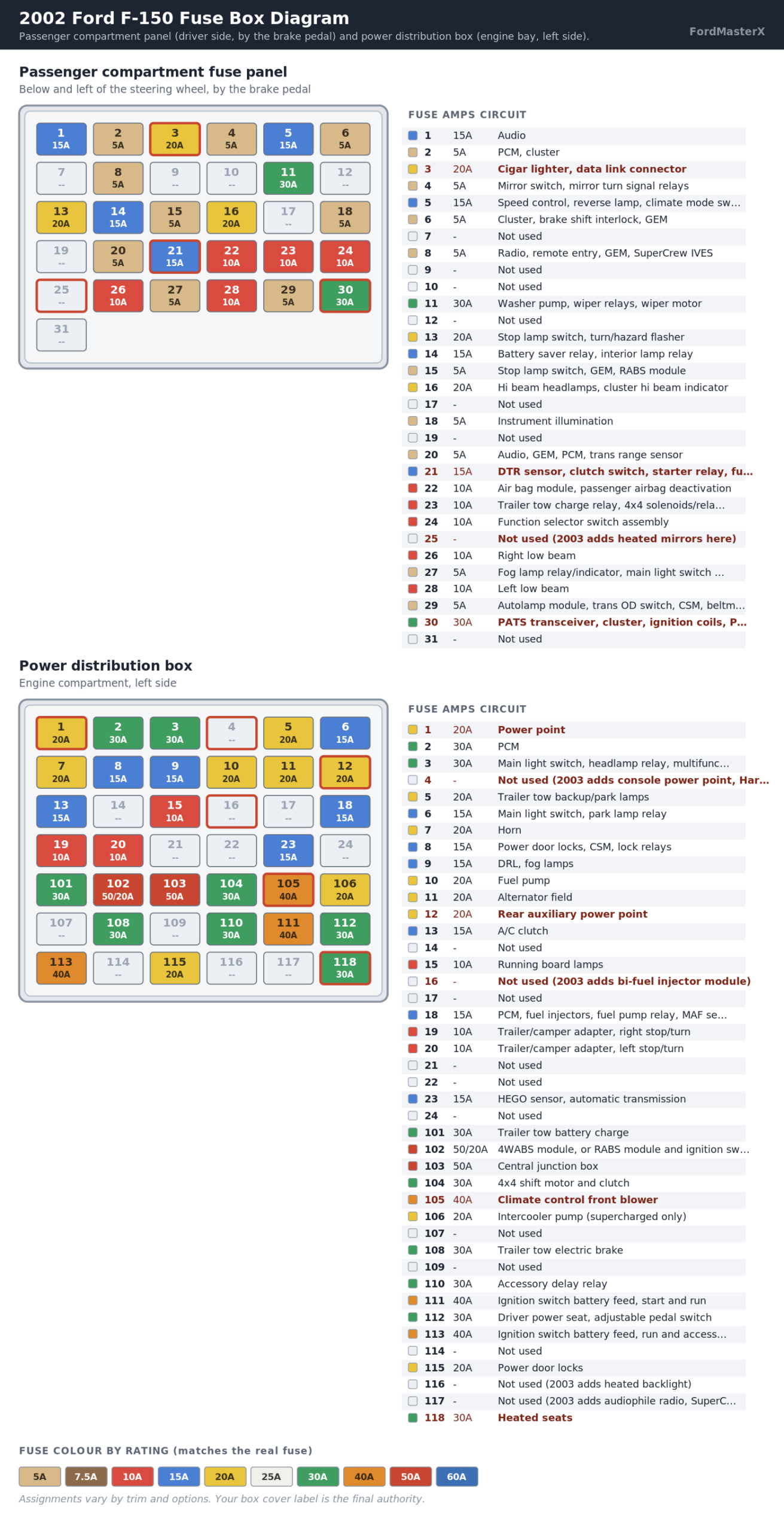
2002 F-150 passenger compartment fuse chart
Driver side, by the brake pedal. All mini fuses.
| Fuse | Amps | Circuit protected |
|---|---|---|
| 1 | 15A | Audio |
| 2 | 5A | Powertrain Control Module, cluster |
| 3 | 20A | Cigar lighter, data link connector |
| 4 | 5A | Mirror switch, mirror turn signal relays |
| 5 | 15A | Speed control module, reverse lamp, climate mode switch, DRL relay, DTR sensor |
| 6 | 5A | Cluster, brake shift interlock solenoid, GEM |
| 7 | – | Not used |
| 8 | 5A | Radio, remote entry module, GEM, in-vehicle entertainment (SuperCrew only) |
| 9 | – | Not used |
| 10 | – | Not used |
| 11 | 30A | Front washer pump relay, wiper run/park relay, wiper HI/LO relay, wiper motor |
| 12 | – | Not used |
| 13 | 20A | Stop lamp switch (lamps), turn and hazard flasher |
| 14 | 15A | Battery saver relay, interior lamp relay |
| 15 | 5A | Stop lamp switch (speed control, brake shift interlock), GEM, RABS module |
| 16 | 20A | High beam headlamps, cluster high beam indicator |
| 17 | – | Not used |
| 18 | 5A | Instrument illumination, dimmer switch power |
| 19 | – | Not used |
| 20 | 5A | Audio, GEM, PCM, transmission range sensor |
| 21 | 15A | DTR sensor, clutch switch, starter relay, panel fuse 20 |
| 22 | 10A | Air bag module, passenger air bag deactivation module |
| 23 | 10A | Trailer tow battery charge relay, flasher, 4×4 solenoids and relays, overhead console, 4WABS module, EC mirror, heated seats |
| 24 | 10A | Function selector switch assembly |
| 25 | – | Not used |
| 26 | 10A | Right-hand low beam headlamp |
| 27 | 5A | Foglamp relay and foglamp indicator, main light switch upstream |
| 28 | 10A | Left-hand low beam headlamp |
| 29 | 5A | Autolamp module, transmission overdrive control switch, central security module, beltminder |
| 30 | 30A | Passive anti-theft transceiver, cluster, ignition coils, PCM relay, coil on plugs, radio noise capacitor, ECC diode |
| 31 | – | Not used |
Relays in this panel: R1 interior lamp, R2 battery saver, R4 one-touch down window, R5 accessory delay. R3 is not used.
Assignments vary with trim and options. Your truck may not use every position listed.
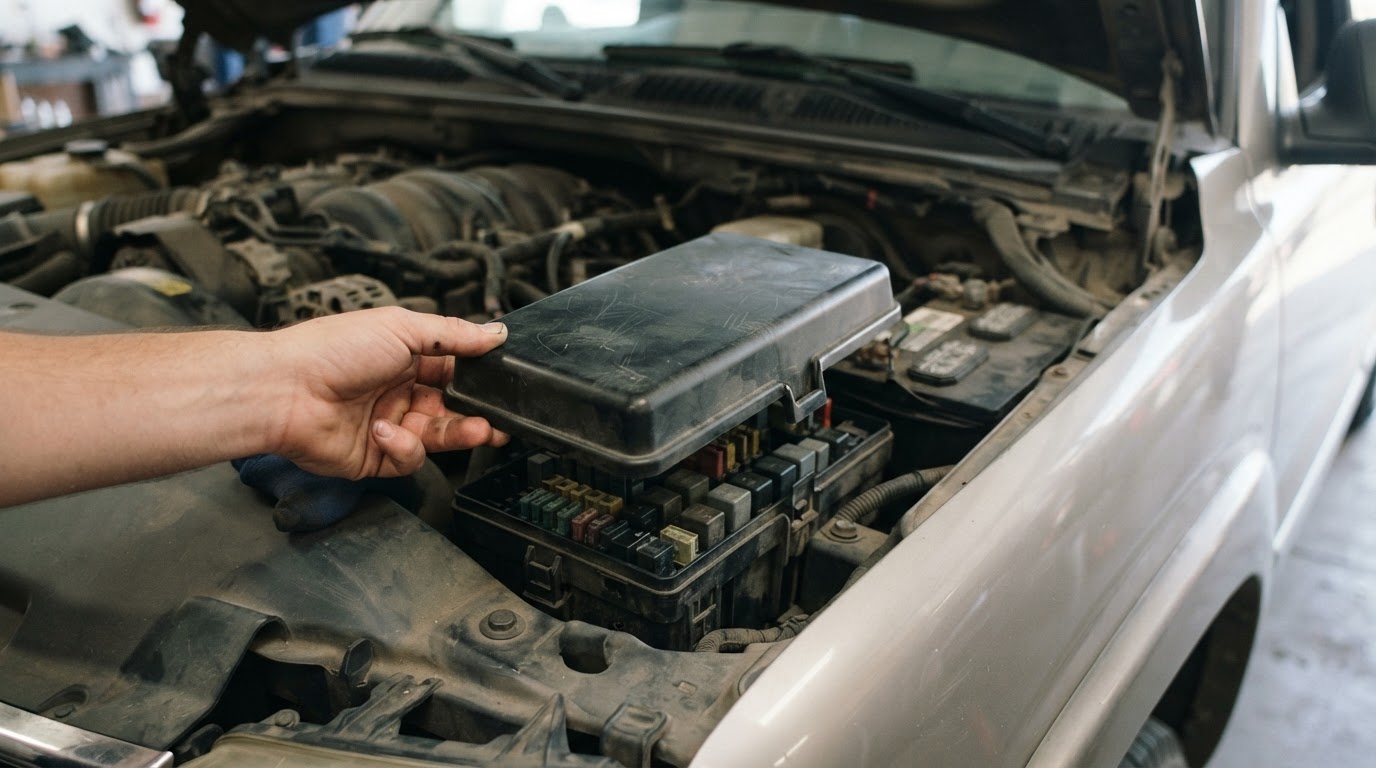
2002 F-150 power distribution box chart
Engine compartment, left side, near the battery. Mini fuses first.
| Fuse | Amps | Circuit protected |
|---|---|---|
| 1 | 20A | Power point |
| 2 | 30A | Powertrain Control Module |
| 3 | 30A | Main light switch, headlamp relay, multifunction switch |
| 4 | – | Not used |
| 5 | 20A | Trailer tow back-up and park lamps |
| 6 | 15A | Main light switch, park lamp relay |
| 7 | 20A | Horn |
| 8 | 15A | Power door locks, central security module, lock relays |
| 9 | 15A | Daytime running lamps, fog lamps |
| 10 | 20A | Fuel pump |
| 11 | 20A | Alternator field |
| 12 | 20A | Rear auxiliary power point |
| 13 | 15A | A/C clutch |
| 14 | – | Not used |
| 15 | 10A | Running board lamps |
| 16 | – | Not used |
| 17 | – | Not used |
| 18 | 15A | PCM, fuel injectors, fuel pump relay, mass air flow sensor |
| 19 | 10A | Trailer or camper adapter, right stop and turn lamp |
| 20 | 10A | Trailer or camper adapter, left stop and turn lamp |
| 21 | – | Not used |
| 22 | – | Not used |
| 23 | 15A | HEGO sensor, automatic transmission |
| 24 | – | Not used |
High current cartridge fuses in the same box:
| Fuse | Amps | Circuit protected |
|---|---|---|
| 101 | 30A | Trailer tow battery charge |
| 102 | 50A or 20A | 4WABS module, or RABS module and ignition switch |
| 103 | 50A | Central junction box |
| 104 | 30A | 4×4 shift motor and clutch |
| 105 | 40A | Climate control front blower |
| 106 | 20A | Intercooler pump (supercharged engine only) |
| 107 | – | Not used |
| 108 | 30A | Trailer tow electric brake |
| 109 | – | Not used |
| 110 | 30A | Accessory delay relay |
| 111 | 40A | Ignition switch battery feed, start and run circuits |
| 112 | 30A | Driver power seat, adjustable pedal switch |
| 113 | 40A | Ignition switch battery feed, run and accessory circuits |
| 114 | – | Not used |
| 115 | 20A | Power door locks |
| 116 | – | Not used |
| 117 | – | Not used |
| 118 | 30A | Heated seats |
| 601 | Circuit breaker | Power windows, moonroof |
Position 102 is the one place ratings split by equipment. One reading is 50A for the four wheel ABS module, the other is 20A for the rear wheel ABS module and ignition switch. Read the number off the fuse you pull and match it to your truck’s brake system.
What changes between a 2002 and a 2003 F-150 (most sites miss this)
A 2002 and a 2003 F-150 are the same nameplate generation, so most fuse sites publish one combined chart for both years. That merge erases four real changes.
Power distribution box, four positions gain a function in 2003 that a 2002 truck does not have:
| Fuse | 2002 | 2003 |
|---|---|---|
| 4 | Not used | 20A, console power point (Harley-Davidson only) |
| 16 | Not used | 15A, bi-fuel injector module and alternative fuel injectors |
| 116 | Not used | 40A, heated backlight |
| 117 | Not used | 40A, audiophile radio (SuperCrew only) |
Passenger compartment panel, one position changes too. Fuse 25 is unused on a 2002 truck. On a 2003 truck it becomes a 10A feed for heated mirrors.
I confirmed this against fuse-box.info’s year-split tables, StartMyCar’s 2002-specific page, and fusesdiagram.com’s separate 2002 and 2003 tables. All three keep 2002 and 2003 apart and agree on every value above. If a chart shows fuse 117 as the SuperCrew audiophile radio and calls itself a “2002-2003” diagram, it is showing you the 2003 truck’s box.
A second, smaller error worth naming. Ricks Free Auto Repair Advice publishes a 2002 chart whose own top-of-page summary lists fuse 7 as the horn, matching every other source here. Its detailed table below that summary lists fuse 6 at 20A instead of 15A, then shifts fuse 7 to power door locks instead of the horn, off by one position for the rest of the box. Trust the summary, not that table, or better, trust the fuse position printed on your own cover.
Which fuse is the cigar lighter and 12V power point?
On a 2002 F-150 the cigar lighter is fuse 3, rated 20A, in the passenger compartment panel. It shares that circuit with the data link connector, so a blown fuse 3 can also stop a scan tool from connecting.
The other power points are in the engine bay box: fuse 1, 20A for the main power point, and fuse 12, 20A for the rear auxiliary point on SuperCrew.
Here is where a chart built for the wrong year sends people wrong.
The rating changed earlier than most charts say. Several sites round this to “1997 to 1999 at 25A, 2000 and later at 20A.” Fuse-box.info’s own year-by-year tables put the actual break one year sooner.
| Model years | Cigar lighter fuse | Rating |
|---|---|---|
| 1997 to 1998 | Fuse 3 | 25A |
| 1999 to 2003 | Fuse 3 | 20A |
The position held at 3 for the whole 1997 to 2003 run. Only the amperage changed, and it changed in the 1999 model year, not in 2000. Fitting a 25A fuse into a 2002 truck because an older chart said so puts 5A more current through wiring sized for 20A.
The position itself changes in 2004. Our own 2003 Ford F-150 fuse box diagram documents the same fuse 3 at 20A, one model year ahead of this one. The 2006 truck moves it to fuse 41. If a chart shows fuse 41, it is describing a truck built at least two years after yours.
The label printed inside your own fuse box cover is the final authority. Trim, market, and mid-year production changes all move things.
Which fuse controls the radio?
Three separate fuses feed the audio system on this truck.
- Fuse 1, 15A: audio. Main feed. Blow this and the radio is dead.
- Fuse 8, 5A: radio, remote entry module, GEM. Also feeds the in-vehicle entertainment system on SuperCrew.
- Fuse 20, 5A: audio, GEM, PCM, transmission range sensor. Shared with powertrain circuits, so a fault here rarely presents as audio alone.
Fuse 30 also touches the radio through the radio noise capacitor, but it is primarily the ignition coil and anti-theft circuit. If fuse 30 is blown your truck will not start, and the silent radio is the smaller problem.
Which fuse controls the A/C, blower and heated seats?
Comfort circuits split across both boxes, so the symptom tells you which box to open.
| Symptom | Check this | Box |
|---|---|---|
| Fan blows but never gets cold | Fuse 13, 15A, A/C clutch | Engine bay |
| No air at any speed | Fuse 105, 40A, front blower | Engine bay |
| Climate controls completely dead | Fuse 5, 15A, climate mode switch | Cab panel |
| Heated seats not working | Fuse 118, 30A | Engine bay |
| Rear window defroster dead | Not fused separately on a 2002 | – |
The blower is the one people get wrong most. It is a 40A cartridge fuse in the engine bay, not a mini fuse in the cab. If the fan works on high but nothing else, the fuse is fine and you are looking at a blower motor resistor instead.
The rear defroster line is worth calling out on its own. A 2002 truck has no dedicated heated backlight fuse in this box. That circuit only gets one at position 116 starting in 2003, which is one more reason not to trust a merged 2002-2003 chart if your rear defroster will not clear.
Which fuse stops the truck from starting?
Three positions can leave you turning the key with nothing happening.
- Fuse 30, 30A, cab panel. Ignition coils, PCM relay, coil on plugs, and the passive anti-theft transceiver. If the theft light behaves oddly alongside the no-start, read our Ford PATS system reset guide before you buy parts.
- Fuse 21, 15A, cab panel. DTR sensor, clutch switch, starter relay.
- Fuse 111, 40A, engine bay. Ignition switch battery feed, start and run circuits.
- Fuse 10, 20A, engine bay. Fuel pump. Engine cranks but will not fire.
Cranks but will not start points at fuel or spark, so check 10 and 30. No crank at all points at 21 or 111.
How do you tell if a fuse is actually blown?
Pull it and look through the plastic window at the metal strip. An intact fuse has an unbroken element. A blown one shows a visible gap, or the window is smoked brown or black.
Three things catch people out on this truck:
- A hairline break looks intact. Hold the fuse to a light. If you are not certain, test continuity with a multimeter set to ohms. Near zero means good.
- Never guess the replacement rating. Match the number printed on the fuse and cross-check the box cover label. Fitting 30A where 10A belongs lets the wiring become the fuse.
- The cartridge fuses need a puller. Positions 101 to 118 are the flat cartridge type. Pliers crack the housing. A mixed ATO/ATC fuse assortment kit costs less than one dealer fuse and usually includes the puller.
Why does the same fuse keep blowing?
A fuse that blows once is usually a surge. One that blows again within days means the fault is upstream, and replacing it repeatedly treats the alarm instead of the fire.
Work through it in this order:
- Unplug whatever you added most recently. Trailer wiring, a dash cam, an aftermarket stereo, a charger left in the 12V socket. Aftermarket accessories cause most repeat blows on these trucks.
- Check where the harness moves. Door jambs, the tailgate run, and anything near the steering column flex thousands of times and chafe.
- Look for water. A wet connector shorts intermittently, which is why the fuse survives a dry week and dies in the rain.
Two circuits on this truck have their own habits worth knowing. Fuse 23 feeds the 4×4 solenoids and relays, so if it keeps blowing and the transfer case is slow to engage, see 4×4 actuator problems. Fuse 101 and 108 feed trailer charging and electric brakes, and a corroded seven-pin connector is the usual culprit, covered in our trailer brake module fault guide.
If a fuse blows the instant you seat it, there is a hard short. Stop replacing fuses and trace the circuit. A Ford-capable scan tool reads live data instead of guessing.
2002 F-150 fuse quick reference
The positions owners look up most, in one place. C means the cab panel, E means the engine bay box.
| What you want | Fuse | Amps | Box |
|---|---|---|---|
| Cigar lighter, 12V outlet | 3 | 20A | C |
| Main power point | 1 | 20A | E |
| Rear power point (SuperCrew) | 12 | 20A | E |
| Radio | 1 | 15A | C |
| Horn | 7 | 20A | E |
| Fuel pump | 10 | 20A | E |
| Ignition coils, anti-theft | 30 | 30A | C |
| High beam headlamps | 16 | 20A | C |
| Low beam, right | 26 | 10A | C |
| Low beam, left | 28 | 10A | C |
| Fog lamps | 9 | 15A | E |
| Wipers and washer | 11 | 30A | C |
| Blower motor | 105 | 40A | E |
| A/C clutch | 13 | 15A | E |
| Heated seats | 118 | 30A | E |
| Power windows | 601 | Breaker | E |
| Power door locks | 8 or 115 | 15A / 20A | E |
| Driver power seat | 112 | 30A | E |
| Trailer electric brake | 108 | 30A | E |
| Starter relay | 21 | 15A | C |
If your truck is a model year later, our 2003 Ford F-150 fuse box diagram covers what actually changes, and the 2006 Ford F-150 fuse box diagram covers the next-generation truck with the moved cigar lighter fuse. Our F-150 fuse box identification guide covers how the panels differ across every generation.
One Comment