Why Are Trucks Called Half-Ton? The Surprising History Explained

The term half-ton is a legacy label from the post-WWII era when a light-duty truck’s safe payload capacity was exactly 1,000 pounds. While modern engineering allows these vehicles to carry much more, the name persists as a standard industry classification to differentiate light-duty pickups from heavy-duty models.
🎯 Key Takeaways
Recommended Best Deal Products

- The half-ton name originally reflected a literal 1,000-pound payload limit.
- Modern half-ton trucks frequently carry between 1,500 and 2,500 pounds.
- The label has transitioned from a measurement to a marketing classification.
- Truck classes are now legally determined by Gross Vehicle Weight Rating (GVWR).
- Consistency in naming helps consumers distinguish between light and heavy-duty models.
The term “half-ton” is a relic from a time when truck ratings were literal. Decades ago, if you bought a half-ton truck, it meant the vehicle’s maximum safe payload—the weight of the passengers, fuel, and cargo in the bed—was exactly 1,000 pounds. While modern “half-ton” trucks like the Ford F-150 or Chevy Silverado 1500 can now carry double or even triple that amount, the name has survived as a shorthand for a specific class of vehicle. Understanding this history helps you navigate the confusing gap between a truck’s marketing label and its actual capability on the road today.

Prime for Young Adults — 6 Months Free
Students and 18–24s get six months of Prime free, then half price.
Start 6 Months Free As an Amazon Associate I earn from qualifying purchases.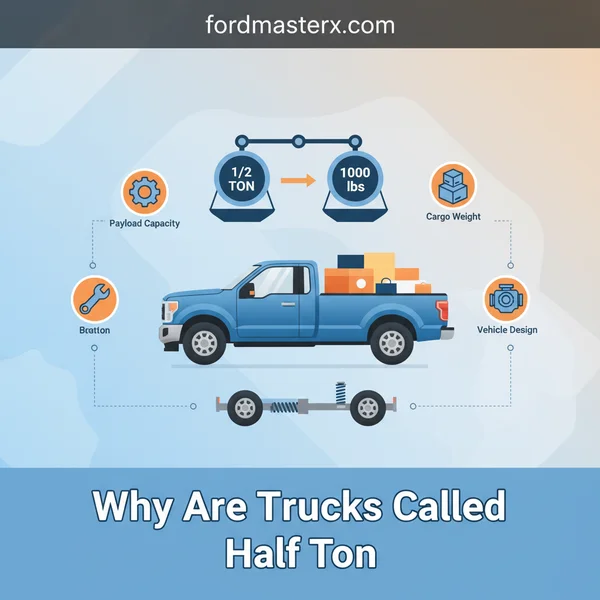
Knowing the origin of these labels is more than a history lesson; it prevents you from making costly mistakes when hauling. If you assume your modern truck is limited to its historical “half-ton” name, you might leave money on the table. Conversely, if you don’t realize these names are now purely categories, you might mix up the capabilities of a 1500-series truck with a 2500-series heavy-duty model. The names stayed the same, but the engineering changed entirely. To understand why your truck is “lying” to you about its weight class, we have to look back at the era of standardized manufacturing following World War II.
The Historical Origin of the Half-Ton Designation
In the early 20th century, truck ratings were a chaotic mess of different manufacturer standards. This changed after World War II when the American automotive industry sought to simplify classifications for consumers and the military. At that time, a “half-ton” truck was a very specific engineering promise. The frame, tires, and suspension were designed to safely handle 1,000 pounds of total payload. If you pushed it to 1,100 pounds, you risked snapping a leaf spring or blowing out a tire. The label was a literal safety warning for the driver.
The Post-WWII Standardized Classifications
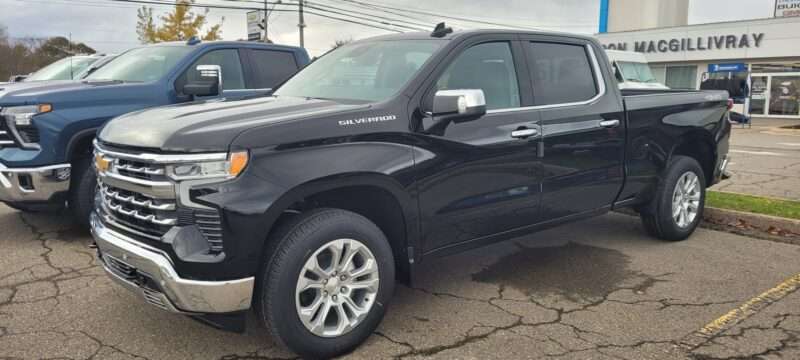
During the late 1940s and 1950s, the “Big Three” (Ford, GM, and Chrysler) adopted a tiered system that created the classes we still recognize today. These classifications were based strictly on the payload capacity of the chassis. Here is how the original hierarchy looked:
- Half-Ton: Designed for light duty and small farm tasks. Examples include the Ford F-1 and the Chevrolet 3100. These had a 1,000-lb capacity.
- Three-Quarter Ton: Aimed at commercial delivery and heavier ranch work. These were rated for 1,500 lbs of cargo.
- One-Ton: The original heavy-duty workhorses, built to carry 2,000 lbs, often used for industrial hauling or construction.
This system was incredibly practical for a society transitioning from horse-drawn wagons to motorized transport. You knew exactly what you were getting. A farmer knew that two 500-pound steers would max out a half-ton truck. For nearly twenty years, these labels and the actual physical capabilities of the trucks remained perfectly in sync. The hardware of the era—primarily ladder frames and basic leaf spring setups—simply couldn’t handle the massive loads we take for granted today without significant failure risks.
The Evolution of Truck Engineering vs. Marketing Names
As the 1960s and 70s rolled around, metallurgy and automotive engineering took massive leaps forward. Manufacturers began using high-strength steel for frames and more sophisticated suspension geometries. Tires evolved from fragile bias-ply constructions to durable radials. Suddenly, the same “half-ton” chassis was capable of carrying 1,200, 1,500, or even 1,800 pounds. However, manufacturers faced a dilemma: should they change the name of the truck every time the engineering improved?
Why Manufacturers Kept the “Old” Labels
Instead of updating the names to reflect actual poundage, companies realized that “half-ton” had become a powerful brand in itself. It signaled a specific size of vehicle to the buyer. If Ford had renamed the F-100 to the “three-quarter ton” because it could now carry 1,500 pounds, it would have confused customers who expected a “three-quarter ton” truck to be a much larger, thirstier commercial vehicle. Marketing won out over mathematical accuracy.
- Brand Recognition: Customers knew exactly where a half-ton truck fit in their driveway and their budget.
- Insurance and Tax Classes: Many states used these weight designations to determine registration fees. Keeping the “half-ton” label helped keep light-duty trucks in a lower tax bracket.
- The Rise of Model Numbers: To bridge the gap, companies introduced numbers like 1500 (GM/Ram) or 150 (Ford). These numbers were meant to sound larger and more capable than the 1000-lb “half-ton” past without officially changing the vehicle’s class.
By the 1980s, the “half-ton” label had drifted almost entirely away from reality. You were no longer buying a truck that carried 1,000 pounds; you were buying a “Class 1” or “Class 2a” light-duty vehicle that was simply called a half-ton for the sake of tradition. This disconnect created the modern landscape where a “half-ton” Ford F-150 can occasionally have a higher payload rating than an older “three-quarter ton” truck from the 1970s. The name became a category of size, not a measurement of weight.
Modern Weight Classifications and GVWR Standards
While the terms “half-ton” and “one-ton” remain popular in casual conversation, the automotive industry has largely moved toward a more precise metric: Gross Vehicle Weight Rating (GVWR). This figure represents the absolute maximum weight a vehicle can safely handle, including the weight of the truck itself, fuel, passengers, and cargo. In the modern era, manufacturers use these ratings to classify trucks into specific “Classes” defined by the Department of Transportation.

Decoding the Gross Vehicle Weight Rating (GVWR)
Today’s truck classifications are determined by where a vehicle falls on the GVWR scale. For instance, most “half-ton” trucks actually fall into Class 2a, which covers vehicles with a GVWR between 6,001 and 8,500 pounds. This is a far cry from the original 1,000-pound payload capacity that gave these trucks their names. When you look at a modern truck, you aren’t just looking at what it can carry in the bed, but how the entire chassis manages the combined weight of everything on board.

Audible — Listen Free for 30 Days
One free credit a month and thousands of titles included.
Listen Free for 30 Days As an Amazon Associate I earn from qualifying purchases.How Manufacturers Categorize Today’s Trucks
Instead of relying on the old ton-based labels, manufacturers now design trucks to meet specific regulatory and performance tiers. Here is how the modern landscape is generally divided:
- Class 1: Small or mid-size pickups (GVWR up to 6,000 lbs), like the Toyota Tacoma or Ford Ranger.
- Class 2: Full-size “half-ton” trucks (GVWR 6,001–10,000 lbs), including the Chevy Silverado 1500 and Ram 1500.
- Class 3: Heavy-duty “one-ton” trucks (GVWR 10,001–14,000 lbs), such as the Ford F-350 or GMC Sierra 3500.
Practical Tip: Always check the safety sticker on your driver-side door jamb. This sticker provides the exact GVWR and payload capacity for your specific vehicle configuration, which is much more accurate than the “half-ton” nickname.
Comparing Half-Ton, Three-Quarter-Ton, and One-Ton Categories
Choosing between these categories often comes down to balancing daily comfort with work-ready capability. The jump from a half-ton to a three-quarter-ton isn’t just about a bigger engine; it involves significant upgrades to the frame, suspension, and braking systems. Understanding these differences is crucial if you plan on towing heavy trailers or hauling construction materials on a regular basis.
Light-Duty vs. Heavy-Duty Performance
The 1500 series (half-ton) is generally considered “light-duty.” These trucks are designed for a smoother ride, better fuel economy, and enough utility for the average homeowner. On the other hand, 2500 (three-quarter-ton) and 3500 (one-ton) models are “heavy-duty” machines. They feature stiffer leaf springs and larger cooling systems to handle the heat generated by hauling massive loads over long distances. While a one-ton truck offers incredible power, it often provides a much “stiff” or bumpy ride when the bed is empty.
Choosing the Right Capacity for Your Needs
To help you decide which category fits your lifestyle, consider these common use cases:
- Half-Ton (1500): Best for daily driving, light towing (small boats or campers), and DIY home improvement projects.
- Three-Quarter-Ton (2500): Ideal for frequent towing of medium-sized horse trailers or large travel trailers where extra stability is needed.
- One-Ton (3500): Necessary for heavy commercial work, fifth-wheel campers, and massive gooseneck trailers.
Practical Example: A modern Ford F-150 (half-ton) can often haul over 2,000 pounds of payload. Meanwhile, a Ford F-350 (one-ton) can sometimes exceed 7,000 pounds of payload. Even though the names suggest a much smaller difference, the actual capability gap is enormous.
Conclusion: More Than Just a Number
The term “half-ton” is a fascinating piece of automotive history that has outlived its original technical meaning. While it started as a literal measure of what a truck could carry, it has evolved into a shorthand label for a vehicle’s size and class. Today’s trucks are more capable than ever, often doubling or even tripling the payload capacities their names would suggest. Understanding this history helps you see past the marketing and focus on the numbers that actually matter for safety and performance.
Ready to put your truck to work? Start by checking your specific payload rating on your door jamb sticker before your next big haul. If you found this trip down memory lane helpful, share this post with a fellow truck enthusiast or leave a comment with your favorite vintage pickup facts!
❓ Frequently Asked Questions
Why did the half-ton label start in the first place?
Following World War II, truck manufacturers standardized ratings based on what the frame and suspension could safely carry. At that time, 1,000 pounds (a half-ton) was the upper limit for light-duty personal and farm pickups.
What do the numbers 1500, 2500, and 3500 represent?
These numbers are manufacturer-specific codes that correlate to the old weight classes. A 1500 series represents a half-ton, 2500 represents a three-quarter-ton, and 3500 represents a one-ton truck.
Audible Premium Plus — Annual Membership
12 audiobook credits up front, plus the full Audible catalogue.
See Annual Plans As an Amazon Associate I earn from qualifying purchases.How did trucks become so much more capable over time?
Advancements in high-strength steel, turbocharging, and heavy-duty suspension systems have allowed manufacturers to increase payload and towing capacities while maintaining the light-duty ‘half-ton’ classification for tax and insurance purposes.
What is the difference between payload and towing capacity?
Payload is the total weight of cargo and passengers inside the truck bed and cabin, while towing capacity is the maximum weight the truck can pull behind it in a trailer.
Are there any legal implications to these classifications?
Yes, vehicle classifications based on weight affect everything from registration fees and insurance premiums to emissions standards and commercial driving requirements.
Should I choose a half-ton or a three-quarter-ton truck?
A half-ton is ideal for daily driving and moderate hauling. If you frequently tow heavy trailers or carry heavy construction materials, a three-quarter-ton (2500) offers the necessary suspension and braking upgrades.