How to Identify Chain Grade: Decode Markings & Ratings

Identify chain grade by locating embossed markings (like G43, 7, or 8) stamped directly onto the links, which indicate the metal’s strength and carbon content. Only Grade 80, 100, and 120 are approved for overhead lifting, while lower grades like G70 are strictly for transport and tie-down applications.
🎯 Key Takeaways
Recommended Best Deal Products


- Check every few links for embossed stamps like G30, G43, G70, or G80.
- Use Grade 80 or higher specifically for all overhead lifting applications.
- Match the identified grade number to a WLL chart based on chain diameter.
- Assume unmarked chains are the lowest grade (Grade 30) for safety purposes.
- Replace chains if markings are worn away or illegible during your inspection.
When you look closely at a chain link, those tiny embossed numbers and letters are the only thing telling you if that chain is safe for your specific job. These markings represent the “Grade,” which is a standardized measurement of the chain’s material strength and weight capacity. If you see a “G70” or an “8,” you are looking at a code that dictates exactly how much stress that metal can handle before it reaches its breaking point.
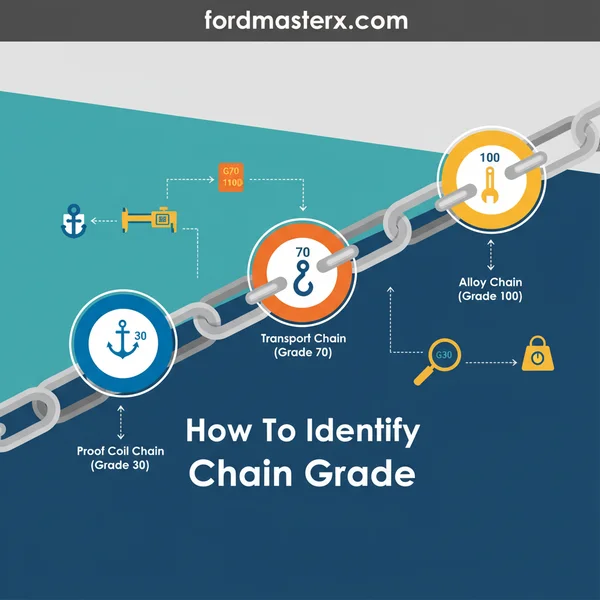
Identifying these codes is a critical safety step. Using a transport chain for overhead lifting is a leading cause of rigging accidents and equipment failure. By learning to decode the stamps on your links, you can verify that your equipment meets OSHA or DOT requirements and ensure you aren’t overstressing a low-grade chain. These markings provide the “Working Load Limit” (WLL) data you need to work confidently and legally.

Prime for Young Adults — 6 Months Free
Students and 18–24s get six months of Prime free, then half price.
Start 6 Months Free As an Amazon Associate I earn from qualifying purchases.Decoding Embossed Markings: Common Chain Grade Symbols
Manufacturers are required to stamp chain links at regular intervals, typically every 10 to 20 links or every foot of chain. These markings are your primary source of truth. The most common format is a letter followed by a number, or just a standalone number, which indicates the grade based on the metal’s tensile strength measured in Newtons per square millimeter.
The Numbering System Simplified
The numbers you see stamped into the metal correlate directly to the strength of the steel. As the numbers increase, the strength-to-weight ratio of the chain also increases. Here is what the most common digits signify:
- 3, 30, or L: This indicates Grade 30, also known as Proof Coil. It is made from low-carbon steel and is used for light-duty tasks like securing a gate or a swing set.
- 4, 40, or 43: This represents Grade 43 High Test chain. It is significantly stronger than Grade 30 and is often used in the trucking industry for tie-downs and stationary binding.
- 7, 70, or 700: This marks Grade 70 Transport chain. You will often see this with a gold or yellow chromate finish. It is high-strength carbon steel designed for load securement on trailers.
- 8, 80, or 800: This signifies Grade 80 Alloy chain. This is the first grade of chain that is legally approved for overhead lifting.
- 10, 100, or 1000: This indicates Grade 100 Alloy. It provides roughly 25% more strength than Grade 80 and is used for heavy-duty overhead lifting.
- 12, 120: This is a newer, ultra-high-performance grade used for specialized lifting where maximum weight reduction is needed.
Manufacturer and Traceability Codes
In addition to the grade number, you will often find letters stamped into the links. These are manufacturer-specific identifiers and traceability codes. For example, letters like “HF” or “A” might signify the specific plant where the chain was forged or the batch of steel used. These letters do not change the strength rating, but they are essential for industrial inspections. If a chain has no markings at all, it should be treated as Grade 30 or lower and never used for any critical load-bearing or lifting application.
Master Chain Grade Identification in 7 Simple Steps
Recommended Best Deal Products

Identifying the grade of a chain is a critical safety procedure whether you are securing a load for transport, rigging for an overhead lift, or simply purchasing hardware for a home project. Chain grades, established by organizations like the ASTM and NACM, dictate the material strength, carbon content, and heat treatment of the metal. Misidentifying a chain can lead to catastrophic failure, as using a low-grade utility chain for overhead lifting is extremely dangerous. This guide will walk you through the precise process of cleaning, inspecting, measuring, and cross-referencing chain markings to ensure you know exactly what weight your equipment can handle and what applications it is suited for.
Step 1: Prepare and Clean the Inspection Surface
What you need: A stiff wire brush, a degreasing solvent (like brake cleaner or simple green), a clean shop rag, and a bright flashlight or headlamp.
Instructions: Chain markings are often tiny, embossed characters that become filled with grease, dirt, or layers of paint over time. To begin, lay the chain out flat on a clean workbench. Use your wire brush to vigorously scrub several links at intervals of every two to three feet. Markings are not usually stamped on every single link; industry standards often require markings every 10th to 20th link or every three feet. Apply the degreaser to remove stubborn grime and wipe the links dry. Once the metal is bare, use your flashlight at an oblique angle (from the side) to create shadows within the embossed numbers. This “raking light” technique makes faint or worn stamps much easier to read against the reflective surface of the steel.
Pro Tip: If the chain is heavily rusted, avoid using a grinder, as this can remove the very markings you are looking for. Stick to a manual wire brush or a chemical rust dissolver to preserve the integrity of the embossed code.
Step 2: Locate and Decipher the Embossed Grade Code
What you need: A magnifying glass and a reference list of common NACM (National Association of Chain Manufacturers) grade designations.
Instructions: Look for a combination of letters and numbers stamped into the side of the links. Common codes include “G3” or “30” (Grade 30 Proof Coil), “G4” or “43” (Grade 43 High Test), “G7” or “70” (Grade 70 Transport), and “G8”, “80”, or “800” (Grade 80 Alloy). If you see a “G10” or “100”, you are dealing with high-performance alloy steel. These numbers represent the “Newtons per square millimeter” of the material’s breaking strength (e.g., Grade 80 means 800 N/mm²). If you find no markings at all after a thorough cleaning of the entire length, you must assume the chain is “Grade 30” or lower, which is general-utility chain never to be used for overhead lifting or critical load-bearing tasks.

Audible — Listen Free for 30 Days
One free credit a month and thousands of titles included.
Listen Free for 30 Days As an Amazon Associate I earn from qualifying purchases.Pro Tip: Be wary of chains marked only with a brand name or country of origin. If a numerical grade is not present, the chain is not rated for specific industrial lifting standards.
Step 3: Analyze the Finish and Color Coding
What you need: Natural lighting or a high-CRI (Color Rendering Index) LED light source.
Instructions: While the embossed stamp is the definitive proof, the finish of the chain provides immediate clues to its grade. Grade 70 Transport chain is almost universally finished with a yellow-gold chromate or gold zinc plating, specifically so DOT inspectors can identify it quickly from a distance. Grade 30 and 43 chains are typically “bright” (uncoated), zinc-plated (silver appearance), or hot-dip galvanized (dull grey, textured). Grade 80 and 100 alloy chains, which are rated for overhead lifting, usually feature a black lacquer, black oxide, or a specific colored powder coating (often blue or grey) to distinguish them from lower-strength utility chains. If you see a gold-colored chain, it is likely a Grade 70 binder chain, designed for load securement on trailers, not for overhead hoisting.
Pro Tip: Finishes can wear off or be repainted. Always prioritize the embossed stamp over the color if there is a discrepancy between the two.
Step 4: Measure the Material Diameter and Link Pitch
What you need: A pair of digital or dial calipers and a tape measure.
Instructions: Use your calipers to measure the diameter of the wire used to make the link. Measure in a clean, non-worn area, typically the straight side of the link rather than the ends. Next, measure the “pitch,” which is the internal length of a single link. Higher grade chains like Grade 80 or 100 often have a “short link” design, meaning the links are tighter and more compact to prevent snagging and to provide better flexibility over sheaves and winches. Compare your measurements to a standard manufacturer’s specification chart. For example, a 3/8-inch Grade 70 chain will have a specific weight per foot and link count per foot that differs slightly from a 3/8-inch Grade 30 chain. Precise measurement helps confirm the identity if the embossed markings are partially obscured.
Pro Tip: When measuring diameter, take measurements at 90-degree angles to each other on the same spot to check for “out-of-round” wear, which could indicate the chain has been overloaded or stretched.
Step 5: Identify Manufacturer Traceability Codes
What you need: Internet access or a rigging hardware catalog (e.g., Crosby, Peerless, or Campbell).
Instructions: In addition to the grade number, many high-quality chains feature a traceability code or a manufacturer’s mark (such as “C” for Crosby or “H” for Gunnebo). These codes allow the manufacturer to trace the specific heat-treat batch and chemistry of the steel. Find these letters and look them up on the manufacturer’s website. This step is particularly important for Grade 80, 100, and 120 chains used in overhead lifting. If you can identify the manufacturer, you can find the exact Working Load Limit (WLL) for that specific model. This eliminates guesswork and ensures that you are following the safety factors (usually 4:1 for transport and 5:1 for overhead lifting) required by OSHA and other regulatory bodies.
Pro Tip: If the chain has a manufacturer mark but no grade mark, it is often a custom industrial chain. Contact the manufacturer directly with the traceability code to get the specifications.
Audible Premium Plus — Annual Membership
12 audiobook credits up front, plus the full Audible catalogue.
See Annual Plans As an Amazon Associate I earn from qualifying purchases.Step 6: Test for Magnetism and Material Type
What you need: A strong neodymium magnet and a basic understanding of stainless steel types.
Instructions: This step helps distinguish between carbon steel chains and stainless steel chains, which have different grading systems (such as Type 304 or 316). Most standard industrial grade chains (G30 to G120) are made of carbon or alloy steel and will be strongly magnetic. If your magnet does not stick or has a very weak pull, the chain is likely stainless steel. Stainless steel chain is typically used in marine or food-grade environments and is not graded the same way as transport or lifting chain. While 316 stainless is highly corrosion-resistant, its working load limit is generally lower than a similarly sized Grade 80 alloy steel chain. Knowing the material ensures you don’t accidentally treat a decorative or marine stainless chain as a high-strength transport chain.
Pro Tip: Some high-strength stainless steel chains exist, but they are rare and will be clearly marked with “6” or “50” designations. When in doubt, never use stainless chain for overhead lifting unless it is explicitly marked for that purpose.
Step 7: Verify Against the Working Load Limit (WLL) Table
What you need: A printed NACM Working Load Limit table or a digital reference chart.
Instructions: Now that you have the grade (e.g., G70) and the size (e.g., 5/16″), cross-reference these two data points on a WLL table. A 5/16″ Grade 70 chain typically has a WLL of 4,700 lbs, whereas a 5/16″ Grade 30 chain only has a WLL of 1,900 lbs. This final step confirms the practical capacity of the chain you have identified. If your measurements and markings suggest one grade, but the physical weight and link style look like another, always default to the lower rating for safety. Document the identified grade and WLL by attaching a metal tag to the chain or recording it in your equipment log. This ensures that the next person who uses the chain doesn’t have to repeat the identification process from scratch.
Pro Tip: Always remember that the WLL is the maximum load that should ever be applied to the chain in “pull” tension. Never exceed this limit, and always account for angles in rigging which can significantly increase the stress on the links.
✅ Final Checklist
- Surface cleaned and embossed markings (e.g., G43, G70, G80) located and read.
- Chain finish (Gold, Black, Silver) matched with the identified grade for consistency.
- Link diameter and pitch measured with calipers to verify size against industry charts.
- Manufacturer marks identified to ensure the chain comes from a reputable, traceable source.
- Final Working Load Limit (WLL) confirmed using an official NACM or manufacturer reference table.
Important Notes:
- Safety First: Never use a chain for overhead lifting unless it is specifically marked as Grade 80, 100, or 120. Using Grade 70 or lower for lifting is a violation of OSHA safety standards.
- When to Seek Help: If the chain shows signs of stretching (elongation), nicks, gouges, or heat damage (discoloration), it should be removed from service regardless of its grade. Consult a certified rigging inspector if you are unsure.
- Estimated Time and Cost: Identification takes approximately 15–30 minutes. The cost is negligible (cleaning supplies and basic tools), but the safety value is immeasurable.
Overhead Lifting vs. Transport: Safety Rating Comparisons
The most important distinction you must make when identifying chain grade is whether the chain is rated for overhead lifting. The legal and safety requirements for lifting a load over people or expensive equipment are much stricter than those for securing a load to a flatbed truck. Using the wrong grade for a lift is not just a safety hazard; it is a violation of federal safety standards.

The Critical Threshold: G80 and Above
For a chain to be rated for overhead lifting, it must be made of high-quality alloy steel. In the United States, only Grade 80, Grade 100, and Grade 120 are approved for overhead lifting. These chains are specifically engineered to stretch before they snap, providing a visual warning of failure. They also have a safety factor of 4:1. This means the actual breaking strength is four times the rated Working Load Limit (WLL).
- Safety Factor: 4:1 (Lifting) vs 3:1 (Transport).
- Material: Heat-treated alloy steel.
- Markings: Must clearly show 8, 80, 10, or 100.
Low-Grade Chains: G30 to G70
Grades 30, 43, and 70 are not rated for overhead lifting. Grade 70 is incredibly strong and used widely in the transport industry for securing heavy machinery, but it is made from heat-treated carbon steel, which is more brittle than the alloy used in lifting chains. If a G70 chain fails, it tends to snap suddenly rather than stretching. Because of this structural difference, OSHA prohibits the use of G70 and lower for any overhead hoisting. Always check for that G80+ stamp before attaching a chain to a crane or hoist.
Factors Influencing Working Load Limits (WLL) and Strength
Identifying the grade on a chain is only half the battle. To use it safely, you must understand that the Working Load Limit (WLL) isn’t just a static number stamped on the metal. While the grade tells you the ultimate breaking strength relative to the cross-sectional area, several physical factors dictate how much weight that specific chain can actually handle in the field.
Material Composition and Heat Treatment
The primary difference between a Grade 30 and a Grade 100 chain lies in the chemistry of the steel and the heat-treatment process. Lower grades are typically made from carbon steel, which is excellent for general utility but lacks the toughness for overhead lifting. High-grade chains (G80 and above) are crafted from alloy steel. These alloys undergo a rigorous “quench and temper” process that reorganizes the molecular structure to increase tensile strength and ductility. This allows a smaller, lighter alloy chain to lift significantly more weight than a bulkier carbon steel version.
Environmental and Operational Stressors
Even the strongest Grade 120 chain can fail if environmental factors are ignored. You must account for variables that degrade the metal’s integrity over time. Key factors include:
- Corrosion: Rust isn’t just cosmetic; it eats away at the link diameter, directly reducing the WLL.
- Extreme Temperatures: High heat (often found in manufacturing or foundries) can “anneal” or soften the steel, permanently lowering its grade strength.
- Shock Loading: Sudden jerks or drops apply forces far beyond the static weight of the load, potentially exceeding the chain’s safety factor instantly.
- Wear and Nicks: Small gouges in a link act as “stress risers” where a crack is likely to start under tension.
Alternatives to Embossed Markings for Chain Identification
What happens when a chain is so old or worn that the embossed markings have faded away? Relying on guesswork is a major safety risk. In these scenarios, professionals look for secondary cues and official documentation to verify the grade before the chain ever touches a load.
Physical Finish and Visual Cues
Manufacturers often use specific finishes as a visual shorthand for different grades. While not a definitive proof of strength, these finishes provide a strong hint for identification. For example, Grade 70 Transport Chain is almost universally recognized by its iridescent gold-toned zinc chromate finish. This makes it easy for DOT inspectors to identify it on the road. In contrast, Grade 80 and 100 lifting chains often feature a black oxide or gray thermal finish to protect against the elements while remaining distinct from utility chains.
Documentation and Hardware Tags
The most reliable way to identify a chain when markings are obscured is through its “paper trail” and attached hardware. Most industrial chains are sold with a Manufacturer’s Certificate that lists the grade, batch number, and break test results. Furthermore, any chain sling used for overhead lifting is required to have a permanent, durable metal tag attached to the master link. These tags contain vital information, including:
- Grade: Clearly stated (e.g., Grade 100).
- Reach: The total length of the assembly.
- Serial Number: For tracking inspection history.
- Rated Capacity: Specified for various lifting angles.
Practical Tip: If a chain lacks both embossed markings and an identification tag, it should be treated as the lowest possible grade (Grade 30) or removed from service entirely until its origin can be verified.
Conclusion: Safety Starts with Identification
Accurately identifying a chain’s grade is the foundation of any safe rigging or towing operation. By decoding the embossed numbers and letters, understanding the metallurgical factors that influence strength, and utilizing secondary identification methods like color finishes and tags, you ensure that every link in your system is up to the task. Remember, a chain is only as strong as its weakest link—and its weakest link is often the one that was misidentified.
To stay safe, make it a habit to inspect your chains for visible markings before every project. If you are ever in doubt, consult the manufacturer’s documentation or replace the hardware. Always prioritize safety over convenience; your equipment and your team are worth the extra effort.
❓ Frequently Asked Questions
What is the primary difference between Grade 70 and Grade 80 chain?
Grade 70 is a transport chain designed for load securement with a gold chromate finish, while Grade 80 is an alloy steel chain specifically engineered and approved for overhead lifting safety.
How often should I check for grade markings on my rigging equipment?
Markings should be verified during every pre-use inspection and during formal annual inspections to ensure the chain’s capacity matches the job requirements.
Do the single numbers 3, 4, 7, and 8 mean the same as G30, G43, G70, and G80?
Yes, manufacturers often use single-digit shorthand (3, 4, 7, 8, 10, or 12) to represent the full grade of the chain on smaller links.
Why is Grade 30 commonly referred to as ‘Proof Coil’?
It is a general-purpose carbon steel chain that has been ‘proof tested’ to twice its working load limit, but it lacks the heat treatment required for heavy industrial pulling or lifting.
Can protective coatings or paint hide the grade markings?
Yes, thick galvanized coatings, heavy paint, or powder coating can obscure stamps; you may need to clean or strip a small area to verify the grade.
What safety factor is applied to identified chain grades?
Overhead lifting chains (G80 and higher) generally utilize a 4:1 safety factor, meaning the breaking strength is four times the rated Working Load Limit (WLL).