What Size Winch for Car Trailer? (Capacity Guide & Formula)

The industry standard for selecting a car trailer winch is to multiply your vehicle’s Gross Vehicle Weight (GVW) by 1.5 to determine the minimum pulling capacity. This buffer accounts for rolling resistance and the steepness of trailer ramps, ensuring the motor isn’t overstrained. If you frequently load vehicles with flat tires or non-rolling wheels, a higher capacity winch is necessary to overcome the added friction.
🎯 Key Takeaways
- Multiply Gross Vehicle Weight by 1.5 to find your minimum winch capacity.
- Account for ‘dead weight’ if loading vehicles with locked or flat tires.
- Use a snatch block to double pulling power for heavy or stuck loads.
- Choose synthetic rope for safety and ease of handling on open trailers.
- Ensure your trailer battery can handle the high amperage draw of the motor.
To determine the correct winch size for your car trailer, you must follow the 1.5x rule: multiply the gross weight of the heaviest vehicle you plan to haul by 1.5. This calculation provides the minimum pulling capacity required to move a vehicle safely up a ramp without overheating the motor or risking a cable failure. While it is tempting to match the winch rating exactly to the vehicle weight, doing so ignores the physics of friction and gravity, which can easily double the effective load on your equipment.
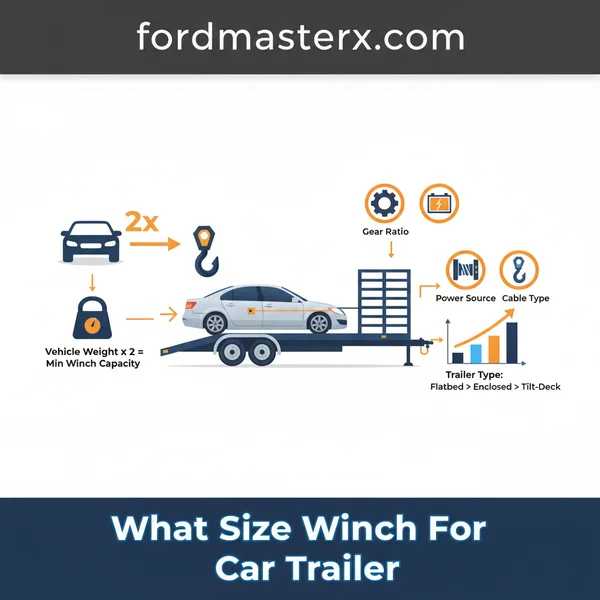
Selecting the right capacity is about more than just getting the car onto the deck; it is about protecting your investment and ensuring safety. A winch that is underpowered for the task will pull higher amperage, drain your battery faster, and significantly shorten the lifespan of the internal gears. By following a specific formula, you ensure that your winch operates within its “sweet spot,” providing enough torque to handle steep inclines or flat tires without straining the system to its breaking point.
The 1.5x Pulling Rule: Calculating Your Minimum Winch Capacity
The 1.5x rule is the gold standard for trailer winching because it accounts for “line pull” variables that are not immediately obvious. When a winch manufacturer rates a unit at 9,500 lbs, that rating only applies to the first layer of cable on the drum. As the cable wraps around the drum and builds layers, the pulling power actually decreases. By using the 1.5x multiplier, you create a buffer that ensures the winch still has enough power to finish the pull even as its mechanical advantage drops.
Applying the Formula to Common Vehicles
To use this rule, you need to know the Gross Vehicle Weight (GVW) of your heaviest potential load. This is the weight of the car plus any fluids, cargo, or modifications. Once you have that number, simply multiply by 1.5. Here are a few practical examples of how this looks in a real-world scenario:
- Compact Sports Car (3,000 lbs): 3,000 x 1.5 = 4,500 lbs. You should look for a winch rated for at least 5,000 lbs.
- Full-Size Sedan (4,500 lbs): 4,500 x 1.5 = 6,750 lbs. A 7,500 lb or 8,000 lb winch is the ideal choice here.
- Half-Ton Pickup Truck (5,500 lbs): 5,500 x 1.5 = 8,250 lbs. You should opt for a 9,000 lb or 9,500 lb winch to ensure longevity.
- Classic Steel Muscle Car (4,000 lbs): 4,000 x 1.5 = 6,000 lbs. A 6,000 lb winch is the absolute minimum, but 8,000 lbs is safer.
Always round up to the nearest available winch size. Manufacturers typically sell winches in specific increments like 2,500, 5,000, 8,000, 9,500, and 12,000 lbs. If your calculation results in 7,200 lbs, do not settle for a 7,000 lb winch. Moving up to an 8,000 lb or 9,500 lb model gives you the overhead necessary to handle the increased resistance of a steep trailer ramp or a car that doesn’t roll perfectly.
Rolling Weight vs. Dead Weight: How Resistance Impacts Performance
It is a common misconception that winching a rolling car is “easy” work for a winch. While rolling weight requires less initial force than lifting a weight vertically, the resistance changes the moment you encounter an obstacle. On a perfectly flat, paved surface, a 5,000 lb car might only require 500 lbs of force to move. However, your car trailer is rarely a perfectly flat environment. The transition from the ground to the ramps creates a significant spike in the force required to maintain movement.
The Impact of Trailer Incline
Gravity is your primary opponent when loading a trailer. As the front wheels of the vehicle hit the ramps, the winch is no longer just overcoming rolling resistance; it is now fighting the weight of the vehicle trying to roll backward. The steeper your trailer ramps, the more “dead weight” the winch feels. For example, on a 10 percent grade, the effective load on the winch increases by 10 percent of the vehicle’s weight. On a 30 percent grade, that resistance jumps significantly.
Additional factors that turn “rolling weight” into “dead weight” include:
- Flat Tires: A car with one or more flat tires creates massive friction against the trailer deck, requiring nearly double the pulling power of a fully inflated tire.
- Seized Brakes: If you are winching a project car where the drum brakes or calipers have locked up, the winch is essentially dragging a dead weight, not rolling a load.
- Bent Axles: Mechanical damage that prevents wheels from tracking straight adds lateral resistance that the winch motor must overcome.
- Soft Ground: If your trailer is parked on grass or gravel, the tires may “dig in” before hitting the ramp, creating a hump that requires a massive burst of torque to surmount.
By using the 1.5x rule mentioned earlier, you are essentially pre-calculating for these “worst-case” resistance scenarios. It ensures that if you ever have to winch a car with a locked transmission or a missing wheel onto your trailer, your equipment won’t stall out or overheat halfway up the ramps. A winch is a safety tool, and you never want to operate a safety tool at 100 percent of its capacity.
Incline Factors: Understanding How Ramp Angles Affect Load Stress
When you are loading a vehicle onto a car trailer, you aren’t just fighting the weight of the car; you are fighting gravity. On a flat surface, a winch only needs to overcome rolling resistance. However, the moment your front wheels touch those ramps, the “effective weight” of the vehicle increases significantly. The steeper the ramp, the more pulling power your winch must exert to keep the load moving upward.
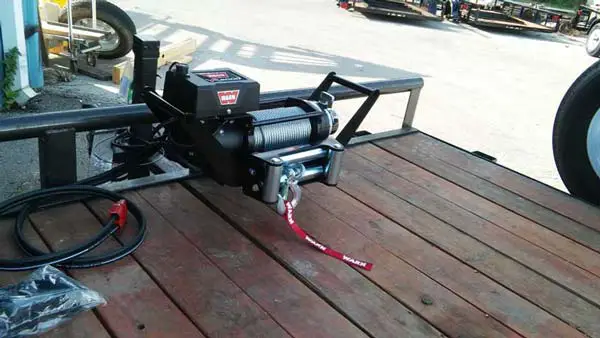
The Math of the Slope
Most car trailers have a ramp angle between 10 and 15 degrees. While that might not look like much, a 15-degree incline can effectively double the strain on your winch compared to a flat pull. For every degree of incline, the winch has to work harder to prevent the vehicle from rolling backward. If you frequently load low-profile cars that require extra-long, steep ramps, or if you often pull “dead” vehicles with locked brakes, this incline factor becomes the most critical part of your setup.
Key Takeaways for Inclines:
- Surface Friction: Loading on grass or gravel adds more resistance than loading on a paved driveway.
- The 20% Rule: As a rule of thumb, assume that a 10% grade increases the required pull force by at least 10-15% of the vehicle’s total weight.
- Safety Margins: Always choose a winch capacity that accounts for the steepest possible angle you might encounter, not just a standard trailer height.
- Snatch Blocks: If you find your winch struggling on a steep ramp, using a snatch block to create a double-line pull can effectively double your pulling capacity while halving the strain on the motor.
Winch Component Selection: Synthetic vs. Steel Rope and Power Requirements
Choosing the right winch isn’t just about the motor’s rated pull; it’s also about the “delivery system”—the rope and the power source. The debate between synthetic rope and steel cable is a common one among trailer owners. Steel is the traditional choice; it is highly abrasion-resistant and holds up well against the friction of trailer edges. However, it is heavy, can develop dangerous “burrs,” and stores a massive amount of kinetic energy, which is a safety risk if it snaps.
Synthetic vs. Steel: Which is Better for Trailers?
Synthetic rope is becoming the gold standard for car trailers for several reasons. It is significantly lighter, which reduces the overall tongue weight of your trailer. Most importantly, it is safer; if a synthetic line breaks, it simply falls to the ground rather than whipping through the air. On the downside, synthetic rope is more susceptible to UV damage and heat, so it requires a protective sleeve if it rubs against the trailer frame.
Meeting the Power Demand
A heavy-duty winch is a power-hungry beast. To ensure your winch performs at its rated capacity, you need a robust electrical setup. A common mistake is using thin gauge wiring that causes a voltage drop, leading to overheated motors and blown fuses. To get the most out of your winch, consider these power tips:
- Battery Choice: Use a dedicated deep-cycle battery mounted on the trailer for consistent power delivery.
- Wiring Gauge: Use at least 2-gauge or 4-gauge copper wiring to connect the winch to its power source to prevent power loss.
- Circuit Protection: Always install a high-amp circuit breaker to protect your winch motor and the trailer’s electrical system from surges.
- Charging: Ensure your tow vehicle is running while winching to keep the battery topped off, or use a solar maintainer for the trailer battery.
Conclusion
Selecting the right winch for your car trailer is the difference between a stressful day at the track and a smooth, professional loading experience. By following the 1.5x weight capacity rule and accounting for the added stress of ramp inclines, you ensure that your equipment is never operating at its absolute limit. Remember that your choice of rope and the quality of your power supply are just as important as the winch’s pound rating.
Now that you understand the capacity requirements, take a moment to weigh your most frequent “heavy load” and check your trailer’s battery health. Investing in a winch that is slightly “over-specced” will provide peace of mind and longevity for years to come. Safe hauling!
❓ Frequently Asked Questions
Why is the 1.5x rule necessary for car trailers?
The 1.5x rule provides a safety margin that accounts for the added strain of pulling a vehicle up an incline. It prevents the winch motor from overheating and ensures the winch can handle ‘dead weight’ scenarios like locked brakes.
How do flat tires affect the winch size I need?
Flat tires significantly increase rolling resistance, turning a rolling load into a ‘dragged’ load. This requires much higher pulling capacity, often requiring a winch rated for at least 2x the vehicle weight.
What is the difference between a recovery winch and a trailer winch?
While the internal mechanics are similar, trailer winches are often used more frequently for controlled loading. Recovery winches are designed for short, high-intensity pulls to get a vehicle unstuck from mud.
Will a winch pull more on the first or last layer of the drum?
A winch has its maximum pulling power on the first layer of rope closest to the drum. As more layers of rope accumulate, the effective pulling power decreases due to the increased radius.
Should I choose a wireless or wired remote for my trailer winch?
Wireless remotes are highly recommended for car trailers because they allow you to stand in a safe position and steer the vehicle while winching. Wired remotes are reliable but limit your movement and visibility.
What gauge wire should I use for my winch power connection?
You should use heavy-gauge wire, typically 2 to 4 AWG, to minimize voltage drop between the battery and the winch. Thinner wires can cause the motor to lose power or even melt under heavy loads.