How to Measure a Steering Wheel: Diameter & Grip Size Guide

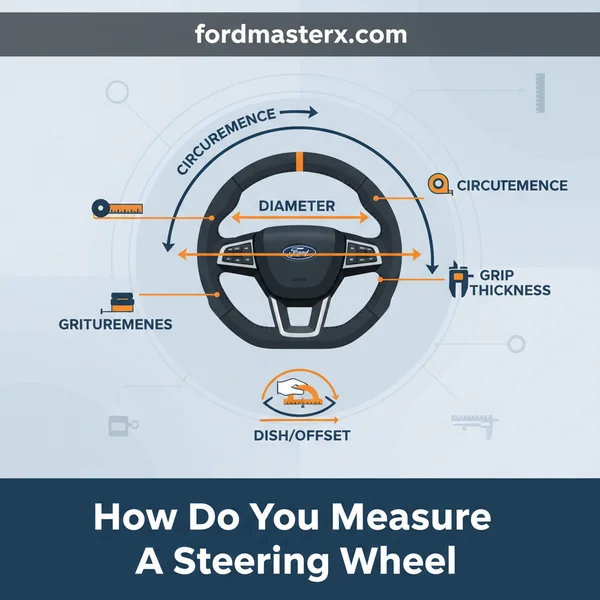
To find the correct size for a cover or replacement, you must measure the outer diameter from one edge to the other across the center. Additionally, calculating the grip circumference by wrapping a flexible tape around the thickest part of the rim ensures a secure, non-slip fit.
Prime Day Pick
Limited-time Prime Day price. Check current discount on Amazon.
🎯 Key Takeaways
- Measure from the furthest outside edge to the opposite outside edge.
- Always pass the measuring tape directly through the center point.
- Wrap a flexible tape around the handle for grip circumference.
- Account for flat-bottom wheels by measuring the widest horizontal span.
- Double-check measurements in both inches and centimeters for accuracy.
To measure your steering wheel accurately, you must find the outer diameter by measuring across the widest part of the wheel from one outside edge to the other. Additionally, you need to determine the grip circumference by wrapping a flexible measuring tape around the rim’s thickest point. These two numbers are the only way to guarantee that a new cover won’t slip during a turn or that a replacement wheel will fit your steering column without obstructing your view of the dashboard.
Getting these dimensions right is a matter of safety and comfort. A cover that is even half an inch too large can slide against the rim, leading to a loss of control during emergency maneuvers. Conversely, a cover that is too small will likely tear during installation or fail to close properly around the back of the grip. By taking sixty seconds to pull a tape measure across the wheel now, you avoid the frustration of returns and the danger of an insecure fit.
Prime Day Pick
Limited-time Prime Day price. Check current discount on Amazon.
Understanding Standard Steering Wheel Sizes and Variations
While steering wheels might look similar across different vehicle classes, they actually vary significantly based on the car’s intended use. Manufacturers choose wheel sizes to balance the effort required to turn the tires with the space available in the cockpit. Understanding where your vehicle likely falls on the spectrum helps you verify your measurements against industry norms.

Common Size Categories by Vehicle Type
Most modern passenger vehicles fall into a few predictable size brackets. Knowing these benchmarks allows you to spot a measurement error before you finalize a purchase. Most steering wheel covers are sold in sizes like “Small,” “Medium,” or “Large,” which correspond to the following diameter ranges:
Prime Day Pick
Limited-time Prime Day price. Check current discount on Amazon.
- Small (13.5 to 14 inches): Typically found in performance sports cars and some subcompact vehicles. These smaller wheels allow for quicker steering response and more legroom in tight cockpits.
- Medium (14.5 to 15 inches): This is the standard for the vast majority of sedans, crossovers, and mid-sized SUVs on the road today. If you drive a Honda Civic, a Toyota Camry, or a Ford Explorer, you are likely in this range.
- Large (15.5 to 17.5 inches): Usually reserved for full-sized pickup trucks, older vintage cars, and commercial vans. Larger wheels provide more leverage, which was historically necessary before power steering became highly efficient.
The Precision of Metric vs. Imperial Measurements
In the aftermarket world, particularly for performance steering wheels, you will often see sizes listed in millimeters. A standard “15-inch” wheel is approximately 380mm. However, many racing wheels are sized at 330mm or 350mm to provide a more direct feel. When you are measuring for a cover, use inches, as most retailers categorize their stock that way. If you are replacing the entire wheel unit, record your measurement in millimeters to ensure the hub adapter and wheel dish match your specific needs. Even a 5mm discrepancy can change the ergonomics of your driving position.
Master Steering Wheel Measurement in 7 Simple Steps
Whether you are looking to install a stylish leather cover, replace a worn-out rim with a performance aftermarket wheel, or simply want to know the specifications of your vehicle for a restoration project, getting accurate measurements is the first and most critical step. A steering wheel that is measured incorrectly can lead to covers that slip and slide, creating a major safety hazard, or aftermarket wheels that sit too close or too far from your turn signal stalks. This guide provides a professional-grade walkthrough to ensure you capture every dimension needed for a perfect fit, covering diameter, circumference, and dish depth with high precision.
Prime Day Pick
Limited-time Prime Day price. Check current discount on Amazon.
Step 1: Gather Your Precision Tools
What you need: A metal retractable tape measure, a flexible tailor’s (sewing) tape measure, a notepad, a pen, and a straight edge or level.
Instructions: Before you even touch the steering wheel, you must have the right tools ready. A standard metal tape measure is excellent for straight lines like the diameter, but it is useless for measuring the curves of the grip. This is why a flexible tailor’s tape is mandatory for accuracy. Begin by parking your vehicle on a flat surface and ensuring the front wheels are pointed perfectly straight. This aligns the steering wheel in its “neutral” position, which makes it much easier to identify the exact top, bottom, and center points. Keep your notepad handy to record measurements in both inches and millimeters, as many aftermarket parts manufacturers use metric units. If your car has an adjustable tilt column, move it to the most comfortable middle position to give yourself plenty of room to move the tape measure around without hitting the dashboard or your knees.
Prime Day Pick
Limited-time Prime Day price. Check current discount on Amazon.
Pro Tip: If you don’t have a flexible tailor’s tape, you can use a piece of string to wrap around the wheel, mark it, and then measure the string against a hard ruler afterward.
Step 2: Measure the Outer Diameter
What you need: A metal retractable tape measure or a long yardstick.
Instructions: The outer diameter is the most common measurement required for purchasing universal steering wheel covers. To find this, place the “zero” end of your metal tape measure against the furthest left outer edge of the steering wheel rim. Pull the tape across the center of the steering wheel, passing directly over the horn button or emblem, to the furthest right outer edge. It is vital to measure the widest point possible; if you measure “off-center,” your number will be too small. Most modern passenger cars have a diameter between 14.5 and 15.5 inches. Once you have the horizontal measurement, perform a vertical check from the top outer edge to the bottom outer edge. Some modern vehicles have “D-shaped” wheels where the bottom is flat; if this is the case for your car, the horizontal and vertical measurements will differ, and you must note both specifically.
Pro Tip: Always measure from the outside edge to the outside edge. Measuring the interior of the rim will result in a cover that is too small to actually pull over the wheel.
Step 3: Determine the Grip Circumference
What you need: A flexible tailor’s tape measure.
Instructions: While the diameter tells you how wide the wheel is, the grip circumference tells you how thick the handle is. This is essential for “lace-up” leather covers that need to wrap tightly around the rim. Take your flexible tape and wrap it around the rim of the steering wheel at a spot that represents the average thickness—usually the 10 o’clock or 2 o’clock position. Ensure the tape is wrapped perpendicular to the rim, not at an angle. Do not include any thumb rests or molded bolsters in this specific measurement unless the cover instructions specifically ask for them. Note the total distance around the rim. If your steering wheel has varying thicknesses (common in ergonomic or sport wheels), take three measurements at different points and record the average. This ensures that the material you buy will have enough “reach” to meet and be stitched together at the seam.
Pro Tip: Pull the flexible tape snug but not so tight that it compresses the foam or leather padding of the wheel, as this will result in an undersized measurement.
Step 4: Calculate the Dish or Depth
What you need: A straight edge (like a level or a piece of stiff cardboard) and a small ruler.
Instructions: The “dish” refers to how far the steering wheel rim sits away from the mounting point on the steering column. This measurement is crucial if you are replacing the entire wheel with an aftermarket racing wheel, as it affects your reach to the pedals and stalks. To measure this, lay your straight edge across the top of the steering wheel so it rests on the outer rim. Then, take your ruler and measure the vertical distance from the center mounting point (where the wheel meets the column) up to the bottom of the straight edge. A “flat” wheel has a dish of 0mm to 20mm, while “deep dish” wheels can exceed 90mm. Knowing this measurement helps you choose a steering wheel hub adapter that keeps your arms at a comfortable, ergonomic angle and ensures you can still reach your turn signals without taking your hands off the wheel.
Pro Tip: If your wheel has a very large center airbag module that sticks out past the rim, you may need to measure from the back of the wheel to the column instead.
Step 5: Identify the Spoke Count and Layout
What you need: Visual inspection and a camera (optional).
Instructions: When buying a custom-fit cover or a replacement wheel, the number and position of the spokes are vital. Most wheels have a 3-spoke or 4-spoke design. Look at where the spokes connect to the rim. Are they at the 3, 6, and 9 o’clock positions? Or are they paired at the bottom? This is important because a wrap-style cover needs to have cutouts that line up perfectly with these spokes. If you are ordering a “blind” cover (one that you stitch yourself), you need to know exactly how much “open” rim space you have between the spokes. Take a clear, top-down photo of your steering wheel with your phone. This serves as a reference when you are browsing products online, allowing you to compare the gaps and spoke widths with the product images to ensure the design matches your specific interior layout.
Pro Tip: Check for any buttons or paddle shifters located behind or on the spokes, as these may require special clearance that a standard cover might obstruct.
Step 6: Measure the Bolt Pattern (For Aftermarket Replacements)
What you need: A pair of calipers or a ruler with millimeter markings.
Instructions: If you are moving beyond covers and are looking to install a hub adapter for a performance wheel (like Momo, Nardi, or Sparco), you must measure the bolt pattern, also known as the PCD (Pitch Circle Diameter). This is the diameter of the circle formed by the centers of the mounting bolts. For a 6-bolt wheel, measure the distance from the center of one bolt hole to the center of the hole directly opposite it. The most common standards are 70mm (Momo, Sparco, OMP) and 74mm (Nardi, Personal). If you are using a 5-bolt pattern, the measurement is slightly more complex, and it is often easier to measure the distance between two adjacent holes and use a conversion chart. Accuracy here is non-negotiable; even a 2mm difference will prevent the wheel from mounting to the hub safely.
Pro Tip: Use digital calipers for this step if possible, as measuring millimeters with a standard tape measure can lead to rounding errors that result in incompatible parts.
Step 7: Final Verification and Unit Conversion
What you need: Your notepad and a calculator or smartphone.
Instructions: The final step is to verify all your data. Measurements should be taken at least twice to ensure consistency. If your first horizontal diameter measurement was 14.5 inches and your second was 14.75 inches, re-measure to find the true center. Once you are confident in your numbers, convert them all. Many high-end steering wheel accessories are manufactured in Europe or Asia and use the Metric system, while domestic products use Imperial. Multiply your inch measurements by 25.4 to get the millimeter equivalent. For example, a 15-inch wheel is 381mm. Having both sets of numbers written down will save you significant time and frustration when looking at technical specification sheets on manufacturer websites. Store this “spec sheet” in your glove box or digitally on your phone for future reference.
Pro Tip: If your measurement falls exactly between two sizes offered by a manufacturer, check the product reviews. Generally, for covers, you want a tight fit, but for hard components, you must have an exact match.
✅ Final Checklist
- Measured the widest part of the outer rim horizontally and vertically?
- Captured the grip thickness (circumference) using a flexible tape?
- Determined if the wheel is round or D-shaped?
- Measured the “dish” depth from the rim to the mounting hub?
- Identified the spoke positions and recorded any obstructions like buttons?
Important Notes:
- Safety First: Never attempt to remove or disassemble a steering wheel containing an airbag without first disconnecting the battery and waiting at least 15-30 minutes for the capacitors to discharge.
- Professional Help: If you are uncomfortable measuring the bolt pattern or installing an aftermarket hub, consult a certified mechanic to ensure the steering column remains structurally sound.
- Estimated Time: 10 to 15 minutes.
- Estimated Cost: $0 – $15 (The cost of a flexible tailor’s tape and a standard tape measure if you don’t already own them).
Factors That Affect Steering Wheel Cover Compatibility
Your steering wheel’s diameter is only one part of the equation. Several physical characteristics of the wheel can complicate how a cover fits or how a replacement wheel sits in your hands. You must account for these variables to ensure the material wraps fully around the rim without leaving a gap or feeling excessively bulky.

Material Thickness and Factory Wraps
The base material of your steering wheel significantly impacts the grip circumference. A base-model vehicle with a molded plastic (urethane) wheel is generally thinner than a high-trim model with a factory-installed leather wrap. If your car already has a leather wrap from the factory, you are effectively measuring a “double-thick” wheel. Many off-the-shelf covers are designed to fit over a standard urethane wheel. If you have a factory leather wrap, you may need a cover designed for a larger grip circumference to ensure the edges meet at the back of the wheel.
Non-Circular and Contoured Designs
Modern automotive design has moved away from perfectly circular hoops. Many newer vehicles, especially those with a “sport” package, feature specific geometry that you must account for during measurement. Consider these common variations:
- D-Shape (Flat Bottom): These wheels have a flat lower edge to provide more thigh clearance. When measuring the diameter, you must measure at the widest horizontal point, not from the top to the flat bottom.
- Thumb Rests and Bolsters: Many wheels have thickened areas at the “10 and 2” positions. When measuring grip circumference, always measure the thickest part of these bolsters to ensure the cover can stretch over them.
- Ergonomic Finger Grooves: The back of the wheel may have indentations. While these don’t usually change the diameter, they can make the grip feel thinner in certain spots. Always prioritize the maximum circumference measurement for fitment.
Proximity to Integrated Controls
Before you choose a cover based on your measurements, look at how close your steering wheel buttons are to the rim. Some modern wheels have cruise control or volume toggles that sit very close to the inner edge of the grip. If your measurements lead you to a particularly thick or padded cover, that extra bulk could potentially interfere with your ability to press those buttons comfortably. Ensure your measurement accounts for about 1/8th of an inch of added thickness on all sides of the rim once the cover is installed.
Essential Tools for Precise Automotive Interior Measurements
To get the most accurate results, you need the right gear. While it is tempting to grab whatever is in your junk drawer, steering wheels require tools that can handle both straight spans and tight curves. Precision here prevents the frustration of ordering a high-end leather wrap only to find it bunches up or leaves a gap because your initial measurements were off by a fraction of an inch.
Soft Tailor’s Tape vs. Rigid Metal Tapes
The most important tool in your arsenal is a flexible tailor’s tape, often made of fiberglass or vinyl. Unlike a standard hardware store metal tape measure, a soft tape can contour perfectly around the grip of the wheel. Metal tapes are notorious for “kinking” or creating a bridge over curved surfaces, which leads to an overestimation of the circumference. For the diameter, a rigid ruler or a standard metal tape is actually preferred because it won’t sag across the empty center of the wheel, ensuring a straight “point-to-point” reading.
- Pro Tip: If you don’t have a soft tape, use a piece of non-elastic string or even a shoelace. Wrap it around the grip, mark the overlap with a fine-tip pen, and then lay the string flat against a rigid ruler.
- The Elasticity Factor: Avoid using rubber bands or stretchy paracord, as these will deform during the measurement and give you a false, smaller reading.
- Example: Professional restorers often use a “pi tape,” which is a specialized tool designed to measure the diameter of a cylinder by measuring its circumference, though a standard flexible tape is usually sufficient for DIY projects.
Digital Calipers for Grip Thickness
If you are looking for extreme precision—especially when choosing between custom-molded aftermarket covers—digital calipers are a game changer. These allow you to measure the exact thickness (cross-section) of the rim at various points, such as the 10 and 2 positions where thumb rests often make the wheel thicker. Knowing these variations helps you identify if a “universal fit” cover will actually be able to close properly over those ergonomic bumps.
Critical Differences Between Circular and D-Shaped Wheels
Not every steering wheel is a perfect circle, and this is where many enthusiasts run into trouble. Modern sports cars and many Audi or VW models feature a “D-shape” or flat-bottom design. This geometry is fantastic for leg clearance and aesthetics, but it complicates the measurement process because the wheel essentially has two different diameters.
Navigating the Flat-Bottom Geometry
When dealing with a D-shaped wheel, you cannot simply measure from top to bottom and call it a day. The “height” of the wheel (from the flat bottom to the top) will be significantly shorter than the “width” (from the 9 o’clock position to the 3 o’clock position). When shopping for covers or replacements, most manufacturers categorize these by their widest horizontal point. However, the vertical measurement is still vital to ensure that a cover won’t be too loose at the bottom.
- Asymmetry Alert: Some high-performance wheels are also “dished,” meaning the center sits closer to the driver than the rim. Always measure the diameter across the face of the wheel, not at an angle toward the steering column.
- The 360-Degree Check: For D-shaped wheels, it is common to find that the grip circumference changes as you move toward the flat section. It is often thinner at the bottom than it is at the sides.
- Practical Example: A racing-style wheel might have a 14.5-inch horizontal diameter but only a 13.2-inch vertical height. Always provide both numbers when ordering custom upholstery.
Understanding Major and Minor Axes
In technical terms, a non-circular wheel has a major axis (the longest distance) and a minor axis (the shortest distance). For most automotive applications, the major axis is your horizontal diameter. If you are replacing the entire wheel with an aftermarket hub, the bolt pattern and the depth of the “dish” become just as important as the diameter itself. A deeper dish brings the wheel closer to your chest, which can drastically change your driving ergonomics and reach to the turn signal stalks.
Conclusion: Mastering Your Interior Specs
Measuring your steering wheel is a small task that yields huge benefits for your driving experience. By understanding the distinction between diameter and grip circumference—and by using the right tools for the job—you eliminate the guesswork that leads to poorly fitting accessories. Whether you are dealing with a classic wooden rim or a modern flat-bottom performance wheel, precision is the key to a professional-looking interior upgrade.
To move forward, grab a flexible tape measure and a notepad, and take three separate readings of both the diameter and the grip thickness to ensure consistency. Once you have your numbers, you can shop with total confidence. Ready to transform your cockpit? Start by confirming your specs today and find the perfect fit for your ride!
❓ Frequently Asked Questions
Why is the outer diameter more important than the inner diameter?
Most steering wheel covers and aftermarket units are designed based on the total exterior width. Measuring the outer diameter ensures the accessory can stretch over the frame without leaving gaps or being impossible to install.
How can I ensure my grip circumference measurement is accurate?
Wrap a flexible tape measure around the thickest part of the rim, typically at the 10 or 2 o’clock positions. If you only have a metal tape, wrap a piece of string around the rim first and then measure the string’s length.
What should I do if my measurement falls between two standard sizes?
If you are between sizes for a stretchable cover, it is usually best to choose the smaller size to ensure a tight, safe fit. A loose cover can slip during turns, creating a serious driving hazard.
Are steering wheel sizes different for trucks compared to cars?
Yes, heavy-duty trucks and commercial vehicles often feature wheels ranging from 16 to 22 inches. Passenger vehicles typically stay between 14 and 15 inches, so never assume a ‘standard’ car cover will fit a truck.
Does the thickness of the steering wheel rim change over time?
While the metal frame is static, factory leather or foam padding can compress or degrade with age. Always measure the current thickness rather than relying on the vehicle’s original factory specifications for the best fit.
Can I use a standard metal tape measure for all measurements?
A metal tape is fine for measuring the diameter across the face of the wheel. However, it is too rigid for the grip circumference; a flexible tailor’s tape or a piece of string is necessary for that specific measurement.