5 Warning Signs of a Bad Pitman Arm: Diagnose Steering Play

The most common sign of a bad pitman arm is excessive steering wheel play or a ‘dead zone’ that makes the vehicle difficult to keep centered. You may also notice the car wandering across the lane or hear audible clunking sounds during low-speed turns, indicating a worn ball joint in the steering linkage.
🎯 Key Takeaways
Recommended Best Deal Products


- Look for ‘steering wandering’ where the car drifts without steering input.
- Check for a ‘dead zone’ of several inches in the steering wheel.
- Listen for clunking or popping noises during low-speed maneuvers.
- Inspect the dust boot for grease leaks or visible tearing.
- Differentiate Pitman arm play from idler arm or gearbox issues.
If your vehicle feels like it is “herding” down the highway rather than driving in a straight line, your Pitman arm is likely the culprit. This heavy-duty component serves as the critical bridge between your steering gear box and the rest of the steering linkage. When the internal ball joint or the splined connection wears out, it creates a disconnect between your hands and the road. You will experience a loose, sloppy sensation that makes precise maneuvers nearly impossible.

Prime for Young Adults — 6 Months Free
Students and 18–24s get six months of Prime free, then half price.
Start 6 Months Free As an Amazon Associate I earn from qualifying purchases.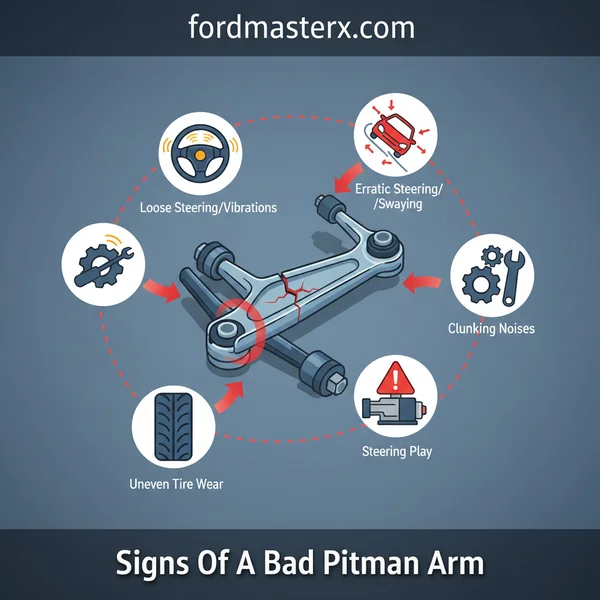
Identifying these symptoms early is essential for maintaining control of your vehicle. A failing Pitman arm does not just make driving annoying; it compromises your ability to react to emergencies. By understanding the specific ways this part fails, you can diagnose whether you need a simple linkage replacement or a more complex steering box adjustment. Let’s dive into the specific driving behaviors that signal a Pitman arm has reached the end of its service life.
Core Symptoms of Pitman Arm Failure while Driving
The most immediate sign of a bad Pitman arm is a dramatic change in how the steering wheel feels in your hands. Because this arm converts the rotational motion of the steering box into the linear motion that moves your wheels, any “slop” in the arm’s joint results in delayed response. You may find yourself moving the wheel several inches before the tires actually begin to turn.
The “Dead Zone” and Excessive Steering Play
A “dead zone” refers to the range of motion where you can wiggle the steering wheel back and forth without the vehicle changing direction. In a healthy system, this play should be minimal—usually less than an inch. When a Pitman arm is failing, this gap widens significantly. You might notice:
- Increased Free Play: You can turn the wheel 2 to 3 inches in either direction at highway speeds before feeling any resistance.
- Vague Center Feel: The steering feels “mushy” or disconnected when you are trying to drive straight.
- Lagged Response: There is a noticeable delay between your steering input and the vehicle’s reaction, which is especially dangerous during quick lane changes.
Highway Wandering and Constant Correction
When the ball joint inside the Pitman arm loses its tension, the front wheels gain the freedom to “track” the grooves in the road. This leads to a phenomenon known as wandering. Instead of the vehicle staying centered in the lane, it will drift toward the left or right, forcing you to make constant, tiring corrections. If you feel like you are fighting the steering wheel just to maintain a straight path on a flat road, the Pitman arm is likely moving independently of the steering box.
Poor Steering Returnability
Properly functioning steering systems are designed to “return to center” naturally after you complete a turn. This happens because of the vehicle’s alignment geometry and the tightness of the linkage. A worn Pitman arm creates excessive friction or binds in the joint, which can prevent the steering wheel from snapping back to the 12 o’clock position. If you find that you have to manually pull the steering wheel back to center after turning a corner, your linkage components are either too loose or are seizing up.
Auditory and Visual Indicators of Steering Linkage Wear
Recommended Best Deal Products


While the driving symptoms provide the first clues, you can often confirm a bad Pitman arm through sound and a specific stationary inspection. Because the Pitman arm is located directly beneath the driver’s side of the chassis, the noises it makes will often telegraph directly through the floorboards or the steering column.
Clunking and Popping During Low-Speed Turns
As the internal ball joint of the Pitman arm wears down, the “ball” begins to bounce around inside its “socket.” This metal-on-metal contact produces distinct sounds that are most audible during low-speed maneuvers, such as parking or pulling into a driveway. Listen for:
- Rhythmic Popping: A “pop” or “snap” felt through the steering wheel when you turn it from lock to lock.
- Metallic Clunking: A dull thud when driving over small bumps or potholes, which indicates the joint has vertical play.
- Grinding: In extreme cases, a lack of lubrication in the joint can cause a dry grinding sound during tight turns.
The “Dry Park” Physical Inspection
The most effective way to diagnose a Pitman arm without special tools is the “dry park” test. This involves checking the linkage while the vehicle’s weight is on the ground, which puts the necessary stress on the joints to reveal play. Follow these steps to inspect the arm:
- Have a helper sit in the driver’s seat with the engine off (or idling, if the steering is too heavy).
- Position yourself safely to the side of the vehicle where you can see the Pitman arm connecting to the steering box and the center link.
- Have your helper move the steering wheel rapidly back and forth between the 9 o’clock and 3 o’clock positions.
- Watch the joint where the Pitman arm meets the center link. If the arm moves up and down or “pops” before the rest of the linkage moves, the joint is shot.
- Check the splined end of the arm (where it attaches to the steering box). If the arm is shifting on the shaft itself, the sector shaft nut may be loose or the splines may be stripped.
During this inspection, even 1/8th of an inch of independent movement in the ball joint is enough to cause significant wandering on the road. If you see any visible “jump” in the joint before the tires move, the component requires immediate replacement.

Audible — Listen Free for 30 Days
One free credit a month and thousands of titles included.
Listen Free for 30 Days As an Amazon Associate I earn from qualifying purchases.Comparing Pitman Arm Failure to Other Steering Component Issues
Diagnosing a steering problem can be frustrating because many components share similar symptoms. However, the pitman arm plays a very specific role as the bridge between your steering gear and the rest of the linkage. Understanding the subtle differences in how these parts fail can save you hours of troubleshooting and prevent you from replacing perfectly good parts.
Pitman Arm vs. Tie Rod Ends
While both a failing pitman arm and worn tie rod ends cause steering play, the “feeling” at the wheel is often different. Tie rod ends usually result in specific alignment issues, such as your steering wheel being off-center while driving straight. A bad pitman arm, however, creates a noticeable dead zone where you can move the steering wheel several inches in either direction before the wheels actually react.
- The Snap Test: Have a friend turn the steering wheel while you watch the linkage. If the pitman arm moves up and down on the sector shaft instead of side-to-side, it is definitely the culprit.
- Vibration Location: Worn tie rods often cause a shimmy felt directly in the steering wheel, whereas a loose pitman arm creates a more general “wandering” sensation across the front end.
- Noise Patterns: Tie rod ends tend to squeak or pop during low-speed maneuvers, like parking. A pitman arm is more likely to clunk when hitting a bump or transitioning from a left to a right turn.
The Idler Arm Connection
In many trucks and SUVs with a recirculating ball steering system, the pitman arm has a “twin” on the passenger side called the idler arm. Because these two components work in tandem to support the center link, they often wear out at the same rate. If you find significant play in your pitman arm, it is highly practical to inspect the idler arm immediately, as a failure in one puts massive mechanical stress on the other.
Safety Implications and Risks of Driving with a Loose Pitman Arm
Recommended Best Deal Products


A worn pitman arm isn’t just a nuisance that makes driving more difficult; it is a critical safety hazard. Because this component is the primary link that translates your steering input to the wheels, any “slack” in the system means you have less control over the vehicle during an emergency maneuver.
Loss of Directional Control and “Death Wobble”
One of the most dangerous risks associated with a bad pitman arm is the onset of the “death wobble.” This occurs when the steering components become so loose that the front wheels begin to oscillate violently back and forth after hitting a pothole or expansion joint. Without a tight pitman arm to stabilize the linkage, it becomes nearly impossible to regain control of the vehicle without coming to a complete stop.
- Reduced Response Time: In a situation where you need to swerve to avoid an obstacle, a loose pitman arm creates a delay that could be the difference between a near-miss and a collision.
- Accelerated Tire Wear: When the steering linkage is loose, your tires are constantly “scrubbing” against the road as they hunt for a straight line. This can ruin a set of expensive tires in just a few hundred miles.
- Total Mechanical Separation: In extreme cases of neglect, the ball joint inside the pitman arm can pop out of its socket, leading to a complete loss of steering.
Secondary Damage to the Steering Gearbox
Ignoring a loose pitman arm can also lead to a much more expensive repair bill. When the arm has excess play, it creates an uneven load on the steering gearbox’s output shaft. Over time, this “shucking” motion can wear out the internal seals and bearings of the gearbox, leading to fluid leaks or a total gearbox failure. Replacing a pitman arm is relatively affordable, but replacing the entire steering gear is a major investment.
Conclusion
Identifying the signs of a bad pitman arm is essential for maintaining the safety and precision of your vehicle’s steering. From the frustrating “steering wander” on the highway to the audible clunks when navigating corners, these symptoms are your vehicle’s way of telling you that the steering linkage is compromised. By distinguishing pitman arm issues from tie rod or idler arm wear, you can tackle the problem efficiently and avoid unnecessary costs.
Next Steps: If you suspect your steering play is caused by a faulty pitman arm, perform a visual inspection of the sector shaft and the drag link connection. If you see any vertical movement or cracked grease boots, it is time to consult a professional mechanic or source a high-quality replacement part. Don’t wait for a small “dead zone” to turn into a dangerous loss of control—address your steering play today and keep your vehicle tracking straight and true!
❓ Frequently Asked Questions
How do I distinguish between a bad pitman arm and a bad idler arm?
While symptoms are similar, the pitman arm is attached directly to the steering box on the driver’s side. The idler arm is located on the passenger side and serves as a pivot point; a visual inspection while a helper turns the wheel will reveal which joint has excessive movement.
Why does my car wander more on uneven roads or in the wind?
A worn pitman arm allows the wheels to move slightly without steering wheel input. External forces like wind or road ruts can push the wheels more easily because the steering linkage has lost its tight, mechanical connection.
Audible Premium Plus — Annual Membership
12 audiobook credits up front, plus the full Audible catalogue.
See Annual Plans As an Amazon Associate I earn from qualifying purchases.What causes a pitman arm to fail prematurely?
Lack of regular lubrication at the grease fittings is the most common cause. Additionally, heavy off-roading, installing oversized tires, or frequent driving on poorly maintained roads increases the stress and wear on the ball joint.
Can a bad pitman arm cause the ‘Death Wobble’?
In vehicles with solid front axles, a loose pitman arm can contribute to severe front-end oscillations. While rarely the sole cause, it amplifies existing vibrations from other worn components like the track bar or steering stabilizer.
How much play in the steering wheel is considered normal?
Most modern steering systems should have almost no perceptible play. If you can move the steering wheel more than an inch or two before the tires begin to respond, it indicates a significant problem in the pitman arm or steering box.
Do I need an alignment after replacing a pitman arm?
Yes, an alignment is mandatory after replacing any major steering component. The new part will likely shift the steering wheel’s center point and change the toe-in settings, which must be professionally recalibrated.