Car Seat in a Single Cab Truck: Safety & Legal Guide

It is legal and safe to install a car seat in a single-cab truck provided the passenger-side airbag is deactivated for rear-facing infants. Because there is no back seat, drivers must strictly follow airbag shut-off protocols and utilize top tether anchors located on the cab’s rear wall for forward-facing seats.
🎯 Key Takeaways
Recommended Best Deal Products


- Rear-facing seats must never be used with an active passenger airbag.
- Manual airbag shut-off switches are essential for older single-cab models.
- Forward-facing seats require the vehicle seat to be moved fully back.
- Locate top tether anchors on the rear cab wall for stability.
- Check state laws for ‘no other option’ front-seat placement exceptions.
Yes, you can legally and safely install a car seat in a single cab truck, provided your vehicle meets specific safety criteria. In almost every state, the law allows children to ride in the front seat if there is no rear seat available. However, because the front seat is statistically the most dangerous place for a child, the burden of safety falls entirely on how you manage the passenger-side airbag and the seat’s physical positioning. You cannot simply “plug and play” a car seat here like you would in a minivan.
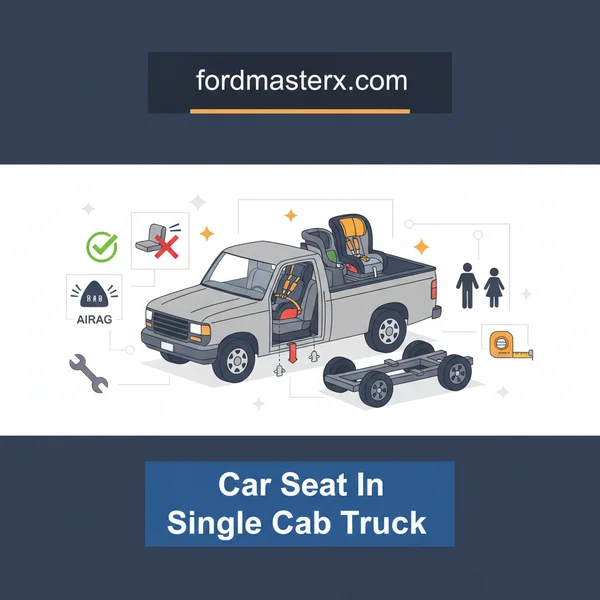
Managing a single cab installation requires a “safety-first” checklist that centers on airbag deactivation and proper tethering. If your truck is older and lacks an airbag shut-off switch, or if it lacks top tether anchors for forward-facing seats, you may not be able to transport a child safely. This guide cuts through the noise to show you exactly how to navigate these technical requirements so you can keep your child protected while driving your truck.

Prime for Young Adults — 6 Months Free
Students and 18–24s get six months of Prime free, then half price.
Start 6 Months Free As an Amazon Associate I earn from qualifying purchases.The Legality and Ethics of Front-Seat Car Seat Installation
Most parents are told from day one that the back seat is the only place for a car seat. While the back seat is always safer, the law recognizes the reality of single cab trucks. Federally and across most state jurisdictions, it is legal to place a car seat in the front if the vehicle does not have a rear bench. This is often referred to as the “no alternative” clause. If your truck has a jump seat (a very small, fold-down rear seat), many state laws require you to use that first, provided the car seat manufacturer allows installation on such a small surface.

Understanding the “No Alternative” Rule
Legal compliance hinges on your ability to disable the airbag for rear-facing infants. If your truck was manufactured after 1995, it likely features a Passenger Airbag Deactivation System (PADS). Using this system is not just a recommendation; it is a legal requirement in many regions. If you are pulled over and a rear-facing seat is in front of an active airbag, you could face significant fines and “endangerment” citations.
- Check your manual: Every truck has a specific section on “Child Restraints in the Front Seat.”
- State variations: Some states, like California or New Jersey, have stricter age/weight triggers for when a child can move to the front, but nearly all waive these for single-row vehicles.
- The “Jump Seat” Trap: If your truck is an extended cab rather than a true single cab, check if the car seat base is at least 80% supported by the seat cushion. If not, the front seat may actually be the legally preferred spot.
Airbag Safety Protocols and Deactivation Technologies in Trucks
Recommended Best Deal Products


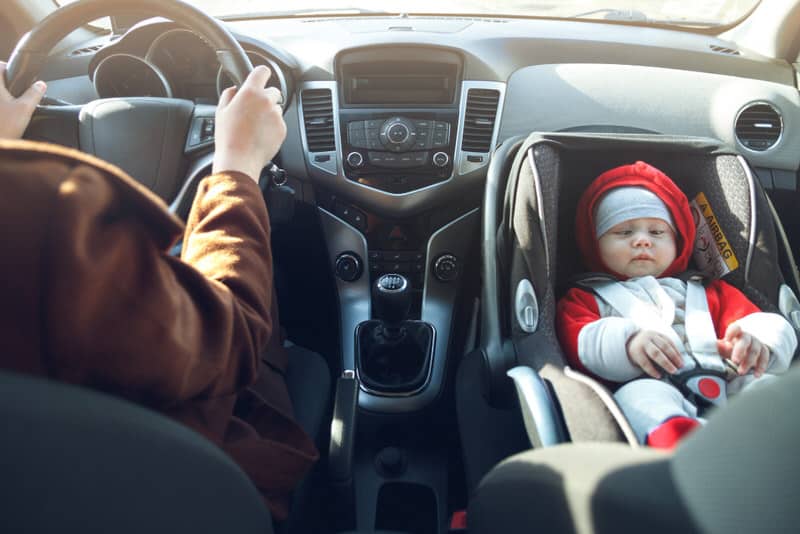
The airbag is your child’s biggest threat in a single cab truck. Passenger-side airbags are designed to protect a full-sized adult by deploying at speeds up to 200 mph. For a child in a car seat—especially a rear-facing one—this force is often fatal. To safely use a car seat in your truck, you must master the two different protocols for rear-facing and forward-facing setups.
Rear-Facing: The Zero-Tolerance Airbag Rule
If you are installing a rear-facing infant or convertible seat, the passenger airbag must be turned off. There is no middle ground. Because the back of a rear-facing seat sits inches away from the dashboard, an inflating airbag will strike the seat with enough force to crush the shell against the vehicle seat. This is the primary reason why single cab trucks were once considered “no-go” zones for babies.
- The Manual Key Switch: Most late-90s and 2000s trucks (like the Ford F-150 or Chevy Silverado) feature a key-operated switch on the dash. You must physically insert your ignition key and turn it to the “Off” position.
- The “Off” Indicator: Always verify that the “Passenger Airbag Off” light is illuminated on your dashboard or rearview mirror before you start the engine.
- Older Trucks: If your truck predates 1995 and does not have an airbag, you can install a rear-facing seat, but you must still ensure the seat is pulled as far back from the dash as possible.
Forward-Facing: The “Distance is Safety” Strategy
For children who have graduated to forward-facing seats, the protocol changes. While some experts still suggest turning the airbag off, many vehicle manufacturers recommend leaving it on but sliding the truck’s passenger seat as far back as it will go. This creates a “crumple zone” of air between the child and the dashboard.
- Maximize Legroom: Slide the truck seat to the furthest rearward position on its tracks. This keeps the child’s head away from the “deployment zone” of the airbag.
- Automatic Sensors: Modern trucks often have weight sensors (Occupant Classification Systems). However, these can be “tricked” by the weight of a car seat and a tight seatbelt. Never trust the sensor alone; if you have a manual override, use it.
- Seat Angle: Keep the truck’s seat back in an upright position. Reclining the truck seat can create a gap between the car seat and the vehicle, compromising the stability of the installation.
Understanding Top Tether Anchors in Compact Cab Environments
In a standard sedan, finding a top tether anchor is usually straightforward—it is often a metal bar located on the rear shelf or the back of the seat. However, in a single cab truck, the “compact” nature of the cabin requires a completely different hardware design. Most modern trucks utilize a webbing loop system located behind the headrests rather than a direct metal-to-metal connection point.
The Webbing Loop System
Unlike cars where you clip directly to a bracket, single cab trucks often feature heavy-duty fabric loops. These loops are designed to route the tether strap to an adjacent anchor point. This layout is necessary because there is simply no physical depth behind the bench seat to accommodate a traditional anchor. It is a unique engineering solution that maintains the seat’s stability during a forward collision.
Why the Top Tether is Non-Negotiable
For forward-facing car seats, the top tether is the most critical safety component. In the limited space of a single cab, “head excursion”—the distance a child’s head moves forward during a crash—is a major risk. Because the dashboard and windshield are much closer in a truck, the top tether works to:
- Reduce forward movement by up to four to six inches.
- Minimize the risk of head impact against the interior trim or glass.
- Stabilize the seat against lateral (side-to-side) shifting.
Essential Weight and Age Constraints for Single-Cab Passengers
Recommended Best Deal Products


When you are operating a vehicle without a back seat, the “safest place” for a child changes by default. However, just because it is legal to put a child in the front of a single cab doesn’t mean every child is ready for it. Weight and height limits dictated by both the car seat manufacturer and the vehicle manufacturer must be strictly followed to ensure the vehicle’s safety systems work with the child, not against them.

Audible — Listen Free for 30 Days
One free credit a month and thousands of titles included.
Listen Free for 30 Days As an Amazon Associate I earn from qualifying purchases.Airbag Sensor Thresholds
Most modern trucks are equipped with Occupant Classification Systems (OCS). These sensors use weight to determine whether to enable or disable the passenger airbag. If a child is too light, the sensor may fluctuate. This is particularly dangerous for children in boosters who are nearing the weight of a small adult. Always verify that the “Airbag Off” light is illuminated whenever a child under 13 is in the seat, regardless of their weight.
Age vs. Physical Maturity
Safety experts and the American Academy of Pediatrics (AAP) generally recommend that children remain in the back seat until age 13. In a single cab truck, this isn’t an option. Therefore, physical maturity becomes the primary focus. Considerations include:
- Bone Density: Younger children have more cartilage than bone, making them more susceptible to seat belt or airbag injuries.
- The “Five-Point” Fit: For older children out of boosters, they must be tall enough for the truck’s shoulder belt to cross the chest, not the neck.
- Leg Length: Their knees should bend comfortably over the edge of the truck’s bench seat to prevent “slouching,” which can cause the lap belt to ride up into the soft tissue of the abdomen.
Conclusion
Driving a single cab truck with a young passenger requires extra diligence and a “safety-first” mindset. While it is entirely possible to transport your child safely, it demands that you understand the unique tethering systems of your pickup and strictly adhere to weight and age restrictions. By disabling the front airbag and ensuring a rock-solid installation, you can mitigate many of the risks associated with the lack of a back seat.
Next Steps: Check your truck’s owner’s manual specifically for the “Child Restraints” section and verify the location of your tether loops today. If you have any doubts, find a local CPST (Child Passenger Safety Technician) to inspect your setup. Stay proactive, stay informed, and enjoy the road with your little co-pilot!
❓ Frequently Asked Questions
What should I do if my truck doesn’t have an airbag shut-off switch?
If your truck lacks a manual switch or advanced occupant sensors, you cannot safely install a rear-facing car seat. In this scenario, you must use a different vehicle or consult a professional about the possibility of installing an aftermarket cutoff switch.
How do I find the top tether anchor in a cramped single-cab?
Single-cab anchors are often hidden compared to SUVs. Look for a metal loop or a webbing strap located directly behind the seat headrest or bolted to the rear cab wall, and refer to your owner’s manual for routing instructions.
Is a booster seat safe for use in a single-cab truck?
Yes, a booster seat can be used if the child meets the height and weight requirements, the airbag is left active, and the truck’s seat belt provides a proper fit across the lap and shoulder.
Are there specific car seat brands better suited for single-cab trucks?
While most seats work, ‘slim’ or ‘compact’ models are often preferred because they better accommodate the limited depth of a truck’s passenger seat and avoid hitting the dashboard.
What does the law say about children in the front seat of trucks?
Most state laws include an exception for single-cab vehicles, allowing children in the front seat if no rear seat exists, provided they are in the age-appropriate restraint system.
Can I use the middle seat of a bench for a car seat installation?
This is only permitted if your truck’s owner’s manual specifically approves the middle position and provides a dedicated seat belt and top tether anchor for that spot.
Audible Premium Plus — Annual Membership
12 audiobook credits up front, plus the full Audible catalogue.
See Annual Plans As an Amazon Associate I earn from qualifying purchases.