
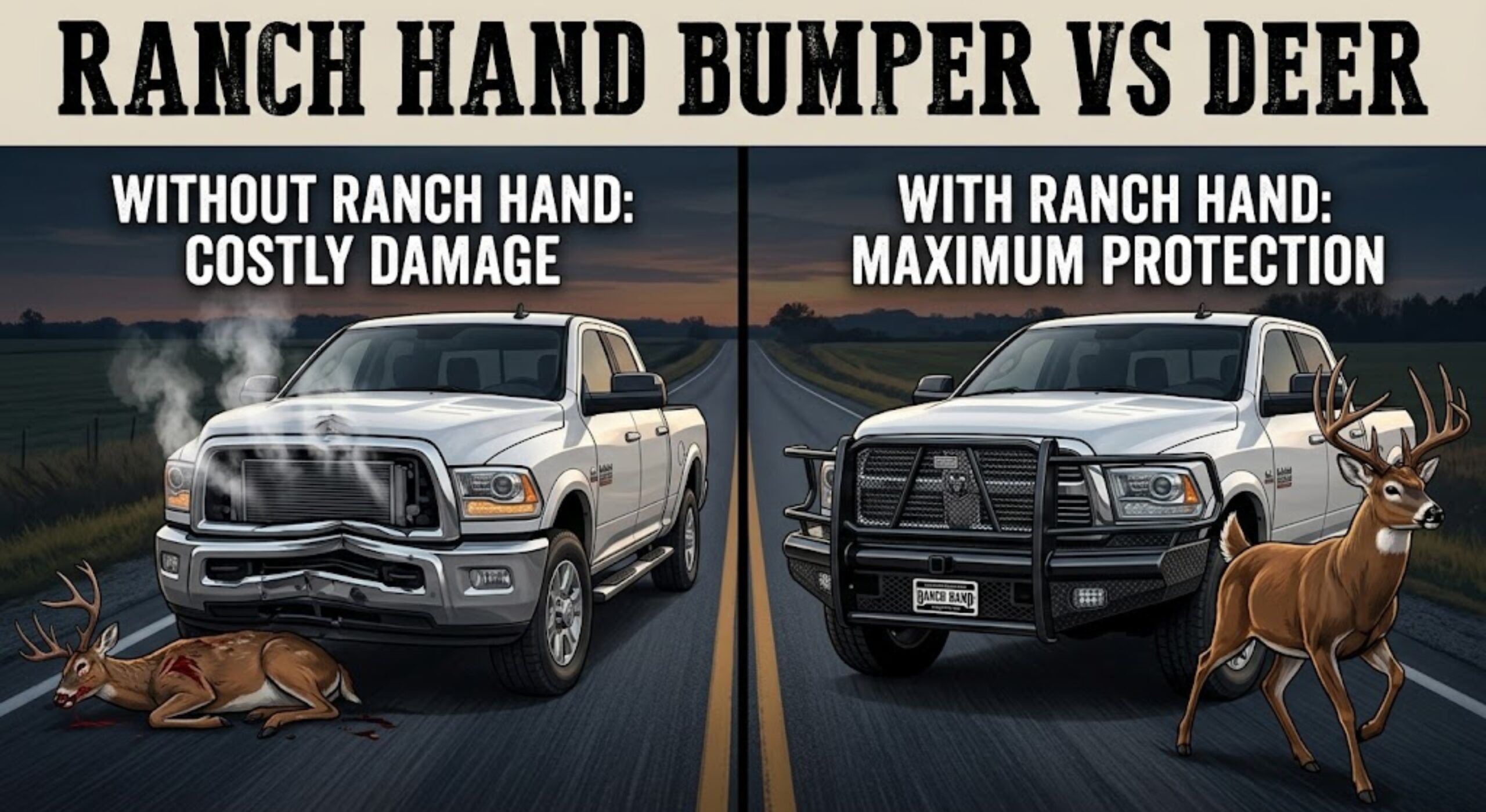
Ranch Hand Bumper vs Deer Which Trucks Actually Need One

If you drive rural roads at highway speeds, a deer collision isn’t a question of if — it’s a question of how much. The average deer strike claim runs $5,620 in high-risk regions, and insurers processed over 1.7 million animal collision claims in the US between mid-2024 and mid-2025. A Ranch Hand front bumper costs $700–$1,100 for the bumper itself, plus installation.
Do the math once and the question answers itself — for some drivers. For others, a Ranch Hand bumper creates problems it’s supposed to prevent. The answer depends on four conditions specific to your truck and where you drive. Here’s how to know whether a Ranch Hand bumper is the right call for your truck.
What a Deer Actually Does to a Stock F-150 Bumper
The stock F-150 front fascia is engineered to crumple in low-speed parking lot impacts and comply with federal pedestrian safety standards. It is not rated for a 150-pound whitetail at 55 mph.
A direct strike at highway speed typically takes out: the front fascia, radiator, both headlight assemblies, the hood, and — if the deer height is right — triggers airbag deployment. That repair bill starts at $4,000 for a grazing hit on an older F-150 and runs $7,000–$8,000 when the airbags fire and the radiator is replaced on a newer model.
The cost comparison against a Ranch Hand bumper is this:
| Scenario | Estimated Cost |
|---|---|
| Stock bumper + one direct deer strike | $4,000–$8,000 repair |
| Ranch Hand Summit installed + one direct deer strike | $700–$1,100 bumper + minimal damage |
| Ranch Hand Summit installed + zero strikes over 5 years | $700–$1,100 total investment |
Researchers estimate actual deer-vehicle collisions total around 2.1 million annually, causing over $10 billion in damage across the US. One collision on your truck erases the price difference between a stock bumper and a Ranch Hand installation several times over.
Cost comparison: stock bumper deer collision vs Ranch Hand bumper investment
avg deer strike claim
$5,620
Ranch Hand Summit (installed)
~$1,000
potential savings
$4,600+
Source: State Farm / MoneyGeek 2024–2025 deer collision data. Ranch Hand Summit F-150 retail pricing.
The question isn’t whether deer cause expensive damage — they do. It’s whether your specific driving profile puts you in the path of one often enough to justify the investment. That brings us to the decision most buyers get wrong.
Why Most Truck Owners Get This Decision Wrong
Most buyers make one of two mistakes with this decision.
Mistake 1 — Buying for aesthetics, not risk. A Ranch Hand bumper looks tough. If you drive suburban routes with occasional weekend trail use, you’re spending $700–$1,100 to protect against a threat that statistically may never materialize. The bumper adds weight, changes your front-end geometry, and may affect sensor function — none of which matters if you’re driving urban highways where deer collisions are near-zero.
Mistake 2 — Skipping it on price alone. Owners in Pennsylvania, Michigan, West Virginia, or Wisconsin who log 15,000+ rural miles per year will statistically see a deer strike within 3–5 years. At those odds, skipping the bumper because of the upfront cost means you’re self-insuring against a $5,000+ claim with a $700 decision.
The right framework is simpler than most buyers think — four conditions determine whether Ranch Hand wins.
4 Factors That Determine If a Heavy Duty Bumper Pays Off
Run through these four conditions before you decide. Each one shifts the math.
Ranch Hand bumper decision matrix: four conditions that determine whether the investment makes sense for your F-150
Deer density zone
Typical driving speed
Truck’s sensor package
Annual rural mileage
Your Deer Density Zone
Pennsylvania reported the highest number of estimated industry claims at 147,000, followed by Michigan at approximately 126,000, North Carolina at 88,000, Texas at 86,000, and Ohio at 80,500. West Virginia and Montana hold the top two spots for collision odds at 1 in 40 and 1 in 53 respectively, with Wisconsin, Michigan, and Pennsylvania rounding out the top five.
Top states for deer-vehicle collisions, annual insurance claims and collision odds — proving which drivers face the highest risk
West Virginia
1 in 40
odds of hitting an animal
Montana
1 in 53
odds of hitting an animal
Wisconsin
1 in 58
odds of hitting an animal
Michigan
1 in 61
126,000 claims/yr
Pennsylvania
1 in 62
147,000 claims/yr
Source: State Farm annual animal collision report, July 2024–June 2025.
If you live in or regularly commute through any of these states, your risk profile makes a Ranch Hand bumper a rational financial decision. If you’re in Nevada, Hawaii, or Arizona — where collision odds run 1 in 577 or worse — the math rarely pencils out.
Your Typical Driving Speed
A deer collision at under 35 mph on a rural road often produces cosmetic damage the stock bumper survives. At 50 mph or above, the kinetic energy involved is enough to push the radiator into the engine and collapse the hood. Speed is identified as the greatest safety factor in the magnitude of damage and physical injury in deer collisions. If your daily commute or regular route runs at 50–70 mph on two-lane rural highways, a Ranch Hand bumper’s steel construction addresses the exact speed range where stock bumpers fail.
Your Truck’s Sensor Package
This is where many buyers create problems for themselves.
- Pre-2015 F-150 (no forward radar): Ranch Hand installs clean with no sensor conflict on most applications.
- 2015–2020 F-150 (some adaptive cruise models): verify your specific model’s sensor placement before ordering. Most Summit Series applications retain factory fog lights and sensors.
- 2021+ F-150 (full ADAS suite): Ranch Hand’s Summit Series for 2021–2023 F-150 is specifically engineered to maintain compatibility with factory parking sensors and adaptive cruise control. Confirm the exact SKU for your year against Ranch Hand’s fitment guide before ordering.
Your Annual Mileage on Rural Roads
Under 5,000 rural miles per year means your statistical exposure is low. Comprehensive insurance plus your deductible may be the smarter financial tool than a bumper. Over 10,000 rural miles per year in a high-deer state, the Ranch Hand ROI is strong — the bumper typically pays for itself within 2–3 years on pure collision avoidance math.
Now let’s look at what each option actually delivers in a real strike.
Stock Bumper Performance in a Real Deer Collision
The stock F-150 front fascia is designed for exactly what it says on the tin — factory applications. It meets federal bumper standards for low-speed collision protection and passes pedestrian safety regulations. In a 5 mph parking lot tap, it performs as designed.
In a deer collision at highway speed, it fails structurally because it was never rated for that load. The plastic fascia shatters or cracks. The energy transfers directly into the radiator support, which bends or collapses. The hood buckles. The headlights go with the fascia. If the deer is full-body height, the airbag sensors trigger.
The stock bumper is the right choice for:
- Urban and suburban drivers with under 5,000 rural miles per year
- 2021+ F-150 owners who haven’t yet verified ADAS compatibility with aftermarket options
- Owners whose annual deer risk exposure is statistically low based on their state and routes
- Drivers already near their truck’s payload limit who can’t absorb 172 lbs of additional front-end weight
Ranch Hand approaches the same scenario with a fundamentally different engineering philosophy.
How Ranch Hand Bumpers Are Built for High Impact Strikes
Ranch Hand builds bumpers to absorb what stock bumpers transfer directly into your radiator. The construction philosophy is frame-mounted, one-piece welded steel — not a bolt-on cover.
Steel Gauge and Construction
The Legend front bumper’s main body is manufactured from 4-inch schedule-40 pipe and diamond-plate steel, with the grille guard portion composed of 12-gauge tubing for wraparound headlight protection. The Summit Series — the more common choice for F-150 owners — uses 12-gauge diamond-plate steel with 5/16-inch uprights throughout.
Both mount directly to the truck’s frame in four locations. In a deer collision, the steel assembly absorbs and redirects the impact load into the frame rails rather than the radiator support. The bumper takes the damage. The truck largely doesn’t.
Sensor and Light Compatibility
Most Ranch Hand applications retain factory fog lights and tow hooks. The Summit Series for F-150 accommodates important factory features such as fog lights, tow hooks, sensors, and adaptive cruise control. For 2021–2023 F-150 owners specifically, Ranch Hand offers a Summit Series application confirmed for factory sensor and camera compatibility — verify the exact SKU using Ranch Hand’s fitment guide at ranchhand.com before ordering.
Weight and Ride Impact
The Ranch Hand Summit F-150 front bumper weighs 172 pounds, which requires two people for installation and adds meaningful front-axle load. If you’ve installed a leveling kit on your F-150, confirm your front suspension load capacity before adding a heavy bumper. Owners carrying heavy payloads regularly should also check against the F-150 Heavy Duty Payload Package specs to confirm GVW compliance.
Here’s how that translates in a direct head-to-head.
Ranch Hand vs Stock Bumper Side by Side Comparison
| Criteria | Stock Bumper | Ranch Hand Summit |
|---|---|---|
| Deer strike protection | Low — designed for low-speed impacts, not wildlife strikes | High — steel frame mount absorbs and redirects impact |
| Direct strike repair cost | $4,000–$8,000 | Typically bumper scuffs or minor damage only |
| Installation | Factory fit, zero cost | Requires two people; bolt-on, no cutting or drilling on most applications |
| Weight added | Baseline | +172 lbs (Summit F-150) |
| ADAS sensor compatibility | Full factory | Verify SKU by year — Summit Series confirmed for 2021–2023 F-150 with factory sensors |
| Bumper cost (part only) | Included in truck | $700–$1,100 (Summit Series F-150) |
Which Truck Owners Should Buy a Ranch Hand Bumper
Ranch Hand is the right choice for F-150 and Super Duty owners who drive rural highways regularly — particularly in West Virginia, Pennsylvania, Michigan, Wisconsin, Texas, or Ohio — because one direct deer strike at highway speed costs more than the bumper itself. A $900 Summit Series bumper against a $5,620 average claim makes the ROI case without much effort.
However, if you drive primarily urban routes, log under 5,000 rural miles per year, or own a 2021+ F-150 and haven’t confirmed your specific build’s sensor compatibility with the correct Ranch Hand SKU, the stock bumper plus comprehensive insurance coverage is the smarter financial call for your situation.
Ranch Hand wins if:
- You drive 10,000+ rural miles per year in a high-deer state
- Your typical speed on rural routes is 50 mph or above
- You own a pre-2021 F-150 or have confirmed ADAS compatibility on a newer model
- You’ve had a deer strike before, or have neighbors who have
Stock bumper wins if:
- Your rural mileage is low and your routes are primarily urban or suburban
- You’re on a 2021+ F-150 and haven’t done the sensor compatibility homework yet
- You’re near your truck’s payload limit and can’t absorb 172 lbs front-end weight
- You carry comprehensive insurance with a low deductible, and your deer risk is genuinely low
There are also specific scenarios where the calculation flips entirely.
When a Ranch Hand Bumper Is the Wrong Choice for Your Truck
There are four scenarios where Ranch Hand is the wrong answer.
- Full ADAS trucks without verified compatibility. The 2021+ F-150 carries forward radar, cameras, and a pre-collision assist system. Installing a bumper without confirming the exact sensor-compatible SKU will disable pre-collision assist and throw persistent warning lights. Ranch Hand does make ADAS-compatible options — but you must verify the specific model before ordering, not after.
- Trucks at or near gross vehicle weight. The Summit adds 172 lbs to your front axle. If you’re already running near your F-150 payload capacity, this addition affects handling, braking distance, and payload compliance in ways that matter more than deer protection.
- Urban and suburban daily drivers. States like Nevada, Hawaii, and the District of Columbia show collision odds of 1 in 966 or worse. If your routes are urban highways and surface streets, you’re adding weight and cost to protect against a threat that the statistics suggest you’ll likely never face.
- Owners prioritizing fuel economy. Adding 172 lbs to the front of your F-150 will reduce fuel efficiency, particularly on highway cycles. If you’re already tracking fuel costs closely, this is a real consideration that doesn’t appear in the deer protection math.
If any of these apply to your truck, the smarter move is to assess your actual rural mileage, check your comprehensive deductible, and look at Ranch Hand’s fitment guide to confirm sensor compatibility before committing.
Frequently Asked Questions
Does a Ranch Hand bumper really protect against deer?
Yes — in a direct collision at highway speed, a Ranch Hand bumper significantly reduces damage to the radiator, hood, and headlights compared to a stock plastic fascia. The frame-mounted steel construction absorbs impact load that a stock bumper transfers directly into the engine bay.
Will a Ranch Hand bumper affect my F-150’s sensors?
Most Ranch Hand applications retain factory fog lights and sensors. The Summit Series for 2021–2023 F-150 models is confirmed for factory parking sensor and adaptive cruise control compatibility. Always verify the exact SKU against Ranch Hand’s fitment guide at ranchhand.com before ordering — the compatible and non-compatible models look similar.
How much does a Ranch Hand bumper cost for an F-150?
The Summit Series front bumper for F-150 runs approximately $700–$1,100 for the part, plus installation labor if you use a shop. The Legend Series — built for 3/4-ton and larger trucks — is heavier steel and priced higher. Budget $1,000–$1,500 all-in for a Summit installation on an F-150.
Is Ranch Hand the best front bumper for deer protection on a Ford truck?
Ranch Hand is one of the most recognized names for steel front bumpers on Ford trucks. For F-150 owners specifically, the Summit Series is the most commonly recommended for deer country given its weight-to-protection ratio and ADAS compatibility options. Westin and Fab Fours are the primary competitors worth comparing on sensor compatibility and price point if you’re evaluating alternatives.
Does comprehensive auto insurance cover deer collisions?
Yes — deer strikes fall under comprehensive coverage, not collision coverage. Your deductible applies, and repeated claims can affect your rate. With the 2024 regional average claim running $5,620, owners who hit more than one deer per three to five years will find the Ranch Hand ROI argument gets significantly stronger versus relying on insurance alone.
The Verdict on Ranch Hand Bumper vs Deer
For rural F-150 and Super Duty owners who drive ranch hand bumper vs deer country regularly, the investment calculus is straightforward: one direct deer collision at highway speed costs more than the bumper several times over. The Summit Series at $700–$1,100 installed is the right call if you’re in a high-risk state and logging serious rural miles.
Before you order, run two steps: check Ranch Hand’s fitment guide at ranchhand.com to confirm the sensor-compatible SKU for your model year, and pull your comprehensive deductible to verify the ROI math for your specific coverage. The protection is real — but only if the bumper is right for your truck.