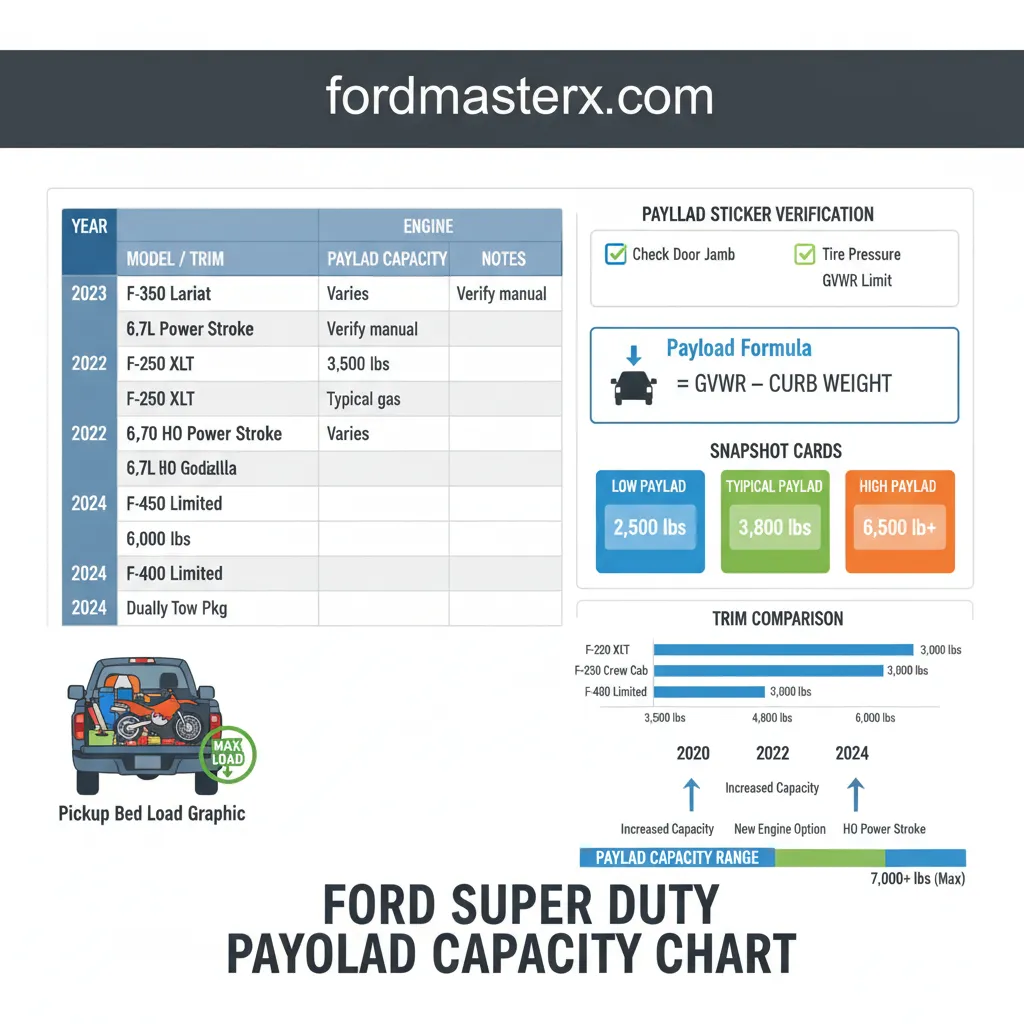
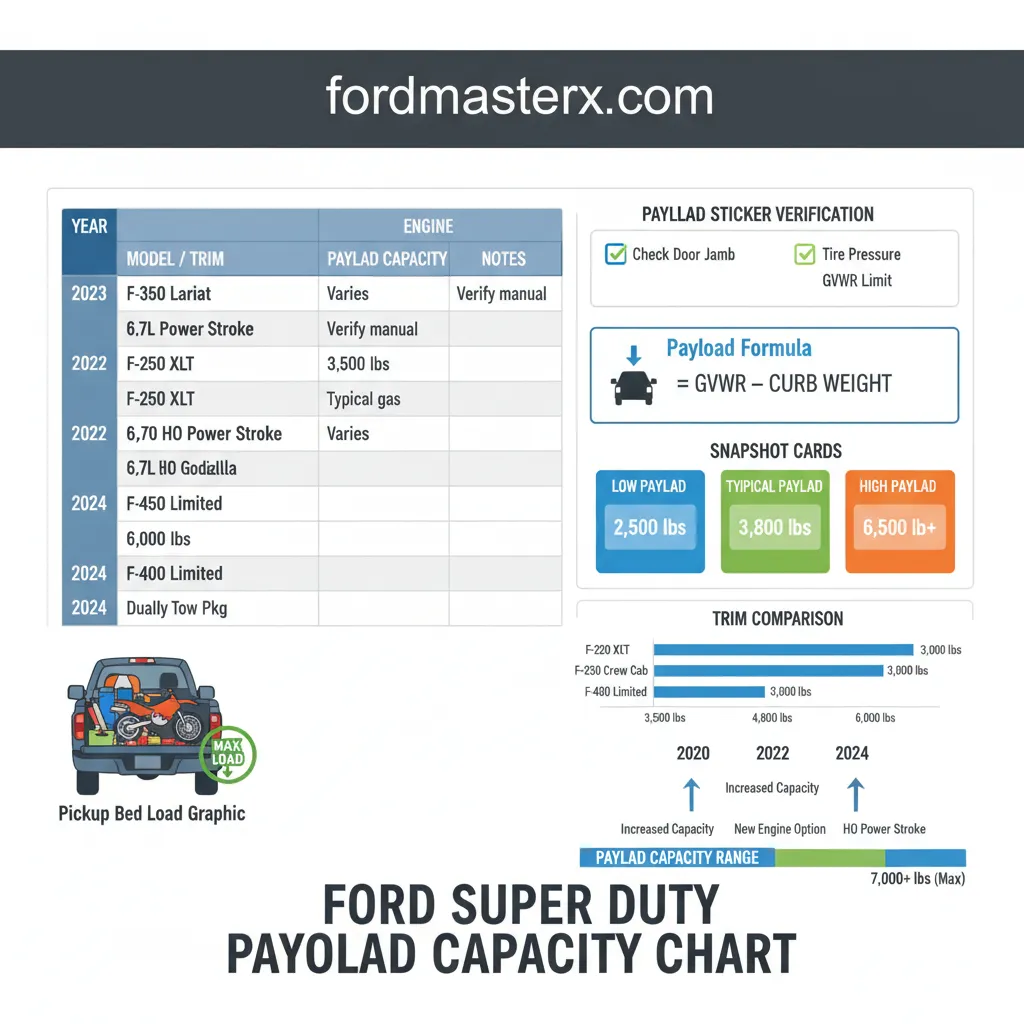
Ford Super Duty Payload Capacity Chart By Year

Quick Answer
Ford Super Duty Payload Capacity Chart depends on the exact year, engine, trim, and configuration. Use the chart and notes in this guide as a starting point, then verify critical numbers with the official manual or vehicle label.
The Ford Super Duty, spanning model years from 2008 to the projected 2026, offers a robust payload capacity designed for serious work. These trucks typically range from approximately 2,500 lbs for entry-level F-250 models to an impressive over 8,000 lbs for optimally configured F-350 and F-450 dual-rear-wheel trucks. Critically, the precise payload figure for any individual Super Duty is determined by its specific Gross Vehicle Weight Rating (GVWR) minus its unique curb weight, a value always found on the driver’s side door jamb sticker, making direct verification essential for safe operation.

Prime for Young Adults — 6 Months Free
Students and 18–24s get six months of Prime free, then half price.
Start 6 Months Free As an Amazon Associate I earn from qualifying purchases.This chart provides representative payload capacities for Ford Super Duty models from 2008 through the projected 2026 model year, covering key engine and configuration options. Data is compiled from Ford’s factory towing guides, owner’s manuals, and industry specifications. Exact payload capacities vary for every individual truck due to unique factory options and curb weight. Readers must always verify their specific vehicle’s payload capacity on the official door jamb sticker. Projections for 2026 models are based on current available information and trends, and official specifications may differ upon release. Last reviewed: May 2026.
Ford Super Duty Payload Capacity Chart By Year (2008-2026)
Recommended Best Deal Products


📤 Share Image
How to read this chart: This table outlines typical payload capacity ranges for various Ford Super Duty models across different years, engines, and configurations. “Max Payload” refers to the highest possible rating for a particular model year and series, usually achieved with the lightest cab, shortest bed, specific axle ratios, and often the gas engine in lighter configurations, or the dual-rear-wheel diesel in heavier ones. “Typical Range” provides a more common expected window. Remember that these are illustrative figures; your truck’s actual capacity is on its door sticker.
| Year | Model / Trim | Engine | Payload Capacity (lbs) | Notes |
|---|---|---|---|---|
| 2026 (Est.) | F-250 SRW | 6.8L Gas / 7.3L Gas / 6.7L Diesel | 2,800 – 4,200+ | Projections based on 2025; varies by cab/bed/options. Max with lightest config, gas engine. |
| 2026 (Est.) | F-350 SRW | 6.8L Gas / 7.3L Gas / 6.7L Diesel | 3,800 – 5,200+ | Projections. Higher GVWR than F-250; can approach F-450 DRW for specific tasks. |
| 2026 (Est.) | F-350 DRW | 6.8L Gas / 7.3L Gas / 6.7L Diesel | 6,500 – 8,000+ | Projections. Dual rear wheels significantly boost GVWR & payload. |
| 2026 (Est.) | F-450 DRW | 6.7L Diesel | 6,000 – 7,000+ | Projections. Dedicated heavy-duty chassis; often focused on towing, less max payload than F-350 DRW due to heavier curb weight. |
| 2025 | F-250 SRW | 6.8L Gas / 7.3L Gas / 6.7L Diesel | ~2,800 – 4,200 | Typically highest with 6.8L gas, Regular Cab, 4×2. Diesel lowers payload slightly. |
| 2025 | F-350 SRW | 6.8L Gas / 7.3L Gas / 6.7L Diesel | ~3,800 – 5,200 | Optional High-Capacity Axle Upgrade can boost payload further. |
| 2025 | F-350 DRW | 6.8L Gas / 7.3L Gas / 6.7L Diesel | ~6,500 – 8,000 | Peak payload usually with Regular Cab, 4×2, 7.3L Gas. |
| 2025 | F-450 DRW | 6.7L Diesel | ~6,000 – 6,800 | Comes standard as Crew Cab, Long Box, 4×4, significantly influencing curb weight. |
| 2023-2024 | F-250 SRW | 6.8L Gas / 7.3L Gas / 6.7L Diesel | ~2,500 – 4,200 | Introduction of 6.8L V8 as standard. Max payload up to 4,268 lbs. |
| 2023-2024 | F-350 SRW | 6.8L Gas / 7.3L Gas / 6.7L Diesel | ~3,500 – 5,200 | Highest for SRW, with 7.3L gas, Regular Cab, 4×2 at 5,200 lbs. |
| 2023-2024 | F-350 DRW | 6.8L Gas / 7.3L Gas / 6.7L Diesel | ~6,500 – 8,000 | Top payload for Super Duty, 8,000 lbs with 7.3L Gas. |
| 2023-2024 | F-450 DRW | 6.7L Diesel | ~6,000 – 6,800 | Specialized for towing heavy trailers (gooseneck/fifth-wheel). |
| 2020-2022 | F-250 SRW | 6.2L Gas / 7.3L Gas / 6.7L Diesel | ~2,500 – 3,900 | Introduction of the 7.3L ‘Godzilla’ V8 improved gas payload. |
| 2020-2022 | F-350 SRW | 6.2L Gas / 7.3L Gas / 6.7L Diesel | ~3,500 – 4,700 | Max payload with 7.3L Gas, Regular Cab, 4×2. |
| 2020-2022 | F-350 DRW | 6.2L Gas / 7.3L Gas / 6.7L Diesel | ~6,000 – 7,800 | 7.3L Gas, Regular Cab, 4×2 could hit 7,850 lbs. |
| 2020-2022 | F-450 DRW | 6.7L Diesel | ~5,800 – 6,200 | 6.7L Power Stroke diesel standard. |
| 2017-2019 | F-250 SRW | 6.2L Gas / 6.7L Diesel | ~2,200 – 3,500 | Aluminum body reduced curb weight, increasing payload significantly. |
| 2017-2019 | F-350 SRW | 6.2L Gas / 6.7L Diesel | ~3,200 – 4,500 | Max payload with 6.2L Gas, Regular Cab, 4×2. |
| 2017-2019 | F-350 DRW | 6.2L Gas / 6.7L Diesel | ~6,000 – 7,600 | Could hit 7,630 lbs with 6.2L Gas, Regular Cab, 4×2. |
| 2017-2019 | F-450 DRW | 6.7L Diesel | ~5,300 – 5,500 | Significantly improved from previous generation due to lighter body. |
| 2011-2016 | F-250 SRW | 6.2L Gas / 6.7L Diesel | ~2,000 – 3,200 | Introduction of 6.2L Gas and 6.7L Power Stroke engines. |
| 2011-2016 | F-350 SRW | 6.2L Gas / 6.7L Diesel | ~3,000 – 4,100 | Minor increases in GVWR and payload over previous gen. |
| 2011-2016 | F-350 DRW | 6.2L Gas / 6.7L Diesel | ~5,500 – 7,000 | Max payload typically with 6.2L Gas. |
| 2011-2016 | F-450 DRW | 6.7L Diesel | ~4,900 – 5,200 | Primarily designed for immense fifth-wheel/gooseneck towing. |
| 2008-2010 | F-250 SRW | 5.4L Gas / 6.8L Gas / 6.4L Diesel | ~1,800 – 2,800 | Refresh included interior and minor exterior updates. |
| 2008-2010 | F-350 SRW | 5.4L Gas / 6.8L Gas / 6.4L Diesel | ~2,800 – 3,800 | Payload capacity slightly higher than F-250 due to increased GVWR. |
| 2008-2010 | F-350 DRW | 5.4L Gas / 6.8L Gas / 6.4L Diesel | ~4,500 – 6,100 | 6.8L V10 Gas often provided highest max payload for DRW. |
| 2008-2010 | F-450 DRW | 6.4L Diesel | ~4,000 – 4,500 | Dedicated F-450 pickup truck introduced as a consumer model. |
Payload Capacity Snapshot: Ford Super Duty (Current Generation)
A quick look at the typical range of payload capacities across the Super Duty lineup (2023-2026 models).
~2,500 lbs
~4,500 lbs
~8,000 lbs
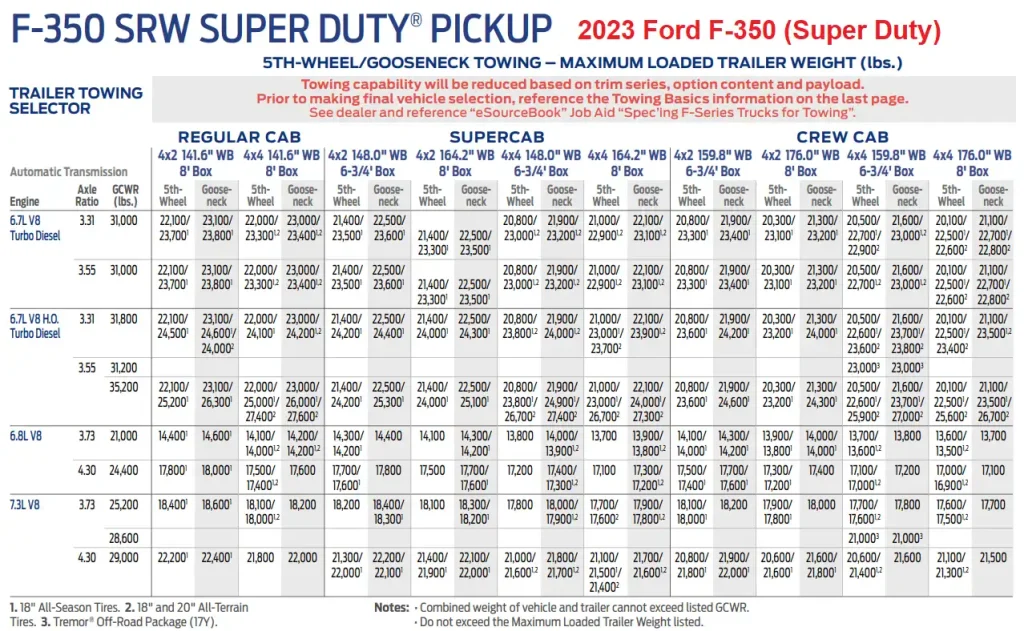
Year-by-Year Payload Changes and Evolution
The Ford Super Duty line has seen continuous evolution, with significant redesigns and powertrain updates directly impacting payload capacities. Understanding these generational shifts is key to interpreting the numbers.
- 2008-2010 (Second Generation Refresh): This period saw an update to the second-generation Super Duty, introducing the 6.4L Power Stroke diesel. Payload capabilities remained strong for the era, with F-350 DRW models generally leading the pack for sheer hauling.
- 2011-2016 (Third Generation): A major powertrain overhaul brought the new 6.2L V8 gasoline engine and the in-house designed 6.7L Power Stroke diesel. These engines, coupled with chassis refinements, allowed for noticeable increases in GVWRs, and consequently, payload capacities across the board. The F-350 DRW continued its dominance, reaching impressive figures.
- 2017-2019 (Fourth Generation – Aluminum Body): This was a monumental shift. The adoption of military-grade aluminum alloy for the body and bed dramatically reduced curb weight, often by hundreds of pounds, while retaining a high-strength steel frame. This weight savings directly translated into significant payload gains, effectively boosting capacities by several hundred pounds for comparable configurations. This is a critical year range for payload improvement.
- 2020-2022 (Fourth Generation Refresh – New Engines): Ford introduced the formidable 7.3L “Godzilla” V8 gasoline engine, offering a potent alternative to the diesel, especially for payload-focused configurations due to its lighter weight compared to the Power Stroke. The 6.7L Power Stroke also received power bumps. These engine options continued to refine payload offerings, pushing F-350 DRW capacities towards and over the 7,800 lb mark.
- 2023-2026 (Fifth Generation – Further Refinements): The latest generation brought another full redesign, including updated styling, interior, and a new standard 6.8L V8 gas engine, alongside the upgraded 7.3L and High-Output 6.7L Power Stroke. Chassis improvements and suspension tuning allowed for further incremental increases in GVWR and payload, with the F-350 DRW reaching a remarkable 8,000 lbs in optimal configurations. Expected 2026 models are projected to maintain or slightly enhance these impressive figures.
The maximum payload figures often cited in marketing materials typically represent the absolute lightest configuration (e.g., Regular Cab, 2WD, base trim, specific axle ratio) with the engine that offers the best power-to-weight ratio for payload. Opting for Crew Cab, 4WD, higher trims, or heavier engines will reduce your actual usable payload.
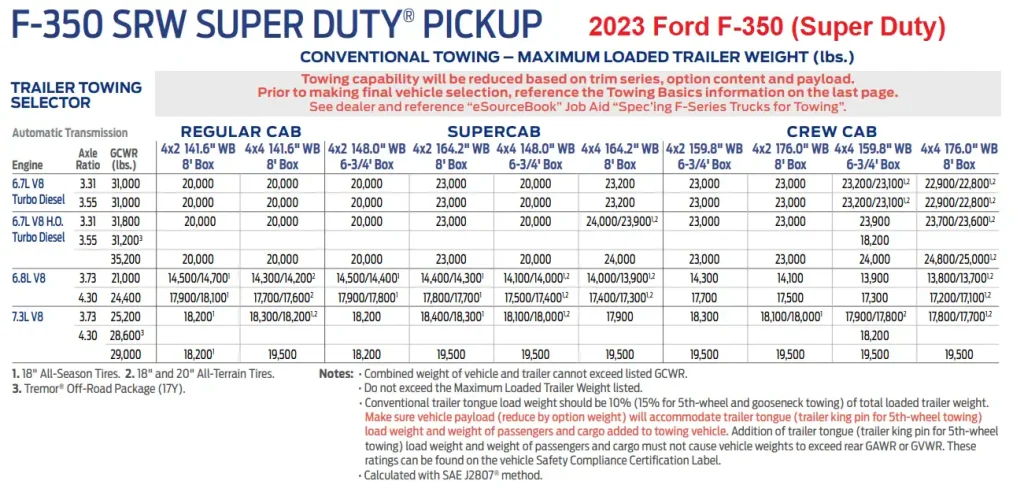
Trim and Configuration Notes
Recommended Best Deal Products


Understanding how different Super Duty configurations impact payload is crucial. Every option added to the truck, from the engine choice to interior amenities, adds curb weight, directly reducing the available payload capacity from the Gross Vehicle Weight Rating (GVWR).
Series (F-250, F-350, F-450) Payload Comparison
The Super Duty lineup is designed with ascending capabilities. Here’s a general comparison of how payload scales:
Payload Capacity by Super Duty Series (Representative)
Note: Figures are representative for 2023-2026 models and will vary based on specific configuration.

Audible — Listen Free for 30 Days
One free credit a month and thousands of titles included.
Listen Free for 30 Days As an Amazon Associate I earn from qualifying purchases.- F-250: Often considered the entry point to Super Duty, the F-250 SRW (Single Rear Wheel) offers excellent capability without requiring a Commercial Driver’s License (CDL) for most applications. Its payload is generally limited by its GVWR, typically maxing out around 4,200 lbs for the lightest configurations.
- F-350 SRW: Steps up in GVWR, offering significantly higher payload than the F-250, often exceeding 5,000 lbs in optimal configurations. This is a popular choice for those needing substantial capacity without the width of dual rear wheels.
- F-350 DRW: This is where maximum payload truly shines. With dual rear wheels, the F-350 DRW significantly increases its GVWR, allowing it to achieve the highest payloads in the entire Super Duty line, up to 8,000 lbs or more. This configuration is often chosen for heavy fifth-wheel trailers or substantial slide-in campers.
- F-450 DRW: While often perceived as the “biggest,” the F-450 pickup model actually has a slightly lower maximum payload capacity than the F-350 DRW in many configurations. This is due to its heavier curb weight from a more robust chassis, wider front axle, and standard features designed for its primary purpose: extreme towing of gooseneck and fifth-wheel trailers. Its strength lies in Gross Combined Weight Rating (GCWR) and stability under massive loads, rather than raw payload capacity.
Engine Options and Drivetrain
- Gasoline Engines (6.2L, 6.8L, 7.3L): Generally, gasoline engines are lighter than their diesel counterparts. This lower curb weight often results in higher maximum payload capacities for a given GVWR. The 7.3L “Godzilla” V8, in particular, offers an excellent balance of power and payload potential.
- Diesel Engines (6.4L, 6.7L Power Stroke): While offering immense torque for towing, diesel engines are significantly heavier. This added curb weight reduces the available payload capacity compared to a similarly configured gas truck. However, their superior towing capabilities often make this a worthwhile trade-off for many users.
- 2WD vs. 4WD: Four-wheel-drive systems add considerable weight due to additional drivetrain components (transfer case, front differential, heavier axles). A 2WD configuration will almost always offer a higher payload capacity than its 4WD equivalent.
Cab Style, Bed Length, and Trim Level
- Cab Styles (Regular, SuperCab, Crew Cab): A Regular Cab is the lightest option, offering the highest potential payload. Moving to a SuperCab (extended cab) and especially a Crew Cab (four-door) adds significant curb weight, reducing payload.
- Bed Lengths (Short Box, Long Box): A long box (8-foot) generally adds curb weight compared to a short box (6.75-foot or 6.5-foot).
- Trim Levels (XL to Platinum/Limited): Higher trim levels often include more luxurious features, power options, larger wheels, and heavier materials (e.g., leather seats, panoramic moonroof, power running boards), all of which contribute to curb weight and decrease payload. Fleet-spec XL trucks often boast the highest theoretical payload figures.
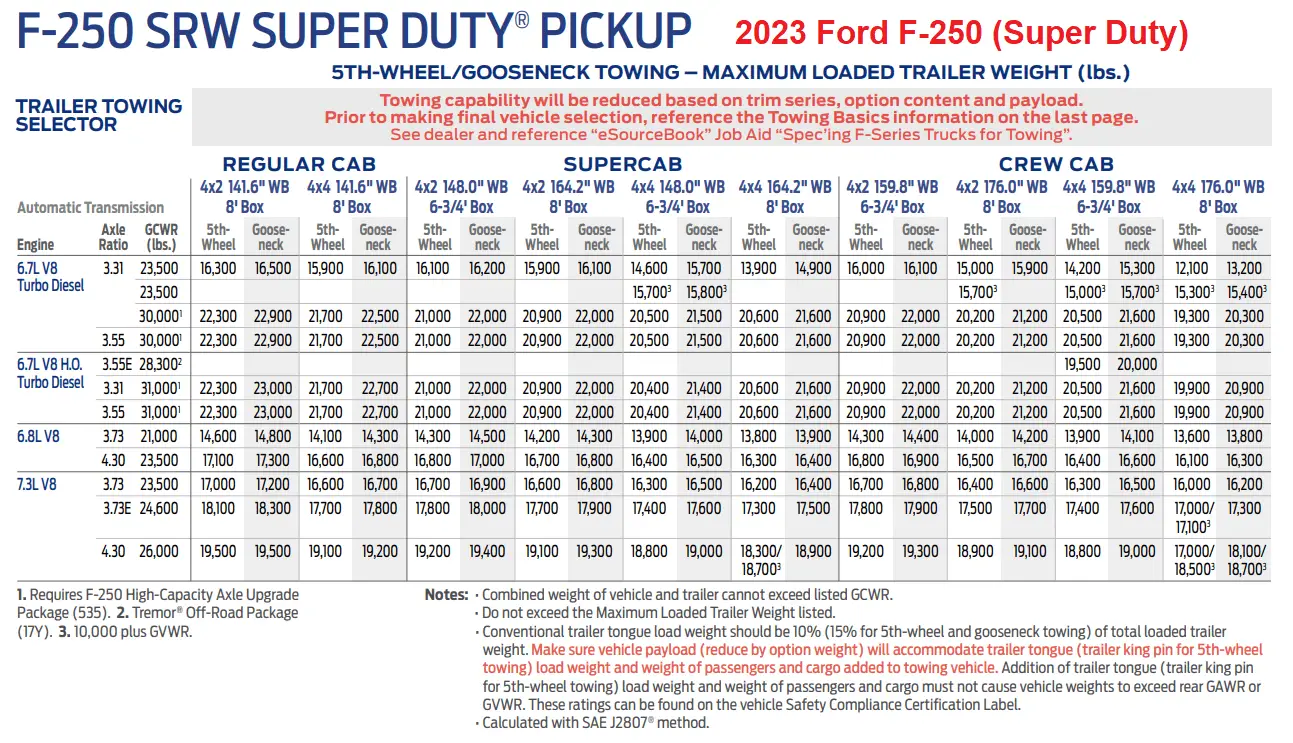
What Affects Payload Capacity?
Payload capacity is not a static number; it’s a dynamic calculation unique to each specific truck. As an industry expert, I emphasize that understanding its components is paramount for safe and legal operation.
Payload Capacity = Gross Vehicle Weight Rating (GVWR) – Curb Weight
This is the maximum permissible weight of the vehicle AND its contents (passengers, cargo, accessories). It’s a fixed number set by the manufacturer for your specific VIN.
This is the weight of the truck as it leaves the factory, with all fluids and a full tank of fuel, but without occupants or cargo. Every option adds to this weight.
This sticker provides the actual “Payload Capacity” or “The combined weight of occupants and cargo should never exceed XXX kg or XXX lbs.” for your specific truck, after all factory options.
Key Factors That Reduce Usable Payload
- Passengers: Every person in the truck counts towards payload. Don’t forget their weight.
- Aftermarket Accessories: Toolboxes, bed liners, heavy bumpers, winches, lift kits, larger tires, aftermarket running boards – anything added after the factory reduces your available payload.
- Fluid Weight: While curb weight includes a full tank of fuel, other fluids like water in a camper’s fresh water tank or extra fuel cans count as cargo.
- Fifth-Wheel/Gooseneck Hitch: These heavy hitches, while essential for towing, are installed into the bed and reduce payload capacity. Always account for their weight.
Never rely solely on generalized charts or brochures. The definitive payload capacity for your specific Ford Super Duty is printed on the yellow-and-white tire and loading information sticker, usually located on the driver’s side door jamb. This sticker accounts for all factory-installed equipment on your unique vehicle.
Door Sticker Verification Checklist
Follow these steps to accurately determine your specific Ford Super Duty’s payload capacity.
Open the driver’s door and find the yellow-and-white “Tire and Loading Information” sticker on the door jamb.
Look for the line that says: “The combined weight of occupants and cargo should never exceed XXX kg or XXX lbs.”
This number is your truck’s actual maximum payload capacity as it left the factory.
Audible Premium Plus — Annual Membership
12 audiobook credits up front, plus the full Audible catalogue.
See Annual Plans As an Amazon Associate I earn from qualifying purchases.Subtract the weight of any aftermarket accessories (e.g., toolboxes, fifth-wheel hitch) that were not factory-installed.
Remember to subtract the total weight of all occupants (including yourself) from the adjusted payload capacity to find your usable cargo capacity.
Frequently Asked Questions (FAQs) About Super Duty Payload
Recommended Best Deal Products


What is the difference between payload and towing capacity?
Payload capacity refers to the maximum weight your truck can carry in its bed and cab, including passengers, cargo, and any accessories. Towing capacity, on the other hand, is the maximum weight your truck can pull behind it in a trailer. While related, they are distinct metrics. A truck can have high towing capacity but a more modest payload, especially if it has a heavier diesel engine and luxury options.
Can I increase my Ford Super Duty’s payload capacity?
No, you cannot legally increase your vehicle’s factory-rated GVWR or official payload capacity. The payload capacity is determined by the manufacturer based on the entire vehicle’s structural integrity, axles, suspension, tires, and brakes. While aftermarket air bags or helper springs can help with ride comfort and prevent sag, they do NOT increase the legal payload rating. Exceeding the door sticker’s payload capacity is unsafe, illegal, and can void your warranty.
Does a fifth-wheel hitch reduce payload?
Yes, absolutely. A fifth-wheel or gooseneck hitch assembly, which can weigh anywhere from 100 to 300+ lbs, is installed into the truck’s bed and becomes part of its curb weight. Therefore, its weight must be subtracted from the sticker’s payload capacity to determine your available capacity for the trailer’s pin weight and other cargo.
Why do diesel Super Duty trucks sometimes have lower payload than gas models?
Diesel engines, particularly the Power Stroke, are substantially heavier than gasoline engines due to their robust construction and additional components (e.g., turbochargers, emissions systems). Since payload is calculated as GVWR minus curb weight, the heavier diesel engine directly increases the truck’s curb weight, leaving less capacity for cargo, even if the GVWR is identical to a gas counterpart.
By The Numbers: Ford Super Duty Payload (2023-2026)
Max F-350 DRW Payload
Max F-250 SRW Payload
Often Highest Payload Engine
Average Payload Gain (2017 Aluminum)
Conclusion: Mastering Your Super Duty’s Capacity
The Ford Super Duty line consistently delivers class-leading payload capacities, evolving over the years with engineering advancements and new powertrains. From the versatile F-250 to the extreme hauling capabilities of the F-350 DRW, there’s a Super Duty configuration for nearly every demanding task. However, maximum payload is not a one-size-fits-all number.
Key takeaways for any Super Duty owner or prospective buyer include:
- Payload Variability: Recognize that every choice—engine, cab, bed, drivetrain, and trim—directly affects your truck’s final payload capacity.
- Door Sticker Accuracy: Always consult the yellow-and-white “Tire and Loading Information” sticker on your specific truck’s door jamb for the definitive payload rating.
- Safety First: Never exceed your truck’s stated payload capacity to ensure safe operation, maintain vehicle integrity, and comply with legal requirements.
By understanding these critical factors, you can confidently utilize your Ford Super Duty to its full potential, knowing you’re operating safely and efficiently. Always cross-reference the detailed information in your owner’s manual and Ford’s factory towing guides for the most comprehensive data specific to your year and model.
Full payload guide: Ford F-150 Payload Capacity Chart