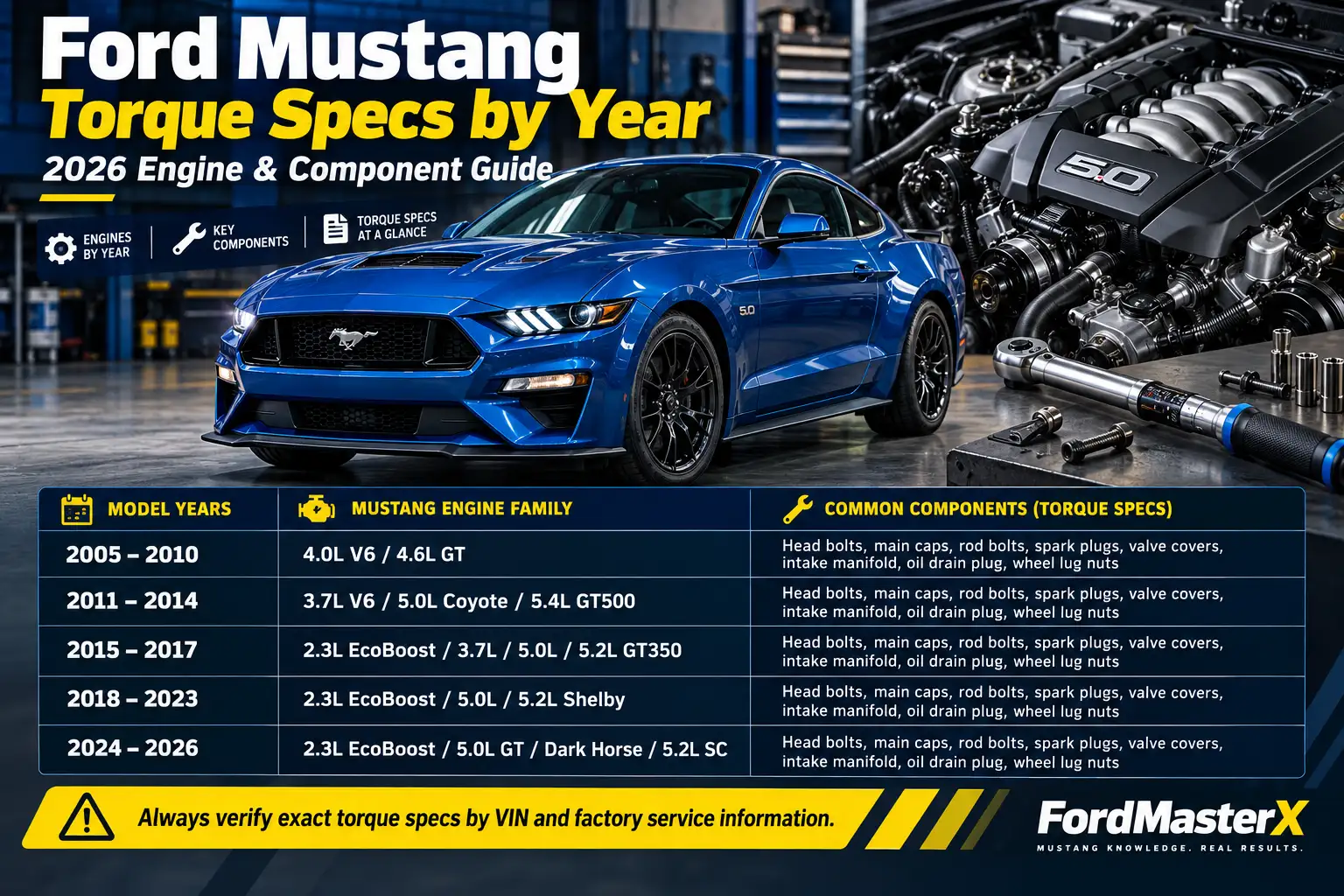
Ford Mustang Torque Specs by Year: 2005-2026 Engine, and Component

Ford Mustang torque specs depend on the model year, engine, brake package, and exact fastener. Wheel, brake, and engine fasteners require different tightening methods.
For example, Ford specifies 100 lb-ft for the wheel lug nuts on a 2014 Mustang, while a standard 2026 Mustang uses 150 lb-ft. The reference tables below separate verified applications instead of treating every Mustang as mechanically identical. Match your hardware and confirm the relevant service procedure before using any value.
FordMasterX • Verified wheel fastener reference
Ford Mustang Wheel Torque Quick Reference
Factory wheel lug nut specifications for selected model years. Values are shown in pound-feet and newton-meters. Match the year, trim, and hardware before tightening.
Factory wheel studs 100 lb-ft 135 Nm Checked years only • 1/2-20 studs
Selected standard applications 150 lb-ft 204 Nm See checked years below • M14 × 1.5
Separate Ford specification 148 ± 15 lb-ft 200 ± 20 Nm Tolerance is part of the published specification
Year-Specific Lookup
Selected verified years only. On a phone, swipe the table sideways to see every column.
| Model year | Torque lb-ft | Torque Nm | Application |
|---|---|---|---|
| 2005 | 100 | 135 | Factory 1/2-20 studs |
| 2008 | 100 | 135 | Factory 1/2-20 studs |
| 2014 | 100 | 135 | Factory 1/2-20 studs |
| 2015 | 150 | 204 | Factory M14 × 1.5 |
| 2016 | 150 | 204 | Checked factory wheel types |
| 2019 | 150 | 204 | Factory M14 × 1.5 |
| 2021 | 150 | 204 | Factory M14 × 1.5 |
| 2024 | 150 | 204 | Factory M14 × 1.5 |
| 2025 | 150 | 204 | Standard factory application |
| 2026 | 150 | 204 | Excluding Dark Horse SC |
| 2026 Dark Horse SC | 148 ± 15 | 200 ± 20 | Trim-specific tolerance |
Do not assume every year shares the same value. Missing years are not verified by this table. Aftermarket wheels, studs, and nuts may require a different manufacturer procedure. Confirm your owner’s manual.
How to Find the Correct Mustang Torque Spec



Start with the model year and the exact part being tightened. Mustangs have different chassis, engines, and brake systems. Performance packages can also change the procedure.
Use this sequence before picking up a torque wrench:
- Identify the model year and trim. Record whether your car is a GT, EcoBoost, V6, Shelby, or another version.
- Identify the engine or brake package.
- Name the exact fastener.
- Check the hardware and instructions.
Use the owner’s manual for wheel nuts and the year-specific workshop manual for engine, brake, steering, and suspension work. Kit instructions apply only to the specified applications.
Ford Mustang Wheel Lug Nut Torque by Year


The wheel chart below shows individually checked model-year examples, not an assumed specification for every intervening year.
| Mustang Model Year | Wheel Lug Nut Torque | Torque in Nm | Application Note |
|---|---|---|---|
| 2005 | 100 lb-ft | 135 Nm | Factory 1/2-20 wheel studs |
| 2008 | 100 lb-ft | 135 Nm | Factory 1/2-20 wheel studs |
| 2014 | 100 lb-ft | 135 Nm | Factory 1/2-20 wheel studs |
| 2015 | 150 lb-ft | 204 Nm | Factory M14 x 1.5 hardware |
| 2016 | 150 lb-ft | 204 Nm | All wheel types in the checked manual |
| 2019 | 150 lb-ft | 204 Nm | Factory M14 x 1.5 hardware |
| 2021 | 150 lb-ft | 204 Nm | Factory M14 x 1.5 hardware |
| 2024 | 150 lb-ft | 204 Nm | Factory M14 x 1.5 hardware |
| 2025 | 150 lb-ft | 204 Nm | Standard factory M14 x 1.5 application |
| 2026, excluding Dark Horse SC | 150 lb-ft | 204 Nm | Factory M14 x 1.5 hardware |
| 2026 Dark Horse SC | 148 ± 15 lb-ft | 200 ± 20 Nm | Separate Ford specification with tolerance |
The 2014 Mustang owner’s manual confirms 100 lb-ft for that year. The 2026 Mustang wheel-nut instructions list 150 lb-ft when the Dark Horse SC exception does not apply. Ford gives the 2026 Dark Horse SC its own torque tolerance.
Notice the 2014–2015 change. Do not apply 100 lb-ft to a 2015 Mustang simply because an older Mustang used it. Likewise, do not treat the Dark Horse SC tolerance as the specification for a regular Mustang GT.
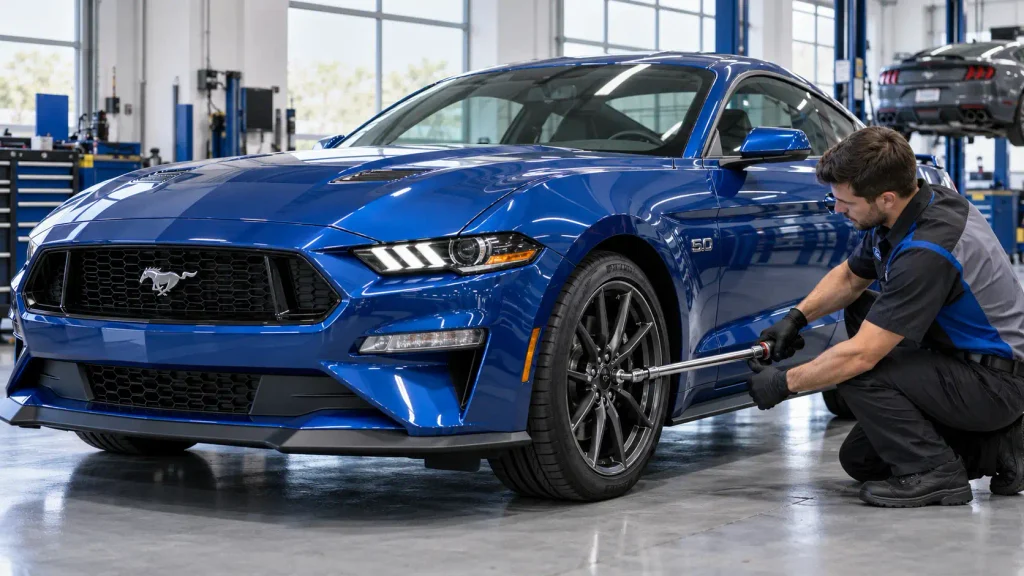
Ford specifies clean, rust-free threads and correctly seated wheels. Tighten the nuts progressively in a crossing pattern with a torque wrench. The 2014 and current 2026 manuals call for a repeat torque check within 100 miles after wheel removal or rotation; some earlier manuals, including 2005 and 2008, specify a 500-mile recheck instead. Follow your year-specific manual.
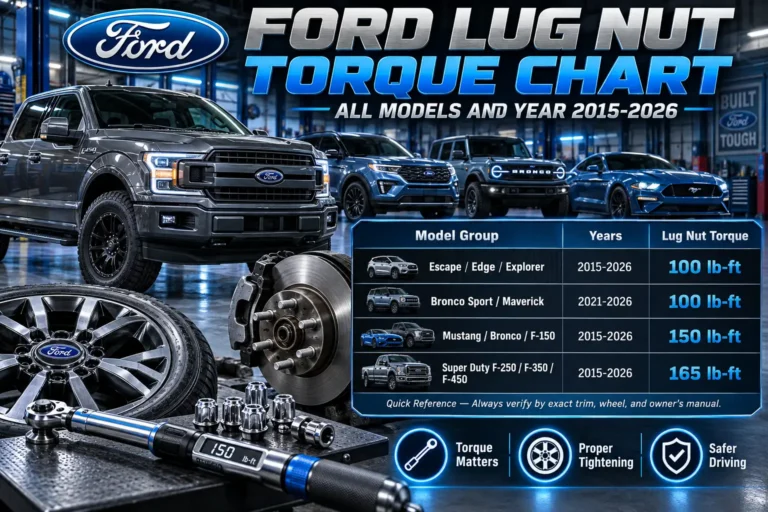
For a broader Ford model comparison, see the Ford lug nut torque chart by model and year.
Which Mustang Engine Fasteners Need Special Torque Steps


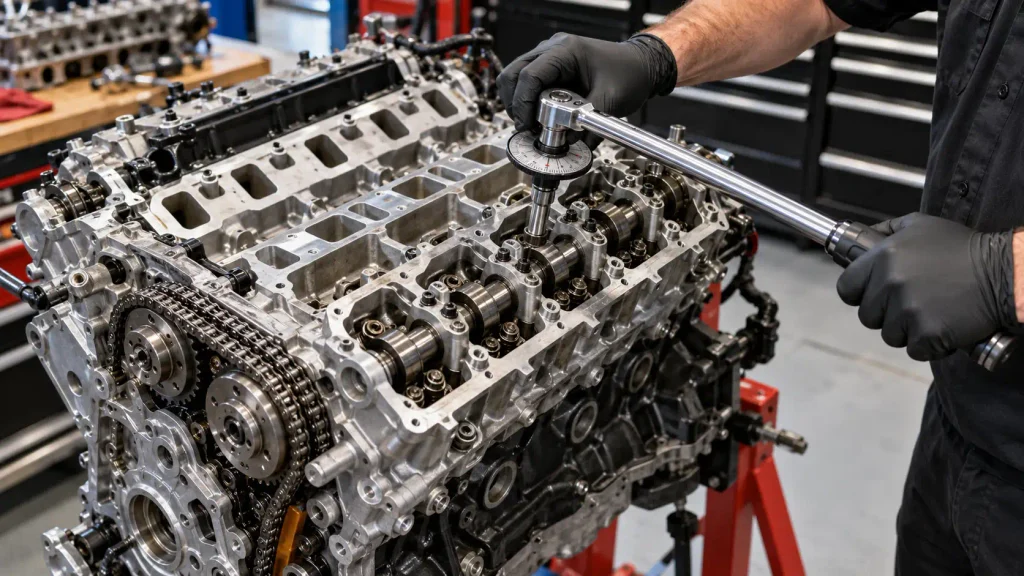
Engine fasteners demand more precision than a single wheel-nut figure. Ignition bolts may be specified in pound-inches; head bolts may need staged tightening.
The following examples come from specified 2014 Mustang engine service sections. They are not general values for every Mustang V6, EcoBoost, or Coyote engine.
| Exact Application | Fastener | Verified Tightening Specification |
|---|---|---|
| 2014 Mustang 3.7L V6 | Spark plug | 15 Nm (133 lb-in, approximately 11 lb-ft) |
| 2014 Mustang 3.7L V6 | Ignition coil bolt | 7 Nm (62 lb-in) |
| 2014 Mustang 5.0L V8 | Ignition coil bolt | 6 Nm (53 lb-in) |
| 2014 Mustang 5.0L V8 | Engine oil pan drain plug | 26 Nm (19 lb-ft) |
These entries come from the 2014 Mustang engine and ignition service sections. Use the matching procedure, not a generic torque chart for a different engine.
Why Coyote Head Bolts Are Different
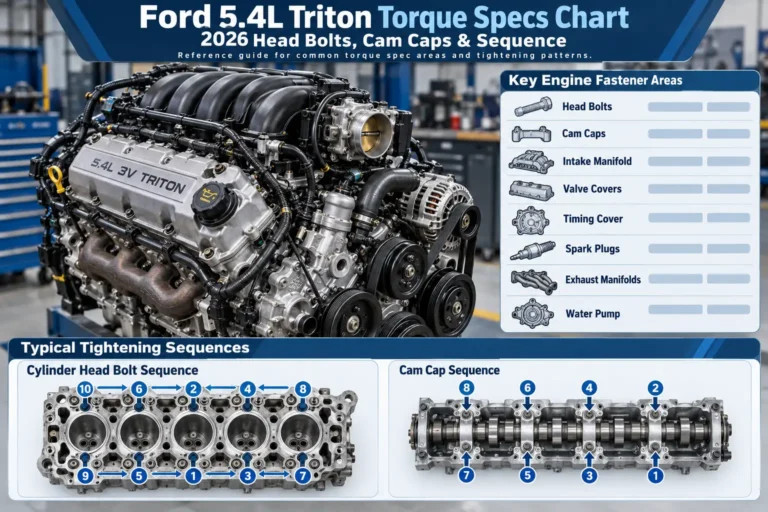
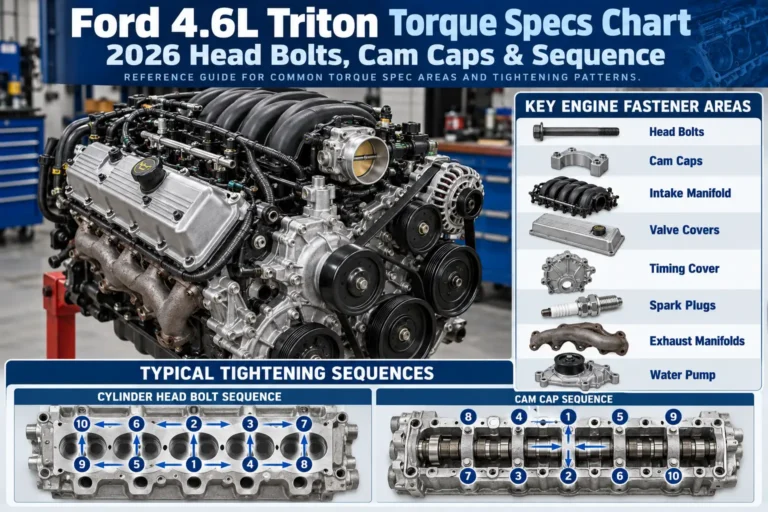
Ford Performance’s M-6067-M5018 head-gasket kit identifies 2018–2025 Mustang 5.0L applications and supplies KR3Z-6065-A head bolts. Its specified sequence is 30 ± 5 Nm, then 50 ± 5 Nm, followed by three separate 90 ± 5° tightening passes in the kit’s numbered bolt order.
Those stages do not automatically apply to a 2011 GT, stock 2026 Coyote, or aftermarket studs. For the detailed application breakdown and tightening-stage comparison, use the Ford 5.0 Coyote torque specs and head-bolt sequence guide.
The 2014 workshop material also contains differing 5.0L spark-plug figures across its ignition and engine specification sections. Rather than select one silently, confirm the current service revision and exact plug application before tightening. This is the kind of discrepancy an application-specific repair procedure must resolve.
How Mustang Brake Caliper Torque Changes by Setup
Caliper anchor bolts and caliper guide-pin bolts are different fasteners. Never interchange their torque values.
The following checked values are from the 2014 Mustang Workshop Manual, Section 206-03, Front Disc Brake, revision dated January 7, 2013. They describe the listed 2014 brake configurations only.
| 2014 Mustang Brake Component | Tightening Torque | Configuration |
|---|---|---|
| Front caliper anchor-plate bolts | 115 Nm (85 lb-ft) | Two-piston caliper |
| Front caliper mounting bolts | 115 Nm (85 lb-ft) | Four- and six-piston calipers |
| Front caliper guide-pin bolts | 34 Nm (25 lb-ft) | Two-piston caliper |
| Front caliper brake-hose flow bolt | 55 Nm (41 lb-ft) | Workshop-manual application |
| Front caliper bleeder screw | 10 Nm (89 lb-in) | Two-piston caliper |
| Front caliper bleeder screw | 18 Nm (159 lb-in) | Four- and six-piston calipers |
| Rear caliper bleeder screw | 10 Nm (89 lb-in) | Listed 2014 applications |
A brake-hose connection also requires the specified sealing washers. Do not use a torque value as a substitute for checking washer replacement, thread condition, hose routing, and fluid leaks.
Later Mustangs can use different brake packages. For a 2015–2026 Mustang, obtain the workshop specification for its exact front or rear brake assembly rather than copying this 2014 table.
Which Mustang Suspension Bolts Require Exact Specs
Suspension torque depends on chassis, bolt location, and replacement rules.
Here are selected values from the 2014 Mustang Workshop Manual, Section 204-01, Front Suspension, including its strut and spring assembly procedures.
| 2014 Mustang Suspension Fastener | Torque | Installation Detail |
|---|---|---|
| Four upper strut-mount nuts | 35 Nm (26 lb-ft) | Procedure specifies new nuts |
| Strut-to-spindle bolts | 225 Nm (166 lb-ft) | Replace specified bolts and flange nuts; cam-bolt exceptions require procedure check |
| Stabilizer-bar link upper nut | 115 Nm (85 lb-ft) | Procedure specifies a new nut; prevent stud rotation |
| Strut-rod nut, excluding GT500 | 103 Nm (76 lb-ft) | Procedure specifies a new nut |
| Strut-rod nut, GT500 | 80 Nm (59 lb-ft) | Separate GT500 specification; new nut |
These are 2014-specific examples, not settings for a 2024 Mustang’s independent rear suspension or later-generation front struts.
The 2014 strut-to-spindle procedure also calls for an alignment check after installation. Some suspension bushings must be tightened at the suspension position specified by the service procedure, not automatically with the suspension hanging at full droop. Confirm the complete removal and installation instructions before tightening any control-arm or steering attachment.
How to Tighten Mustang Bolts to Specification
Preparation and tightening sequence matter as much as the number. Follow the service method that accompanies the specification.
- Identify and inspect the fastener. Confirm its exact position, size, condition, and whether the procedure requires replacement. Do not reuse a one-time-use bolt or nut when the service instructions say to discard it.
- Prepare the connection as specified. Clean wheel-to-hub mating surfaces. For other components, follow the stated instructions for dry threads, oil, sealant, threadlocker, or replacement washers. Do not add lubricant to wheel-stud threads unless the applicable manufacturer procedure explicitly requires it.
- Use the correct tool and sequence. Choose a calibrated wrench that covers the specified torque range. For low-torque ignition bolts, a pound-inch wrench may provide better control. For head bolts, use the prescribed torque-angle equipment and bolt order.
- Complete the required checks. Verify wheel-nut retorque distance, look for brake-fluid leaks after brake work, and obtain an alignment when the suspension procedure calls for one.
Units matter: 12 lb-in equals 1 lb-ft. If a specification is in lb-in, do not set a pound-foot wrench to the same number. Also, 90° means a further quarter-turn after the specified torque stage; it does not mean 90 lb-ft.
How to Verify Classic Mustang Engine Torque Specs
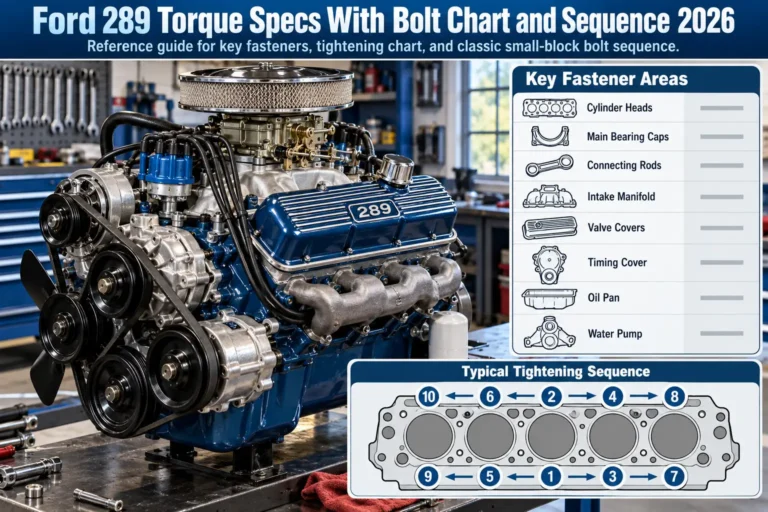
Classic 289 and 302 Windsor engines do not use modern Coyote tightening procedures.
Identify the engine, heads, gasket, and bolt or stud manufacturer. A factory service specification and an aftermarket ARP instruction sheet can call for different torque values or lubrication conditions.
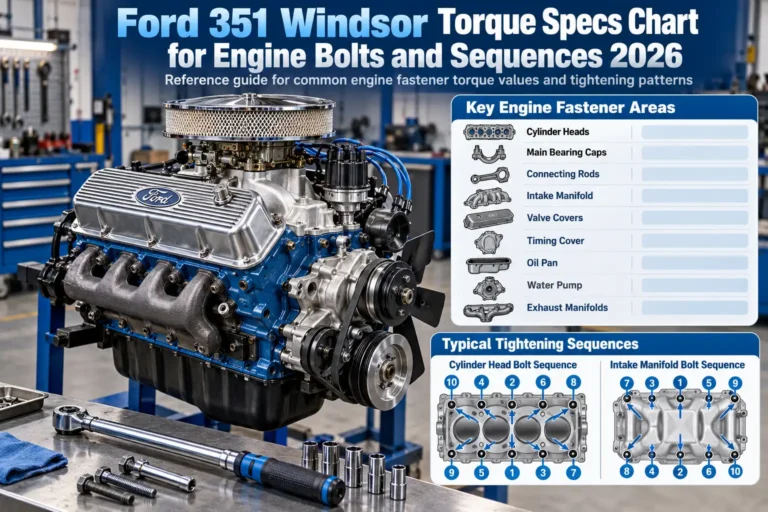
For older 302 Windsor applications, the Ford 302 torque specs and bolt-sequence guide explains the differences between engine eras and fastener types. Match your exact engine and hardware before following its figures. This page does not assign one head-bolt number to all classic Mustangs.
What to Check When Mustang Torque Figures Conflict
Different components and revisions can have different torque values. Never average conflicting specifications.
Check these details in order:
- The model year and engine: A 2014 5.0L component is not automatically identical to its 2024 counterpart.
- The fastener description: Caliper guide pins, caliper mounting bolts, and bleeder screws have different functions and torque values.
- The instructions supplied with a kit: The Ford Performance head-gasket-kit sequence applies to its named hardware, not to every Coyote head.
- Replacement and lubrication rules: A new torque-to-yield bolt or a lubricated aftermarket stud can require a different procedure from an original dry bolt.
- The units and revision date: A figure expressed in lb-in can appear much larger than the equivalent lb-ft value. Revisions can also change published instructions.
For example, a generic third-party 2014 Mustang brake chart may show a different caliper-bolt number than the identified factory workshop section. The component description and procedure determine which figure can be used. When that match is unclear, stop and confirm the current Ford repair instruction before tightening.
Where to Find Official Mustang Torque References
Start with your Mustang owner’s manual for wheel torque. Ford’s online manuals can confirm year and trim exceptions.
For an engine rebuild, brake repair, or suspension replacement, use the corresponding factory workshop procedure through Ford service information. The correct page should identify the component, hardware, tightening stages, bolt sequence, and any replacement requirements.
For aftermarket hardware, consult its manufacturer’s instructions.
Which Mustang Torque Specs Should You Trust
The most reliable Ford Mustang torque specs come from the documentation for the exact model year, engine, component, and installed hardware. The verified wheel examples show why: a 2014 Mustang uses 100 lb-ft for its factory lug nuts, while a regular 2026 Mustang uses 150 lb-ft and the Dark Horse SC has a separate tolerance-based specification.
Use the tables as a starting reference, not a substitute for complete service procedures. For brake, steering, suspension, and internal engine repairs, check whether bolts must be replaced, whether an angle pass is required, and whether the tightening sequence affects the result. When the application cannot be verified, do not guess. Identify the fastener and consult the matching Ford workshop instruction before applying torque.
Frequently Asked Mustang Torque Questions
What Is the Lug Nut Torque for a Ford Mustang?
It depends on the model year and wheel hardware. Ford lists 100 lb-ft for the factory 2014 Mustang, 150 lb-ft for regular 2026 models, and 148 ± 15 lb-ft for the 2026 Dark Horse SC. Check your specific owner’s manual rather than assuming one number fits every Mustang.
Are Mustang GT and EcoBoost Torque Specs the Same?
Not for every component. Some model-year wheel-nut specifications apply across standard configurations, but engine fasteners, accessories, and certain brake packages have different instructions. Match the engine, trim, and exact bolt before applying a value.
What Are the 5.0 Coyote Head Bolt Torque Specs?
There is no single correct head-bolt sequence for every Coyote engine and hardware kit. One Ford Performance kit for 2018–2025 Mustang 5.0L applications uses 30 ± 5 Nm, then 50 ± 5 Nm, followed by three 90 ± 5° passes. Use that procedure only when its kit and application match your repair.
Can I Reuse Mustang Torque to Yield Bolts?
Do not reuse a torque-to-yield fastener when the specified service procedure requires a new one. Head bolts and certain suspension fasteners may be designated for replacement after removal. Check the precise component instructions before reassembly.
Should I Retorque Mustang Wheels After Installation?
Yes, when your owner’s manual requires it. Ford specifies a recheck within 100 miles for the verified 2014 and 2026 wheel-nut applications, while some older manuals specify 500 miles. Use the interval and torque figure for your exact model year.