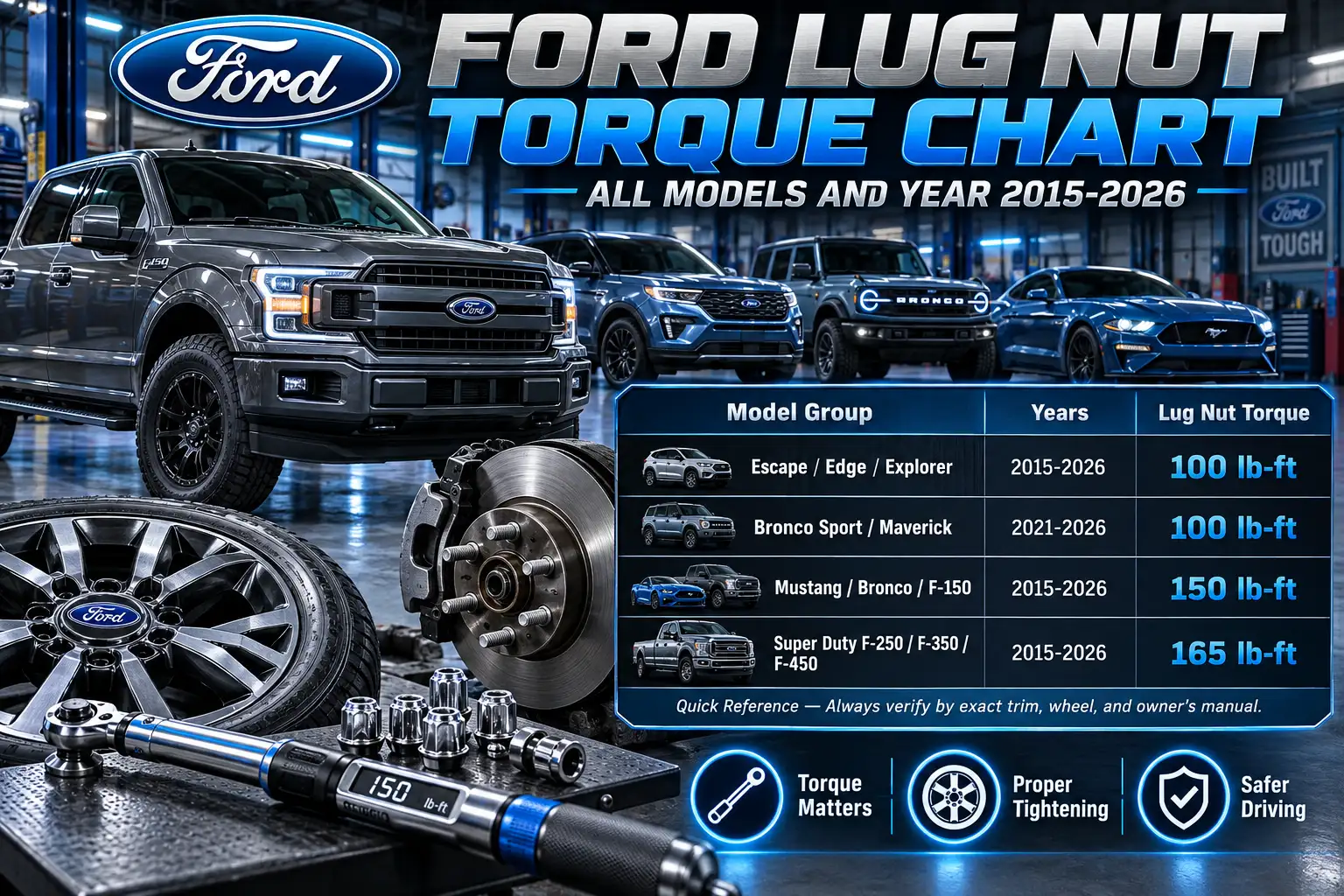
Ford Lug Nut Torque Chart: All Models and Year 2015-2026

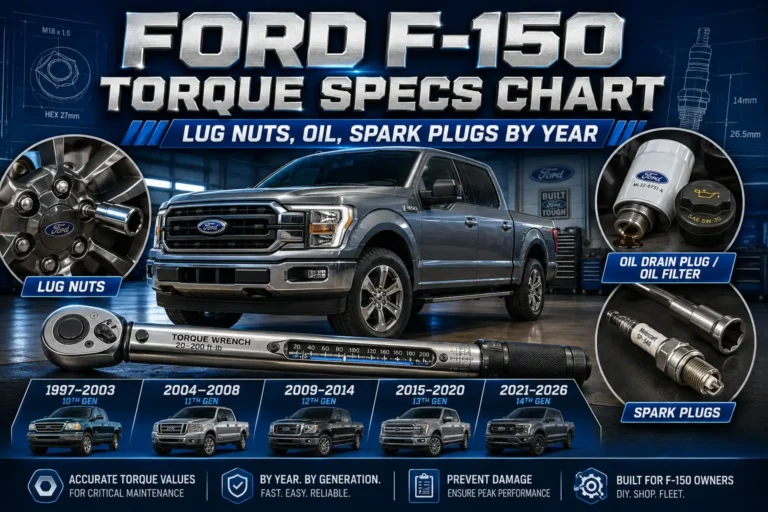
The Ford lug nut torque chart below gives you verified wheel nut torque specifications for common Ford trucks, SUVs, vans, and performance models. Ford does not use one universal lug nut torque value across every model or model year.
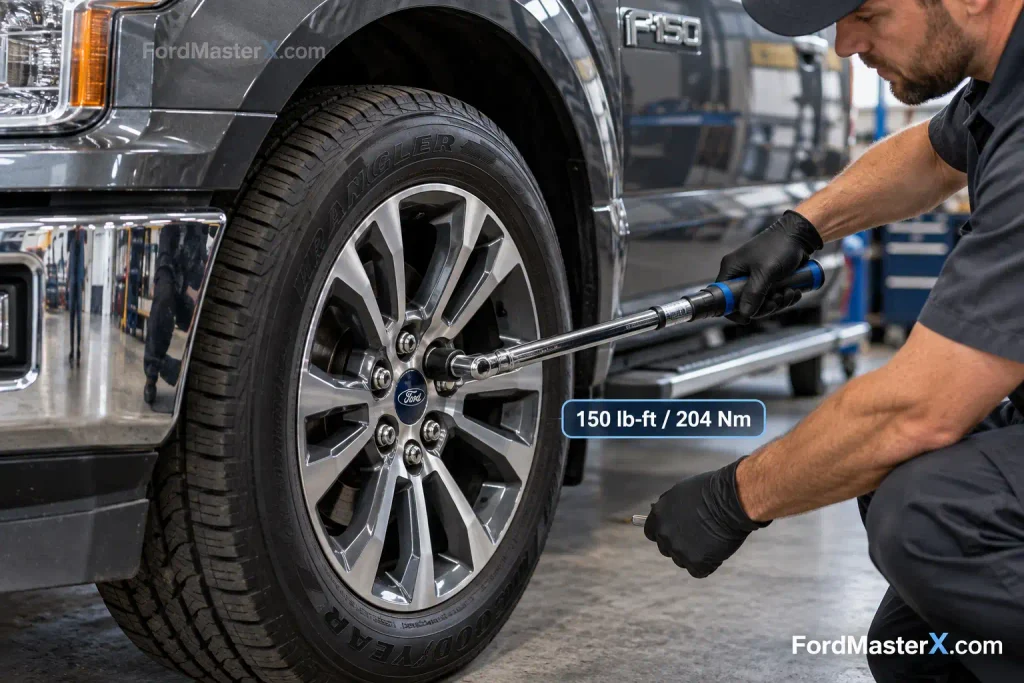
Depending on the application, Ford specifies values ranging from 100 lb-ft on models such as the Bronco Sport to 150 lb-ft or more on trucks such as the F-150 and Super Duty. Always match the model year and factory wheel hardware before tightening the lug nuts.

Prime for Young Adults — 6 Months Free
Students and 18–24s get six months of Prime free, then half price.
Start 6 Months Free As an Amazon Associate I earn from qualifying purchases.Ford Lug Nut Torque Specs by Model and Year
Recommended Best Deal Products


Use the table as a quick reference for factory-style wheels and fasteners. Ford has changed wheel hardware and torque specifications between platforms and, in some cases, between model years.
If you are also checking wheel fitment, our Ford bolt pattern chart covers Ford bolt patterns across major models.
| Ford Model | Model Year or Range | Thread Size | Torque lb-ft | Torque Nm | Notes |
|---|---|---|---|---|---|
| F-150 | 2015 | M14 x 1.5 | 150 | 204 | Ford factory specification |
| F-150 | 2020 | M14 x 1.5 | 150 | 204 | Ford factory specification |
| F-150 | 2021 | M14 x 1.5 | 150 | 204 | Ford lists 150 lb-ft cold wheel torque |
| F-150 | 2022 | M14 x 1.5 | 150 | 204 | Ford factory specification |
| F-150 | 2023 | M14 x 1.5 | 162 | 220 | Ford online manual lists revised value |
| F-250 and F-350 Super Duty | 2011 | M14 x 1.5 | 165 | 224 | Earlier Super Duty specification |
| F-250 and F-350 Super Duty | 2015 | M14 x 1.5 | 165 | 224 | Earlier Super Duty specification |
| Super Duty | 2022 | M14 x 1.5 | 150 | 204 | Includes special DRW retorque instructions |
| Super Duty | 2023 | M14 x 1.5 | 150 | 204 | Ford factory specification |
| Maverick | 2025 | M14 x 1.5 | 148 | 200 | Ford factory specification |
| Ranger | Current Ford online manual | Not stated on retrieved page | 100 | 135 | All vehicle types on retrieved Ranger page |
| Bronco | 2025 excluding Raptor | M12 x 1.5 | 100 | 135 | Raptor uses separate specifications |
| Bronco Sport | 2022 to 2024 | M12 x 1.5 | 100 | 135 | Same specification shown in multiple Ford manuals |
| Escape | 2026 | M12 x 1.5 | 100 | 135 | Ford factory specification |
| Expedition | 2019 | M14 x 1.5 | 150 | 204 | Ford factory specification |
| Mustang | 2025 | M14 x 1.5 | 150 | 204 | Ford factory specification |
| Transit | 2025 | M14 x 1.5 | 150 | 204 | Ford factory specification |
The table intentionally does not group unverified intermediate years into broad ranges. A 2015 specification should not automatically be applied to a 2025 truck just because both use similar-looking lug nuts.
Ford’s own F-150 documentation demonstrates why year checking matters. The 2022 manual specifies 150 lb-ft, while Ford’s online 2023 F-150 information lists 162 lb-ft.
How Ford Lug Nut Torque Changes by Model
Ford lug nut torque changes with the wheel studs, lug nuts, wheel design, and load requirements used on each platform. Two Ford models built in the same year can require different torque values.
That makes the model and year more useful than simply knowing that you own a Ford.
F-150 Wheel Hardware
The 2015 and 2020 F-150 owner manuals specify M14 x 1.5 wheel fasteners tightened to 150 lb-ft or 204 Nm. The 2021 and 2022 documentation also supports the 150 lb-ft figure.
Ford’s online 2023 F-150 documentation lists 162 lb-ft or 220 Nm for M14 x 1.5 fasteners. That difference is a good example of why the exact model year should be checked instead of relying on a generic F-150 number.
Owners researching an older truck can also use our dedicated 2013 F-150 lug nut torque specifications page.

Audible — Listen Free for 30 Days
One free credit a month and thousands of titles included.
Listen Free for 30 Days As an Amazon Associate I earn from qualifying purchases.Super Duty Wheel Hardware
Older and newer Super Duty trucks should not be treated as one torque group. Ford documentation for earlier F-250 and F-350 applications lists 165 lb-ft or 224 Nm with M14 x 1.5 hardware, while newer documentation can specify 150 lb-ft or 204 Nm.
Newer dual-rear-wheel applications also have additional retorque requirements. Ford instructs owners to check the torque at 100 miles and again at 500 miles in applicable DRW situations.
For a deeper model-specific reference, see our F-250 lug nut torque specs.
Ford SUV Wheel Hardware
Ford SUVs show the same variation. A 2024 Bronco Sport uses M12 x 1.5 fasteners at 100 lb-ft or 135 Nm, while the 2019 Expedition uses M14 x 1.5 fasteners at 150 lb-ft or 204 Nm.
The 2025 Bronco excluding Raptor also uses a 100 lb-ft specification with M12 x 1.5 fasteners. Bronco Raptor applications need to be checked separately because Ford lists them under different wheel nut instructions.
Maverick Ranger and Transit Hardware
The 2025 Maverick uses M14 x 1.5 fasteners at 148 lb-ft or 200 Nm, which is another reason not to round every Ford truck to 150 lb-ft.
The retrieved Ranger owner-manual page specifies 100 lb-ft or 135 Nm, while the 2025 Transit manual specifies 150 lb-ft or 204 Nm with M14 x 1.5 hardware.
What Ford Lug Nut Thread Sizes Mean
Recommended Best Deal Products
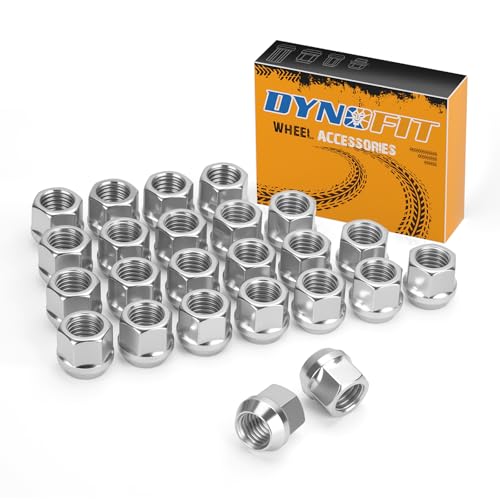

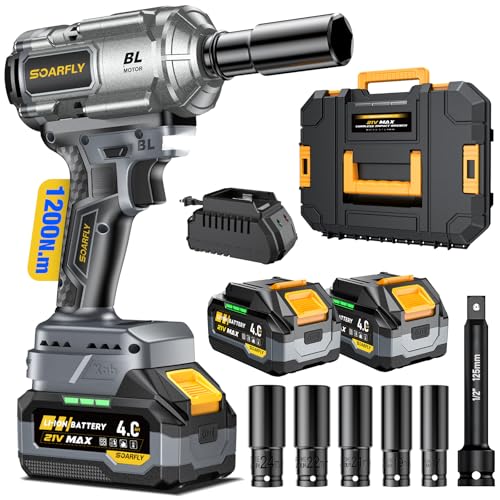
The thread-size marking identifies the diameter and thread pitch of the wheel stud. It does not tell you the correct torque by itself.
For example, M14 x 1.5 means the threaded portion has a nominal 14 mm diameter and a 1.5 mm thread pitch. M12 x 1.5 uses a smaller 12 mm nominal diameter with the same 1.5 mm pitch.
Two vehicles with M14 x 1.5 hardware can still use different torque specifications. Ford’s 2022 F-150 uses M14 x 1.5 at 150 lb-ft, while the 2023 F-150 online manual lists the same nominal thread size at 162 lb-ft.
Audible Premium Plus — Annual Membership
12 audiobook credits up front, plus the full Audible catalogue.
See Annual Plans As an Amazon Associate I earn from qualifying purchases.Use the thread size to confirm the hardware, then use the exact Ford specification for your model year to set the torque wrench.
How to Torque Ford Lug Nuts in 5 Steps
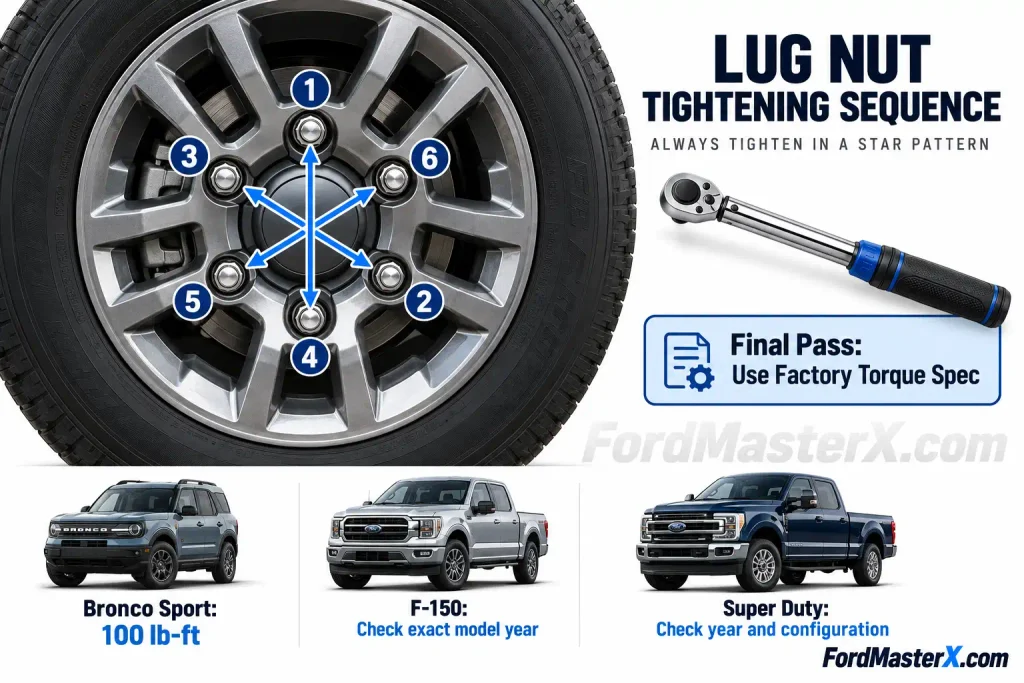
Correct torque depends on both the number and the installation method. Ford specifically warns that corrosion or debris between the wheel and hub can prevent proper metal-to-metal contact and allow the wheel nuts to loosen.
- Confirm your torque specification. Match the Ford model, model year, and factory wheel hardware before setting the torque wrench.
- Clean the mounting surfaces. Remove visible corrosion, loose material, and dirt from the wheel pilot bore, hub, and mating surfaces.
- Start every lug nut by hand. This reduces the chance of cross-threading and helps seat the wheel evenly.
- Tighten the lug nuts progressively. Use a crossing or star sequence rather than fully tightening one lug nut before the others.
- Finish with a calibrated torque wrench. Set the wrench to the Ford specification for your exact application and make the final pass with the wheel properly seated.
Ford states that its listed torque figures apply to nut and bolt threads that are free of dirt and rust. The company also recommends using the correct Ford replacement fasteners when replacement is required.
Do not automatically lubricate wheel stud threads before torquing them. Some specialized Super Duty hardware has separate lubrication instructions for the interface between a two-piece nut and washer, while Ford specifically says not to put that oil on the stud or nut threads.
When Should You Retorque Ford Lug Nuts
Recommended Best Deal Products


Many modern Ford owner manuals instruct owners to retighten the lug nuts within 100 miles or 160 km after a wheel disturbance. A wheel disturbance includes tire rotation, replacing a flat tire, or removing and reinstalling a wheel.
This second torque check matters because the wheel and fasteners can settle after installation. Use the same verified torque specification for the recheck.
Dual-rear-wheel Super Duty applications can have extra requirements. Ford documentation calls for retorquing applicable DRW wheel nuts at 100 miles and again at 500 miles after new vehicle operation or wheel disturbance.
Follow the owner manual supplied with your exact truck when its instructions differ from the general guidance above.
When Factory Ford Torque Specs May Not Apply
The values in this Ford lug nut torque chart are intended for factory-style Ford wheel hardware. Modified wheel systems can require different procedures.
Aftermarket Wheels
An aftermarket wheel manufacturer may specify its own lug nut type, seat design, and installation procedure. Follow those requirements when they differ from the factory wheel setup.
Aftermarket Lug Nuts and Studs
Changing studs or lug nuts can change the hardware being tightened. Confirm that the replacement parts are designed for your wheel and hub before relying on the original specification.
Wheel Spacers and Adapters
Wheel spacers and bolt-pattern adapters introduce another set of fasteners between the hub and wheel. Follow the manufacturer’s torque procedure for those fasteners instead of treating them as factory Ford lug nuts.
Damaged or Corroded Hardware
A higher torque setting does not repair damaged threads. Replace damaged wheel studs, deformed lug nuts, or badly corroded hardware with the correct replacement parts.
Conflicting Specifications
Use the original owner manual supplied with the vehicle as the primary reference when an online specification conflicts with your exact truck. Ford itself notes that its current online owner-manual information can differ from the printed manual originally supplied with a vehicle.
Five Key Ford Lug Nut Torque Rules
Use the exact model and model year before choosing a torque value. Then confirm the wheel hardware if the truck or SUV has modified wheels, replacement studs, spacers, or non-factory lug nuts.
Factory Ford torque values assume properly installed hardware and clean threads. Tighten progressively, make the final pass with a torque wrench, and complete Ford’s required retorque check after the wheel has been disturbed.
Most importantly, do not assume every F-150, Super Duty, Bronco, or other Ford shares the same specification. Small changes between generations can change the correct torque.
Ford Lug Nut Torque FAQ
What Is the Lug Nut Torque for a Ford F-150
Many 2015 through 2022 F-150 references specify 150 lb-ft or 204 Nm with M14 x 1.5 fasteners, but you should verify your exact year. Ford’s online 2023 F-150 documentation lists 162 lb-ft or 220 Nm, showing that one number should not be applied across every year.
What Is the Lug Nut Torque for a Ford F-250
The answer depends on the model year and wheel configuration. Earlier Super Duty references can specify 165 lb-ft or 224 Nm, while newer Ford documentation lists 150 lb-ft or 204 Nm for applicable M14 x 1.5 hardware.
Are All Ford Lug Nuts Torqued to 150 lb-ft
No. Ford uses different specifications across models. The Bronco Sport uses 100 lb-ft, the 2025 Maverick uses 148 lb-ft, and many F-150 applications use 150 lb-ft.
Should Ford Lug Nuts Be Retorqued After Tire Rotation
Yes, many current Ford manuals instruct owners to retighten the lug nuts within 100 miles or 160 km after tire rotation, wheel removal, or changing a flat tire. Check your model-year manual because specialized applications can require an additional retorque.
Can I Use Factory Torque With Aftermarket Wheels
Only when the aftermarket wheel and fastener manufacturer confirms that the factory specification still applies. Different wheel seats, lug nuts, studs, spacers, or adapters can require a different installation procedure.
Use the Correct Ford Torque Before Driving
A Ford lug nut torque chart is useful only when the torque value is matched to the correct model, model year, and wheel hardware. Ford specifications range substantially across its lineup, so a generic number is not reliable enough for every truck or SUV.
Check your exact application, clean the wheel and hub mounting surfaces, tighten the lug nuts evenly, and finish with a torque wrench. After wheel removal or tire rotation, follow the retorque interval in your Ford owner manual before considering the job complete.