Ford F-350 Fuel Tank Capacity: Size by Bed & Engine Type

The Ford F-350 fuel tank capacity is primarily determined by the truck’s wheelbase, ranging from 34 to 48 gallons. While short-bed models typically feature a 34-gallon tank, the long-bed Crew Cab configurations offer a 48-gallon capacity to maximize towing range.
🎯 Key Takeaways


- Short bed (6.75′) F-350 models typically feature a 34-gallon fuel tank.
- Long bed (8′) Crew Cab models offer the maximum 48-gallon factory tank.
- Fuel capacity is determined by wheelbase length rather than engine displacement.
- Diesel-equipped F-350s include a separate DEF tank ranging from 5 to 7.5 gallons.
- Chassis Cab models offer unique dual-tank configurations up to 66.5 gallons.
The Ford F-350 fuel tank capacity typically ranges from 29 gallons to 48 gallons, depending on your truck’s wheelbase, bed length, and engine type. For most modern owners, the most common sizes you will encounter are the 34-gallon tank found in standard-bed models and the massive 48-gallon tank reserved for long-bed Crew Cabs. If you are driving an older model or a specialized Chassis Cab, those numbers can shift down to 26 or up to 40 gallons for aft-of-axle configurations.
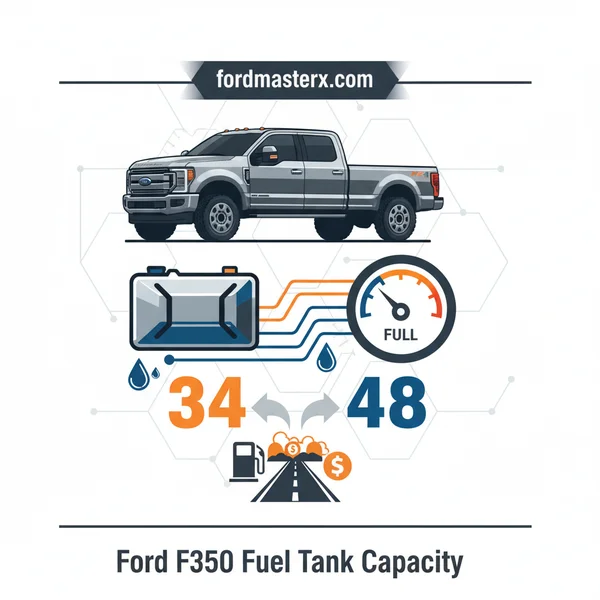
Understanding these specific volumes is more than just trivia; it is vital for calculating your range while towing heavy loads. When you are pulling a fifth-wheel or a gooseneck trailer, your fuel economy drops significantly. Knowing whether you have 34 or 48 gallons available dictates whether you can bypass a crowded, expensive gas station for a cheaper one 100 miles down the road. This guide breaks down the exact capacities so you can plan your stops with confidence.
Breakdown of F-350 Fuel Tank Sizes by Bed Length


The physical length of your truck’s frame is the biggest determining factor for fuel capacity. Ford utilizes the space between the frame rails to mount the fuel tank. Because a long-bed truck has a longer wheelbase, it provides more linear space for a larger, elongated tank. If you are shopping for an F-350 or trying to identify your own, look first at the bed length.

Standard Bed (6.75-foot) Configurations
The 6.75-foot bed is common on Crew Cab and SuperCab models. Because the wheelbase is shorter—typically 148 to 160 inches—the available real estate under the truck is limited. In almost all F-350 pickups from the 2017 model year to the present, the 6.75-foot bed comes standard with a 34-gallon fuel tank. This applies regardless of whether you have the SRW (Single Rear Wheel) or DRW (Dual Rear Wheel) setup, as the frame width remains the same.
Long Bed (8-foot) Configurations
When you step up to the 8-foot bed, the capacity increases significantly. The 176-inch wheelbase of a Crew Cab with an 8-foot bed allows Ford to fit their largest factory tank. For most 2017+ models, this is a 48-gallon tank. However, if you have a Regular Cab with an 8-foot bed, your capacity may still be limited to 34 gallons because the overall wheelbase is actually shorter than a Crew Cab standard bed. Here is a quick reference for modern F-350 pickup capacities:
- Regular Cab (8′ Bed): 34 Gallons
- SuperCab (6.75′ Bed): 34 Gallons
- SuperCab (8′ Bed): 34 Gallons (Gas) or 48 Gallons (Diesel in specific trims)
- Crew Cab (6.75′ Bed): 34 Gallons
- Crew Cab (8′ Bed): 48 Gallons
Comparing Diesel vs. Gasoline Fuel Tank Configurations
While bed length is the primary driver of size, the fuel type in your F-350 dictates how that fuel is stored and what other components are competing for space under the chassis. Diesel engines require emissions equipment that gasoline engines do not, which historically led to variations in tank size to accommodate the extra hardware.
The Impact of the Diesel Exhaust Fluid (DEF) Tank
If your F-350 has the 6.7L Power Stroke V8 Turbo Diesel, you have a DEF tank to consider. In modern Super Duty trucks, the DEF tank usually holds between 5 and 7.5 gallons. Ford engineers have designed the frame to house both the fuel tank and the DEF reservoir without sacrificing primary fuel capacity in most configurations. However, on older models (pre-2017), the presence of the DEF system sometimes forced the use of a 26-gallon or 29-gallon fuel tank on shorter wheelbase models. In current versions, the 34-gallon and 48-gallon standards remain the benchmark for diesel pickups.
Gasoline Engine Capacity Advantages
Gasoline F-350s, powered by the 6.2L, 6.8L, or 7.3L Godzilla V8, do not require DEF or heavy particulate filters. This often makes the under-truck packaging simpler. While the fuel capacities generally mirror the diesel versions for the sake of manufacturing consistency, gasoline owners often feel the “range anxiety” more acutely because gas engines typically have a lower range-per-gallon than diesel counterparts. For this reason, many gasoline F-350 buyers specifically seek out the 48-gallon long-bed configuration to compensate for the lower fuel density of gas.
Chassis Cab vs. Pickup Truck Differences
It is important to distinguish between a standard F-350 pickup and an F-350 Chassis Cab (the trucks often used for flatbeds or service bodies). Chassis Cabs have different frame rails and often use “aft-of-axle” tanks located behind the rear wheels.
- Standard Pickup: Mid-ship tank (located between the axles), usually 34 or 48 gallons.
- Chassis Cab: Often features a 40-gallon aft-of-axle tank.
- Dual Tank Option: Some Chassis Cab configurations allow for a combined capacity of up to 66.5 gallons by using both a mid-ship and an aft-of-axle tank.
Evolution of F-350 Fuel Capacity Across Recent Generations
The Ford F-350 has undergone significant changes over the last decade. As Ford transitioned to high-strength, military-grade aluminum bodies in 2017, they also re-evaluated how they utilized the space beneath the chassis. This shift allowed for better weight distribution and the introduction of larger fuel reservoirs to satisfy the demands of long-haul towers.
The 2017 Redesign Milestone
Before 2017, finding a tank larger than 37 gallons was a rarity unless you opted for an aftermarket solution. With the launch of the 4th generation Super Duty, Ford introduced the massive 48-gallon tank for long-wheelbase crew cab models. This was a game-changer for drivers who were tired of constant fuel stops while hauling heavy trailers across state lines. Some key changes during this evolution include:
- Transition to Polymer: Modern F-350s use high-density polyethylene tanks, which are lighter and more resistant to corrosion than older steel versions.
- Optimized Framing: The move to a fully boxed frame in recent generations provided more protected space for larger mid-ship fuel tanks.
- Engine Efficiency: While tanks got larger, the 6.7L Power Stroke Diesel also became more efficient, effectively doubling the driving range compared to trucks from the early 2000s.
Consistency in the 2023+ Models
The newest generation of the F-350 continues to prioritize range, especially for the High Output Diesel variants. Ford has maintained the 34-gallon standard for most configurations while keeping the 48-gallon “megatank” as the gold standard for the 176-inch wheelbase models. Even the 7.3L “Godzilla” gas engine benefits from these larger capacities, helping to offset its higher fuel consumption during heavy labor.
Factors Influencing Real-World Driving Range and Fuel Economy
Knowing your tank size is only half the battle. Your actual range—the distance you can travel before the “low fuel” light flickers—depends heavily on how you use your truck. An F-350 with a 48-gallon tank might go 700 miles while empty, but that number can drop drastically under pressure.
The Impact of Payload and Towing
Towing a 15,000-pound fifth-wheel trailer is the ultimate “fuel killer.” When you are maxing out your F-350’s capabilities, your miles per gallon (MPG) can easily be cut in half. For example, a diesel F-350 that averages 16 MPG on the highway might drop to 8 or 9 MPG when hitched to a heavy load. Always calculate your range based on your “towing MPG” rather than your unloaded average to avoid getting stranded between remote gas stations.
Driving Habits and Environmental Conditions
Your environment plays a massive role in how quickly you burn through those gallons. High winds, steep mountain grades, and extreme cold all force the engine to work harder. To maximize every drop in your tank, consider these practical tips:
- Monitor Your Idle Time: Super Duty trucks can burn significant fuel just sitting still, especially during remote starts in the winter.
- Maintain Proper Tire Pressure: Low pressure increases rolling resistance, which can shave 1-2 MPG off your trip.
- Use Cruise Control: On flat highways, maintaining a steady speed helps the engine stay in its most efficient power band.
- Watch the Turbo Boost: Heavy acceleration spikes fuel consumption; keeping the boost gauge low leads to much better range.
Conclusion
Understanding your Ford F-350’s fuel tank capacity is essential for both daily planning and long-distance hauling. Whether you have the standard 34-gallon tank in a short-bed gas model or the massive 48-gallon reservoir in a long-bed diesel, knowing your limits ensures you can focus on the job at hand rather than the fuel gauge. Remember that your engine type and wheelbase are the biggest factors in determining just how much fuel you can carry.
To get the most out of your truck, take a moment to verify your specific tank size using your VIN or owner’s manual, and always track your MPG during your first few hauls. This data will be your best friend when planning your next big trip. Now that you are powered up with the right information, it is time to hit the road and put that Super Duty to work!
❓ Frequently Asked Questions
Why does the F-350 long bed have a larger tank than the short bed?
The longer wheelbase of the 8-foot bed model provides more physical space along the frame rails, allowing Ford to install a larger 48-gallon tank compared to the 34-gallon tank in shorter models.
Can I upgrade my F-350 fuel tank to a larger aftermarket size?
Yes, many owners install aftermarket high-capacity replacement tanks from brands like S&B or Transfer Flow, which can increase capacity to over 60 gallons for extended range.
Does the F-350 Chassis Cab have different fuel tank options?
Yes, Chassis Cab models offer distinct configurations, including a 26.5-gallon mid-ship tank, a 40-gallon aft-of-axle tank, or a combined dual setup totaling 66.5 gallons.
What is the estimated driving range for an F-350 with a 48-gallon tank?
Depending on the load and engine type, a 48-gallon tank can provide a cruising range of approximately 400 to 700 miles per fill-up under normal driving conditions.
Has the fuel tank capacity changed for the 2023+ Ford F-350?
The 2023 and newer models largely maintain the standard 34-gallon and 48-gallon options found in the 2017-2022 generation for most consumer trims.
Does the F-350 Tremor package affect the fuel tank size?
No, the Tremor off-road package does not alter the fuel tank capacity; it follows the standard specifications based on the bed length and cab style of the donor truck.