How Does a Torque Multiplier Work? The Science Explained

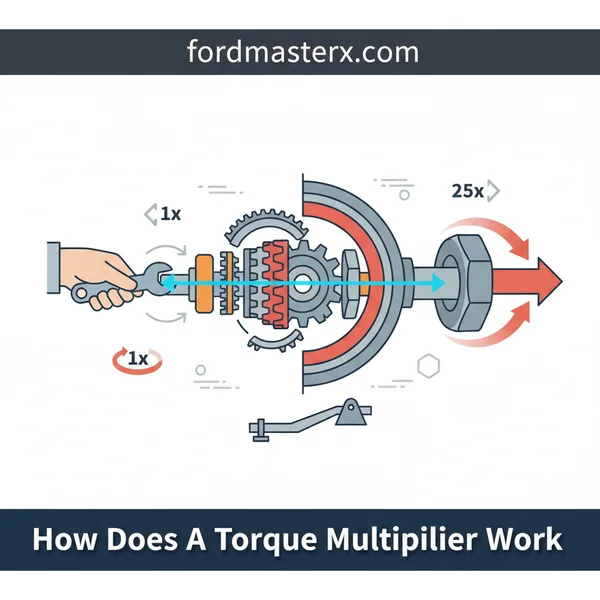
A torque multiplier works by using planetary gear systems to increase rotational force at the expense of speed. By utilizing multiple stages of gears and a stationary reaction arm, the tool allows a small input force to generate massive output torque for heavy-duty applications.
🎯 Key Takeaways


- Uses planetary gear sets to multiply input force efficiently.
- Trade-off involves high input rotations for low-speed output.
- A reaction arm is essential to stabilize the counter-torque.
- Internal gear ratios determine the exact multiplication factor.
- Ideal for confined spaces where long breaker bars won’t fit.
A torque multiplier works by using a complex series of planetary gears to trade rotational speed for mechanical advantage. In simple terms, it acts like a gearbox that allows you to input a small amount of manual force and receive a massive amount of output torque at the other end. This is not magic or “free” energy; it is the practical application of gear ratios that reduces the speed of the output shaft while simultaneously multiplying the force applied to the fastener.
This mechanism is critical because manual effort has its limits. When you are dealing with industrial bolts that require 3,000 foot-pounds of torque, a standard wrench would need to be dozens of feet long to be effective. The torque multiplier solves this by packing that mechanical advantage into a compact housing. It allows a single technician to exert thousands of pounds of pressure using a standard torque wrench, ensuring that heavy-duty bolts are tightened or loosened with precision and safety.
The Mechanical Heart: Understanding Planetary Gear Systems


The core of every torque multiplier is the planetary gear set. This arrangement is named for its resemblance to a solar system, where gears orbit a central point. To understand how the force is multiplied, you need to visualize how three distinct gear types interact within the tool’s housing. The harmony between these parts determines the final multiplication factor, often expressed as ratios like 5:1, 25:1, or even higher.
The Three Essential Components
Inside the multiplier, the mechanical work is distributed across three main parts. Each plays a specific role in maintaining the structural integrity of the tool while magnifying your input:
- The Sun Gear: This is the central gear located in the middle of the stack. It is directly connected to the input drive where you attach your wrench. When you turn your wrench, you are turning the sun gear.
- The Planet Gears: Usually, three or four smaller gears surround the sun gear. They are held in a “carrier” and mesh with the sun gear’s teeth. As the sun gear spins, it forces these planet gears to rotate and “walk” around the perimeter.
- The Ring Gear: This is the outer, internal-toothed gear that remains stationary. It acts as the track that the planet gears move along. Because the ring gear is fixed to the tool’s housing, it provides the necessary resistance to redirect the energy toward the output drive.
How Gear Ratios Create Power
The multiplication happens because of the difference in tooth counts between the input and output stages. In a typical 5:1 torque multiplier, the internal gearing is designed so that the input sun gear must complete five full rotations to move the output carrier one full rotation. By slowing down the output, the tool “concentrates” the energy. Imagine trying to push a heavy car; it is much easier to push it slowly over a long distance than to snap it into high speed instantly. The planetary gears allow you to perform “more work” over a longer rotational distance (more turns of your hand) to overcome the high resistance of the bolt.
Master Torque Multipliers in 7 Simple Steps


This guide provides a comprehensive breakdown of how a torque multiplier operates, from the internal planetary gear mechanics to the practical application of force on heavy-duty industrial fasteners. Understanding these steps is crucial for mechanics, engineers, and DIY enthusiasts who need to apply massive amounts of torque—often thousands of foot-pounds—without relying on dangerously long cheater bars or massive pneumatic tools. By following this walkthrough, you will learn how to safely amplify your physical input to tackle even the most stubborn bolts found on heavy machinery, truck wheels, and structural steel.
Step 1: Grasping the Planetary Gear Arrangement
What you need: A basic understanding of gear ratios and a visual diagram of a planetary gear set (optional but helpful).
Instructions: The heart of every torque multiplier is the planetary gear system. This consists of a central “sun gear,” multiple “planet gears” that rotate around it, and an outer “ring gear” that holds the assembly together. When you apply force to the input drive, you are rotating the sun gear. This sun gear then drives the planet gears, which are housed in a carrier. Because the planet gears are forced to walk around the stationary ring gear, they move much slower than the input sun gear but with significantly more force. This mechanical advantage is the core “magic” behind the tool, allowing a small input rotation to translate into a high-force output rotation at a reduced speed.
Pro Tip: Think of the torque multiplier as a transmission for your arm; you are trading speed (distance moved) for power (torque generated).
Step 2: Determining the Multiplier Ratio and Efficiency
What you need: The manufacturer’s specification sheet for your specific torque multiplier model.
Instructions: Every multiplier has a specific ratio, such as 3:1, 5:1, or even 25:1. This means if you apply 100 ft-lbs of torque to the input, a 5:1 multiplier should theoretically output 500 ft-lbs. However, you must account for friction loss within the gear teeth. Most high-quality multipliers are about 80% to 90% efficient. To calculate your actual output, use the formula: (Input Torque x Ratio) x Efficiency. For example, if your tool is 90% efficient with a 4:1 ratio, and you want 400 ft-lbs of output, you would actually need to apply roughly 111 ft-lbs of input torque rather than exactly 100.
Pro Tip: Always check if the manufacturer lists the “Effective Multiplication Ratio,” which already factors in the friction loss for simpler calculations.
Step 3: Positioning the Reaction Arm Securely
What you need: The torque multiplier unit and a solid, immovable anchor point near the fastener.
Instructions: Because of Newton’s third law—for every action, there is an equal and opposite reaction—the body of the torque multiplier will want to rotate in the opposite direction of the force you apply. The reaction arm is a heavy steel bar attached to the multiplier’s housing that prevents this rotation. You must find a sturdy “reaction point,” such as a neighboring bolt head, a frame rail, or a specialized reaction plate. Ensure the arm is seated flush against the surface and that the surface is strong enough to withstand the same amount of torque you are applying to the fastener. If the reaction arm slips or the anchor point fails, the tool can spin violently, causing severe injury.
Pro Tip: Never use your hand or foot as a reaction point; the forces generated can easily crush bones or sever digits.
Step 4: Connecting the Input and Output Drives
What you need: A calibrated torque wrench (input) and a heavy-duty impact socket (output).
Instructions: Start by placing the correct size heavy-duty impact socket onto the output square drive of the multiplier. Place this assembly onto the fastener you wish to tighten or loosen. Next, insert your manual torque wrench into the input female drive of the multiplier. It is vital that you use a manual torque wrench rather than a standard ratchet so you can precisely measure the amount of force you are introducing into the system. Ensure all connections are fully seated and that the square drives are not worn or rounded, as the high stress of multiplication can cause damaged drives to shatter under load.
Pro Tip: Use only high-quality “impact-rated” sockets on the output side, as chrome sockets are too brittle and can explode under high torque.
Step 5: Applying Smooth, Controlled Input Force
What you need: Steady physical pressure and a focused eye on your input torque wrench.
Instructions: Begin applying force to your torque wrench in a slow, steady motion. You will notice that you have to turn the wrench several full rotations just to see the output fastener move a small amount—this is normal. If you are using a 5:1 multiplier, you will rotate the input five times for every one rotation of the bolt. Avoid jerky movements or “bouncing” on the wrench, as this can create torque spikes that exceed the tool’s rated capacity. Listen for the “click” of your torque wrench if it is a preset type, or monitor the dial carefully. The reaction arm will press firmly into your anchor point; this is when the multiplication effect is fully engaged.
Pro Tip: Keep your body positioned away from the plane of the reaction arm in case the tool slips or the fastener shears off unexpectedly.
Step 6: Managing the Anti-Backlash Mechanism
What you need: A torque multiplier equipped with an internal ratchet or pawl (usually found on ratios 10:1 and higher).
Instructions: When working with very high ratios, the gears and the metal fasteners themselves begin to act like a spring, storing energy. This is known as “wind-up.” Without an anti-backlash mechanism, when you stop applying pressure to the input wrench, the system will want to “spring back,” potentially spinning the input wrench backward with dangerous force. Many multipliers include a directional pawl that holds the torque in place between strokes. If your tool has this, ensure it is set to the correct direction (tighten or loosen). If your tool does not have this, you must maintain constant pressure on the input wrench until the fastener is fully seated or loosened to a safe level.
Pro Tip: If the tool feels “springy,” you are likely dealing with significant wind-up; release the pressure slowly and carefully to avoid a sudden snap-back.
Step 7: Verifying Final Torque and Safe Removal
What you need: A calculator and a removal plan for the loaded tool.
Instructions: Once you have reached your target input value, stop. Verify your math one last time to ensure the output meets the fastener specifications. To remove the tool, you must first neutralize the stored energy (wind-up). Gently apply a small amount of pressure to the input wrench to release the anti-backlash pawl, then slowly back the wrench off until the tension in the reaction arm is gone. Once the reaction arm is loose and can be moved by hand, you can safely pull the torque multiplier off the fastener. Inspect the tool for any signs of gear binding or metal shavings, which could indicate that you exceeded the tool’s maximum rated capacity during the operation.
Pro Tip: Always store your torque multiplier in its protective case to prevent dust and grit from entering the gear housing, which can drastically reduce efficiency and tool life.
✅ Final Checklist
- Verified the specific gear ratio and efficiency factor of the tool before starting.
- Confirmed the reaction arm is braced against a solid, non-moving structural member.
- Ensured all sockets and extensions used are impact-rated for the expected load.
- Calculated the final output torque to ensure it does not exceed the bolt’s yield strength.
- Successfully released all “wind-up” tension before attempting to remove the tool from the work surface.
Important Notes:
- Safety Warning: Never exceed the maximum input torque rated by the manufacturer. Overloading the tool can cause catastrophic gear failure, resulting in flying metal shards.
- Professional Help: If you are working on critical structural components like bridge girders or aircraft engines, consult a certified lead technician to verify torque sequences.
- Estimated Time: 15–30 minutes per fastener depending on the ratio and access.
- Cost Range: Torque multipliers range from $150 for basic automotive sets to over $2,000 for industrial-grade high-ratio units.
The Physics of Torque: Input Rotation vs. Output Power
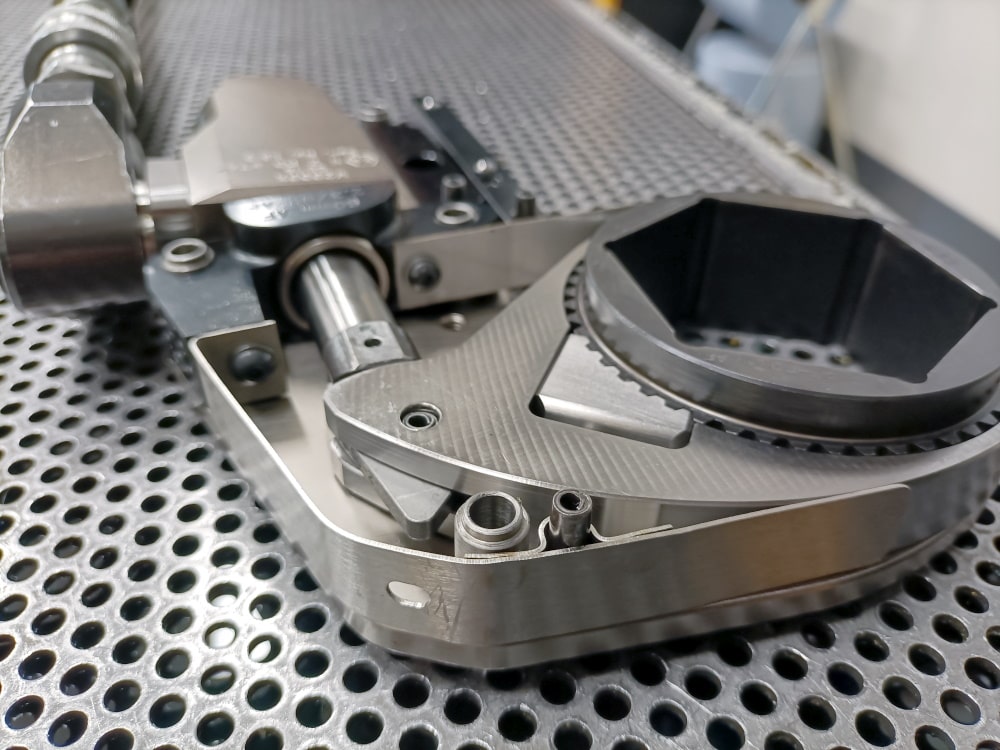
To understand the science behind a torque multiplier, you must look at the Law of Conservation of Energy. Physics dictates that energy cannot be created; it can only be transformed. In the case of this tool, you are transforming angular distance into rotational force. If you want the tool to put out more force than you put in, you must pay for that force by rotating the input handle many more times than the bolt actually turns.
The Speed-to-Power Trade-off
Every torque multiplier operates on a strict mathematical trade-off. If a tool has a 4:1 ratio, you will theoretically get four times the torque out, but the output drive will move four times slower than your hand. This is known as mechanical advantage. In a real-world scenario, if you need to reach 1,000 Nm of torque:
- You set your input wrench to 250 Nm (assuming a 4:1 ratio).
- You rotate your wrench through a 360-degree circle.
- The bolt only rotates 90 degrees (one-quarter of a turn).
- The “missing” distance is converted into the massive pressure required to stretch the bolt.
Accounting for Frictional Loss
While the gear ratio provides the theoretical multiplier, the physical reality involves friction. No mechanical system is 100% efficient. As the sun and planet gears mesh, a small amount of energy is lost to heat and surface friction. This is why a “true” 5:1 gear ratio might only yield a 4.8:1 or 4.5:1 effective torque increase. High-quality multipliers use needle bearings and specialized lubricants to minimize these losses, ensuring that the power you put into the handle is transferred as efficiently as possible to the fastener. When using these tools, professionals always check the actual multiplication factor provided by the manufacturer rather than relying solely on the gear count.
The Role of the Reaction Arm in Force Counter-Balancing
While the internal gears do the heavy lifting of multiplying force, the reaction arm is what makes the tool usable. Without it, the torque multiplier would simply spin in your hands. This component relies on Newton’s Third Law of Motion: for every action, there is an equal and opposite reaction. As the gears apply clockwise force to a bolt, the body of the tool wants to spin counter-clockwise with the same intensity.
Newton’s Third Law in Mechanical Application
The reaction arm serves as a stationary anchor. It transfers that opposite rotational force into a solid, unmoving object nearby. By bracing the arm against a structural frame or an adjacent nut, you neutralize the counter-force. This ensures that 100% of the mechanical advantage is directed into the fastener rather than back into the operator’s wrists.
Maximizing Stability and Anchor Points
Finding a secure “reaction point” is the most critical part of understanding the tool’s physics. If the anchor point is unstable or at a strange angle, the tool can slip, leading to inaccurate torque readings or equipment damage.
- Right-Angle Contact: For maximum accuracy, ensure the reaction arm meets the anchor point at a 90-degree angle.
- Solid Foundations: Only use structural steel or heavy machinery frames as anchor points; avoid using thin covers or electrical components.
- Extension Awareness: Using custom reaction arm extensions can change the leverage physics, often requiring recalibration of your torque calculations.
Factors Influencing Efficiency and Gear Ratio Accuracy
On paper, a 5:1 torque multiplier should turn 100 ft-lbs of input into 500 ft-lbs of output. However, the physical world is rarely that perfect. In reality, you might only get 475 ft-lbs. This discrepancy is due to mechanical efficiency, which is the measure of how much energy is lost as it moves through the planetary gear system.
Friction: The Silent Torque Thief
Every time gear teeth mesh, they generate friction. This friction creates heat and consumes a small percentage of the energy you provide. Most high-quality torque multipliers operate at about 90% to 95% efficiency. If you ignore this loss, you may end up under-tightening critical fasteners, which can lead to mechanical failure in heavy-duty applications like bridge construction or wind turbine maintenance.
The Difference Between Nominal and Actual Ratios
Manufacturers often provide two different ratios: the nominal ratio (the raw mathematical gear count) and the actual ratio (the ratio after accounting for frictional loss). Understanding this distinction is the secret to precision engineering.
- Lubrication Quality: The type of grease inside the gear housing significantly impacts efficiency. Cold or old grease increases drag.
- Gear Stage Count: Generally, the more gear stages a multiplier has (e.g., a 25:1 vs. a 5:1), the more efficiency is lost because there are more contact points.
- Wear and Tear: Burrs on gear teeth or debris in the housing will cause the actual ratio to drop over time, requiring professional servicing.
Conclusion
Understanding the science behind a torque multiplier transforms it from a “black box” tool into a precision instrument. By leveraging planetary gear sets, these tools allow a single operator to exert thousands of pounds of force with minimal physical strain. Remember that the reaction arm is your best friend for safety, and always account for a 5-10% efficiency loss when calculating your final torque output.
To get started, always verify your tool’s specific efficiency rating in the manufacturer’s manual before beginning a job. If you are working on high-stakes machinery, consider having your multiplier calibrated annually to ensure the gear ratios remain accurate. Ready to upgrade your toolkit? Look for a multiplier with a robust reaction arm and high-efficiency ratings to make your next heavy-duty project a breeze.
❓ Frequently Asked Questions
How do planetary gears multiply torque within the tool?
The input drive turns a central sun gear, which rotates multiple planet gears inside a stationary ring gear. This arrangement reduces the speed of the output shaft while significantly increasing the leverage and force applied to the bolt.
What is the significance of the gear ratio in a torque multiplier?
The gear ratio, such as 5:1, indicates how many times the input torque is multiplied. However, due to internal friction, the actual output is usually slightly less than the theoretical ratio, requiring a friction loss calculation.
Why is the reaction arm considered a safety feature?
The reaction arm absorbs the equal and opposite force generated during the torquing process. Without it, the tool would spin uncontrollably in the user’s hands, potentially causing severe injury or tool failure.
How does the law of conservation of energy apply here?
Energy is conserved because while the torque (force) increases, the distance (rotational speed) decreases. You are doing the same amount of work over a longer period, making it physically possible to move heavy loads.
Are there different types of torque multipliers for specific jobs?
Yes, they range from compact manual versions for tight spaces to heavy-duty multi-stage units for industrial plants. Some feature anti-backlash mechanisms to maintain tension between turns.
How much torque can these tools realistically handle?
Depending on the model and gear stages, torque multipliers can output anywhere from 1,000 to over 50,000 foot-pounds of torque. Always check the tool’s maximum capacity to prevent internal gear shearing.