Can You Mix Yellow and Orange Antifreeze? Risks & Results

No, you should generally avoid mixing yellow and orange antifreeze because their distinct chemical inhibitors (HOAT and OAT) often react poorly when combined. This mixture can lead to gelling or sludge formation, which clogs your radiator and can lead to catastrophic engine overheating.
🎯 Key Takeaways


- Mixing different chemistries can create thick, radiator-clogging sludge.
- Color is not a reliable indicator of coolant chemical compatibility.
- Yellow coolant is usually HOAT, while orange is typically OAT.
- Consult your owner’s manual for specific manufacturer coolant requirements.
- If accidentally mixed, perform a full system flush immediately.
You should avoid mixing yellow and orange antifreeze unless you are certain their chemical specifications are identical. While it is tempting to top off your reservoir with whatever bottle is on the shelf, the color of the fluid is often a secondary concern to the underlying chemistry. Mixing these two colors without verifying their formula usually leads to chemical incompatibility, which compromises your engine’s ability to regulate temperature effectively.
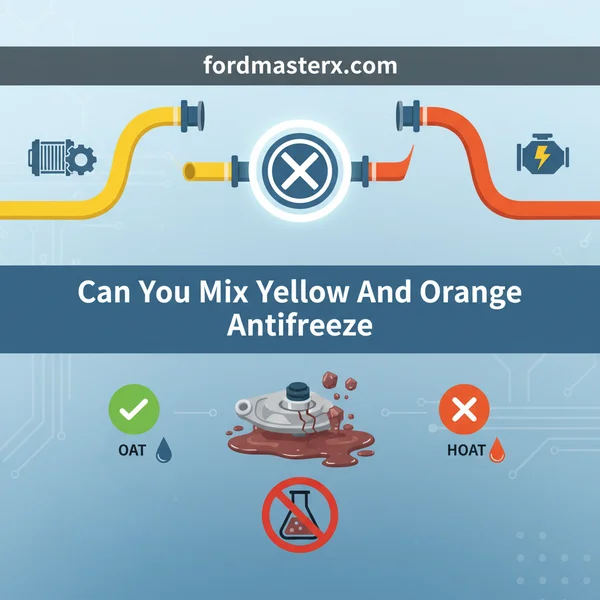
This matters practically because modern cooling systems are designed with very tight tolerances. The inhibitors in yellow and orange coolants are often formulated for specific metal alloys within your engine block, radiator, and heater core. When you mix incompatible formulas, these inhibitors can neutralize each other. This leaves your internal components vulnerable to rapid corrosion and can even lead to the total failure of your cooling system components in a surprisingly short amount of time.
Chemical Differences Between Yellow and Orange Coolant (OAT vs. HOAT)


The most critical thing to understand is that color is merely a dye added by manufacturers. The real difference lies in the additive package. Orange antifreeze is typically an Organic Acid Technology (OAT) formula, famously known as Dex-Cool in General Motors vehicles. Yellow antifreeze, however, is often a Hybrid Organic Acid Technology (HOAT) formula, which is common in many Ford, Chrysler, and European vehicles. These two technologies protect your engine using entirely different chemical philosophies.

The Inhibitor Clash
OAT coolants (orange) use organic acids to provide long-term protection for aluminum and nylon components. They do not contain silicates or phosphates. In contrast, HOAT coolants (yellow) use a combination of organic acids and a small amount of inorganic inhibitors, such as silicates or phosphates, to provide faster-acting protection. When you mix them, the chemicals do not simply “average out.” Instead, they can react and cause the inhibitors to drop out of the liquid solution, leaving your engine unprotected.
- Orange Coolant (OAT): Contains sebacate and 2-ethylhexanoic acid (2-EHA). It is designed for long service intervals but is slow to form a protective layer.
- Yellow Coolant (HOAT): Uses silicates to provide an almost immediate protective coating on metal surfaces.
- Chemical Reaction: Mixing these often causes the silicates in the yellow coolant to “fall out” of the mixture, creating a gritty residue.
- Service Life: Mixing different technologies significantly reduces the lifespan of the coolant, requiring a full system flush much sooner than expected.
Why Dye Color is Deceptive
You cannot rely on the “eye test” because different manufacturers use yellow and orange dyes for different purposes. Some “Universal” coolants are dyed yellow but use an OAT formula that might be compatible with orange OAT. However, many OEM-specific yellow coolants are strictly HOAT. If you pour a silicate-heavy yellow HOAT into an OAT-optimized orange system, you are essentially introducing contaminants that the system was never designed to handle. Always check the bottle for the specific ASTM or OEM performance specification rather than matching the color.
The Dangers of Sludge and Gelling in Your Cooling System


The primary physical consequence of mixing yellow and orange antifreeze is a phenomenon known as “gelling.” When the silicate inhibitors in HOAT (yellow) interact with the organic acids in OAT (orange), they can undergo a chemical precipitation. This process turns the liquid antifreeze into a thick, gelatinous sludge that looks like brown mud or “jello.” Once this sludge forms, it does not easily turn back into a liquid, even when the engine reaches operating temperatures.
How Gelling Destroys Components
Your cooling system relies on small, narrow passages to transfer heat away from the engine. This sludge acts like a clog in an artery. It naturally migrates to the areas with the lowest flow and the smallest openings, which are often the most critical parts of your car’s climate and cooling systems. Once the gel settles, it hardens over time, making it nearly impossible to remove without replacing the parts entirely.
- Heater Core Failure: The heater core has the narrowest tubes in the entire system. Sludge settles here first, leaving you with no heat in the cabin during winter.
- Radiator Clogs: The “fins” within your radiator become blocked by the gel, drastically reducing the surface area available for cooling.
- Water Pump Damage: The thick consistency of the gel creates mechanical strain on the water pump impeller and can cause the pump seal to leak or the shaft to snap.
- Thermostat Sticking: Gelling can coat the thermostat, causing it to stick in the closed position. This leads to immediate and catastrophic engine overheating.
The Cost of Chemical Incompatibility
If you catch the mistake early, a professional cooling system flush might save your vehicle. However, once the “mud” has circulated through the engine block, the labor costs skyrocket. You are no longer looking at a simple $100 fluid change; you are looking at thousands of dollars in repairs to replace the radiator, heater core, and water pump. The chemical reaction essentially creates a “corrosion soup” that eats away at gaskets and seals from the inside out, often leading to head gasket leaks that can effectively total an older vehicle.
Why Coolant Color Is Often a Misleading Compatibility Indicator
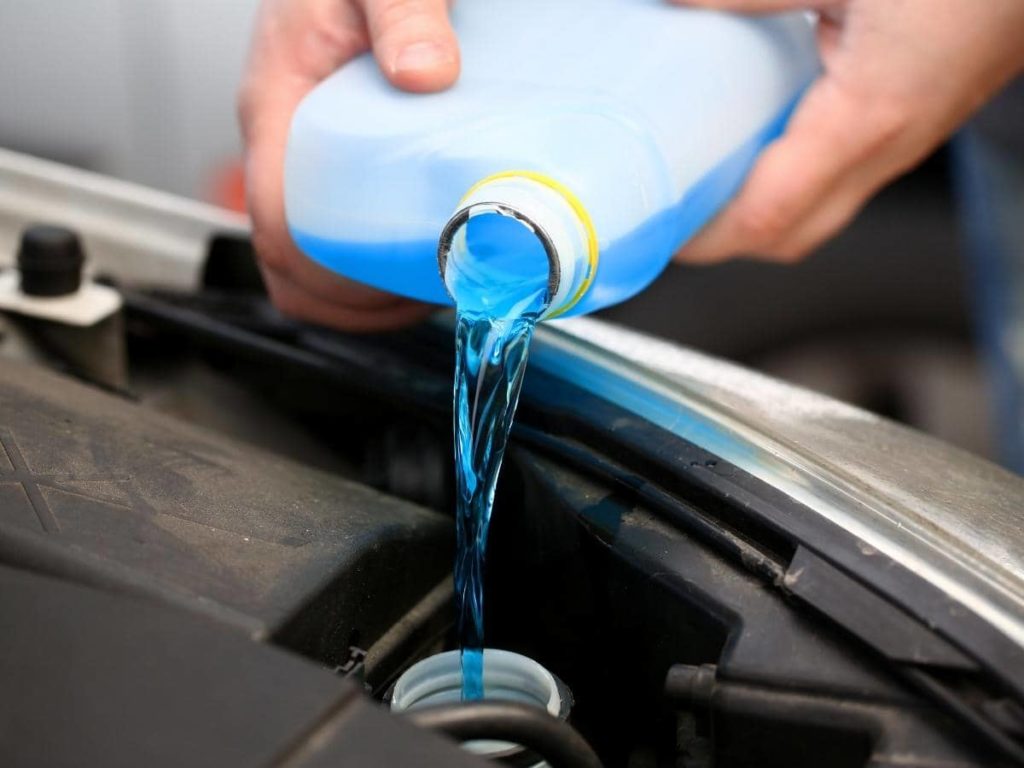
In the early days of automotive maintenance, choosing coolant was simple: green was for everyone. Today, the rainbow of options under the hood can be incredibly deceptive. While color is meant to help identify chemistry, there is no universal law requiring manufacturers to stick to a specific palette. This lack of standardization is exactly why grabbing a bottle based on sight alone is a risky move for your engine.
The Lack of Industry Standardization
There is a common misconception that all yellow coolants are the same. In reality, one brand’s yellow might be a Hybrid Organic Acid Technology (HOAT) formula, while another brand uses yellow dye for a Universal OAT formula. For example, modern Ford vehicles often use a specific “Yellow” coolant (P-OAT) that is chemically distinct from the “Gold” (HOAT) used in older models. If you mix these based on their similar golden-yellow hues, you are actually mixing two different chemical packages that may not play well together.
Marketing vs. Chemistry
Coolant manufacturers often use dye as a branding tool rather than a technical specification. Some aftermarket “all-makes, all-models” fluids are dyed a pale yellow to look neutral, but their chemical makeup may still conflict with the orange OAT (like Dex-Cool) already in your system.
- Check the Label: Always look for the specific ASTM or manufacturer specification (like Ford WSS or GM 6277M) instead of the color.
- Dye Fading: Over time, heat and age can cause orange coolant to look yellow or brown, making visual identification almost impossible.
- The “Universal” Trap: Even if a bottle says “universal,” it may not meet the specific anti-corrosion requirements of your vehicle’s radiator materials.
Long-Term Consequences of Using Incompatible Antifreeze Formulas
The danger of mixing yellow and orange antifreeze isn’t usually immediate. Your car won’t explode the moment you turn the key. Instead, the damage happens silently over thousands of miles as the competing additives begin to clash. This chemical “war” under your hood eventually compromises the very system meant to protect your engine from melting down.
Chemical Fallout and “The Sludge Factor”
When incompatible chemistries meet, the most common result is precipitation. This occurs when the additives in the yellow and orange fluids react and “fall out” of the liquid solution, turning into a thick, jelly-like sludge. This brown goo settles in the lowest points of your cooling system, creating a nightmare for your engine’s internal circulation.
Premature Component Failure
Beyond just clogging the system, a chemical mismatch can lead to rapid physical degradation of your cooling components. The wrong mixture can become acidic or lose its ability to prevent cavitation (tiny air bubbles that implode and “pit” metal surfaces).
- Radiator Clogging: Sludge builds up in the narrow cooling fins, leading to hot spots and eventual overheating.
- Water Pump Damage: Solid particles in the coolant act like sandpaper, wearing down the water pump seals and leading to leaks.
- Heater Core Issues: The tiny passages in your heater core are usually the first to clog, leaving you without heat during the winter.
- Gasket Erosion: Improper pH levels caused by mixing can eat away at head gaskets and intake manifold gaskets over time.
Conclusion
While it might be tempting to top off your reservoir with whatever yellow or orange bottle is on the shelf, the risks far outweigh the convenience. Because color is not a reliable indicator of chemical compatibility, mixing these fluids can lead to expensive sludge buildup, clogged radiators, and damaged water pumps. Protecting your engine requires more than a visual match; it requires a chemical match.
Next Steps: First, always consult your owner’s manual to verify the exact coolant specification required for your vehicle. If you have already mixed different colors or are unsure what is currently in your system, the safest course of action is to perform a professional cooling system flush. Staying proactive now will save you from a massive repair bill down the road. Keep your cooling system clean, and your engine will thank you with years of reliable performance!
❓ Frequently Asked Questions
Why is the chemistry of yellow and orange antifreeze so different?
Orange antifreeze usually uses Organic Acid Technology (OAT) for long-life protection, while yellow is often Hybrid Organic Acid Technology (HOAT) containing silicates or phosphates. Mixing these creates a chemical conflict that cancels out corrosion protection and precipitates solids.
Can I top off my orange coolant with a small amount of yellow?
Even small amounts can destabilize the chemical balance, leading to ‘silicate drop-out’ or the formation of debris. It is always safer to use distilled water for a minor top-off than the wrong type of coolant if you are in an emergency.
How can I tell if my coolant has already started to gel?
Check the radiator or overflow tank (when cool) for a thick, muddy, or jelly-like consistency instead of a clear liquid. Other signs include a failing heater core or the engine running hotter than usual despite having enough fluid.
Are all yellow coolants the same chemical formula?
No, yellow dyes are used for various formulas including older IAT, modern HOAT, and some ‘Universal’ OAT variations. This variability is why reading the technical specifications on the back of the bottle is more important than the liquid’s color.
What is the typical cost of repairing damage from mixed antifreeze?
If gelling occurs, you may need to replace the radiator, heater core, and water pump, which can cost between $1,000 and $2,500. A professional system flush is significantly cheaper and should be done immediately if mixing occurs.
Does the age of the vehicle matter when mixing these coolants?
Yes, older vehicles with copper radiators react differently than modern aluminum systems, but mixing OAT and HOAT is dangerous for both. Modern engines have narrower cooling passages that are much more susceptible to clogging from chemical sludge.