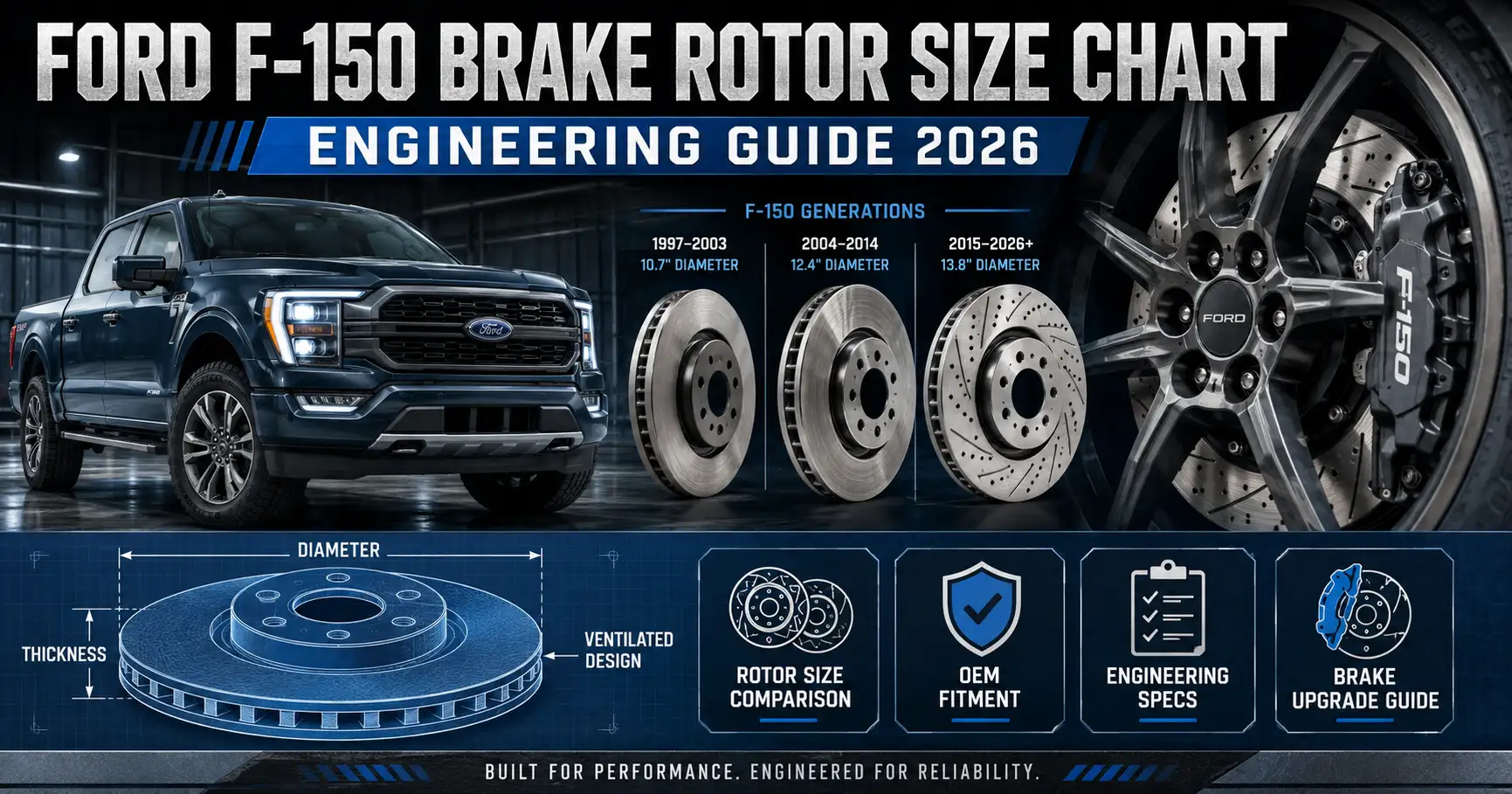
Ford F-150 Brake Rotor Size Chart and Engineering Guide 2026

The Ford F-150 dominates the global truck market, offering a staggering variety of trims, payloads, and towing configurations. This immense versatility makes sourcing exact replacement brake components uniquely challenging.
Depending on the specific generation, payload package, and parking brake mechanism, brake rotor dimensions vary drastically. Installing incorrectly sized rotors compromises vehicle safety and can cause immediate mechanical failure.
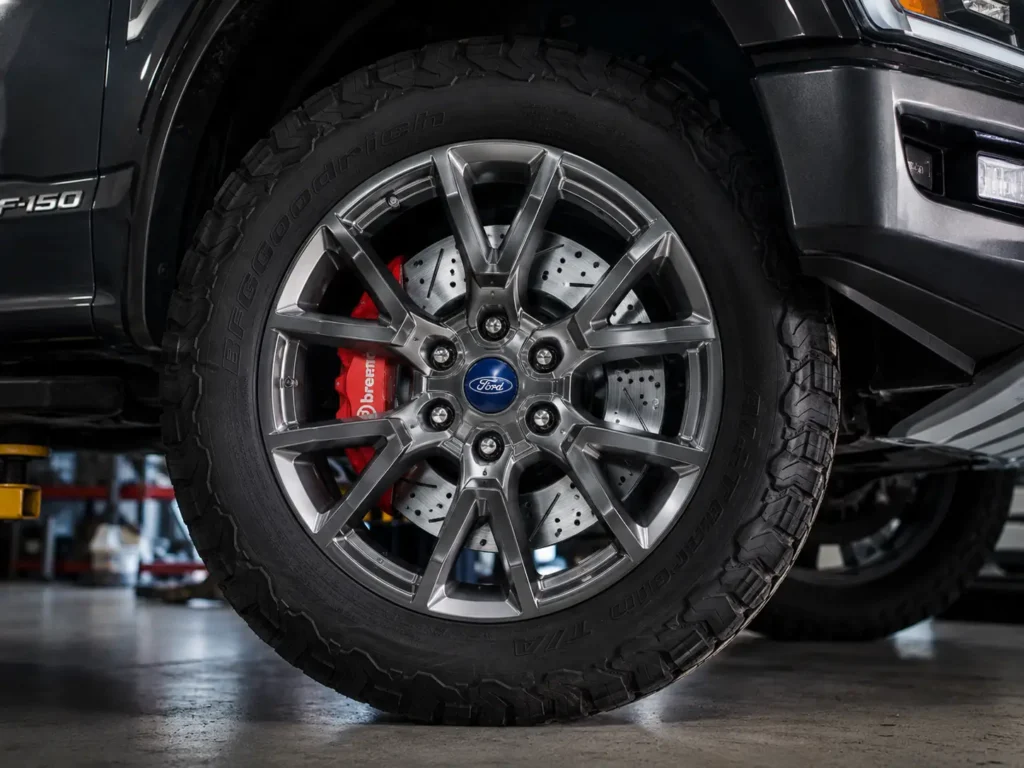
This exhaustive analysis provides a highly detailed Ford F-150 brake rotor size chart spanning the late 1990s through the current generation. The data synthesized here covers standard models, the off-road Raptor, the all-electric Lightning, and the rare 7-lug Heavy Duty variants.
Understanding these exact specifications is critical for safe vehicle operation and optimal thermal management. By leveraging the data below, truck owners and fleet managers can ensure flawless braking performance.
F-150 Brake Rotor Master Guide
Comprehensive sizing, generational evolution, and technical specifications for the optimal braking performance of America’s best-selling truck.
Core Braking Metrics (14th Gen)
Modern F-150s are heavier and tow more than ever. To combat extreme kinetic energy, standard rotor sizes have been standardized to massive dimensions across most modern trims.
Standard Front Rotor
Vented design for optimal heat dissipation during heavy towing.
Standard Rear Rotor
Solid or vented depending on Electric Parking Brake (EPB) configuration.
Standard Lug Pattern
Heavy Duty Payload Package (HDPP) models may feature a 7-lug variant in older generations.
Generational Size Evolution
As the F-150’s payload and towing capacities surged from the late 90s to today, braking hardware had to keep pace. Notice the significant jump in rotor diameter transitioning from the 10th Generation into the 11th Generation (2004).
Key Takeaway:
Since 2015, Ford has largely standardized the 13.8″ front / 13.7″ rear setup across most standard F-150 trims.
Braking Force Distribution
Why are front rotors inherently thicker and primarily vented? When a truck decelerates, weight transfers dramatically to the front axle. The front rotors handle the vast majority of the kinetic energy conversion.
Curb Weight vs. Required Stopping Power
This scatter plot illustrates the relationship between various F-150 trim curb weights and the immense kinetic energy (in Megajoules) the rotors must dissipate during a 60-0 mph panic stop.
The Master F-150 Rotor Size Reference
| Generation | Years | Front Diameter | Rear Diameter | Lug Pattern |
|---|---|---|---|---|
| 14th Gen | 2021-Present | 13.8″ (350mm) | 13.2″ / 13.7″ | 6x135mm |
| 13th Gen | 2015-2020 | 13.8″ (350mm) | 13.7″ (348mm) | 6x135mm |
| 12th Gen | 2009-2014 | 13.8″ (350mm) | 13.7″ (348mm) | 6x135mm / 7x150mm* |
| 11th Gen | 2004-2008 | 13.0″ (330mm) | 13.7″ (348mm) | 6x135mm / 7x150mm* |
| 10th Gen | 1997-2003 | 12.1″ (307mm) | 13.1″ (333mm) | 5x135mm |
* 7-lug configurations are specific to the Heavy Duty Payload Package (HDPP).
Rotor Upgrade & Measurement Protocol
1. Visual Inspection
Check for deep scoring, blueing (heat damage), or severe rust lips on the outer edge.
2. Measure Thickness
Use a micrometer. Discard if below the stamped minimum thickness (usually around 32mm front).
3. Select Replacement
Choose blank rotors for daily driving, or slotted/drilled for heavy towing and heat dissipation.
The Physics of Stopping a Half-Ton Truck
The primary function of a brake rotor is to act as a massive thermal sink. When brake pads clamp down on the spinning cast-iron disc, they convert the truck’s kinetic energy into extreme thermal energy.
The rotor must rapidly absorb this heat and dissipate it into the surrounding airflow to prevent brake fade. Heavier trucks naturally require larger rotors, as greater vehicle mass generates exponentially more kinetic energy at highway speeds.
Ford engineers meticulously specify rotor diameters based on the Gross Vehicle Weight Rating (GVWR) and maximum towing capacities of each trim. A base model XL requires vastly different thermal management than a Lariat equipped with the Max Trailer Tow Package.
Rotor thickness and internal venting structures are equally critical to this thermal exchange. Vented rotors feature internal cooling vanes that act as a centrifugal air pump, drawing cool air from the hub center and expelling it outward.
This continuous internal airflow prevents the cast iron from exceeding its thermal thresholds during prolonged, heavy braking. Solid rotors, which lack these internal vanes, are typically reserved for the rear axles of older generations where braking forces are lower.
Fourteenth Generation (2021-2026) Brake Specifications
The current fourteenth generation of the Ford F-150 introduces advanced electronic braking architectures and complex, trim-specific rotor sizing. The engineering tolerances for this generation are tighter than ever before.
Front brake rotors across all standard 14th-generation models maintain a uniform, massive diameter of 350mm, or roughly 13.78 inches. These robust front components utilize the standard 6-lug 135mm bolt pattern and are fully vented for maximum thermal efficiency.
Rear rotor sizing for the 2021-2026 models is entirely dependent on the specific factory towing configuration. This is where many owners purchase the incorrect replacement parts.
| Configuration | Front Rotor Diameter | Rear Rotor Diameter | Bolt Pattern | Front Venting | Rear Venting |
| Standard / Non-Max Tow | 350mm (13.78″) | 336mm (13.22″) | 6x135mm | Vented | Vented |
| Max Trailer Tow Package | 350mm (13.78″) | 350mm (13.78″) | 6x135mm | Vented | Vented |
| Police Responder / SSV | 350mm (13.78″) | 350mm (13.78″) | 6x135mm | Vented | Vented |
Trucks equipped with the standard or non-Max Tow/Haul package feature 336mm rear disc brakes. This sizing provides ample stopping power for daily commuting, payload hauling, and light-duty towing applications.
Conversely, trucks ordered with the Factory Max Tow/Haul Package receive upgraded 350mm rear rotors. This larger rear thermal mass is strictly required to manage the elevated temperatures generated when towing up to 14,000 pounds.
Proper identification of the vehicle’s tow package is mandatory before sourcing replacement rear rotors. Installing a 336mm rotor on a Max Tow caliper bracket will result in the brake pads missing the rotor friction surface entirely.
Thirteenth Generation (2015-2020) Brake Specifications
The transition to a military-grade aluminum-alloy body in 2015 significantly reduced the F-150’s curb weight. However, Ford wisely maintained massive brake rotors to ensure maximum safety and towing dominance.
Front rotors for this era measure identically to the current generation at 350mm. The center hub bore remained standardized at 87.1mm, paired securely with the familiar 6x135mm bolt pattern.
Rear brake specifications for the 13th generation introduce a critical split based entirely on the parking brake mechanism. This nuance causes massive confusion in the aftermarket parts industry.
| Configuration | Front Rotor Diameter | Rear Rotor Diameter | Bolt Pattern | Parking Brake Type |
| Standard Payload (Manual PB) | 350mm (13.78″) | 348mm (13.70″) | 6x135mm | Mechanical Drum-in-Hat |
| Standard Payload (Electric PB) | 350mm (13.78″) | 348mm (13.70″) | 6x135mm | Electronic Caliper Motor |
Ford utilized rear rotors measuring roughly 348mm across the entire generation. However, the physical hat offset and internal drum dimensions differ significantly between models with a manual parking brake and those with the Electric Parking Brake (EPB).
The manual parking brake system utilizes mechanical brake shoes that press against the inside of the rotor hat. The EPB system relies on an electric motor mounted directly to the brake caliper to compress the primary brake pads.
Installing an EPB-designated rotor on a manual parking brake truck will result in catastrophic interference and complete system failure. The EPB system became increasingly standard on higher trims like the Lariat and Platinum.
Base XL and XLT models often retained the mechanical foot pedal, especially in the earlier years of the generation. Technicians must physically verify the parking brake type in the cabin before servicing the rear axle.
Twelfth Generation (2009-2014) Brake Specifications
The 2009-2014 F-150 represented a period of broad stabilization for Ford’s braking architecture. The parts interchangeability during this generation is much simpler than modern iterations.
Standard front rotors for this generation measure 350mm and are fully vented with cooling vanes. These components bolt to the standard 6x135mm hub, which had become the universal standard for non-heavy-duty light trucks in Ford’s lineup.
Rear rotors for the 12th generation measure 348mm and are completely solid, lacking the internal cooling vanes found on the front axle. This is a critical distinction from later generations.
| Configuration | Front Rotor Diameter | Rear Rotor Diameter | Bolt Pattern | Front Venting | Rear Venting |
| Standard Payload | 350mm (13.78″) | 348mm (13.70″) | 6x135mm | Vented | Solid |
| Heavy Duty Payload (HDPP) | 350mm (13.78″) | 348mm (13.70″) | 7x150mm | Vented | Solid |
Because the front brakes handle approximately 70% of the vehicle’s stopping force, the rear solid rotors are mathematically sufficient for standard load distribution. Rear venting was deemed unnecessary for the base payload ratings of this era.
During this era, Ford continued to offer the elusive Heavy Duty Payload Package (HDPP) on select long-bed configurations. These specific work-oriented trucks utilized a completely different 7-lug wheel pattern.
The 7-lug rotors are entirely incompatible with standard 6-lug components. They require specialized aftermarket sourcing, as the central hub bore and stud spacing are uniquely oversized.
Eleventh Generation (2004-2008) Brake Specifications
The complete chassis redesign of the F-150 in 2004 brought significant improvements, but it featured slightly smaller front rotors compared to modern iterations.
Front brake rotors for the 2004-2008 standard models measure 330mm, or roughly 12.99 inches in diameter. This generation also marked the permanent shift from a 5-lug design to the modern 6x135mm bolt pattern for standard trucks.
A massive mechanical complication exists for 2-Wheel Drive (2WD) models during this specific generation. It drastically alters the brake replacement process.
| Drivetrain | Front Rotor Diameter | Rear Rotor Diameter | Hub Design | Bolt Pattern |
| 2-Wheel Drive (2WD) | 330mm (12.99″) | 348mm (13.70″) | Integrated Hub/Bearing | 6x135mm |
| 4-Wheel Drive (4WD) | 330mm (12.99″) | 348mm (13.70″) | Slip-on Rotor | 6x135mm |
On 2WD configurations, the front brake rotor and the wheel hub bearing are manufactured as a single, permanently integrated assembly. Replacing the front brake rotors on a 2WD 2004-2008 F-150 strictly requires purchasing and installing the entire hub and bearing assembly.
This manufacturing choice makes routine brake jobs significantly more expensive and labor-intensive for 2WD owners. The heavy spindle nut must be removed, and a new nut must be torqued precisely during reassembly.
On 4-Wheel Drive (4WD) models from the same era, the rotor is a traditional slip-on component that rests independently over the 4WD hub. Rear rotors for both 2WD and 4WD configurations measure 348mm and are separate from the axle shafts.
Tenth Generation (1997-2003) Brake Specifications
The 10th generation F-150 features some of the smallest brake components in the modern era, directly reflecting the much lighter curb weights of the late 1990s.
Front disc brakes measure just 308mm (12.12 inches), while the rear rotors measure 334mm (13.15 inches). This inverted sizing—where the rear rotor is physically larger in diameter than the front—is highly unusual in modern automotive engineering.
This generation utilizes a highly unique 5-lug bolt pattern measuring 5x135mm. This specific lug arrangement was only used from 1997 through 2003.
| Model Year Range | Front Rotor Diameter | Rear Rotor Diameter | Bolt Pattern | Wheel Stud Size |
| 1997 – Early 2000 | 308mm (12.12″) | 334mm (13.15″) | 5x135mm | 12mm |
| Late 2000 – 2003 | 308mm (12.12″) | 334mm (13.15″) | 5x135mm | 14mm |
It is entirely cross-incompatible with older 5×5.5-inch classic Ford wheels or newer 6-lug designs. Furthermore, mid-way through the 2000 model year, Ford transitioned the wheel stud thickness from 12mm to 14mm.
Purchasing rotors for a 1999 or 2000 F-150 requires physically verifying the lug nut size. A 19mm socket indicates older 12mm studs, while a 21mm socket indicates the upgraded 14mm studs.
Installing a rotor drilled for 14mm studs onto a 12mm hub will cause fatal high-speed vibrations. The excess clearance allows the heavy rotor to shift laterally under braking, potentially shearing the studs entirely.
High-Performance and Specialty Braking Systems
Ford F-150 Raptor Braking Specifications
The Baja-inspired Ford Raptor undergoes immense off-road abuse, necessitating highly robust thermal management. Desert running requires frequent, heavy braking that can easily warp inferior metals.
First and second-generation Raptors (2010-2020) utilize 350mm front rotors and 348mm rear rotors. While the dimensions match standard F-150s, the OEM Raptor rotors are cast from heavier high-carbon iron to prevent cracking under severe impact.
For the third-generation Raptor (2021-2026), Ford upgraded the rear brakes to a massive 350mm rotor. This perfectly balances the 350mm front rotors, providing exceptional stopping power when navigating steep, loose-terrain descents.
| Raptor Generation | Front Rotor Size | Rear Rotor Size | Bolt Pattern | Parking Brake |
| Gen 1 (2010-2014) | 350mm (13.78″) | 348mm (13.70″) | 6x135mm | Manual |
| Gen 2 (2017-2020) | 350mm (13.78″) | 348mm (13.70″) | 6x135mm | Electric (EPB) |
| Gen 3 (2021-2026) | 350mm (13.78″) | 350mm (13.78″) | 6x135mm | Electric (EPB) |
The third-generation Raptor also features the Electronic Parking Brake, matching the architecture of premium standard F-150 trims.
Aftermarket support for the Raptor is extensive, with companies like Alcon offering dedicated Big Brake Kits (BBK). These high-tier systems replace the factory 350mm cast iron units with massive 360mm heavy-duty assemblies and 6-piston calipers.
Such upgrades are virtually mandatory for Raptors running heavy optional 37-inch tire packages. The increased rotational mass of a 37-inch mud-terrain tire easily overwhelms the factory 350mm rotors during repeated panic stops.
Ford F-150 Lightning EV Specifications
The introduction of the all-electric Ford F-150 Lightning drastically altered the physics of stopping a full-size truck. Due to the massive lithium-ion battery packs, the Lightning tips the scales at over 6,000 pounds, requiring extreme stopping power.
Ford equipped the Lightning with 350mm front rotors and matching 350mm rear rotors to safely handle this immense curb weight. These are some of the thickest rotors ever mounted to a half-ton chassis.
Despite the heavy curb weight, the Lightning heavily relies on regenerative braking through its electric motors to decelerate. This magnetic resistance captures kinetic energy and feeds it back into the battery pack, doing the majority of the deceleration work.
| Lightning Model Year | Front Rotor Size | Rear Rotor Size | Bolt Pattern | Regenerative Braking |
| 2022 – 2025 | 350mm (13.78″) | 350mm (13.78″) | 6x135mm | Standard 4-Wheel |
Consequently, the physical cast-iron rotors experience far less mechanical wear than a traditional internal combustion F-150. Because the friction brakes are used so infrequently, the Lightning’s rotors are highly susceptible to severe rust and corrosion buildup.
Fully coated plain rotors are strongly recommended for the Lightning. Premium anti-corrosion coatings prevent degradation from the elements during prolonged periods of pure regenerative braking reliance.
The 7-Lug Heavy Duty Payload Package (7700 / HDPP)
One of the most confusing anomalies in the Ford F-150 lineage is the Heavy Duty Payload Package, previously known as the 7700 GVWR package. Offered periodically from 2000 to 2014, this package was designed for commercial buyers who needed near-F-250 capabilities in a half-ton frame.
The bolt pattern on these highly specific fleet trucks measures an unusual 7x150mm. Standard 6-lug rotors absolutely will not fit an HDPP truck under any circumstances.
Finding 7-lug replacement components is extremely difficult, as they are scarce in the traditional aftermarket. The 7-lug rotors are notably thicker and heavier to withstand commercial-grade thermal shock on job sites.
| HDPP Generation | Front Rotor Size | Rear Rotor Size | Bolt Pattern | Application |
| 2000 – 2003 (7700) | 308mm (12.12″) | 334mm (13.15″) | 7x150mm | Commercial Fleet |
| 2004 – 2014 (HDPP) | 350mm (13.78″) | 348mm (13.70″) | 7x150mm | Commercial Fleet |
Owners must physically count the lug nuts on their vehicle before ordering parts. Identifying an HDPP truck by the body style alone is practically impossible without running the VIN or checking the door jamb sticker.
The HDPP trucks boast payload capacities exceeding 3,000 pounds and GVWRs up to 8,200 pounds. The entire braking system, including the calipers and master cylinder, is upsized to safely halt this tremendous weight.
The Science of Rotor Upgrades: Drilled vs. Slotted vs. Coated
Choosing the correct aftermarket brake rotor dictates the truck’s thermal efficiency. Ford owners must select a rotor design that aligns with their driving habits, towing frequency, and local climate.
There is no universal “best” rotor; each design prioritizes different mechanical outcomes. Below is a comprehensive breakdown of the structural differences between drilled, slotted, and coated plain rotors.
| Rotor Type | Best Application | Heat Dissipation | Pad Wear Rate | Wet Weather Grip | Towing Suitability |
| Plain Coated | Daily Driving | Moderate | Lowest | Moderate | Good |
| Drilled | Street Performance | High | Moderate | Excellent | Poor (Cracking Risk) |
| Slotted | Heavy Towing / Fleet | High | High | Good | Excellent |
| Drilled & Slotted | Aggressive Street | Very High | High | Excellent | Moderate |
The Role and Risks of Cross-Drilled Rotors
Cross-drilled brake rotors feature cylindrical holes machined completely through the friction surface. These holes were originally developed in early motorsport to vent the highly volatile gases produced by older asbestos brake pads.
Today, modern ceramic and semi-metallic pads no longer produce these extreme gases. This shifts the primary benefit of drilled holes strictly to water evacuation and localized cooling.
During severe rainstorms, a thin film of water can build up between the brake pad and a solid rotor. This creates a dangerous hydroplaning effect that drastically delays stopping response.
The holes in a drilled rotor give water an immediate escape route, ensuring instantaneous pad bite in wet conditions. Furthermore, they shave rotational mass off the wheel hub, slightly improving steering response and fuel economy.
However, drilled rotors possess severe structural weaknesses that make them entirely unsuitable for heavy towing. The drilled holes act as microscopic stress risers within the iron grain structure.
Under the extreme thermal expansion of towing a heavy trailer down a grade, microscopic cracks will quickly propagate between the holes. Once a rotor cracks, it is completely compromised and poses an immediate, catastrophic safety hazard. For quality replacement components, reputable suppliers like PowerStop offer drilled options designed strictly for street use.
The Superiority of Slotted Rotors for Towing
Slotted rotors feature shallow, machined grooves that sweep across the friction face. Unlike drilled holes, these slots do not penetrate the internal cooling vanes, thereby perfectly preserving the structural integrity of the cast iron.
For F-150 owners who regularly tow RVs, boats, or heavy equipment, slotted rotors are universally recognized as the optimal engineering upgrade. They provide the thermal benefits of a modified rotor without the cracking risks.
The primary function of the slot is to act as a continuously sweeping blade that cleans the surface of the brake pad. As pads overheat under heavy loads, they can “glaze” over, creating a hard, glassy surface that dramatically reduces friction.
Slotted rotors scrape away this glazed material millisecond by millisecond, ensuring fresh friction material is always exposed to the iron. The venting provided by slotted rotors is the main defense against terrifying brake fade.
The only notable drawback to slotted rotors is an accelerated rate of brake pad wear. Because the slots actively shave the pad surface, owners can expect to replace brake pads slightly more frequently. Additionally, the aggressive sweeping action can create a faint whirring noise during hard deceleration, which is perfectly normal.
Plain Coated Rotors: The Daily Driving Standard
For the vast majority of F-150 owners who use their trucks for daily commuting and light hauling, plain coated rotors remain the most practical and reliable choice. Plain rotors offer the absolute maximum surface area for the brake pad to clamp against.
This massive unbroken surface area ensures quiet, consistent, and highly predictable stopping power. The introduction of Geomet and electrophoretic anti-corrosion coatings has revolutionized plain rotors in recent years.
High-quality coated rotors treat the central hat and the internal cooling vanes with a powerful rust-preventative layer. This coating ensures the internal vanes do not clog with rust flakes over time, maintaining optimal thermal airflow for the life of the rotor.
Plain coated rotors are also exceptionally resistant to cracking and warping because they contain no structural voids. They represent the best long-term financial value, as they are gentle on brake pads and generally cost 30% to 70% less than specialized drilled or slotted variants.
Debunking the Myth of “Warped” Brake Rotors
One of the most persistent misconceptions in the automotive industry is the concept of a “warped” brake rotor. When an F-150 experiences severe steering wheel judder or brake pedal pulsation, mechanics and owners frequently assume the cast iron rotor has physically bent or distorted like a potato chip.
Metallurgical science proves this is highly inaccurate. Cast iron brake rotors are manufactured at temperatures far exceeding anything achievable by a passenger truck braking system.
True physical warping of an F-150 rotor would require an unimaginable thermal event that would melt the surrounding aluminum caliper long before bending the iron. The vibration is actually caused by a microscopic phenomenon known as “uneven pad material transfer”.
The Mechanics of Cementite Formation
When brake pads are overheated during a steep descent or heavy towing, the friction material becomes semi-fluid. If the driver comes to a complete halt and holds the brake pedal down firmly, a microscopic layer of the overheated pad material fuses directly to the hot rotor surface.
This creates an invisible high spot of hardened friction material. As the wheel continues to spin, the brake pad impacts this raised high spot on every single revolution.
Over time, the intense localized heat at this specific patch transforms the underlying cast iron into an exceptionally hard crystalline structure called “cementite”. The cementite patch wears down much slower than the rest of the rotor, eventually creating a severe physical thickness variation.
It is this thickness variation—not a physical bend in the metal—that violently kicks the brake pads back and forth. This lateral kicking vibrates the brake fluid, which travels up the lines and violently pulses the brake pedal and steering rack. The exact measurement of this variance is known in the industry as rotor runout.
Prevention Through Proper Bedding
The absolute primary defense against uneven pad transfer is properly “bedding in” new brake pads and rotors. Bedding is a controlled heating cycle that intentionally transfers a smooth, uniform layer of friction material across the entire rotor face.
Without this uniform foundation, the raw cast iron is highly susceptible to random, localized material deposits. A standard bedding procedure requires finding a safe, open stretch of road away from traffic.
The driver accelerates to 40 mph and applies moderate-to-aggressive brake pressure to slow the vehicle to 10 mph in rapid succession. This is done strictly without coming to a complete stop. This process is repeated five times.
The sequence is then duplicated from 35 mph down to 5 mph. Following these aggressive stops, the brake system will emit a strong odor of curing resin, which is entirely normal and expected.
The driver must then drive at a moderate speed for several minutes without touching the brakes, allowing the rotors to air-cool dynamically. This process fully cures the resin and practically eliminates the risk of future vibration. For detailed technical bulletins on brake bedding, consulting authoritative bodies like the NHTSA or OEM service manuals is highly recommended.
The Dangers of Improper Lug Nut Torque
Another leading cause of rotor failure on the Ford F-150 is the improper installation of lug nuts. Dealerships and tire shops frequently use pneumatic impact wrenches to aggressively hammer lug nuts onto the wheel studs.
This applies vastly unequal pressure across the hub flange, physically pinching and distorting the rotor hat against the axle bearing. Ford specifies a strict lug nut torque of 150 ft-lbs for all standard F-150 models from 2004 onwards.
Older 1997-2003 models utilize a 100 ft-lb torque specification. Lug nuts must always be tightened using a calibrated manual torque wrench in a crisscross, star pattern to ensure even distribution of force.
Failure to adhere to these torque specifications will almost guarantee brake pulsation within the first few thousand miles. Mechanics must also rigorously clean the wheel hub face with a wire brush before installing a new rotor.
Even a millimeter of rust scale trapped between the hub and the new rotor will cause lateral runout. This runout multiplies as it reaches the outer edge of the rotor, manifesting as a severe high-speed vibration.
Maintenance Imperative: The Electronic Parking Brake (EPB)
Servicing the rear brakes on modern Ford F-150s (2015-present) requires navigating the Electronic Parking Brake (EPB) module. Unlike traditional cable-driven parking brakes, the EPB utilizes a powerful electric actuator mounted directly on the rear brake caliper.
This electric motor physically drives a mechanical piston outward to lock the rear wheels when parked. Attempting to compress an EPB rear caliper using a traditional C-clamp will instantly shatter the internal electric gearing.
This mistake results in hundreds of dollars in damage and necessitates a complete caliper replacement. The truck’s internal computer must be commanded to retract the electric motor autonomously before any mechanical work begins.
This specific sequence is known as EPB Service Mode or Maintenance Mode. It effectively disables the automated parking brake safeguards.
Step-by-Step EPB Service Mode Activation
Activating Service Mode requires a very specific sequence of driver inputs. First, without starting the engine, turn the vehicle’s ignition to the “ON” accessory position.
Next, physically depress the accelerator pedal fully to the floor and hold it there. Simultaneously, press and hold the electronic parking brake switch downward in the “Release” position.
While holding both the gas pedal and the EPB switch downward, turn the ignition “OFF” and immediately back to the “ON” position within five seconds. The dashboard will illuminate a yellow ABS warning light.
A prompt reading “Park Brake Maintenance Mode” will appear on the digital cluster. The rear electric motors will audibly whir for several seconds as they fully retract the pistons back into the caliper housing.
Once the motors fall completely silent, the ignition can be turned off. The physical brake pads and rotors can now be swapped safely, and the calipers can be gently compressed with a standard tool.
Deactivating EPB Service Mode
After installing the new rear rotors and pads, the EPB system must be safely recalibrated. Turn the ignition back to the “ON” accessory position without starting the engine.
Depress the accelerator pedal fully to the floor and hold it firmly. Instead of pushing the EPB switch down, pull the EPB switch upward into the “Apply” position and hold it.
Turn the ignition “OFF” and then back to “ON” within five seconds. The rear motors will engage, pressing the new pads tightly against the fresh rotors to measure the new friction thickness.
The maintenance message will clear from the dashboard, confirming the system is fully operational. The vehicle is now safe to drive, and the parking brake will function normally.
FAQs
What is the minimum safe thickness for an F-150 brake rotor?
The exact minimum thickness dictates when a rotor becomes too structurally compromised to absorb heat safely. While it varies slightly by generation, modern front F-150 rotors typically have a discard thickness around 32.5mm. Rear rotors run naturally thinner, generally presenting a discard thickness around 22.5mm for the 350mm variants, and 18.5mm for the 336mm variants. If a rotor falls below this stamped threshold, it cannot be safely resurfaced on a brake lathe. It must be replaced immediately to prevent catastrophic thermal cracking under heavy loads.
Do aftermarket wheel spacers affect the F-150 lug pattern or braking performance?
High-quality, hub-centric wheel spacers do not change the vehicle’s native lug pattern; a 6x135mm truck remains a 6x135mm truck. However, adding massive spacers dramatically alters the suspension geometry and the scrub radius. This places vastly increased leverage and mechanical stress on the wheel bearings and brake components. If wide wheel spacers are utilized, heavy-duty slotted rotors are highly recommended to counteract the additional rotational mass and kinetic strain generated by the wider track width.
Can I install F-250 Super Duty rotors on my F-150 to improve braking?
Absolutely not. The Ford F-250 Super Duty utilizes an entirely different 8x170mm bolt pattern that will physically not align with an F-150 hub. Furthermore, the entire braking architecture, from the caliper mounting brackets to the brake master cylinder fluid displacement ratios, is mathematically incompatible. F-150 owners seeking Super Duty levels of stopping power must rely on dedicated aftermarket Big Brake Kits engineered specifically for the 6x135mm half-ton hub.
Why do my front F-150 brakes wear out twice as fast as the rears?
Under severe deceleration, the physical weight of the massive F-150 shifts violently forward onto the front suspension geometry. This intense weight transfer forces the front braking components to handle approximately 70% to 80% of the total vehicle stopping force. Consequently, the front 350mm vented rotors experience vastly higher thermal loads and friction degradation than the rear solid or vented components. It is entirely normal automotive physics to replace front brake pads twice for every one rear pad replacement cycle.
Is it safe to resurface or “turn” drilled and slotted rotors on a brake lathe?
Generally, no. Most standard automotive repair shops refuse to resurface drilled or slotted rotors because the aggressive grooves will chatter and break the delicate carbide cutting bits used on their commercial brake lathes. Attempting to machine a drilled rotor also risks worsening the microscopic stress risers around the drilled holes, promoting failure. High-performance drilled and slotted rotors should be treated as consumable items; once they reach their discard thickness or exhibit deep grooving, they must be discarded and replaced entirely with fresh iron.