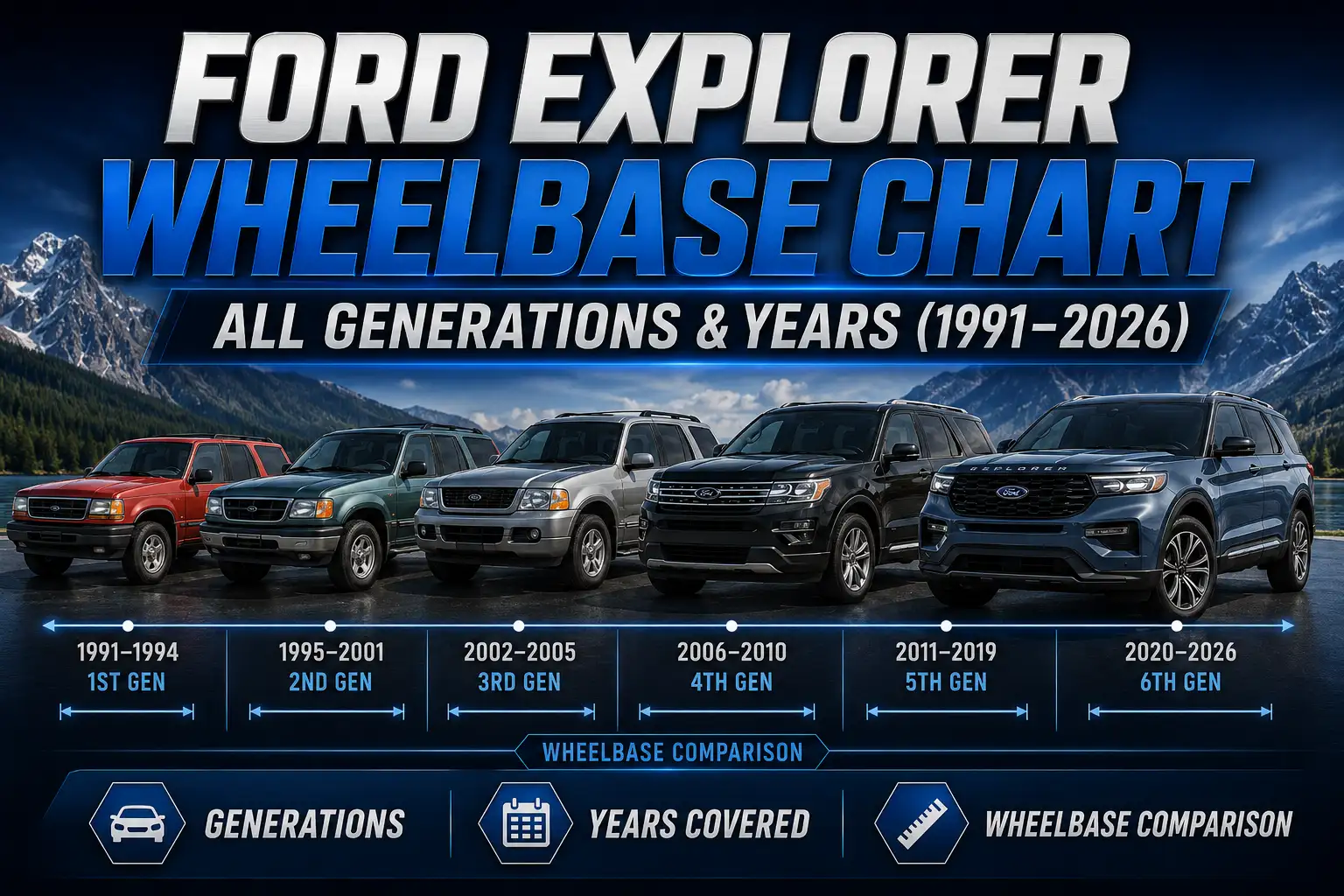
Ford Explorer Wheelbase Chart: All Generations & Years (1991–2026)

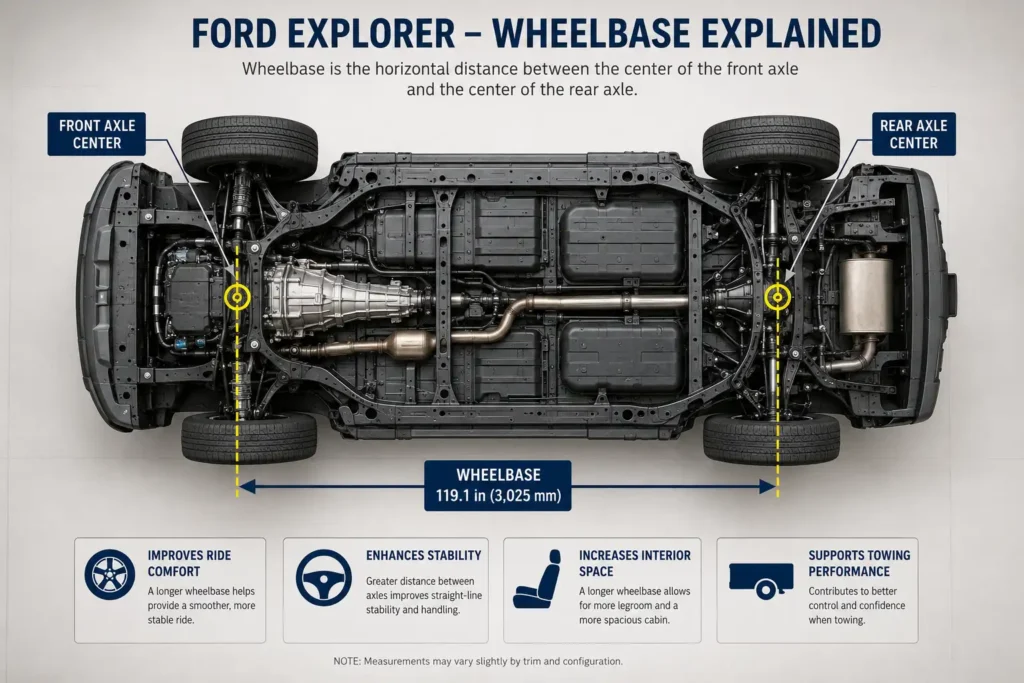
The Ford Explorer’s wheelbase ranges from 101.7 inches on early first- and second-generation short-wheelbase models to 119.1 inches on the current sixth-generation (2020–2026) Explorer. Wheelbase — the distance between the front and rear axles — directly affects towing stability, turning radius, and third-row room. The chart below covers every Explorer generation from 1991 through 2026, plus the Sport Trac and Police Interceptor Utility variants.
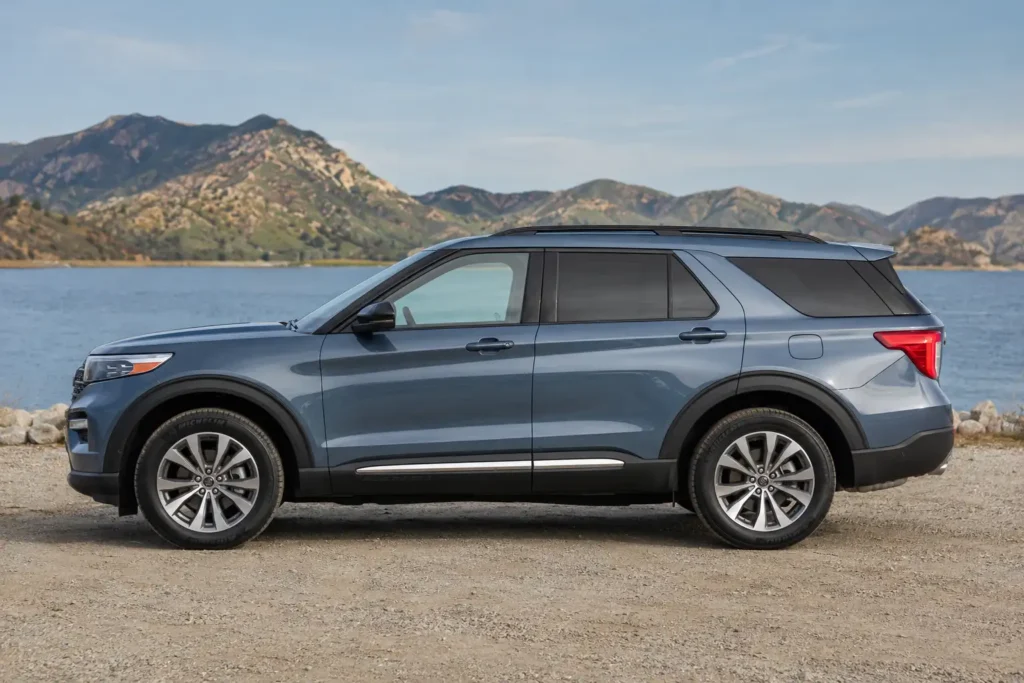
Ford Explorer Wheelbase Evolution
Six generations, 1991–2026

Prime for Young Adults — 6 Months Free
Students and 18–24s get six months of Prime free, then half price.
Start 6 Months Free As an Amazon Associate I earn from qualifying purchases.Data summary: Ford Explorer wheelbase by generation — 1st gen (1991-1994) 102.1 to 111.9 inches; 2nd gen (1995-2001) 101.7 to 111.6 inches; 3rd gen (2002-2005) 113.7 to 113.8 inches; 4th gen (2006-2010) 113.7 inches; 5th gen (2011-2019) 112.6 inches; 6th gen (2020-2026) 119.1 inches, the longest in Explorer history.
Ford Explorer Wheelbase by Generation (1991–2026)
Recommended Best Deal Products


| Generation | Model Years | Wheelbase (in) | Chassis Type |
|---|---|---|---|
| 1st Gen | 1991–1994 | 102.1–111.9 | Body-on-frame (Ranger-derived) |
| 2nd Gen | 1995–2001 | 101.7–111.6 | Body-on-frame |
| 3rd Gen | 2002–2005 | 113.7–113.8 | Body-on-frame, independent rear suspension |
| 4th Gen | 2006–2010 | 113.7 | Body-on-frame (carried over 3rd-gen platform) |
| 5th Gen | 2011–2019 | 112.6 | Unibody (first unibody Explorer) |
| 6th Gen | 2020–2026 | 119.1 | Unibody, RWD-based (CD6) platform |
Why the Explorer’s Wheelbase Changed So Much Across Generations
For its first four generations (1991–2010), the Explorer rode on a body-on-frame platform derived from the Ford Ranger. Wheelbase grew modestly over that span — from around 102 inches on early short-wheelbase trims to 113.7 inches once the third-generation redesign arrived in 2002 with independent rear suspension and a stretched frame.
That 113.7-inch figure carried through the fourth generation (2006–2010) essentially unchanged, since the 2006 refresh reused the third-gen frame with new sheet metal and a stronger chassis rather than a full platform change.
The biggest shift came in 2011. The fifth-generation Explorer abandoned body-on-frame construction entirely for a car-like unibody platform shared with the Ford Taurus, and wheelbase actually shrank slightly to 112.6 inches even as overall length grew — a byproduct of the unibody architecture repackaging the vehicle’s proportions.
The current sixth generation, introduced for 2020, reversed course again: Ford moved the Explorer to a new rear-wheel-drive-based unibody platform (shared with the Lincoln Aviator and Police Interceptor Utility), which pushed wheelbase up to 119.1 inches — the longest in the nameplate’s history and a full 6.5 inches longer than the 5th-gen model it replaced.
That extra wheelbase is a big part of why the current Explorer offers noticeably more third-row and cargo room than its predecessor. For a broader sense of where the Explorer sits size-wise against the rest of the lineup, see the Ford SUV Size Chart.
How Wheelbase Affects Explorer Towing and Handling
Recommended Best Deal Products


A longer wheelbase generally means a more stable tow platform. Distributing weight over a longer distance between the axles reduces pitching and trailer sway at highway speed, which is why the 6th-gen Explorer’s 119.1-inch wheelbase gives it a steadier feel behind a loaded trailer than the shorter 5th-gen model. The tradeoff is turning radius — a longer wheelbase means a wider turning circle, which matters in tight parking structures or off-camber trail switchbacks.
This isn’t unique to the Explorer. The same wheelbase-to-stability relationship shows up across Ford’s SUV lineup — shorter-wheelbase models like the 2-door Bronco are more prone to sway under load than longer-wheelbase trucks. If towing capacity by model year matters more to your decision than raw wheelbase, the Ford Explorer Towing Capacity Chart by Year breaks down exact ratings across generations.
Explorer Sport Trac and Police Interceptor Utility: Wheelbase Differences
Sport Trac. The second-generation Explorer Sport Trac (2007–2010), Ford’s crew-cab pickup variant built off the 4th-gen Explorer platform, rides on a 130.5-inch wheelbase — nearly 17 inches longer than the standard Explorer of the same years. That extension accommodates the pickup bed grafted onto the Explorer’s SUV cabin.

Audible — Listen Free for 30 Days
One free credit a month and thousands of titles included.
Listen Free for 30 Days As an Amazon Associate I earn from qualifying purchases.Police Interceptor Utility. The current PIU (2020–2025), based on the 6th-gen Explorer platform, shares the same 119.1-inch wheelbase as the civilian Explorer — confirmed by Ford’s own PIU technical specification sheet. There’s no wheelbase penalty or benefit for the police-spec chassis; the differences are in suspension tuning, brakes, and cooling, not dimensions. Owners cross-shopping a used PIU as a civilian project vehicle can reference Ford Explorer Sport Trac Years to Avoid for related generation-specific reliability context.
Ford Explorer Wheelbase vs Other Ford SUVs
Recommended Best Deal Products


| Model (2026) | Wheelbase (in) |
|---|---|
| Ford Bronco 2-Door | 100.4 |
| Ford Bronco Sport | 105.1 |
| Ford Escape | 106.7 |
| Ford Bronco 4-Door | 116.1 |
| Ford Explorer | 119.1 |
| Ford Expedition | 122.5 |
| Ford Expedition MAX | 131.5 |
The current Explorer sits roughly in the middle of Ford’s SUV lineup — longer than every compact and mid-size crossover Ford builds, but shorter than both Expedition variants.
Does Wheelbase Affect Tire and Lift Kit Fitment on the Explorer?
Wheelbase is not the spec that governs wheel or tire fitment — that’s determined by bolt pattern, offset, and track width (the side-to-side distance between wheels), not the front-to-rear axle distance. A common mix-up among Explorer owners shopping for aftermarket wheels is assuming wheelbase and bolt pattern are related; they aren’t. If you’re sourcing wheels or checking fitment across Explorer generations, check the Ford Bolt Pattern Chart instead — wheelbase won’t tell you whether a wheel will bolt on.
How to Identify Your Explorer’s Generation (If You’re Not Sure)
- Check the model year on your registration or title. Cross-reference it against the generation table above (1991–1994, 1995–2001, 2002–2005, 2006–2010, 2011–2019, or 2020–present).
- Decode your VIN. The 10th character of your VIN indicates model year — most VIN decoder tools (including Ford’s own) will confirm generation instantly.
- Look at the body style. Body-on-frame Explorers (pre-2011) have a visible frame rail underneath when viewed from the side; unibody Explorers (2011+) do not.
Once you know your generation, match it to the wheelbase figure in the table above.
The Bottom Line
Across 35 years and six generations, the Ford Explorer’s wheelbase has ranged from roughly 101.7 inches on the shortest early models to 119.1 inches on the current 2020–2026 generation — with the biggest jump coming in 2020, when Ford’s platform switch added over six inches versus the 5th-gen model. If you’re comparing tow ratings, cargo room, or handling across Explorer years, wheelbase is one of the clearest single numbers that explains why later generations feel steadier and roomier than earlier ones.
FAQ
What is the wheelbase of a 2024 Ford Explorer?
The 2024 Explorer, part of the 6th generation (2020–2026), has a 119.1-inch wheelbase — unchanged since the platform’s 2020 introduction.
Did the Explorer’s wheelbase change in 2020?
Yes. The 2020 redesign moved the Explorer to a new RWD-based platform, increasing wheelbase from 112.6 inches (5th gen) to 119.1 inches — a 6.5-inch jump.
Is the Explorer Sport Trac wheelbase different from the standard Explorer?
Yes, significantly. The 2007–2010 Sport Trac’s 130.5-inch wheelbase is nearly 17 inches longer than the standard 4th-gen Explorer’s 113.7 inches, due to its pickup bed extension.
How does Explorer wheelbase compare to the Ford Escape?
The 2026 Explorer’s 119.1-inch wheelbase is about 12.4 inches longer than the 2026 Escape’s 106.7 inches, reflecting the Explorer’s larger 3-row footprint.
Does a longer wheelbase mean a smoother ride?
Generally yes — a longer wheelbase tends to smooth out pitch over bumps and improve highway stability, though suspension tuning and tire choice also play a large role.
Audible Premium Plus — Annual Membership
12 audiobook credits up front, plus the full Audible catalogue.
See Annual Plans As an Amazon Associate I earn from qualifying purchases.Full wheelbase guide: Ford Wheelbase Chart (Every Model, 2011–2026)