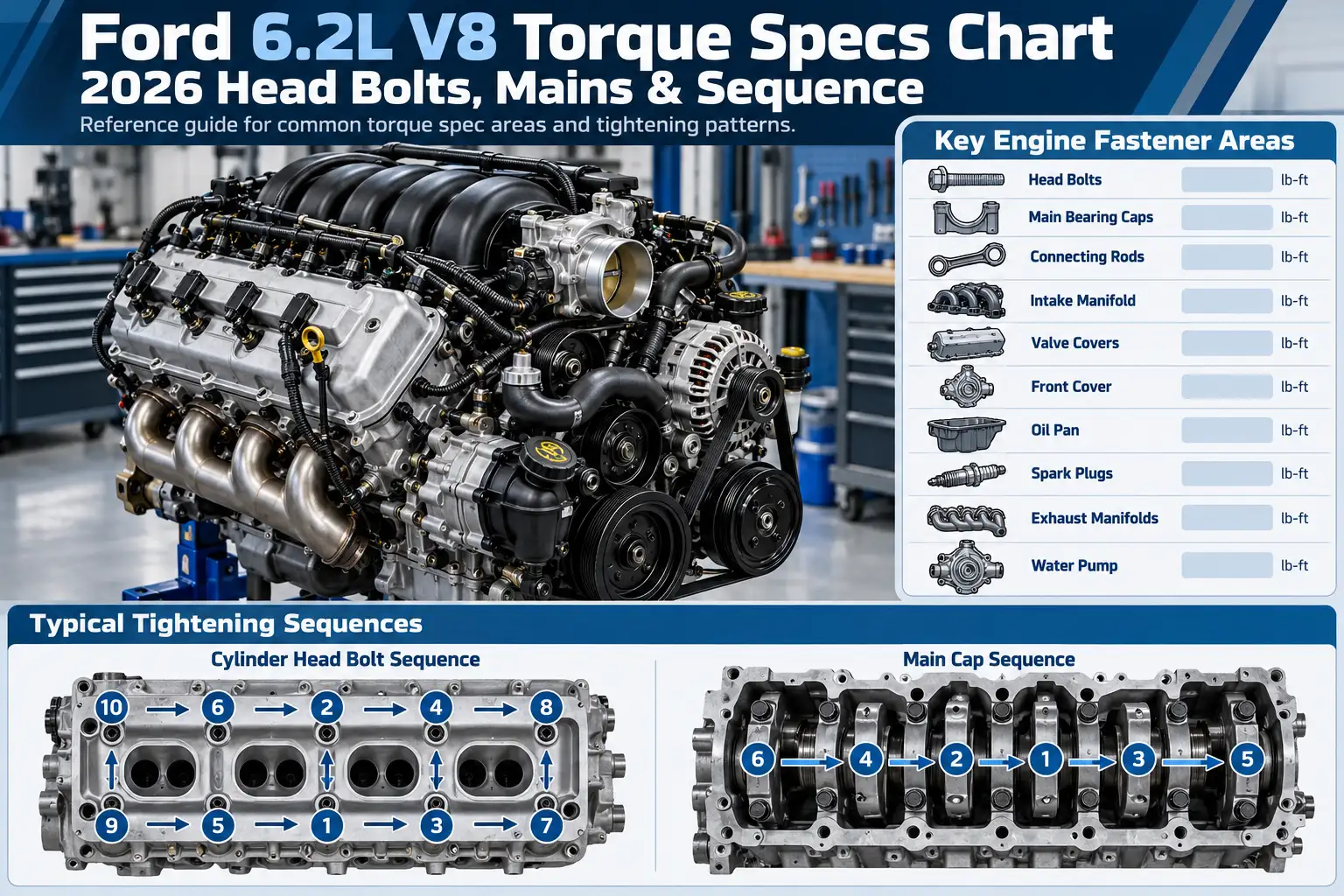
Ford 6.2L V8 Torque Specs Chart: 2026 Head Bolts, Mains & Sequence

Ford 6.2 torque specs depend on the fastener, the truck’s model year, and the tightening sequence. For example, a 2012 6.2L cylinder head uses a different procedure from a 2022 cylinder head. Connecting rod bolts and spark plugs also have documented year-specific differences.
This reference covers the Ford 6.2L Boss gasoline V8, focusing on engine fasteners rather than horsepower, wheel nuts, or suspension bolts. Use the quick chart to find a documented value, then read the component notes before using a torque wrench. An engine overhaul still requires the complete factory service procedure and its illustrated tightening order.
FORD 6.2L BOSS V8 / ENGINE FASTENERS
Same engine family.
Different torque procedures.
Three real examples showing why the model year and exact fastener matter. Follow the stages from left to right.
Cylinder head main bolts
Torque-to-yield head bolts: use new hardware and the correct bank-specific order.
Main M12 bolts, both cylinder heads
- 25 Nm
- 60 Nm
- +90°
- +90°
Right-hand head, main bolts 1–10
- 25 Nm
- 75 Nm
- Loosen 180°
- 25 Nm
- 50 Nm
- +90°
- +90°
Connecting rod cap bolts
Use new connecting rod bolts according to the cited assembly procedures.
- 20 Nm
- 43 Nm
- +135°
- 20 Nm
- 38 Nm
- +105°
Spark plug installation torque
Upper and lower plugs; these are torque values, not spark plug gaps.
18 Nm
159 lb-in / approximately 13 lb-ft
24 Nm
Approximately 18 lb-ft
HOW TO READ: Nm = newton-meters • +90° = extra 90° turn after the preceding stage • “Loosen 180°” is a required step where specified.
Before tightening: These figures are application-specific examples, not universal values for every Ford 6.2L. Confirm the VIN/model year, exact fastener, service-manual tightening order, and replacement-bolt requirements. The 2022 left-hand cylinder head has a different additional-bolt procedure.
Which Ford 6.2L Engine and Model Year Do You Have
Recommended Best Deal Products


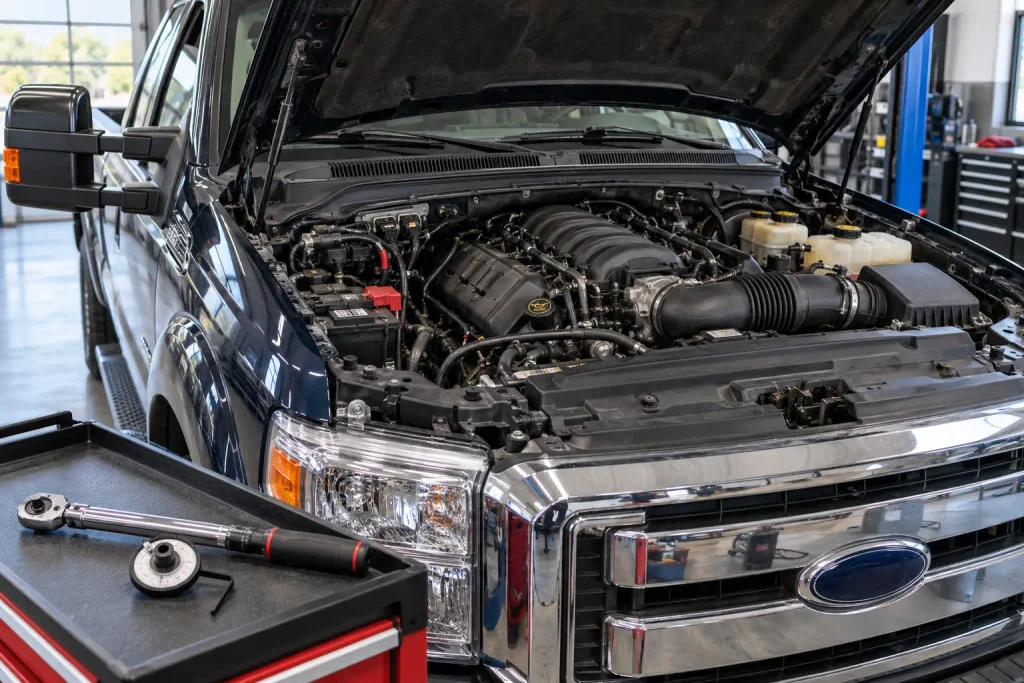
The 6.2L Boss V8 appeared in the first-generation F-150 SVT Raptor beginning during the 2010 model year, other selected F-150 configurations, and F-250/F-350 Super Duty gasoline trucks. Its use continued in Super Duty applications through the 2022 model year. Engine displacement alone is not enough to choose an installation procedure.
Before looking up a torque specification, identify:
- Model and model year. A 2012 F-250 and a 2022 F-350 cannot be assumed to share every tightening stage.
- Engine and hardware. Confirm the truck actually has the 6.2L Boss gasoline V8, not a 6.7L Power Stroke diesel or 7.3L gas V8.
- Repair operation. Identify the exact fastener, its location, and whether the procedure requires new bolts, lubrication, or a torque-angle gauge.
The Ford F-150 torque specs chart covers other F-150 maintenance fasteners. The specifications below deal specifically with the 6.2L engine and are labeled by verified application.
Ford 6.2 Torque Specs Quick Reference Chart
The following values come from Ford repair procedures reproduced in technical service-manual databases. A row labeled 2012 or 2022 is verified for that application, not automatically for every intervening model year. Arrows indicate successive tightening stages; + indicates an additional angle after the preceding torque stage.
| Engine Fastener | Verified Application | Tightening Specification |
|---|---|---|
| Cylinder head, RH M12 bolts | 2012 F-250 6.2L | 25 Nm → 60 Nm → +90° → +90° |
| Cylinder head, LH M12 bolts | 2012 F-250 6.2L | 25 Nm → 60 Nm → +90° → +90° |
| Cylinder head, LH M8 bolt | 2012 F-250 6.2L | 20 Nm → +45° |
| Cylinder head, RH main bolts | 2022 F-350 6.2L | 25 Nm → 75 Nm → loosen 180° → 25 Nm → 50 Nm → +90° → +90° |
| Main bearing cap, vertical outer | 2012 F-250 6.2L | 35 Nm → 50 Nm → +90° |
| Main bearing cap, vertical inner | 2012 F-250 6.2L | 35 Nm → 65 Nm → +90° |
| Main bearing cap, cross bolts | 2012 F-250 6.2L | 20 Nm → 35 Nm → +60° |
| Connecting rod cap bolts | 2012 F-250 6.2L | 20 Nm → 43 Nm → +135° |
| Connecting rod cap bolts | 2022 F-350 6.2L | 20 Nm → 38 Nm → +105° |
| Rocker arm shaft bolts | 2012 F-250 6.2L | 10 Nm → 20 Nm → +60° |
| Intake manifold bolts | 2012 F-250 6.2L | 10 Nm → +45° |
| Fuel rail bolts | 2012 F-250 6.2L | 10 Nm → +90° |
| Throttle body bolts | 2012 F-250 6.2L | 12 Nm → +60° |
| Exhaust manifold studs | 2012 F-250 6.2L | 25 Nm (18 lb-ft) |
| Exhaust manifold nuts | 2012 F-250 6.2L | 25 Nm → 32 Nm |
| Spark plugs, upper and lower | 2012 F-250 6.2L | 18 Nm (159 lb-in; about 13 lb-ft) |
| Spark plugs, upper and lower | 2018 F-250 6.2L | 24 Nm (18 lb-ft) |
| Oil drain plug | 2012 F-250 and 2022 F-350 6.2L | 23 Nm (17 lb-ft) |
The source for the 2012 lower-engine and valvetrain procedures is the 2012 Ford F-250 6.2L engine assembly service procedure. Values are presented in Nm where the service information contains inconsistent pound-foot conversions; 50 Nm is approximately 37 lb-ft, not 26 lb-ft.
How Ford 6.2 Head Bolt Torque Changes by Year
Recommended Best Deal Products


Cylinder head bolts are torque-to-yield fasteners. Ford specifies new bolts after removal, a bank-specific tightening order, and multiple torque-angle stages. Do not use a value from the opposite cylinder bank or skip a loosening stage because it appears unusual.
2012 Ford 6.2 Head Bolt Stages
For the 2012 F-250 6.2L, the ten main M12 bolts on each head use four stages:
- Tighten to 25 Nm (18 lb-ft) in the illustrated order.
- Tighten to 60 Nm (44 lb-ft) in the same order.
- Turn each bolt an additional 90°.
- Turn each bolt another 90°.
The left-hand head also has an eleventh, smaller M8 fastener. After the M12 stages, tighten that M8 bolt to 20 Nm (177 lb-in) and then an additional 45°. The right-hand head has ten main bolts and no matching eleventh head fastener in this procedure.
The 2012 cylinder head installation instructions also require clean sealing surfaces, dry head gaskets, and replacement head bolts.
2022 Ford 6.2 Head Bolt Stages
The 2022 F-350 6.2L uses a different procedure. For the right-hand head, bolts 1 through 10 follow seven stages:
- 25 Nm (18 lb-ft).
- 75 Nm (55 lb-ft).
- Loosen 180°.
- 25 Nm (18 lb-ft) again.
- 50 Nm (37 lb-ft).
- Turn an additional 90°.
- Turn another 90°.
The 2022 left-hand head has ten stages because its eleventh bolt has additional operations. After the 25, 75, loosen-180, 25 and 50 Nm stages for bolts 1 through 10, tighten bolt 11 to 10 Nm. Apply the two additional 90° turns to bolts 1 through 10, then tighten bolt 11 to 20 Nm and finally 45° more.
These 2022 instructions are documented in the 2022 F-350 6.2L engine assembly procedure. The exact bolt numbers and tightening order must come from the diagrams for your engine; a torque table does not replace those diagrams. Do not infer which intermediate model year adopted the revised procedure from these two examples alone.
How to Tighten Ford 6.2 Main Bearing Bolts
The Ford 6.2L crankshaft uses vertical main-cap fasteners plus cross-mounted side bolts. They perform different jobs and cannot share one torque value.
Vertical Outer Main Cap Bolts
For the 2012 F-250 service procedure, tighten the ten outer vertical bolts in the specified order to 35 Nm (26 lb-ft), then 50 Nm (37 lb-ft), followed by 90°.
Vertical Inner Main Cap Bolts
Tighten the ten inner vertical bolts to 35 Nm (26 lb-ft), then 65 Nm (48 lb-ft), followed by 90°. The second torque stage is higher than the outer-bolt value.
Cross-Mounted Main Cap Bolts
Tighten the ten side bolts to 20 Nm (177 lb-in), then 35 Nm (26 lb-ft), followed by 60°. Apply the documented bolt order after the vertical caps are seated.
The 2022 F-350 assembly information independently lists these same main-cap torque stages. That agreement does not eliminate the need to check bearing selection, thrust positioning, thread condition, and the current service instructions before assembly.
What Are Ford 6.2 Connecting Rod Torque Stages
Recommended Best Deal Products


Connecting rod torque is one of the clearest year-specific differences. Do not substitute a 2012 rod procedure for the 2022 version because both engines are called 6.2L Boss V8.
| Verified Truck | Connecting Rod Bolt Procedure |
|---|---|
| 2012 F-250 6.2L | 20 Nm (177 lb-in) → 43 Nm (32 lb-ft) → +135° |
| 2022 F-350 6.2L | 20 Nm (177 lb-in) → 38 Nm (28 lb-ft) → +105° |
Both reviewed assembly procedures specify new connecting rod bolts. The rod caps are matched to their rods and must stay in the original orientation; Ford also warns against damaging crankshaft journals and cylinder walls during installation.
A service-manual mirror inconsistently calls the 2012 rod operation “two stages” while listing three explicit stages. The three-step values shown above follow the listed torque and angle operations. Use the complete illustrated procedure for the exact build before applying torque.
How to Torque Ford 6.2 Rocker Arm Shafts
The 2012 F-250 6.2L procedure specifies the same torque stages for the four rocker shaft assemblies: 10 Nm (89 lb-in), 20 Nm (177 lb-in), then an additional 60°.
That applies to the LH intake, LH exhaust, RH intake, and RH exhaust shaft assemblies in the verified service procedure. However, the camshaft must be rotated to the specified lobe position for the assembly being installed. The left and right procedures do not use interchangeable camshaft positioning instructions.
Lubricate the rocker-to-camshaft and rocker-to-valve-tip contact surfaces as instructed. Start the bolts finger-tight and follow the diagram for each shaft. A generic single “rocker bolt torque” figure is not sufficient to reinstall this valvetrain correctly.
Ford 6.2 Intake and Exhaust Manifold Torque Specs
On the 2012 F-250 6.2L, the 12 intake manifold bolts tighten to 10 Nm (89 lb-in) and then another 45° in the illustrated order. Afterward, the four fuel rail bolts tighten to 10 Nm and then another 90°.
The four throttle body bolts use 12 Nm (106 lb-in) plus an additional 60°. These values are separate from the intake manifold fasteners; do not carry the 45° manifold angle over to the throttle body.
For the 2012 exhaust manifolds, new studs tighten to 25 Nm (18 lb-ft). New exhaust manifold nuts use 25 Nm, then 32 Nm (24 lb-ft), in the specified sequence. Heat-shield bolts tighten to 12 Nm (106 lb-in).
Use the proper gaskets and keep sealing surfaces clean. Apply the full specified sequence rather than tightening one corner completely before the remaining fasteners. These 2012 values should not be assumed to describe later replacement hardware without verification.
What Are Ford 6.2 Spark Plug and Oil Plug Specs
The 6.2L Boss V8 has 16 spark plugs, two per cylinder. Its spark plug torque is not a universal value for every model year.
The 2012 F-250 6.2L spark plug specification is 18 Nm, equivalent to 159 lb-in or about 13 lb-ft. A separately documented 2018 F-250 6.2L spark plug installation instead specifies 24 Nm (18 lb-ft). That later value is shown in the 2018 F-250 spark plug service procedure.
Ford’s documented 2012 F-250 and 2022 F-350 oil-drain procedures both specify 23 Nm (17 lb-ft) for the drain plug. Confirm that the drain plug, oil pan, and hardware match the factory application before tightening.
Torque and spark plug gap are different measurements. For the 6.2L ignition gap and related F-250 engine comparisons, see the Ford F-250 spark plug gap chart. When removing or installing these plugs, follow Ford’s engine-temperature and hand-tool instructions to protect the cylinder head threads.
How to Read Ford 6.2 Torque and Angle Specs
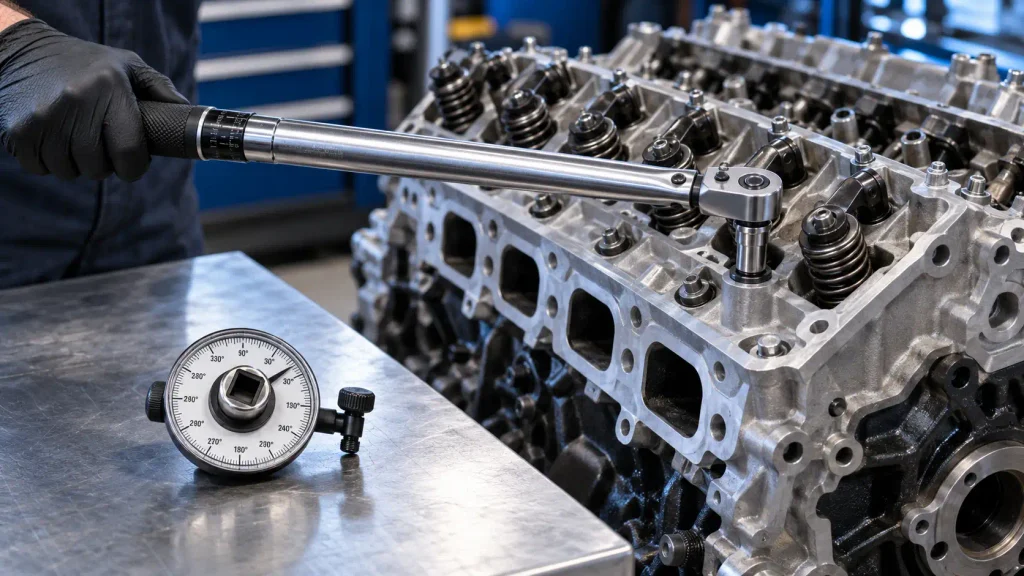
An instruction such as 20 Nm → 38 Nm → +105° means three consecutive operations on the specified fastener. It does not mean finding a torque-wrench setting equivalent to 105 degrees.
- Nm: Newton-meters, the metric unit of torque.
- lb-ft: Pound-feet. One lb-ft is approximately 1.356 Nm.
- lb-in: Pound-inches. Twelve lb-in equal one lb-ft.
- Additional angle: Rotation after reaching the previous torque stage, measured with a suitable angle gauge.
For example, 159 lb-in equals 13.25 lb-ft, not 159 lb-ft. That unit error would drastically over-tighten a spark plug. Also, “loosen 180°” is a required step when specified; it is not permission to skip directly to the final torque.
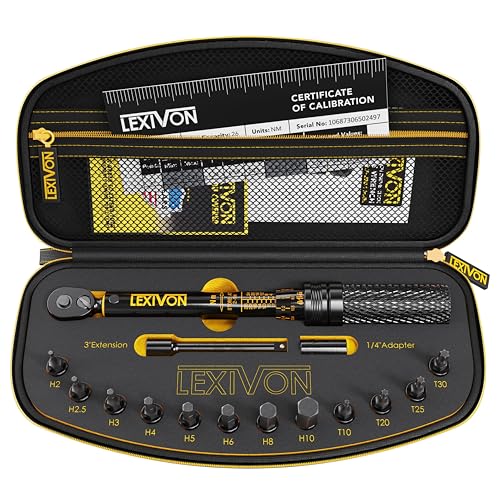
Use a calibrated wrench with a suitable operating range, plus an angle gauge where required. Observe Ford’s instructions for thread lubrication, fastener replacement, tightening order, and surface preparation.
Which Ford 6.2 Engine Bolts Cannot Be Reused
The reviewed Ford procedures explicitly require new cylinder head bolts. They are torque-to-yield fasteners and must not be reused after removal. The reviewed 2012 and 2022 connecting rod assembly procedures also call for new rod bolts.
For the 2012 exhaust manifold procedure, Ford specifies new studs and new nuts. Do not assume all main-cap, rocker shaft, or intake bolts are either reusable or single-use based only on their torque angle. Check the particular repair operation and parts instructions before reassembly.
Common mistakes include mixing up outer and inner main bearing cap specifications, confusing lb-in with lb-ft, applying an early-year rod torque to a later truck, or tightening without following the numbered diagram. Every one of those errors is avoidable by checking the exact operation first.
How to Use Your Ford 6.2 Torque Specs Safely
The correct Ford 6.2 torque specs are a combination of fastener identity, model-year application, tightening stages, and sequence, not just a single number. The 2012 and 2022 cylinder-head and connecting-rod examples show why apparently similar engines can require different procedures.
For a minor job, start with the verified spark plug or drain plug specification for your exact truck. For internal engine assembly, confirm the applicable Ford workshop procedure and illustrated bolt order before touching the torque wrench. Replace fasteners whenever the procedure requires new hardware, and use the stated torque and angle stages in sequence.
If your year or component is not covered by a verified row, do not use the nearest year as a substitute.
5 Ford 6.2 Torque Specs Questions for DIY Repairs
What Is the Ford 6.2 Head Bolt Torque Sequence
There is no single sequence for every model year. The 2012 F-250 procedure uses 25 Nm, 60 Nm, and two 90° turns for the main M12 head bolts; the 2022 F-350 procedure adds a 75 Nm stage and a 180° loosening operation. Follow the diagram for the correct year and cylinder bank.
What Is the Spark Plug Torque for a Ford 6.2
The documented 2012 F-250 value is 18 Nm (159 lb-in), while the 2018 F-250 service procedure specifies 24 Nm (18 lb-ft). Confirm your model year and the applicable Ford service information rather than assuming either value fits every 6.2L engine.
What Are the Ford 6.2 Rocker Arm Torque Specs
For the documented 2012 F-250 6.2L procedure, rocker shaft bolts tighten to 10 Nm, then 20 Nm, followed by an additional 60°. Camshaft positioning and the illustrated tightening sequence are also part of that procedure.
Can You Reuse Ford 6.2 Cylinder Head Bolts
No. The reviewed Ford 6.2L cylinder-head installation procedures explicitly require new torque-to-yield head bolts. Check the exact service procedure for other engine fasteners instead of assuming they follow the same replacement rule.
Are Ford 6.2 Engine Torque Specs the Same as Lug Nut Torque
No. Engine fastener torque has no interchangeable relationship with wheel nut torque. If you are servicing wheels rather than the 6.2L engine, use the separate Ford lug nut torque chart and match the wheel hardware to the correct truck year.