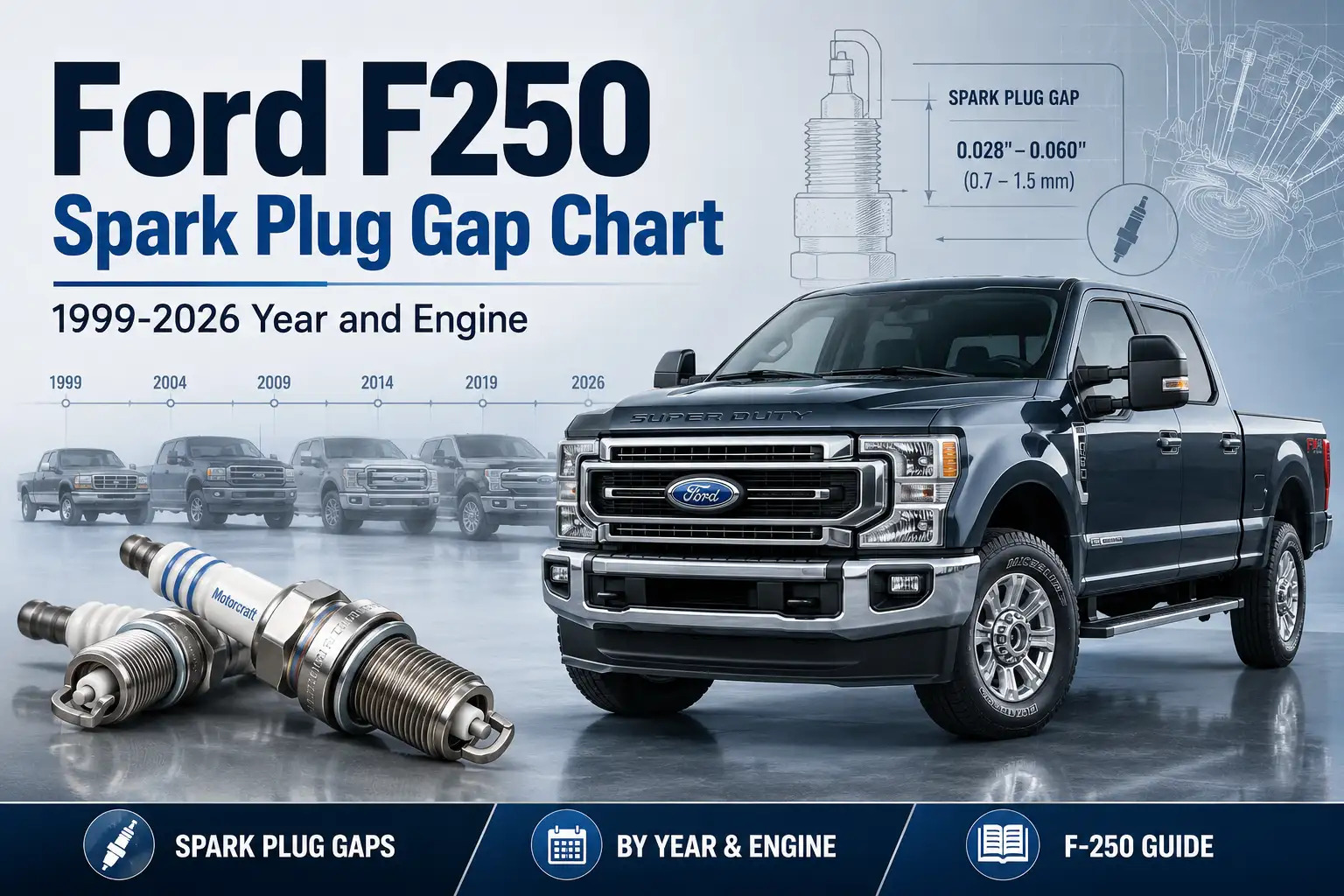
Ford F250 Spark Plug Gap Chart: 1999-2026 Year and Engine

The Ford F250 spark plug gap is not one universal number. It changes by model year and gasoline engine, ranging from 0.039 inch on some Triton applications to about 0.053 inch at the upper end of the 7.3L Godzilla specification.
For example, 1999 to 2004 F-250 trucks with the 5.4L V8 or 6.8L V10 use a 0.052 to 0.056 inch range. Ford changed the specification substantially on later engines.

Prime for Young Adults — 6 Months Free
Students and 18–24s get six months of Prime free, then half price.
Start 6 Months Free As an Amazon Associate I earn from qualifying purchases.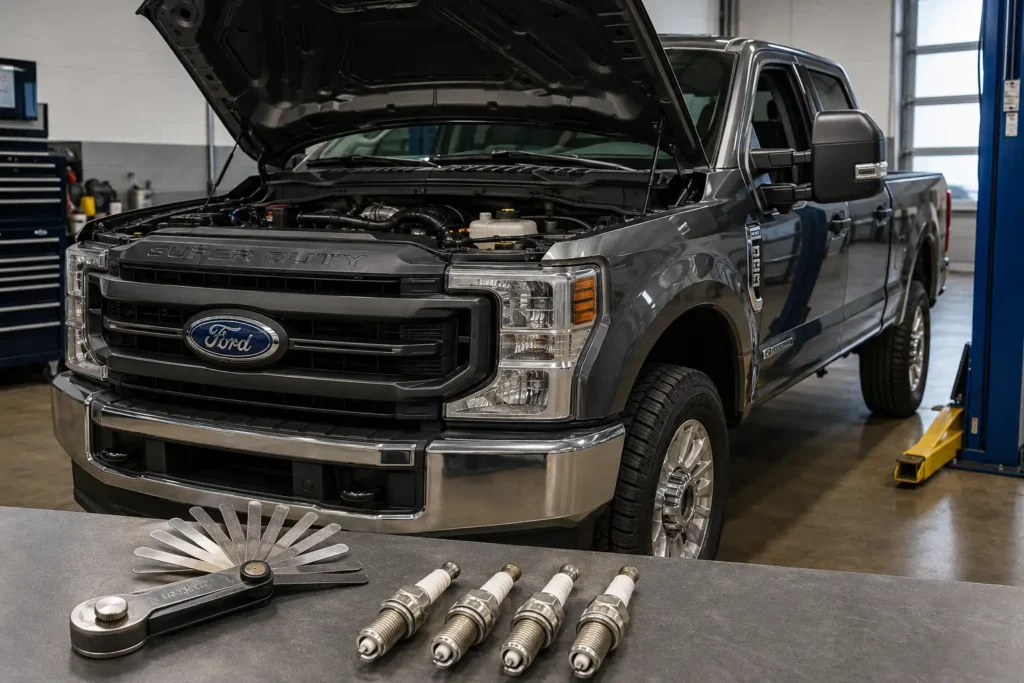
Use the chart below to match the model year and exact gas engine before checking or changing a plug. Power Stroke diesel engines are not included because they use compression ignition and glow plugs rather than ignition spark plugs.
Ford Super Duty Quick Reference
Ford F250 Spark Plug Gap Chart
Recommended Best Deal Products


Use your exact model year and gasoline engine before setting or checking plug gap. There is no one-size-fits-all F-250 spark plug specification.
Engine Generation Breakdown
1999 to 2004
Early Triton gas engines use the widest gap range in this chart.
- 5.4L Triton V8: 0.052 to 0.056 in
- 6.8L Triton V10: 0.052 to 0.056 in
2005 to 2008
Three-valve Triton engines moved to a tighter specification.
- 5.4L Triton 3V: 0.040 to 0.050 in
- 6.8L Triton 3V V10: 0.040 to 0.050 in
2009 to 2010
Final F-250 Triton years use an even tighter gap range.
- 5.4L Triton V8: 0.039 to 0.043 in
- 6.8L Triton V10: 0.039 to 0.043 in
2011 to 2026
Modern Super Duty gas engines use three different specs.
- 6.2L Boss V8: 0.041 to 0.047 in
- 7.3L Godzilla V8: 0.049 to 0.053 in
- 6.8L Gas V8: 0.051 in
Quick Reference Table
| Model Years | Gas Engine | Gap Inches | Gap MM | Plug Count | Adjustment Status |
|---|---|---|---|---|---|
| 1999 to 2004 | 5.4L Triton V8 | 0.052 to 0.056 | 1.3 to 1.4 | 8 | Verify against VECI label |
| 1999 to 2004 | 6.8L Triton V10 | 0.052 to 0.056 | 1.3 to 1.4 | 10 | Verify against VECI label |
| 2005 to 2008 | 5.4L Triton 3V V8 | 0.040 to 0.050 | 1.02 to 1.28 | 8 | Do not adjust |
| 2005 to 2008 | 6.8L Triton 3V V10 | 0.040 to 0.050 | 1.02 to 1.28 | 10 | Do not adjust |
| 2009 to 2010 | 5.4L Triton V8 | 0.039 to 0.043 | 1.0 to 1.1 | 8 | Check replacement plug |
| 2009 to 2010 | 6.8L Triton V10 | 0.039 to 0.043 | 1.0 to 1.1 | 10 | Check replacement plug |
| 2011 to 2022 | 6.2L Boss V8 | 0.041 to 0.047 | 1.04 to 1.20 | 16 | Adjust if needed |
| 2020 to 2026 | 7.3L Godzilla V8 | 0.049 to 0.053 | 1.25 to 1.35 | 8 | Verify new plug |
| 2023 to 2026 | 6.8L Gas V8 | 0.051 | 1.3 | 8 | Verify new plug |
Best Way To Use This Chart
First confirm the model year. Then identify the exact gasoline engine. Finally compare the replacement plug to the chart before installation. The 6.8L V10 and the newer 6.8L V8 are different engines and do not use the same reference row.
Not For Power Stroke Diesels
F-250 Power Stroke diesel engines do not use ignition spark plugs. They use compression ignition and glow plugs, so this spark plug gap infographic does not apply to diesel models.

Audible — Listen Free for 30 Days
One free credit a month and thousands of titles included.
Listen Free for 30 Days As an Amazon Associate I earn from qualifying purchases.Ford F250 Spark Plug Gap Chart by Year
The fastest way to find the correct gap is to match your F-250 model year with its gasoline engine. Do not choose a specification based only on the F-250 badge.
Match both your F-250 model year and gasoline engine before using a spark plug gap specification.
| Model Years | Gas Engine | Gap Inches | Gap Millimeters | Plug Count | Adjustment Note |
|---|---|---|---|---|---|
| 1999 to 2004 | 5.4L Triton V8 | 0.052 to 0.056 | 1.3 to 1.4 mm | 8 | Verify against VECI label |
| 1999 to 2004 | 6.8L Triton V10 | 0.052 to 0.056 | 1.3 to 1.4 mm | 10 | Verify against VECI label |
| 2005 to 2008 | 5.4L Triton 3V V8 | 0.040 to 0.050 | 1.02 to 1.28 mm | 8 | Ford says gap cannot be adjusted |
| 2005 to 2008 | 6.8L Triton 3V V10 | 0.040 to 0.050 | 1.02 to 1.28 mm | 10 | Ford says gap cannot be adjusted |
| 2009 to 2010 | 5.4L Triton V8 | 0.039 to 0.043 | 1.0 to 1.1 mm | 8 | Check replacement plug specification |
| 2009 to 2010 | 6.8L Triton V10 | 0.039 to 0.043 | 1.0 to 1.1 mm | 10 | Check replacement plug specification |
| 2011 to 2022 | 6.2L Boss V8 | 0.041 to 0.047 | 1.04 to 1.20 mm | 16 | Adjust only when necessary |
| 2020 to 2026 | 7.3L Godzilla V8 | 0.049 to 0.053 | 1.25 to 1.35 mm | 8 | Verify new plug before adjustment |
| 2023 to 2026 | 6.8L Gas V8 | 0.051 | 1.3 mm | 8 | Verify replacement plug |
Ford’s manuals support the major breaks shown in this chart. The 2005 and 2008 manuals specify 0.040 to 0.050 inch for the 5.4L and 6.8L three-valve engines and explicitly state that those gaps cannot be adjusted.
For 2009 and 2010, Ford lists 0.039 to 0.043 inch for both the F-250’s 5.4L V8 and 6.8L V10.
Ford specifies 0.041 to 0.047 inch for the 6.2L V8, while the 7.3L gas V8 uses 0.049 to 0.053 inch. The current 6.8L gas V8 specification is 0.051 inch.
Ford advises owners to treat the original owner’s manual as the primary information source for their individual truck. If your underhood Vehicle Emissions Control Information label gives a different specification for a particular emissions package, follow the label for that truck.
How F250 Spark Plug Gaps Changed Across 5 Engines
Recommended Best Deal Products


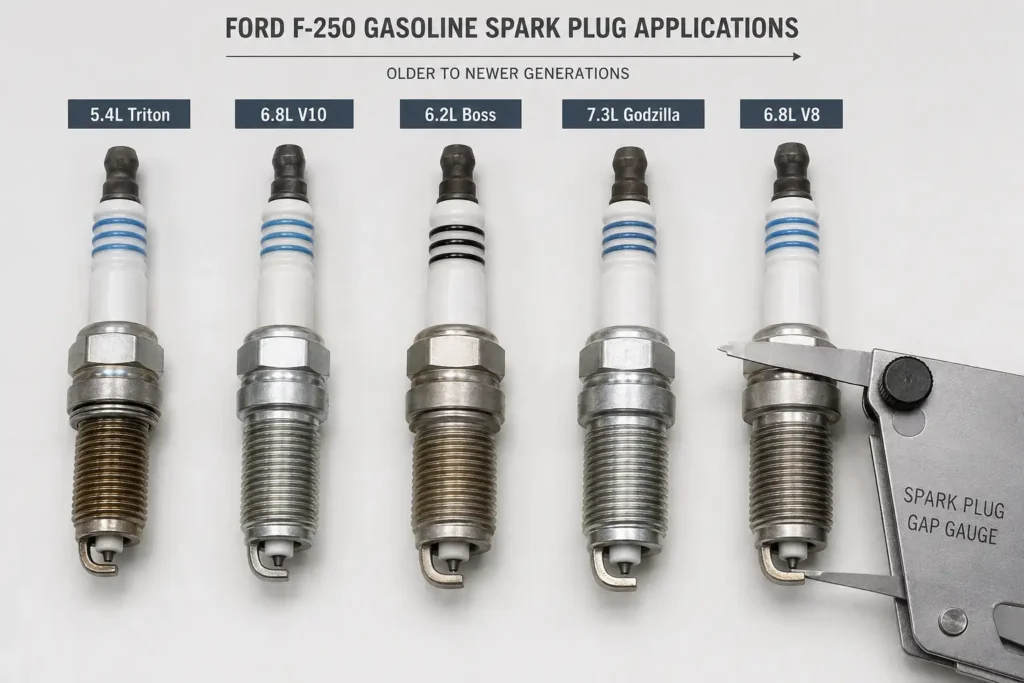
F-250 spark plug gaps changed mainly with engine design. That is why two correct Ford specifications can look contradictory when the model year or engine is omitted.
5.4L Triton V8
The early Super Duty 5.4L used a 0.052 to 0.056 inch gap. Ford listed that specification for trucks such as the 1999, 2001, 2002, and 2004 F-250.
The specification changed with the later three-valve engine. For 2005 through 2008 applications, Ford lists 0.040 to 0.050 inch and states that the gap cannot be adjusted.
Audible Premium Plus — Annual Membership
12 audiobook credits up front, plus the full Audible catalogue.
See Annual Plans As an Amazon Associate I earn from qualifying purchases.For the final 2009 and 2010 F-250 applications, the manual shows 0.039 to 0.043 inch.
6.8L Triton V10
The old F-250 6.8L Triton is a V10, not the modern 6.8L V8.
Its early 1999 to 2004 F-250 specification matches the 5.4L at 0.052 to 0.056 inch. The 2005 to 2008 three-valve version changed to 0.040 to 0.050 inch, with Ford stating that the gap cannot be adjusted.
The 2009 and 2010 F-250 V10 specification is 0.039 to 0.043 inch.
If you need to identify ignition coils, cylinder locations, or other components before servicing this engine, the Ford 6.8 V10 engine diagram maps the V10 layout in more detail.
6.2L Boss V8
Ford replaced the older F-250 gasoline-engine lineup with the 6.2L Boss V8 for the 2011 model year.
Its factory spark plug gap is 0.041 to 0.047 inch, or 1.04 to 1.20 mm. Ford continued listing this range in later Super Duty documentation, including 2017, 2019, and 2020 applications.
The unusual part is the plug count. The 6.2L uses two plugs per cylinder for 16 spark plugs total. Parts listings for the F-250 specify a required quantity of 16, and service information separates the upper and lower plugs.
That makes a full 6.2L plug service significantly different from a conventional eight-plug V8.
7.3L Godzilla V8
Ford introduced the 7.3L gasoline V8 to the Super Duty lineup for 2020.
Ford specifies a spark plug gap of 0.049 to 0.053 inch, or 1.25 to 1.35 mm. The same range remains listed in current Super Duty documentation.
Do not confuse this engine with the old 7.3L Power Stroke diesel. The 7.3L Godzilla is a gasoline V8 and uses eight ignition spark plugs.
For other service specifications on this engine, our Ford 7.3 gas oil capacity and maintenance specifications page covers the related 7.3L Super Duty maintenance data.
6.8L Gas V8
The modern 6.8L gasoline V8 arrived with the newer Super Duty generation and should not be confused with Ford’s earlier 6.8L Triton V10.
Ford’s current specification is 0.051 inch, or 1.3 mm. It uses a coil-on-plug ignition system and one plug per cylinder.
This is a good example of why searching only for “6.8 Ford spark plug gap” can return the wrong answer. Engine configuration and model year have to be identified first.
How to Find Your Correct F250 Gap in 4 Steps
You need two facts before using any spark plug specification: the F-250’s model year and gasoline engine.
1. Confirm the Model Year
Check the registration, VIN information, or certification label rather than estimating the year from body styling.
A one-year difference matters near engine-generation changes.
2. Identify the Gas Engine
Determine whether your F-250 has the 5.4L Triton, 6.8L Triton V10, 6.2L Boss, 7.3L Godzilla, or newer 6.8L V8.
Do not identify it by displacement alone. Ford has used the 6.8L designation for both a V10 and a much newer V8.
3. Match the Exact Chart Row
Match both pieces of information to the chart.
For example, a 2004 6.8L uses 0.052 to 0.056 inch. A 2009 6.8L F-250 uses 0.039 to 0.043 inch. The engine displacement is the same, but the correct gap is different.
4. Inspect the Replacement Plug
Check every new plug before installation even when it is sold as pre-gapped.
Compare it with the Ford specification for your application. If Ford or the plug manufacturer says the electrode is non-adjustable, do not bend it simply because your gap tool shows a slightly different reading.
When Should You Adjust an F250 Spark Plug Gap
Recommended Best Deal Products


Checking a spark plug gap and physically changing it are two different jobs.
Ford explicitly states that the 2005 to 2008 5.4L 3V and 6.8L 3V spark plug gaps cannot be adjusted. Those manuals still publish the 0.040 to 0.050 inch specification, but that does not mean Ford wants the installer bending the electrode.
The 6.2L service procedure is different. Ford service information instructs technicians to adjust the spark plug gaps as necessary and then install the plugs using the specified procedure.
Use these rules when checking a new plug:
- Confirm the part fits your exact engine and model year.
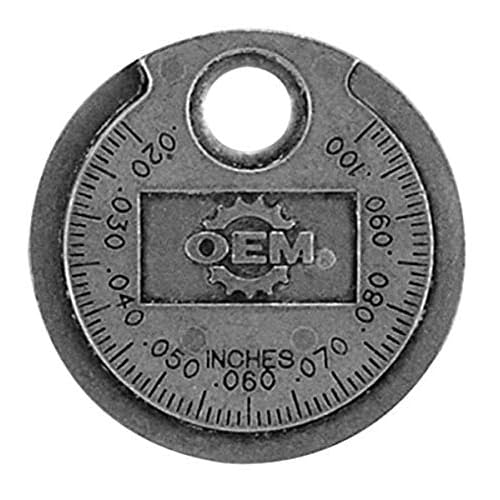
- Measure the gap without forcing the gauge through the electrodes.
- Compare the reading with Ford’s published range.
- Follow any non-adjustable warning for that plug design.
- Never pry against a fine center electrode.
- Replace a plug if it was dropped or its electrode is visibly damaged.
A factory specification tells you what the engine requires. The construction of the replacement plug determines how you should reach that specification.
5 Signs the Spark Plug Gap May Be Wrong
An incorrect plug gap can affect ignition performance, but these symptoms do not prove the gap itself is the problem.
1. Rough Idle
A plug that cannot consistently ignite the mixture can contribute to an uneven idle.
Worn plugs, ignition coils, injectors, vacuum leaks, or mechanical problems can create similar symptoms.
2. Misfire Under Load
A weak spark becomes more noticeable when cylinder pressure rises during acceleration or towing.
A truck that runs normally at idle but misfires under load needs proper ignition-system diagnosis rather than an automatic gap adjustment.
3. Hard Starting
Excessive plug wear or an incorrect ignition gap can make combustion less consistent during starting.
Check battery condition, fuel delivery, and stored diagnostic codes as part of the diagnosis.
4. Weak Acceleration
Repeated misfires reduce engine output and can make the F-250 hesitate during acceleration.
On a 6.2L, remember that each cylinder has two plugs, so the ignition layout is more involved than on a conventional V8.
5. Check Engine Light
A misfire may trigger a cylinder-specific P0301 through P0308 code on an eight-cylinder engine.
The code identifies the affected cylinder, not the failed component. A bad plug, coil, plug wire, injector, wiring fault, or mechanical issue can produce the same cylinder misfire code.
Why Power Stroke F250 Engines Have No Spark Plug Gap
If your F-250 has a Power Stroke diesel, this Ford F250 spark plug gap chart does not apply.
Diesel engines use compression to ignite the injected fuel. They do not rely on an electrical spark across an ignition spark plug.
That applies to F-250 engines such as the 7.3L Power Stroke, 6.0L Power Stroke, 6.4L Power Stroke, and 6.7L Power Stroke.
These engines may use glow plugs to help cold starting, but a glow plug does not have an ignition gap that you set like a gasoline spark plug.
This distinction is especially useful with the 7.3L name. A 7.3L Godzilla gas V8 needs spark plugs and uses a 0.049 to 0.053 inch specification. A 7.3L Power Stroke diesel does not use spark plugs at all.
Which F250 Spark Plug Gap Should You Use
Use the specification assigned to your exact F-250 model year and gasoline engine.
For 1999 to 2004 5.4L and 6.8L trucks, that generally means 0.052 to 0.056 inch. The 2005 to 2008 three-valve engines use 0.040 to 0.050 inch but carry Ford’s non-adjustable warning.
The 2009 to 2010 Triton engines use 0.039 to 0.043 inch. The 6.2L uses 0.041 to 0.047 inch, while the 7.3L Godzilla uses 0.049 to 0.053 inch. Current 6.8L V8 trucks use 0.051 inch.
Before installing plugs, confirm the engine, replacement plug application, and any VECI-label information specific to your truck.
5 Common Ford F250 Spark Plug Gap Questions
What Is the Spark Plug Gap on a Ford F250
There is no single Ford F-250 spark plug gap for every year. Depending on the engine and generation, factory specifications in this chart range from 0.039 inch to 0.056 inch.
Match the truck’s year and gasoline engine before selecting a gap.
What Is the F250 6.2 Spark Plug Gap
The Ford F-250 6.2L V8 spark plug gap is 0.041 to 0.047 inch, or 1.04 to 1.20 mm. Ford lists this range in Super Duty engine specifications across multiple 6.2L model years.
The 6.2L also uses 16 spark plugs, with two plugs per cylinder.
What Is the 7.3 Godzilla Spark Plug Gap
The 7.3L Godzilla gasoline V8 uses a 0.049 to 0.053 inch, or 1.25 to 1.35 mm, spark plug gap. Ford lists the same range in current Super Duty documentation.
Do not use this specification for a 7.3L Power Stroke diesel.
Should Motorcraft Spark Plugs Be Re Gapped
Check the plug against the factory specification, but do not assume every Motorcraft plug should be physically re-gapped.
Ford specifically says the gap cannot be adjusted on certain 5.4L 3V and 6.8L 3V applications, while the 6.2L service procedure allows adjustment as necessary.
Does a Power Stroke F250 Use Spark Plugs
No. Ford F-250 Power Stroke diesel engines use compression ignition rather than spark plugs.
Glow plugs assist cold starting on applicable diesels, but they do not have a spark plug-style ignition gap that needs adjustment.