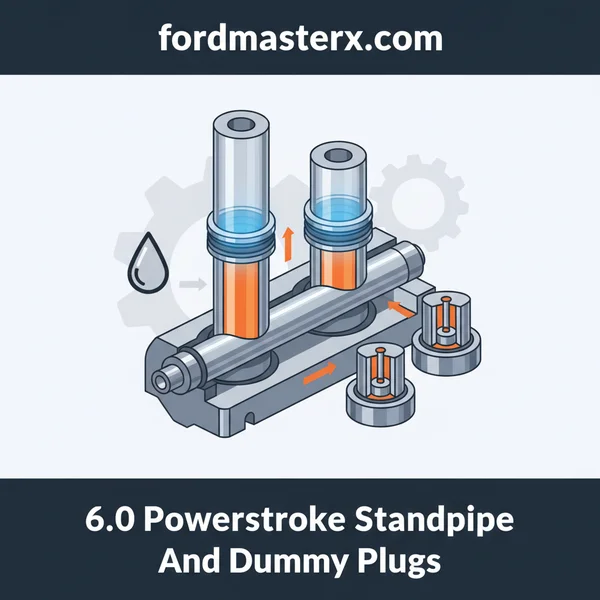
6.0 Powerstroke Standpipe & Dummy Plugs: Diagnosis & Repair

A hot no-start condition on a 6.0 Powerstroke is frequently caused by failed seals in the standpipes and dummy plugs. Upgrading to the redesigned D-ring versions and torquing to 60 lb-ft is essential for maintaining high-pressure oil system integrity.
🎯 Key Takeaways


- Perform an air test to confirm high-pressure oil system leaks.
- Always replace failing components with updated Ford OEM D-ring kits.
- Tighten all standpipes and dummy plugs to exactly 60 lb-ft.
- Monitor ICP and IPR percentages for real-time diagnostic data.
- Lubricate new O-rings with fresh engine oil before installation.
A “hard start hot” or “no start hot” condition on a 6.0 Powerstroke is almost always caused by a high-pressure oil leak. Your engine requires at least 500 PSI of injection control pressure (ICP) to fire the injectors. When the O-rings on your standpipes and dummy plugs degrade, they allow high-pressure oil to bleed back into the crankcase. This prevents the system from reaching the necessary pressure threshold when the oil is thin and hot. Upgrading these components to the revised versions is the most effective way to restore reliability to your high-pressure oil system (HPOS).
Replacing these parts is a labor-intensive but straightforward DIY task. By swapping the old, failure-prone seals for the updated Ford designs, you eliminate the most common leak points in the 2004.5 through 2007 model years. You do not need to pull the engine or the cylinder heads to perform this fix. All you need is a basic set of hand tools, a few specialized hex sockets, and a methodical approach to cleaning the oil rail surfaces.
Identifying High-Pressure Oil System Failure Symptoms


Before you tear into the engine, you must confirm that the standpipes or dummy plugs are actually the source of your trouble. The hallmark symptom is an engine that starts perfectly when cold but refuses to restart after reaching operating temperature. As oil heats up, its viscosity drops, making it much easier for it to slip past a torn or flattened O-ring. If your truck stalls at a stoplight or fails to start after a quick fuel stop, the high-pressure system is losing volume.

Monitoring ICP and IPR Data
You can diagnose this accurately using a digital monitor or scan tool. Watch your Injection Control Pressure (ICP) and Injection Pressure Regulator (IPR) duty cycle while cranking the engine. If the ICP struggles to hit 500 PSI and the IPR duty cycle climbs toward 85% (the maximum command), the computer is desperately trying to close the regulator to build pressure. A healthy system should build pressure almost instantly. If you see low pressure paired with a high IPR percentage, you have a confirmed leak.
- ICP Pressure: Must reach 500 PSI minimum to trigger fuel injection.
- IPR Duty Cycle: Anything above 30% at a warm idle suggests a small leak; 85% during cranking indicates a major failure.
- Oil Temperature: Symptoms usually worsen once oil temperatures exceed 180°F.
The High-Pressure Air Test
To pinpoint the exact location, perform an air test. You can do this by introducing shop air (100+ PSI) into the system through the ICP sensor port or the IPR valve port using a specialized adapter. With the valve covers off, listen for the sound of rushing air. A localized “hiss” or “gurgle” coming from the top of the oil rail indicates a dummy plug or standpipe failure. This test removes the guesswork and ensures you aren’t chasing a failing HPOP when the issue is simply a five-dollar seal.
Comparing Original vs. Updated D-Ring Designs


The original standpipes and dummy plugs installed by Ford and International utilized a standard D-ring seal that lacked proper support. Over thousands of heat cycles, these seals flatten out and eventually “blow out,” creating a massive path for oil to escape. Ford recognized this flaw and released an updated part featuring a white Teflon backup ring. This backup ring supports the rubber seal, preventing it from distorting under the 3,000+ PSI generated by the high-pressure oil pump.
Why the Old Seals Fail
The primary cause of failure is the lack of a mechanical “stop” for the O-ring. In the high-heat environment of the 6.0L valley, the rubber becomes brittle. Once the seal loses its elasticity, the high-pressure oil literally pushes the seal out of its groove. This is why a truck might run fine once started (because the pump can move enough volume to overcome a small leak) but will not restart (because the pump cannot build initial pressure at cranking speeds).
Identifying the Updated Components
When purchasing your replacement kit, ensure you are getting the “Updated” version. You can identify the new style by the presence of a white Teflon washer behind the black O-ring. Additionally, the updated dummy plugs and standpipes usually feature a different drive size. While many older versions used a 10mm hex, the newer, reinforced versions often require a 12mm hex socket. Always verify the part numbers (usually 6E7Z-9A332-A or similar) to ensure you aren’t installing “new old stock” that will fail again in 20,000 miles.
- Old Style: Single black O-ring, prone to “walking” out of the groove.
- New Style: Black O-ring supported by a white Teflon backup ring.
- Tooling Change: Ensure you have both 10mm and 12mm hex drivers on hand for removal and installation.
Step-by-Step Replacement: Preparation and Access
To reach the standpipes and dummy plugs, you must remove the valve covers. This is the most time-consuming part of the job due to the cramped engine bay of the Super Duty. Start on the passenger side, as it is generally easier to access and will give you a “feel” for the components before you tackle the more obstructed driver’s side. You will need to move the FICM (Fuel Injection Control Module) and the glow plug control module out of the way to clear a path.

Essential Tools and Diagnostic Equipment Requirements
Diagnosing a high-pressure oil leak on a 6.0 Powerstroke requires more than just a basic socket set. Since these leaks are internal, you can’t see them with the naked eye while the engine is running. You need to simulate oil pressure using compressed air to pinpoint exactly where the hiss is coming from.
The High-Pressure Air Test Setup
The gold standard for diagnosing failed standpipes or dummy plugs is the IPR air test tool. This fitting screws into the IPR (Injection Pressure Regulator) port, allowing you to shop-air the system. Once the system is pressurized, you can listen through the oil fill tube or the CCV port. A distinct “whooshing” sound usually indicates a blown-out D-ring on a dummy plug or a failed seal at the standpipe junction. Without this specific diagnostic tool, you are essentially guessing, which can lead to expensive “parts cannon” repairs that don’t fix the root cause.
Must-Have Hardware for the Job
When you move from diagnosis to the actual repair, there are a few specialized hand tools you simply cannot do without. High-quality bits are essential because these plugs can be stubborn after years of heat cycles.
- 12mm Hex (Allen) Driver: The updated dummy plugs and standpipes use a 12mm internal hex. Using a cheap or poorly fitting bit often leads to stripping the plug, turning a two-hour job into a nightmare.
- 10mm Swivel Socket: Essential for reaching the back bolts of the valve covers, especially on the passenger side near the HVAC housing.
- Long-Reach Magnet: Helpful for retrieving old standpipe halves that might separate during removal.
- Digital Torque Wrench: Precision is everything here. Over-tightening can crush the new seals, while under-tightening leads to a premature “hot no-start” return.
Critical Torque Specifications and Seal Integrity Factors
The 6.0 Powerstroke operates at pressures exceeding 3,000 PSI. At these intensities, even a microscopic imperfection in the seal or a slight deviation in torque can cause a total system failure. This is why the updated Ford/Motorcraft parts are the only recommended solution.
The “D-Ring” and Backup Washer Design
The original factory dummy plugs failed because they used a standard round O-ring that would eventually extrude and tear under pressure. The updated versions feature a D-shaped backup ring and a white Teflon washer. This design provides much better support against the high-pressure pulses of the oil pump. When installing these, it is critical to lubricate the seals with clean 15W-40 engine oil. Installing them “dry” is one of the most common causes of immediate seal failure, as the rubber can nick or tear as it seats into the high-pressure oil rail.
Precision Torque: The 60 Lb-Ft Rule
Consistency across the oil rail is vital for maintaining hydraulic balance. Many DIYers make the mistake of “gut-tightening” these plugs, but that’s a recipe for disaster. The torque spec for the updated 12mm hex standpipes and dummy plugs is 60 lb-ft (81 Nm).
- Cleanliness is Key: Before installing new plugs, ensure the threads inside the oil rail are completely free of debris. A tiny speck of carbon can prevent the plug from seating flush.
- Seal Inspection: Always double-check the white Teflon washer. If it is distorted out of the box, do not install it.
- One-Way Trip: Standpipes are generally considered a “one-time-use” item regarding their primary seals. If you install them and have to pull them back out, it’s best practice to replace the seals again.
Conclusion
Addressing the standpipes and dummy plugs is a rite of passage for 6.0 Powerstroke owners. While a “hot no-start” condition can be frustrating, understanding that the issue usually boils down to a few small rubber seals makes the repair much more manageable. By using the correct air-test diagnostic equipment and adhering to the 60 lb-ft torque specification, you can ensure your high-pressure oil system remains rock solid for years to come.
Your next step should be to perform a diagnostic air test to confirm the leak location before ordering parts. Once confirmed, always opt for the updated Motorcraft kit to avoid doing the job twice. Ready to get your truck back to its reliable self? Grab your 12mm hex bit and get to work—your 6.0 will thank you for it!
❓ Frequently Asked Questions
Why do standpipes and dummy plugs cause a ‘hot no-start’?
When the engine oil is hot, it becomes thinner. This allow high-pressure oil to leak past worn or damaged seals in the standpipes, preventing the high-pressure oil system from reaching the 500 PSI threshold required to command the injectors to fire.
How can I tell the difference between the old and updated part designs?
The original failure-prone design uses a single white O-ring that often tears or flattens. The updated Ford design features a more robust D-ring seal with a backup washer and a 12mm hex head for easier installation.
Is a shop air test necessary to diagnose these leaks?
Yes, an air test is the most definitive diagnostic tool. By applying shop air through the IPR port or ICP sensor hole, you can literally hear the air hissing from the valve cover area if a standpipe or dummy plug seal has failed.
What are the common ICP and IPR readings for a leak?
During cranking, if you see the IPR (Injection Pressure Regulator) duty cycle climb to 85% while the ICP (Injection Control Pressure) remains below 500 PSI, it strongly indicates a significant leak in the high-pressure oil system.
Why is the 60 lb-ft torque spec so critical for this repair?
Under-torquing can cause the plugs to vibrate loose over time, while over-torquing can distort the high-pressure oil rail or damage the threads, both of which lead to immediate or future seal failure.
What is the Ford OEM part number for the updated kit?
The standard updated kit for the 2004.5–2007 6.0L Powerstroke is generally found under Ford part number 6E7Z-9A332-A, which includes both standpipes and dummy plugs.