
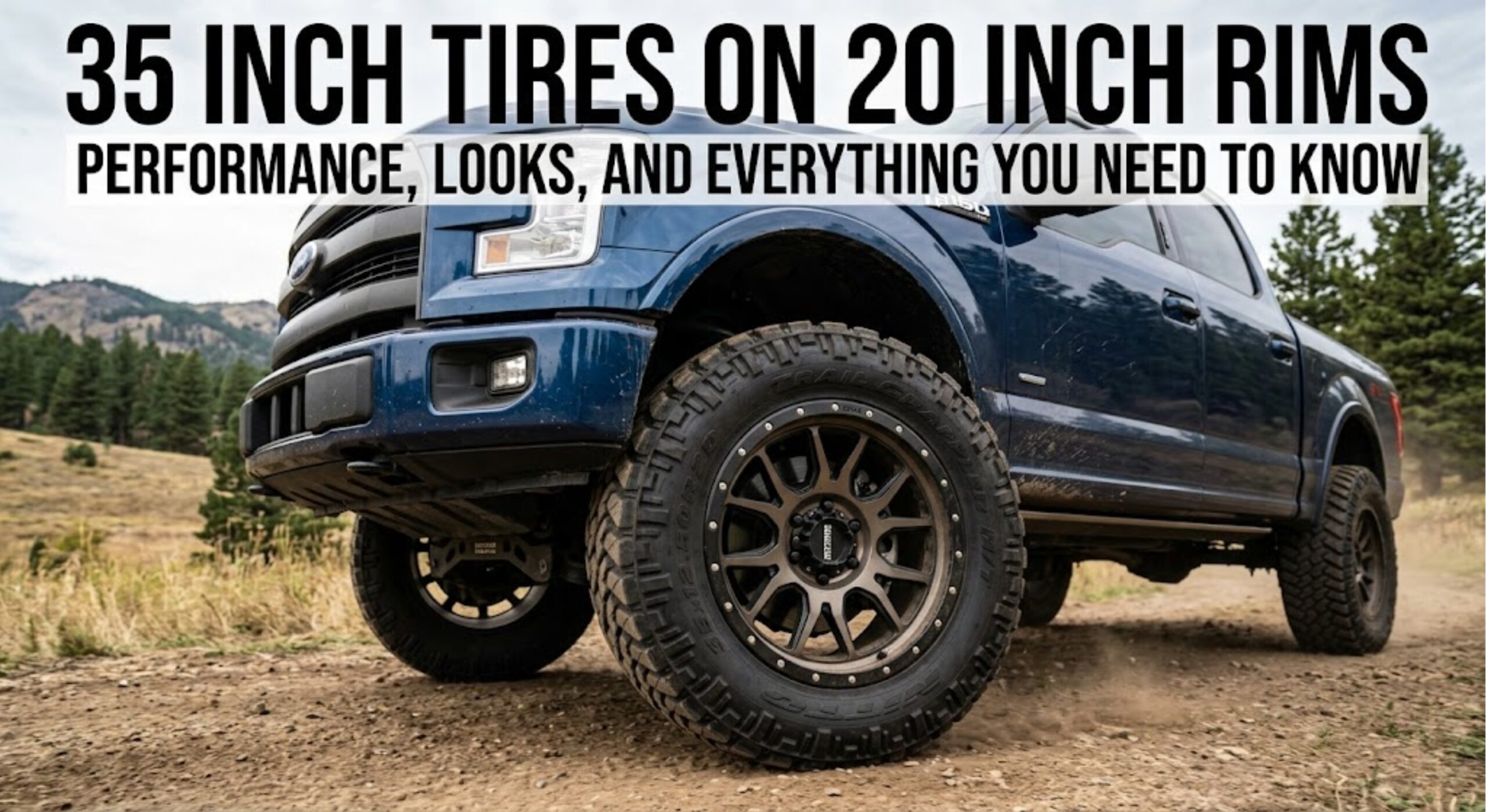
35 Inch Tires on 20 Inch Rims Fitment Guide for Trucks in 2026

Whether 35 inch tires on 20 inch rims will work on your truck comes down to three things: your vehicle platform, your current lift or leveling kit height, and your rim width and offset. Change any one of those three, and the fitment answer changes completely.
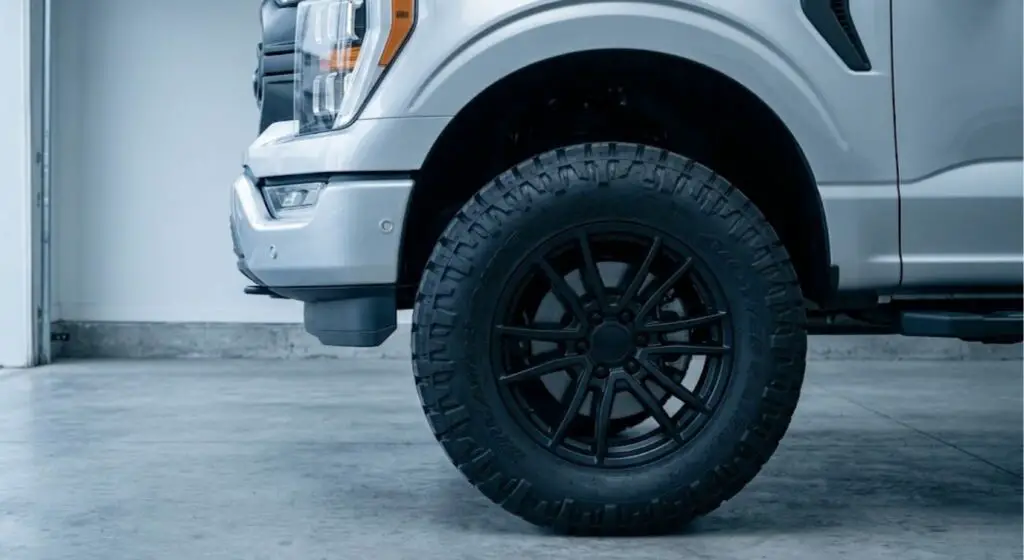
This guide walks through each condition with explicit if/then logic so you can find your exact setup and know the outcome before you spend a dollar on tires or wheels.
Prime Day Pick
Limited-time Prime Day price. Check current discount on Amazon.
Here is exactly how each condition changes the fitment outcome.
What Actually Determines If 35 Inch Tires Fit on 20 Inch Rims
Before answering whether 35s fit your truck, you need four numbers. These four variables control every fitment outcome in this guide.
Prime Day Pick
Limited-time Prime Day price. Check current discount on Amazon.
Variable 1: Your Vehicle Platform and Model Year
A Ford F-150 and a Ford F-250 have different wheel arch clearance from the factory. A Jeep Wrangler JL has more clearance than either. The same 35-inch tire on the same 20-inch rim produces a different result depending on which truck is underneath it.
Model year matters too. The 2021+ F-150 (14th gen) has a slightly different front suspension geometry than the 2015–2020 13th gen, which changes how much the tire sweeps through the wheel well at full steering lock.
Prime Day Pick
Limited-time Prime Day price. Check current discount on Amazon.
Variable 2: Your Current Lift or Leveling Kit Height
Stock height is the most restrictive condition. A 2-inch leveling kit opens up fitment significantly. A 3-inch level is the sweet spot for most half-ton builds. A 4-inch or taller lift gives full clearance but introduces new offset requirements.
If you do not know your current lift height, measure from the center of the wheel to the top of the wheel arch on both front and rear before going further.
Prime Day Pick
Limited-time Prime Day price. Check current discount on Amazon.
Variable 3: Your Rim Width
The correct rim width for a 35×12.50r20 tire is 8.5 to 10 inches. An 8-inch rim is the absolute minimum — the tire will mount but the sidewall balloons outward, creating an unstable contact patch and accelerated edge wear. A 12-inch rim flattens the sidewall too aggressively and pushes the tire toward the inner fender even on lifted trucks.
Stay between 8.5 and 10 inches for correct tire profile and predictable fitment.
Prime Day Pick
Limited-time Prime Day price. Check current discount on Amazon.
Variable 4: Your Wheel Offset and Backspacing
Offset is measured in millimeters from the wheel centerline to the mounting face. For a 20-inch rim running 35s on a Ford F-150, the correct offset range is -12mm to +12mm. Going more positive than +12mm pushes the tire inward toward the inner fender liner. Going more negative than -25mm pushes the tire outward past the fender edge, which creates body rub and can be illegal in some states.
Backspacing is the physical measurement from the mounting face to the inner edge of the rim. For a lifted F-150 with 35s on 20-inch rims, 4.5 to 5.5 inches of backspacing is the safe range for inner fender clearance.
Once you know these four numbers, the fitment answer becomes straightforward. Here is the main path most trucks follow.
How 35 Inch Tires Fit on Stock Trucks With 20 Inch Rims
If your truck is completely stock with no lift, here is what happens with 35s on 20-inch rims.
F-150 Stock Fitment Result
On a stock 2015–2024 Ford F-150, a 35×12.50r20 tire does not fit cleanly. The tire will clear in a straight line and at gentle steering angles, but at full steering lock — which happens every time you park or make a tight turn — the front tire contacts the front mud flap and inner fender liner.
You will also get upper control arm contact on the tire sidewall at full compression and full lock simultaneously, which is a common scenario on uneven surfaces. Running 35s stock on an F-150 is not recommended without at minimum removing the front mud flap — and if you want a clean no-drill solution, no-drill mud flaps for the F-150 give you a clean replacement after trimming the factory bracket.
Running 35s stock on an F-150 is not recommended without at minimum trimming the front mud flaps and removing the lower portion of the inner fender liner.
F-250 and F-350 Stock Fitment Result
The F-250 and F-350 Super Duty have more factory wheel arch clearance than the F-150 due to their heavier-duty front suspension geometry and larger wheel wells.
On a stock 2017–2024 F-250, a 35×12.50r20 tire fits with minor modifications only. The front mud flap still needs trimming, but inner fender liner contact is minimal and the upper control arm clears cleanly at full lock.
If you are on a Super Duty and want to run 35s stock, you can — with mud flap trimming as the only required modification.
If you are adding a lift or leveling kit — which most people do — the fitment picture changes significantly.
How Much Lift You Need To Run 35s on 20 Inch Rims
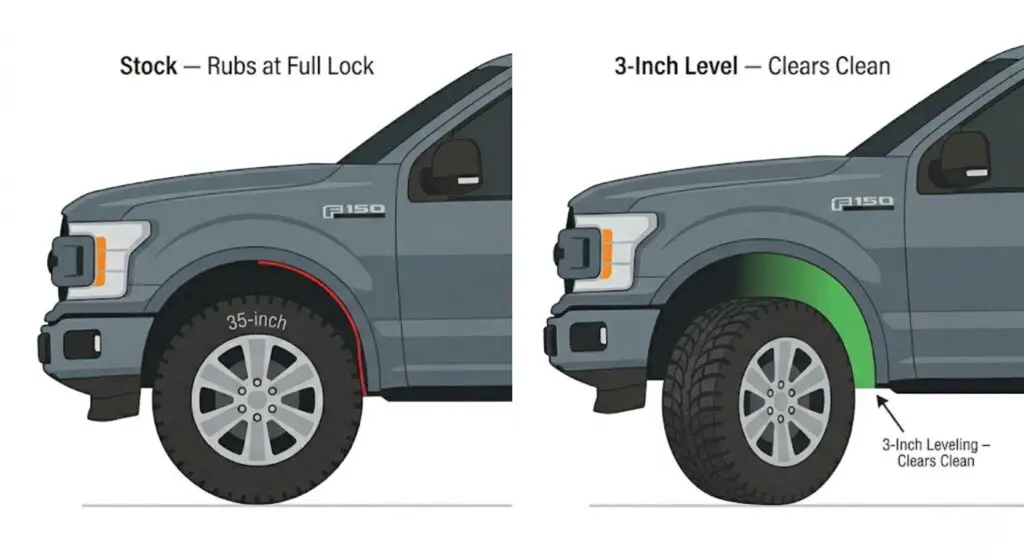
If you are running a leveling kit or lift, the fitment outcome changes based on exactly how much height you have added. Before committing to a lift height, it is worth understanding whether leveling kits are bad for the F-150 in terms of long-term wear — the short answer is no, with the right kit and alignment correction.
2 Inch Leveling Kit
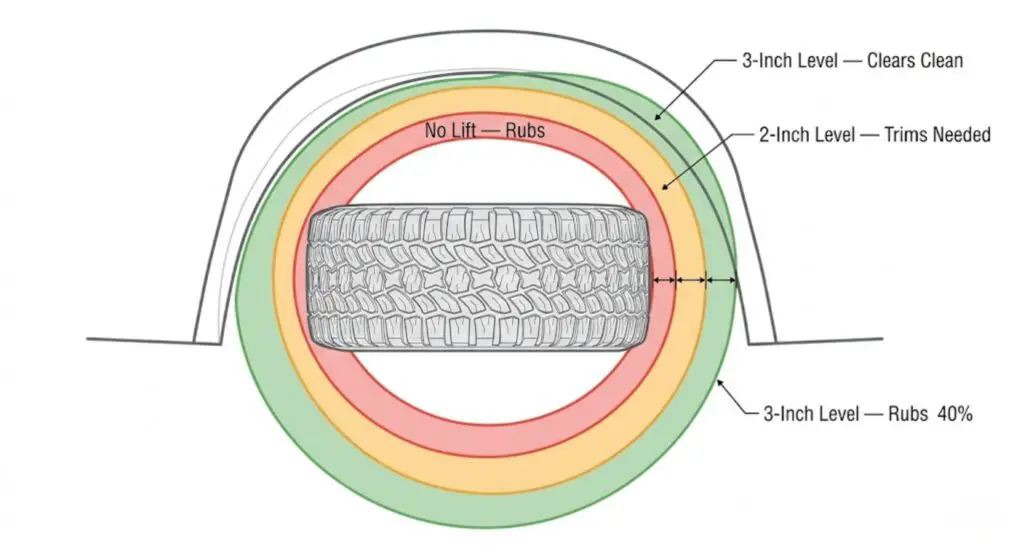
If you are on a 2-inch leveling kit, a 35×12.50r20 tire will fit on an F-150 with trimming. The front mud flap must be removed or trimmed. The lower corner of the inner fender liner will contact the tire at full lock and needs to be cut back approximately 1 to 1.5 inches.
On the 2021+ F-150 specifically, the front crash bar sits lower and can contact a 35-inch tire at full droop on a 2-inch level. A UCA (upper control arm) spacer or extended bump stop resolves this.
On the 2015–2020 F-150, a 2-inch level with mud flap and minor liner trimming is a clean build with no other modifications needed.
3 Inch Leveling Kit
If you are on a 3-inch leveling kit, a 35×12.50r20 tire fits on an F-150 with mud flap trimming only. No inner fender liner cutting is required on most trims. This is the most popular fitment for the F-150 platform for this reason.
The 3-inch level clears the tire at full steering lock on both the 2015–2020 and 2021–2024 F-150, provided your rim offset is within the -12mm to +12mm range specified above.
4 Inch Lift and Above
If you are on a 4-inch lift kit, a 35×12.50r20 tire fits cleanly on an F-150 with no trimming required. Full steering lock clearance is not an issue at this height.
However, a 4-inch lift changes your offset requirements. At this height, you have more room for negative offset without inner fender contact, which means wider rim options open up. Backspacing of 4.0 to 5.0 inches becomes the correct range rather than 4.5 to 5.5 inches at the 3-inch level.
Lift height is only half the equation. The width and offset of your 20-inch rim controls whether the tire clears the inner fender.
When Rim Width and Offset Change the Fitment Answer
If your lift clears the tire but you are still getting rub, rim width or offset is almost always the cause.
Narrow Rims (8 Inches)
A 35×12.50r20 tire mounted on an 8-inch rim stretches the sidewall inward, causing the tread face to bow outward beyond its intended profile. The tire looks visually round but the contact patch is narrower than designed, and the outer sidewall bulges. This creates unpredictable handling and irregular wear starting at the outer tread blocks within 10,000 to 15,000 miles.
Eight inches is technically within the mounting range but is the wrong choice for this tire size.
Correct Rim Width (8.5 to 10 Inches)
An 8.5 to 10-inch rim produces the correct sidewall profile for a 35×12.50r20. The tread sits flat, the sidewall is straight, and the fitment behavior is exactly what the tire manufacturer designed for.
If you are buying new rims specifically for this build, 9 or 9.5 inches is the ideal width.
Wide Rims (10.5 to 12 Inches)
A 35×12.50r20 on a 10.5-inch rim is within range but starts to flatten the sidewall noticeably. On a 12-inch rim, the tire is stretched in reverse — the tread flattens and the sidewall pulls inward, which pushes the outer face of the tire further out. At this width, even a correctly lifted truck can develop inner fender contact because the tire is physically wider than its labeled size.
Avoid 12-inch rims with a 35×12.50r20 unless you have confirmed clearance on your specific build.
Even with the right lift and rim specs, some builds still run into edge case problems. Here is what to watch for.
35 Inch Tires on 20 Rims Rubbing and Trimming Edge Cases
Even when the basic conditions are met, a few specific scenarios can still cause fitment problems.
- Full steering lock rub on a 2-inch level: The most common complaint after installation. The tire clears at normal driving angles but contacts the mud flap or liner at maximum steering input. Fix: remove the front mud flap bracket and trim the lower front corner of the inner fender liner.
- UCA contact at full compression and full lock simultaneously: Happens on F-150 builds with aftermarket UCAs that have more travel than stock. The arm sweeps into the tire sidewall at the apex of compression plus steering input. Fix: verify UCA-to-tire clearance with a zip tie test before driving — wrap a zip tie around the UCA, drive a full day including parking lot maneuvers, and check whether the zip tie shows contact marks.
- F-150 Tremor and FX4 clearance advantage: The F-150 Tremor package runs a factory 33-inch tire on a wider arch and has 1 to 1.5 inches more clearance than the base XL or XLT trim. If you are on a Tremor, a 35-inch tire on a 2-inch level fits with mud flap trimming only — no liner cutting needed. The FX4 Off-Road package does not change wheel arch dimensions but includes a more aggressive bump stop that can contact the tire — removing the extended bump stop resolves this.
- Speedometer deviation: A 35×12.50r20 tire has an overall diameter of approximately 34.5 inches. If your stock tire was a 275/55r20 (32.1 inches overall), your speedometer reads approximately 7.5% high after the swap. At an indicated 60 mph, your actual speed is approximately 55.5 mph. At an indicated 75 mph, your actual speed is approximately 69.4 mph. This also affects transmission shift points and, if you tow, it connects directly to your tire load range rating— running load range E vs F on a 35-inch tire changes your payload and towing limits. Recalibrate using a tuner (SCT, Bully Dog, or dealer recalibration) before driving at highway speeds.
- Metric size equivalents: The 35×12.50r20 is the most common size, but 305/55r20 and 325/60r20 are also marketed as 35-inch tires. The 305/55r20 has an overall diameter of 33.2 inches — it is technically a 33-inch tire, not a 35. The 325/60r20 has a diameter of 35.4 inches and is the closest metric equivalent to a true 35. Confirm overall diameter before purchasing using a tire size calculator.
35 Inch Tire Fitment Decision Matrix for 20 Inch Rims
Use this matrix to look up your exact setup. Rim width assumed to be 9 inches at correct offset for all rows.
| Vehicle | Lift Height | Rim Width | Fitment Outcome |
|---|---|---|---|
| F-150 (2015–2024) | Stock | 9 inch | Does Not Fit Cleanly |
| F-150 (2015–2020) | 2-inch level | 9 inch | Fits With Trimming |
| F-150 (2021–2024) | 2-inch level | 9 inch | Fits With Trimming |
| F-150 (2015–2024) | 3-inch level | 9 inch | Fits Clean |
| F-150 Tremor | 2-inch level | 9 inch | Fits Clean |
| F-150 (2015–2024) | 4-inch lift | 9 inch | Fits Clean — No Trimming |
| F-250 Super Duty (2017–2024) | Stock | 9 inch | Fits With Minor Trimming |
| F-250 Super Duty (2017–2024) | 2-inch level | 9 inch | Fits Clean |
| Any Truck | Stock | 8 inch | Not Recommended |
| Any Truck | Any lift | 12 inch | Verify Before Install |
| Vehicle | Lift Height | Rim Width | Outcome |
|---|---|---|---|
| F-150 (2015–2024) | Stock | 9 inch | Does Not Fit — full lock rub, UCA contact |
| F-150 (2015–2020) | 2-inch level | 9 inch | Fits with trimming — mud flap + liner corner |
| F-150 (2021–2024) | 2-inch level | 9 inch | Fits with trimming — mud flap + extended bump stop removal |
| F-150 (2015–2024) | 3-inch level | 9 inch | Fits Clean — mud flap removal only |
| F-150 Tremor | 2-inch level | 9 inch | Fits Clean — mud flap removal only |
| F-150 (2015–2024) | 4-inch lift | 9 inch | Fits Clean — no trimming required |
| F-250 Super Duty (2017–2024) | Stock | 9 inch | Fits with minor trimming — mud flap only |
| F-250 Super Duty (2017–2024) | 2-inch level | 9 inch | Fits Clean — no trimming required |
| Any Truck | Stock | 8 inch | Not Recommended — sidewall balloon, irregular wear |
| Any Truck | Any lift | 12 inch | Risk of inner fender contact — verify before install |
When To Get a Professional Fitment Check Before Installing 35s
This guide covers standard lift and leveling builds on production trucks. A few situations go beyond what a fitment guide can safely answer.
- Custom or coilover suspension: Long-travel setups, coilover conversions, and spacer lifts change suspension geometry in ways that affect tire sweep at full compression — a shop with a lift and a steering angle measurement tool needs to verify clearance physically.
- Modified axles or differential drops: A differential drop changes the angle at which the CV axle sweeps through its arc, which directly affects how close the tire gets to the UCA at full droop. This is not a number you can calculate from a guide.
- Towing and payload builds: If your truck is used for towing or commercial payload, speedometer deviation is not just a convenience issue. Accurate speed calibration affects transmission shift points, trailer brake timing, and in some jurisdictions, compliance with commercial vehicle regulations. Get a dealer or certified tuner recalibration before towing with uncalibrated 35s.
- State fender protrusion laws: Several US states — including California, Washington, and Oregon — prohibit tires that extend beyond the fender line without fender flares. Negative offset builds that push the tire outward may require aftermarket flares to be street legal. Verify your state’s vehicle code before finalizing offset selection.
When any of these conditions apply, a fitment consultation at a tire and suspension shop takes 30 minutes and eliminates the risk of a $1,200 tire set that does not clear your specific build.
Frequently Asked Questions
What size tire is considered a 35 inch tire on a 20 inch rim?
The standard size is 35×12.50r20, which has an overall diameter of approximately 34.5 inches. The closest metric equivalent is 325/60r20 at 35.4 inches diameter. The commonly cited 305/55r20 is actually a 33-inch tire, not a 35 — confirm overall diameter before purchasing.
Can you put 35 inch tires on a stock truck with 20 inch rims?
On a stock F-150, 35s will not fit cleanly — full lock rub on the mud flap and inner fender liner is unavoidable without trimming. On a stock F-250 or F-350, 35s fit with mud flap trimming only due to the larger factory wheel arch. A 2-inch leveling kit resolves most fitment issues on the F-150.
Do 35 inch tires on 20 inch rims hurt fuel economy?
Yes. Switching from a stock 275/55r20 to a 35×12.50r20 typically reduces fuel economy by 1 to 2 mpg on the highway and 2 to 3 mpg in the city, primarily due to increased rotational mass and rolling resistance. The exact impact depends on driving style, terrain, and tire brand.
What is the minimum rim width for 35 inch tires?
The minimum rim width for a 35×12.50r20 is 8 inches, but 8.5 to 10 inches is the correct range for proper sidewall profile and even tread wear. An 8-inch rim causes sidewall ballooning and accelerated outer edge wear. Never mount a 35×12.50r20 on a rim narrower than 8 inches.
Will 35 inch tires throw off my speedometer on a 20 inch rim setup?
Yes. A 35×12.50r20 is approximately 7.5% larger in diameter than a stock 275/55r20. This causes your speedometer to read approximately 7.5% high — at an indicated 60 mph, your actual speed is closer to 55.5 mph. Recalibrate with a tuner or dealer before highway driving.
Conclusion
Running 35 inch tires on 20 inch rims is a straightforward build when you match the three controlling conditions: your vehicle platform, your lift height, and your rim width and offset. On a Ford F-150 with a 3-inch leveling kit and a 9-inch rim at correct offset, this is one of the cleanest tire upgrades you can do — mud flap off, tires on, done.
Use the decision matrix above to confirm your specific setup before purchasing. If you are planning the leveling kit side of this build, check our [leveling kit options for F-150] guide for the right kit by model year and budget. Get the fitment right first — the tires last.