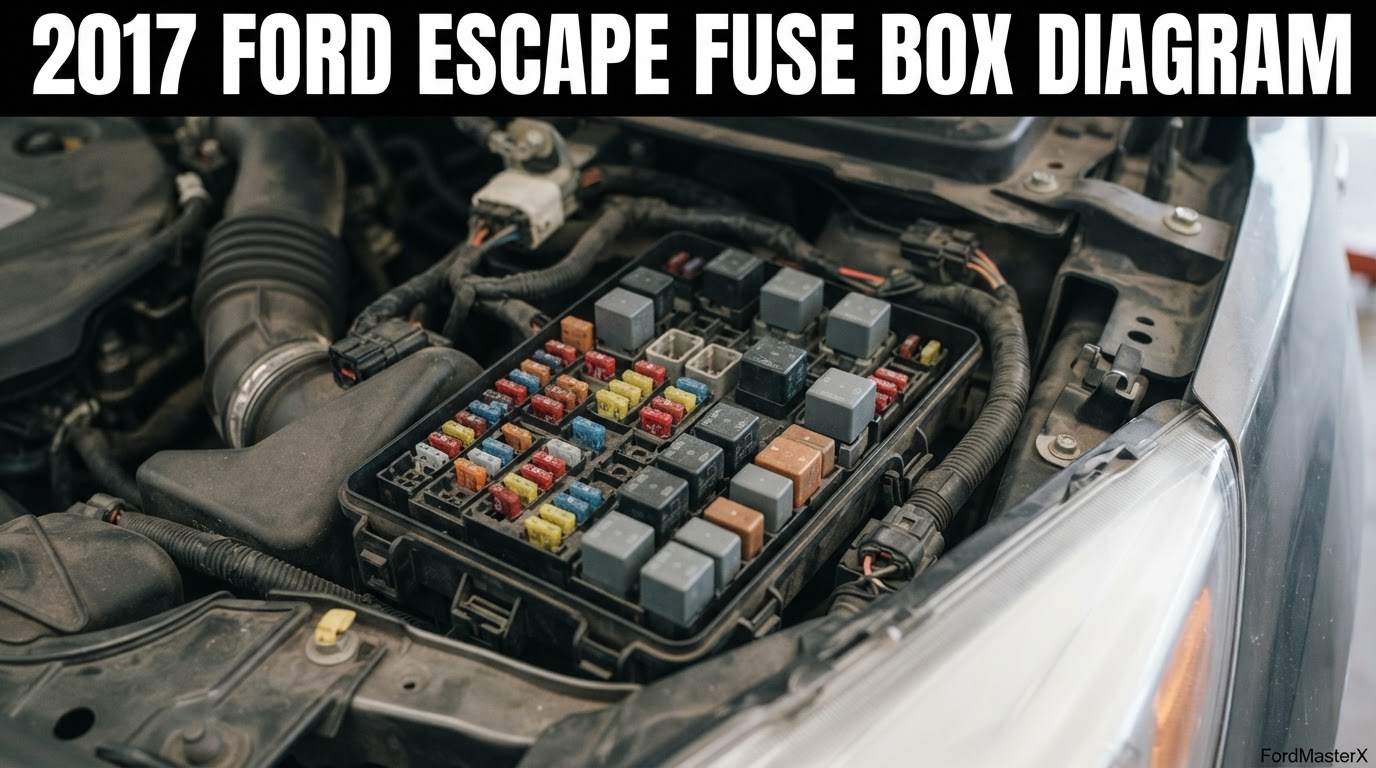
2017 Ford Escape Fuse Box Diagram: Both Panels, Every Fuse

Your 2017 Ford Escape has three fuse boxes: a passenger compartment panel below the glove box, a power distribution box in the engine bay, and a luggage compartment panel behind the passenger side wheel well. The cigar lighter and front power point run on fuse F61, rated 20A, in the passenger compartment panel. This is a mid-cycle refresh year, so its engine bay chart is not the same as a 2014 or 2016 Escape.
Where are the fuse boxes on a 2017 Ford Escape?
Recommended Best Deal Products


This is a third-generation Escape, chassis code C520, built 2013 to 2019. Ford refreshed the lineup at the 2017 model year: a new 1.5L EcoBoost engine option, forward-looking radar for adaptive cruise and collision warning, and SYNC 3 arrived together. That refresh changed real fuse assignments, not just trim badges.

Prime for Young Adults — 6 Months Free
Students and 18–24s get six months of Prime free, then half price.
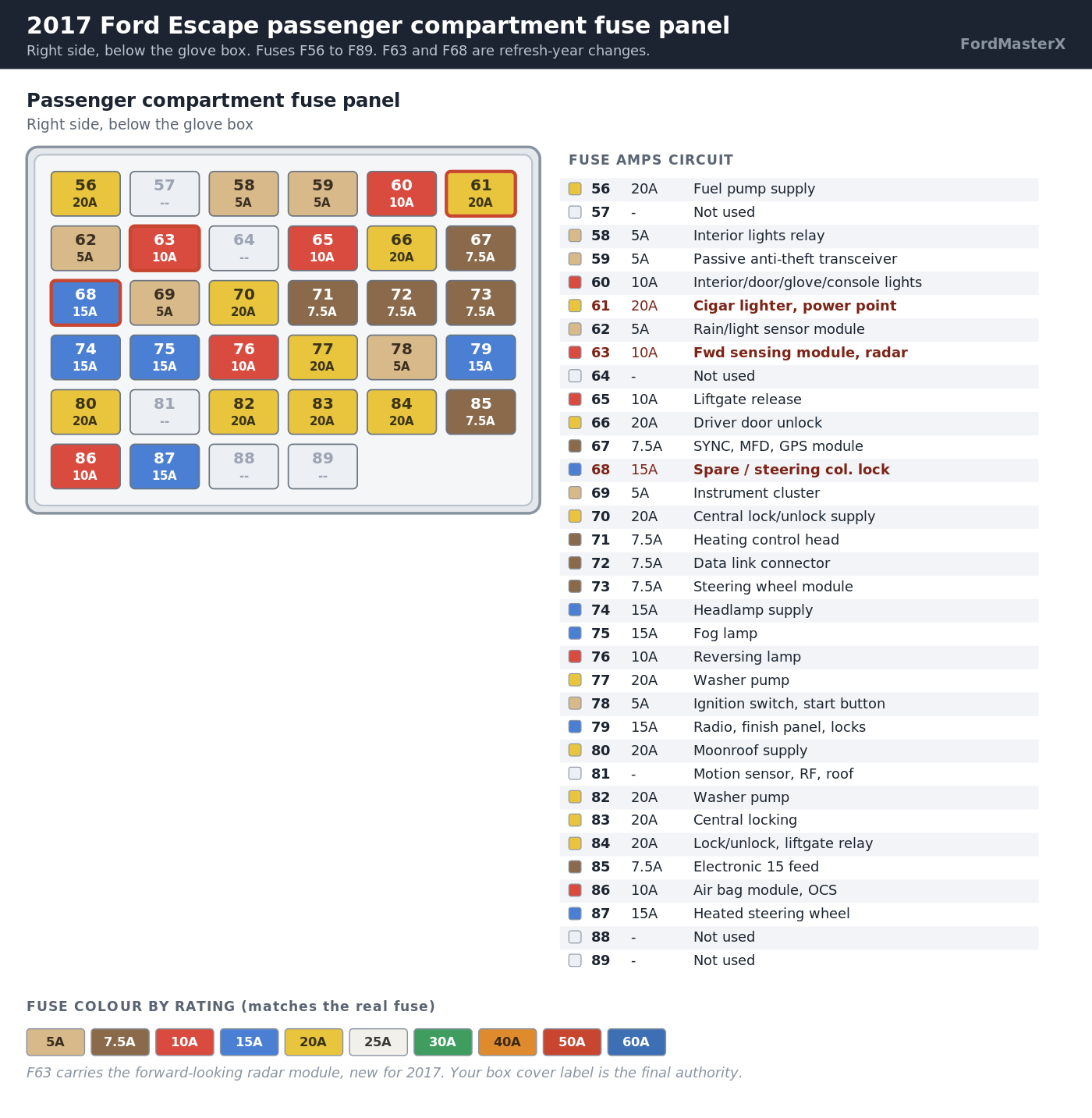
Start 6 Months Free As an Amazon Associate I earn from qualifying purchases.Passenger compartment fuse panel. Right side, below the glove box. Remove the glove box bottom to reach it. Holds fuses F56 through F89.
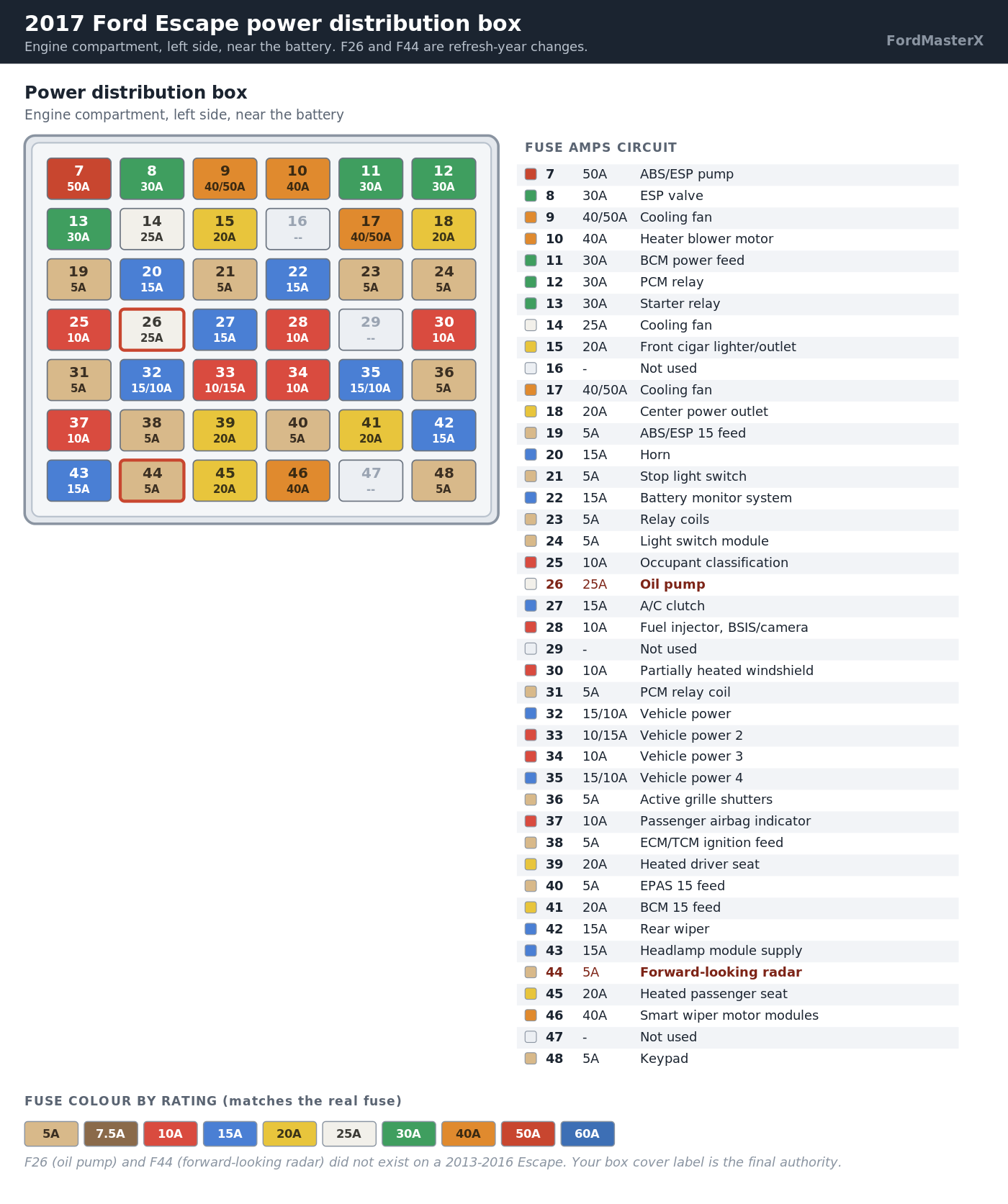
Power distribution box. Engine compartment, left side, near the battery. Holds fuses F7 through F48 plus sixteen relay positions.
Luggage compartment fuse panel. Behind the passenger side wheel well in the cargo area. Pop the cover to reach fuses F1 through F46.
Do not reuse a 2013 to 2016 Escape chart on a 2017. Three positions change because of hardware Ford added for this model year: F63 goes from an unused spare to the forward-looking radar module, F26 in the engine bay goes from a 5A keep-alive feed to a 25A oil pump circuit, and F44 in the engine bay drops from the front fog lamp feed to the radar module’s own 5A line. If you have a 2013 to 2016 Escape instead, use the 2014 Ford Escape fuse box diagram, which carries the pre-refresh table.
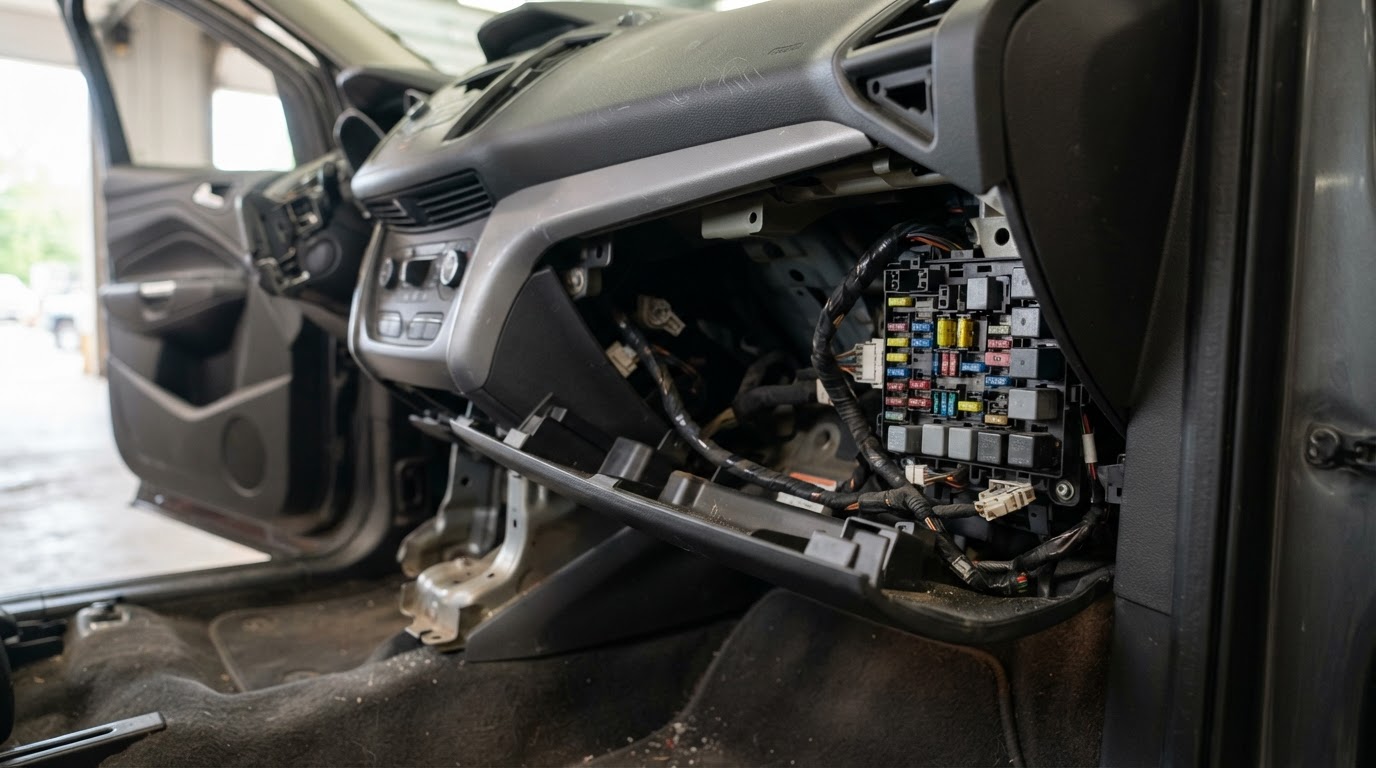
2017 Ford Escape passenger compartment fuse chart
Right side, below the glove box. All mini fuses.
| Fuse | Amps | Circuit protected |
|---|---|---|
| F56 | 20A | Fuel pump supply |
| F57 | – | Not used |
| F58 | 5A | Interior lights relay |
| F59 | 5A | Passive anti-theft transceiver |
| F60 | 10A | Interior light, driver door switch pack, glove box light, overhead console switch bank |
| F61 | 20A | Cigar lighter, power point |
| F62 | 5A | Rain sensor module, light sensor module |
| F63 | 10A | Front sensing module, forward-looking radar |
| F64 | – | Not used |
| F65 | 10A | Liftgate release |
| F66 | 20A | Driver door unlock |
| F67 | 7.5A | SYNC, multifunction display, global positioning system module |
| F68 | 15A | Not used (spare) on Ford’s own chart; see the note below |
| F69 | 5A | Instrument cluster |
| F70 | 20A | Central lock and unlock supply |
| F71 | 7.5A | Heating control head (manual air conditioner), dual electronic automatic temperature control |
| F72 | 7.5A | Data link connector |
| F73 | 7.5A | Steering wheel module |
| F74 | 15A | Headlamp supply |
| F75 | 15A | Fog lamp |
| F76 | 10A | Reversing lamp |
| F77 | 20A | Washer pump |
| F78 | 5A | Ignition switch, start button, keyless vehicle module |
| F79 | 15A | Radio, electronic finish panel, hazard light switch, door lock switch |
| F80 | 20A | Moonroof supply |
| F81 | – | Interior motion sensor supply, radio frequency receiver supply, panorama roof power/open |
| F82 | 20A | Washer pump |
| F83 | 20A | Central locking |
| F84 | 20A | Lock/unlock relay, liftgate relay |
| F85 | 7.5A | Electronic 15 feed |
| F86 | 10A | Air bag module, occupant classification system, passenger air bag deactivation indicator |
| F87 | 15A | Heated steering wheel |
| F88 | – | Not used |
| F89 | – | Not used |
F68 is a genuine source conflict, not a typo. Ford’s own official 2017 owner’s manual on fordservicecontent.com lists F68 as an unused 15A spare. Two independently compiled trackers, fuse-box.info and StartMyCar, both citing the same 2017 Escape manual, list F68 as the electronic steering column lock instead. The likely explanation is trim: the electronic steering column lock only exists on Escapes built with push-button start and passive entry, so a base key-ignition trim’s chart legitimately shows the position as spare. If your Escape has push-button start, treat F68 as the steering column lock fuse. If it does not, F68 is the spare Ford’s chart describes.
2017 Ford Escape power distribution box chart
Recommended Best Deal Products


Engine compartment, left side, near the battery. Cartridge fuses are marked with two asterisks below, mini fuses with one. Several positions carry two values because they depend on your engine or cooling fan option; both are shown.
| Fuse | Amps | Circuit protected |
|---|---|---|
| F7 | 50A** | Anti-lock brake system and electronic stability program pump |
| F8 | 30A** | Electronic stability program valve |
| F9 | 40A / 50A | Cooling fan, 600W / cooling fan, 390W and 750W |
| F10 | 40A** | Heater blower motor |
| F11 | 30A** | Body control module power feed, voltage quality module |
| F12 | 30A** | Powertrain control module relay |
| F13 | 30A** | Starter relay |
| F14 | 25A** | Cooling fan, 600W and 750W |
| F15 | 20A** | Front cigar lighter or power outlet |
| F16 | – | Not used |
| F17 | 40A / 50A | Cooling fan, 600W / cooling fan, 750W |
| F18 | 20A** | Center power outlet |
| F19 | 5A* | Anti-lock brake system and electronic stability program 15 feed |
| F20 | 15A* | Horn |
| F21 | 5A* | Stop light switch |
| F22 | 15A* | Battery monitor system |
| F23 | 5A* | Relay coils |
| F24 | 5A* | Light switch module |
| F25 | 10A* | Occupant classification system |
| F26 | 25A* | Oil pump |
| F27 | 15A* | Air conditioner clutch |
| F28 | 10A* | Vehicle power, fuel injector (2.5L engine), blind spot information system and rear view camera on stop/start equipped vehicles |
| F29 | – | Not used |
| F30 | 10A* | Partially heated windshield |
| F31 | 5A* | Powertrain control relay coil |
| F32 | 15A / 10A | Vehicle power, 2.0L and 2.5L engine / vehicle power, 1.5L engine |
| F33 | 10A / 15A | Vehicle power 2, 2.0L and 2.5L engine / vehicle power 2, 1.5L engine |
| F34 | 10A* | Vehicle power 3 |
| F35 | 15A / 10A | Vehicle power 4, 2.0L and 2.5L engine / vehicle power 4, 1.5L engine |
| F36 | 5A* | Active grille shutters |
| F37 | 10A* | Passenger airbag deactivation indicator |
| F38 | 5A* | Engine control module and transmission control module ignition feed |
| F39 | 20A* | Heated driver seat |
| F40 | 5A* | Electronic power assist steering 15 feed |
| F41 | 20A* | Body control module 15 feed |
| F42 | 15A* | Rear wiper |
| F43 | 15A* | Headlamp control module supply |
| F44 | 5A* | Forward-looking radar |
| F45 | 20A* | Heated passenger seat |
| F46 | 40A** | Smart wiper motor modules |
| F47 | – | Not used |
| F48 | 5A* | Keypad |
F26 and F44 are the two positions that mark this as a refresh-year chart. On a 2013 to 2016 Escape, F26 is a 5A keep-alive feed and F44 is a 15A front fog lamp circuit. On this 2017 chart, F26 carries a 25A oil pump circuit and F44 drops to a 5A feed for the forward-looking radar module, the sensor behind adaptive cruise control and forward collision warning. Neither of those systems exists on the pre-refresh Escape, which is why generic charts that lump 2014 through 2017 into one table get both positions wrong for a true 2017 build.
Relays in this box: R2 horn, R7 partially heated windshield, R8 high current power windows front, R11 A/C clutch, R12 cooling fan. Also R1, R5 and R6 cooling fan, R10 starter, R13 heater blower, R14 engine control, R15 cooling fan, R16 ignition 15. R3, R4 and R9 are not used on this generation.
2017 Ford Escape luggage compartment fuse chart
Behind the passenger side wheel well, in the cargo area.

Audible — Listen Free for 30 Days
One free credit a month and thousands of titles included.
Listen Free for 30 Days As an Amazon Associate I earn from qualifying purchases.| Fuse | Amps | Circuit protected |
|---|---|---|
| F1 | 5A | Hands-free liftgate entry module |
| F2 | 15A | Heated outside mirror (without door control unit), heated wiper park |
| F3 | 5A | Keyless vehicle door handles |
| F4 | 25A | Door control unit, front left |
| F5 | 25A | Door control unit, front right |
| F6 | 25A | Door control unit, rear left |
| F7 | 25A | Door control unit, rear right |
| F8 | 25A | Passenger seat |
| F9 | 25A | Driver seat |
| F10 | 5A | Driver seat memory module logic feed |
| F11 | 5A | Rear ignition coil feed |
| F12, F13 | – | Not used |
| F14 | 25A | Rear door power windows (one-touch-down trims) |
| F15 to F19 | – | Not used |
| F20 | 5A | Embedded modem |
| F21 | – | Not used |
| F22 | 25A | Heated rear window |
| F23 | 25A | Audio amplifier |
| F24 | 30A | DC/AC power converter |
| F25 | 25A / 40A | Power liftgate (one-touch trims) / trailer tow (one-touch-down trims) |
| F26 | 20A | Rear power outlet |
| F27 | 20A | Luggage compartment power outlet |
| F28 | 40A / 25A | Trailer tow (one-touch trims) / front door power windows (one-touch-down trims) |
| F29 | 5A | Blind spot detection system, rear view camera with park assist |
| F30 | 5A | Parking aid module |
| F31 | – | Not used |
| F32 | 5A | DC/AC power converter |
| F33 | 10A | High current power window switch |
| F34 to F45 | – | Not used |
| F46 | 5A | Heated outside mirror relay coil |
F25 and F28 split by your window package, not by a printing error. Escapes with driver-side one-touch-down only put trailer tow on F28 and power windows on F25. Escapes with one-touch up and down on every window put power liftgate on F25 and trailer tow on F28. Check your fuse box cover label if you need to confirm which your vehicle has before pulling either one.
Relay: R2 mini relay, rear 15 relay. R3 micro relay, heated rear window relay. R6 micro relay, heated outside mirror relay. R1, R4 and R5 are not used.
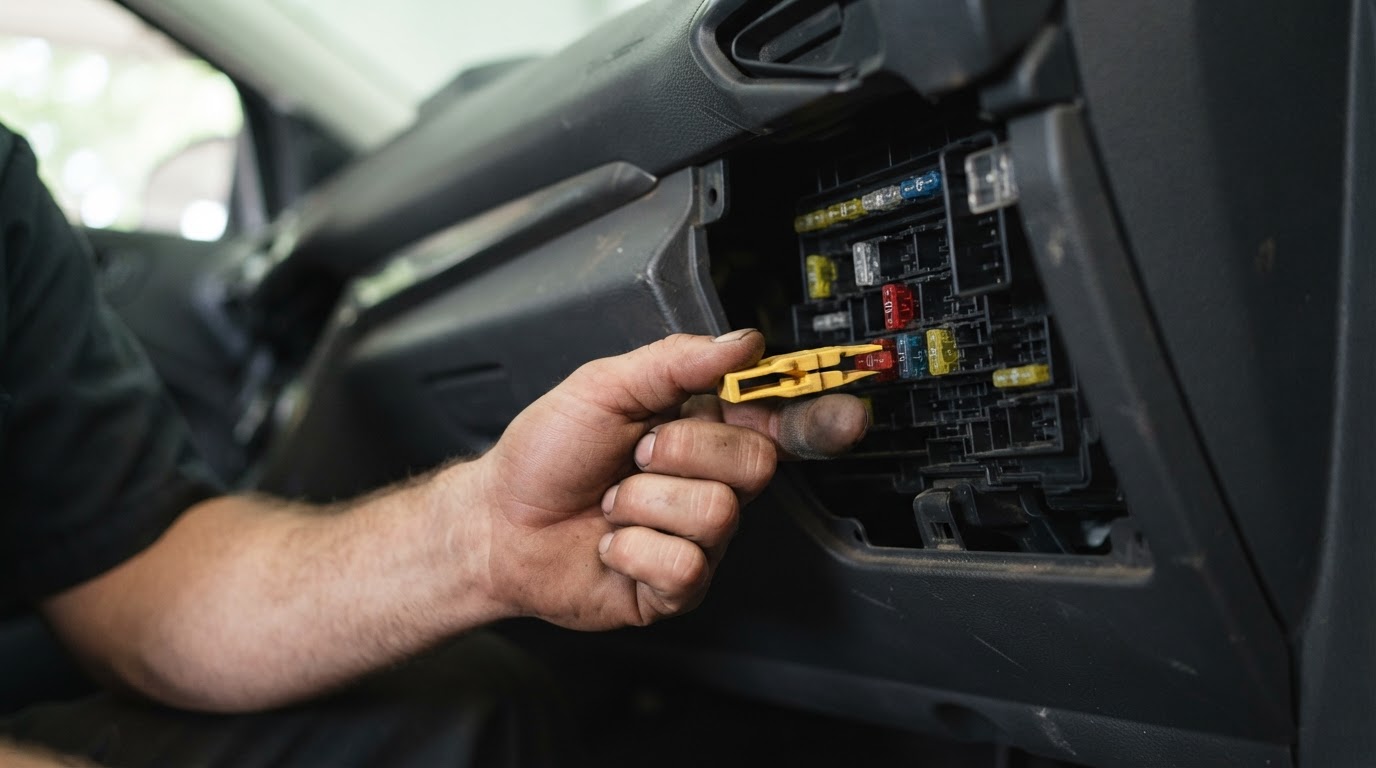
Which fuse is the cigar lighter and power outlets?
Recommended Best Deal Products


The main cigar lighter and front power point is fuse F61, rated 20A, in the passenger compartment panel below the glove box.
The rest of the outlets split across the other two boxes:
- F15, 20A, engine bay. Front cigar lighter or power outlet, a second point on the same circuit type.
- F18, 20A, engine bay. Center power outlet.
- F26, 20A, luggage compartment. Rear power outlet.
- F27, 20A, luggage compartment. Cargo area power outlet.
If the front 12V socket in the console is dead, check F61 first. If a rear or cargo outlet is dead but the front one still works, the fault is isolated to F18, F26 or F27.
Which fuse controls the radio and SYNC 3?
Fuse F79, 15A, passenger compartment panel is the direct radio fuse on this generation. It also carries the electronic finish panel, hazard light switch and door lock switch.
Two other fuses affect the infotainment system:
- F67, 7.5A. SYNC, the multifunction display and the GPS module. A 2017 with SYNC 3 runs through the same position as earlier years.
- F23, 25A, luggage compartment. Audio amplifier. If the head unit powers on and shows its screen but no sound comes out of any speaker, this is the fuse to check, not F79.
Symptom-to-fuse quick lookup
| Symptom | Check this fuse | Box |
|---|---|---|
| Radio powers on, no sound from speakers | F23, 25A | Luggage compartment |
| Front 12V socket dead | F61, 20A | Passenger compartment |
| Rear or cargo 12V outlet dead, front works | F18, F26 or F27, 20A | Engine bay or luggage |
| Heater blower does not run at any speed | F10, 40A | Engine bay |
| A/C compressor will not engage | F27, 15A | Engine bay |
| Adaptive cruise control or collision warning disabled | F44 or F63 | Engine bay and passenger compartment |
| Oil pump circuit fault code | F26, 25A | Engine bay |
| Liftgate will not release from the button | F65, 10A | Passenger compartment |
| Power liftgate will not open under power | F25, 25A (one-touch trims) | Luggage compartment |
| Heated seat, driver or passenger, not warming | F39 or F45, 20A | Engine bay |
| Moonroof will not move | F80, 20A | Passenger compartment |
| Rear wiper does not run | F42, 15A | Engine bay |
| No crank at the key | F13, 30A | Engine bay |
| SYNC screen frozen or blank, everything else fine | F67, 7.5A | Passenger compartment |
How do you tell if a fuse is actually blown?
Pull it and check the metal element through the plastic window. A good fuse shows an unbroken strip. A blown one shows a visible gap or a window smoked brown or black.
A hairline crack can still look intact under normal light. If you are not sure, test continuity with a multimeter set to ohms. Near zero ohms means the fuse is good. The cartridge fuses in the power distribution box, marked with two asterisks above, need a puller, not pliers, or you crack the housing. A mixed ATO/ATC fuse assortment kit usually includes one and costs less than a single dealer fuse.
Why does the same fuse keep blowing?
A fuse that blows once is usually a surge. One that blows again within days means the fault sits upstream. Replacing it on repeat just treats the symptom, not the cause.
Audible Premium Plus — Annual Membership
12 audiobook credits up front, plus the full Audible catalogue.
See Annual Plans As an Amazon Associate I earn from qualifying purchases.- Unplug anything added recently. A phone charger left in the power point, an aftermarket stereo, or trailer wiring are the most common repeat blows on this generation.
- Check where the harness flexes. The liftgate harness and the door jambs take the most wear on an Escape this age, since both move every time they are used.
- Look for water intrusion. A damp connector shorts intermittently, so the fuse can survive a dry week and fail after rain.
- Consider the load itself. A binding power window motor keeps tripping its fuse. A failing blower motor resistor does the same to F10.
If a fuse blows the instant you seat it, that is a hard short, not a surge. Stop replacing fuses and read live data instead. Our Ford diagnostic tool comparison covers scan tools that read circuit-level data on this generation rather than just pulling trouble codes.
Where most 2017 Escape fuse charts get it wrong
I cross-checked three sources for this chart: Ford’s own official 2017 Escape owner’s manual on fordservicecontent.com, fuse-box.info’s year-split table which separates 2013, 2014-2015, 2016, 2017, and 2018-2019 into their own tables, and StartMyCar’s 2017-specific diagram, which states it is built from the 2017 Ford Escape owner’s manual. All three agree on every fuse in the power distribution box and the passenger compartment panel except the F68 trim split noted above.
A fourth site, a “2013 to 2019” merged fuse guide, folds 2014 through 2017 into a single table and gets 2017 wrong in two places. It shows F63 as an unused spare, when a genuine 2017 chart carries the forward-looking radar module there. It also shows F71 at 10A, when Ford’s 2017 chart and both other independent sources put F71 at 7.5A. Both errors come from carrying a 2014-2016 row forward into a year Ford actually changed it, the same mistake this site’s own 2003 versus 2006 F-150 research already flagged as the most common failure mode in fuse charts online.
2017 Ford Escape fuse quick reference
The positions owners look up most, in one place. P is passenger compartment, E is engine bay, L is luggage compartment.
| What you want | Fuse | Amps | Box |
|---|---|---|---|
| Cigar lighter, front power point | F61 | 20A | P |
| Radio | F79 | 15A | P |
| Audio amplifier | F23 | 25A | L |
| Heater blower | F10 | 40A | E |
| A/C clutch | F27 | 15A | E |
| Oil pump | F26 | 25A | E |
| Forward-looking radar | F44 / F63 | 5A / 10A | E / P |
| Liftgate release button | F65 | 10A | P |
| Power liftgate motor | F25 | 25A | L |
| Heated seats | F39 / F45 | 20A | E |
| Moonroof | F80 | 20A | P |
| Rear wiper | F42 | 15A | E |
| Starter relay | F13 | 30A | E |
| Instrument cluster | F69 | 5A | P |
| SYNC / multifunction display | F67 | 7.5A | P |
| Trailer tow module | F25 or F28 | 40A | L |
If your Escape needs its oil life monitor reset too, our 2017 Ford Escape oil reset guide covers the exact button sequence for this model year. For the closest fuse chart in this generation, the 2014 Ford Escape fuse box diagram covers the pre-refresh layout, and the 2013 Ford Escape fuse box diagram covers the first year of this generation.