
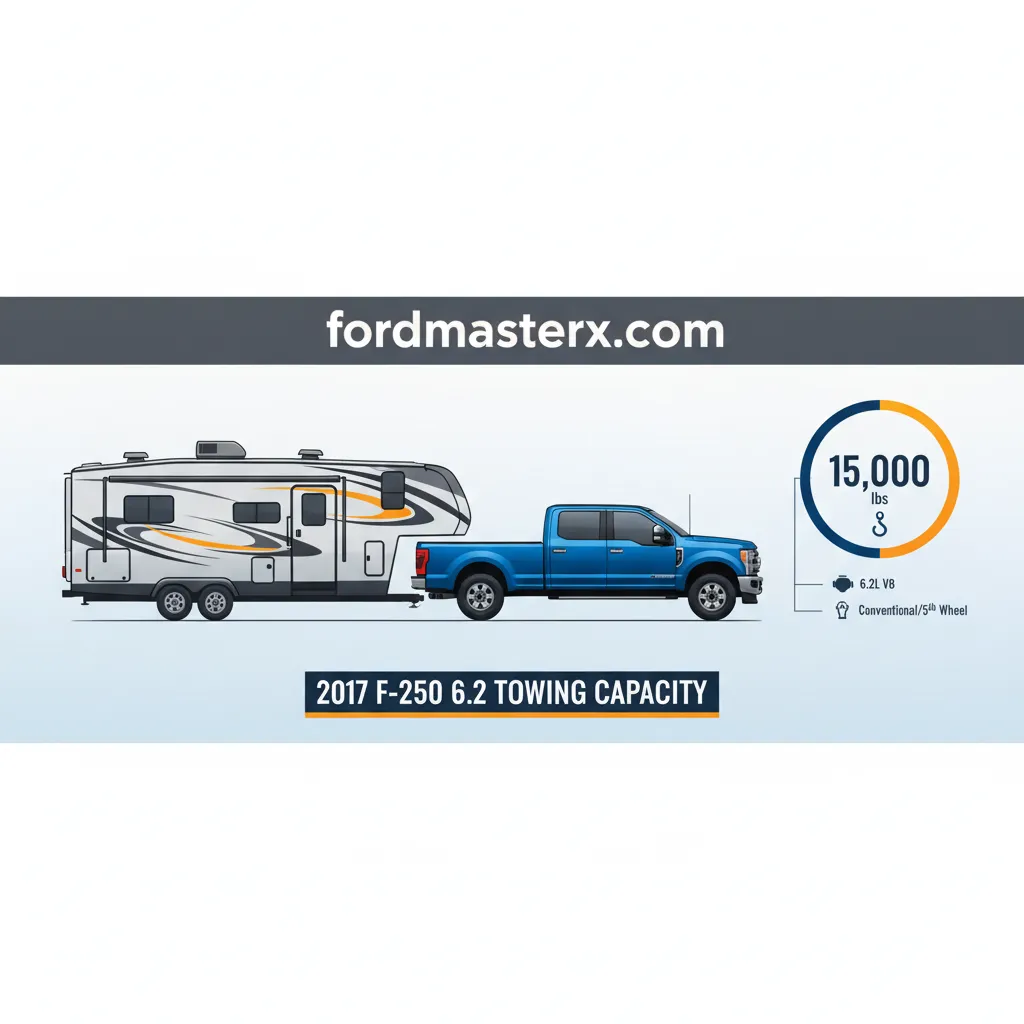
2017 F250 6.2 Towing Capacity: Performance Specs And Configuration Limits

The 2017 Ford F-250 Super Duty redefined the heavy-duty gas segment by combining a high-strength, military-grade aluminum body with the proven 6.2L Boss V8. While the spotlight often shines on the high-torque diesel variants, the gas-powered F-250 offers a compelling value proposition for those prioritizing payload, lower maintenance costs, and impressive cold-weather reliability. However, potential owners and fleet managers often struggle to navigate the complex matrix of axle ratios, cab configurations, and hitch types that dictate actual towing limits. This comprehensive guide provides a professional breakdown of the 2017 F250 6.2 towing capacity, ensuring you select the right configuration for your hauling requirements with trusted accuracy.
Section 1: Understanding the 2017 F250 6.2L V8 Powertrain and Torque Curve
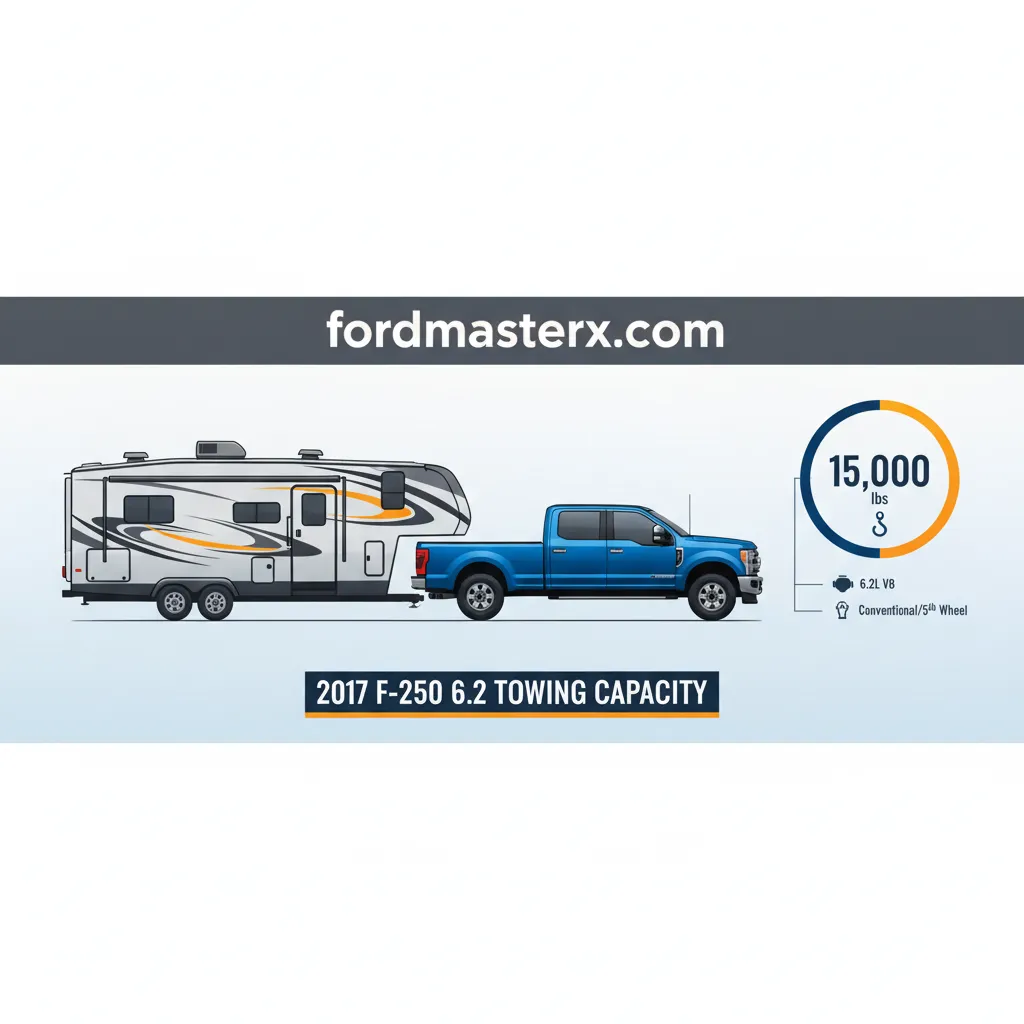
📤 Share Image
At the heart of the 2017 F-250 gas lineup is the 6.2L SOHC (Single Overhead Cam) V8 engine, colloquially known as the “Boss.” In this iteration, the engine delivers a stout 385 horsepower at 5,750 RPM and 430 lb-ft of torque at 3,800 RPM. Unlike smaller displacement engines that rely on forced induction, the 6.2L is a naturally aspirated workhorse designed for durability and sustained high-RPM operation, which is a critical quality for towing up steep grades.
The TorqShift-G 6-Speed Transmission
A pivotal mechanical update for 2017 was the introduction of the TorqShift-G 6-speed automatic transmission (6R100), specifically paired with the 6.2L engine in the F-250 series. This transmission is lighter than its diesel-bound counterpart but features specifically tuned gear ratios to improve low-end launch performance. In my expert experience, this gearbox provides much crisper shifts and better management of the gas engine’s power band compared to the older transmissions found in the steel-body generation.
By The Numbers: 6.2L V8 Performance
Horsepower (HP)
Torque (lb-ft)
Peak Torque RPM
The transition to an aluminum-alloy body in 2017 resulted in a weight reduction of approximately 350 pounds. This reduction directly enhances the power-to-weight ratio. When comparing the 2017 model to previous steel-body iterations, the truck feels significantly more agile under load, particularly during initial acceleration. The SOHC valvetrain is engineered to withstand sustained high temperatures, making it a reliable choice for drivers who frequently tow trailers in mountainous terrain where the engine must hold high RPMs to maintain momentum.
Section 2: Conventional Towing Capacity and Axle Ratio Variations
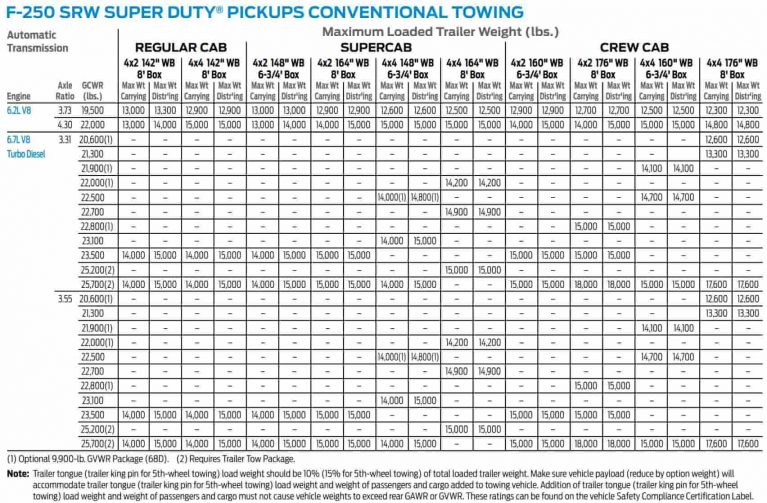
When discussing the complete towing profile of the F-250, the axle ratio is the single most important variable. Ford offered the 2017 6.2L with two primary gear ratios: the 3.73 axle ratio and the 4.30 limited-slip rear axle. Your choice here drastically alters the Gross Combined Weight Rating (GCWR).
Selecting the Right Ratio for Your Needs
The 3.73 ratio serves as a balanced option for those who use their truck as a daily driver or for light hauling. It offers slightly better fuel economy on the highway. However, for professional operators hauling heavy construction equipment or large travel trailers, the 4.30 ratio is non-negotiable. It increases the GCWR from 19,500 lbs to a substantial 22,000 lbs, allowing the F-250 to pull up to 15,000 lbs conventionally across almost all cab styles.
If you plan on upgrading to larger-than-stock tires, the 4.30 ratio becomes even more critical. Larger tires effectively “taller” your gearing, which can make the 3.73 ratio feel sluggish and reduce your effective towing capacity significantly.
Section 3: 5th-Wheel and Gooseneck Capability for the 6.2L Gas Engine
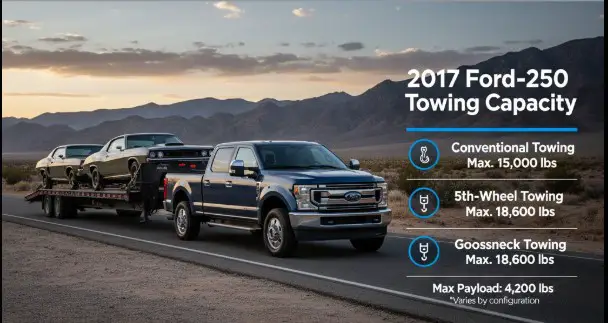
For heavy-duty hauling of mid-sized horse trailers or luxury campers, the 2017 F-250 6.2L is highly capable when utilizing a gooseneck or 5th-wheel hitch. The maximum gooseneck rating for a 4×2 Regular Cab with 4.30 gears reaches 15,800 pounds. Most Crew Cab 4×4 configurations with the same gearing will hover around the 14,700 to 15,000-pound mark.
The 5th-Wheel/Gooseneck Hitch Prep Package
To achieve these limits safely, Ford offers an optional factory-installed Hitch Prep Package. This package is structurally integrated into the frame, providing cross-members that distribute the massive vertical pin weight across the chassis. For the 6.2L gas engine, vertical pin weight management is actually easier than with the 6.7L diesel. Because the gas engine is approximately 800 lbs lighter, the truck has more remaining capacity for the heavy downward force (pin weight) applied by a 5th-wheel trailer before hitting the 10,000-lb GVWR ceiling.
Non-CDL Friendly
The standard 10,000-lb GVWR on most F-250s often helps commercial users stay below the 26,001-lb GCWR threshold that requires a CDL in many jurisdictions.
Bed Length Matters
The 8-foot bed provides superior pivot clearance for 5th-wheel maneuvering, whereas the 6.75-foot bed may require a sliding hitch to prevent cab strikes.
Section 4: Payload Capacity and Gross Vehicle Weight Ratings
Payload is often the most misunderstood spec in comprehensive towing discussions. It is calculated by subtracting the truck’s curb weight from its Gross Vehicle Weight Rating (GVWR). For the 2017 F-250, the standard GVWR is 10,000 lbs.
One of the expert advantages of the 6.2L gas engine is that it weighs significantly less than the 6.7L diesel engine. This weight savings is “given back” to the user in the form of increased payload capacity. In a class where many trucks are limited by their rear axle weight rating, the gas F-250 stands out as a payload leader.
Real-World Payload Example
Consider a Crew Cab 4×4 configuration. While the brochure may state a maximum payload of 3,450 lbs, this is for a base XL trim. As you move up to Lariat, King Ranch, or Platinum trims, the weight of features like panoramic sunroofs, power-deployable running boards, and heated leather seats reduces that payload. If you add four passengers (800 lbs) and a full tank of fuel, your available payload for tongue weight might drop to 2,200 lbs. Always check your specific door jamb sticker for the “Tire and Loading Information” to find your VIN-specific limit.
✅ Pros of 6.2L Towing
- Higher payload capacity than diesel F-250s
- Simplified emissions (no DEF required)
- Faster cabin heating in extreme cold
- Lower initial purchase price
❌ Cons of 6.2L Towing
- Lower fuel economy under heavy load
- Requires higher RPMs to find power
- Less engine braking than diesel exhaust brakes
- Lower resale value in some markets
Section 5: Essential Towing Features and Real-World Performance Technology
The 2017 Super Duty isn’t just about raw numbers; it’s about the trusted technology that makes towing safer and more predictable. Every 2017 F-250 comes equipped with a massive braking system featuring 14.29-inch front rotors and 14.3-inch rear rotors, providing consistent stopping power even when the trailer brakes are under heavy stress.
📋
Optimizing Performance with Technology
This alters shift points to keep the 6.2L in its power band (above 3,000 RPM) and provides automatic downshifting during deceleration to assist with engine braking.
The factory Integrated Trailer Brake Controller (TBC) communicates directly with the truck’s ABS system to provide seamless, proportional braking to the trailer.
Another game-changer is the Ultimate Trailer Tow Camera System. This uses four high-definition cameras to provide a 360-degree bird’s-eye view, making it possible for a single person to hitch a trailer with precision. When descending a steep 6% grade, the combination of Tow/Haul mode and the 6.2L’s natural compression allows for controlled descents, preserving the service brakes for emergency situations. Standard Trailer Sway Control and Hill Start Assist further enhance driver confidence, particularly in windy conditions or when restarting on an incline.
Do not confuse “towing capacity” with “total weight.” While the truck can pull 15,000 lbs, you must ensure that the weight on the truck’s own axles (including fuel, people, and trailer tongue weight) does not exceed the 10,000-lb GVWR. Exceeding this can lead to catastrophic tire or axle failure and legal liability.
Final Verdict on the 2017 F250 6.2L
The 6.2L V8 offers a robust 15,000-lb conventional and 15,800-lb gooseneck maximum towing capacity when properly equipped with the 4.30 axle ratio. Choosing this specific gear ratio is critical for those looking to maximize the GCWR and low-end pulling power. Furthermore, the 2017 model’s reduced curb weight translates directly into superior payload capacity compared to diesel counterparts in the same weight class, making it the professional choice for high-payload applications. Consult your door jamb sticker for your specific vehicle’s VIN-verified payload and ensure your trailer equipment matches these trusted specifications for a safe and reliable towing experience.
Frequently Asked Questions
Does the 2017 F250 6.2 need a 4.30 axle ratio for maximum towing?
Yes, to reach the maximum 15,000-pound conventional towing capacity, the 4.30 axle ratio is required. While the 3.73 ratio is reliable for general use, it limits the GCWR. The 4.30 ratio provides the necessary mechanical advantage for moving heavier loads from a standstill and maintaining speed on inclines without over-stressing the TorqShift-G transmission.
How does the 6.2L gas towing capacity compare to the 6.7L diesel?
The 6.7L Power Stroke diesel offers significantly higher towing limits, often exceeding 18,000 lbs conventional. However, the 6.2L gas engine is a professional choice for those who prioritize a higher payload capacity and lower maintenance costs. Because the gas engine is lighter, it allows for more weight to be carried in the bed while staying under the 10,000-lb GVWR.
Can I tow a 5th-wheel trailer with a short bed 2017 F250 6.2?
You can tow a 5th-wheel with a 6.75-foot short bed, but it requires a sliding hitch or a specialized pin box to prevent the trailer from contacting the truck cab during tight turns. The towing capacity remains high, but you must be mindful of the Gross Combined Weight Rating and ensure the pin weight does not exceed your specific payload capacity.
What is the GCWR for a 2017 F250 with the 6.2L engine?
The Gross Combined Weight Rating (GCWR) for the 2017 F250 6.2L varies by configuration. With the 3.73 axle ratio, the GCWR is typically 19,500 lbs. Upgrading to the 4.30 axle ratio increases the GCWR to 22,000 lbs. This rating represents the total allowable weight of the truck, passengers, cargo, and the fully loaded trailer combined.
Is the 2017 F250 6.2 reliable for daily heavy towing?
The 6.2L Boss V8 is widely regarded as a trusted, professional-grade engine known for its longevity. Unlike diesels, it lacks complex emissions systems like DEF, making it highly reliable for short-trip towing and fleet operations. While it works harder (higher RPMs) than a diesel on grades, its SOHC architecture is designed for sustained high-load performance and extreme durability.