2016 Ford Explorer Transmission Fluid: Specs & Capacities

The 2016 Ford Explorer requires Motorcraft Mercon LV transmission fluid for all engine configurations to ensure proper lubrication and shifting performance. It is critical to check the level via the low-profile dipstick while the engine is at full operating temperature (185°F-200°F).
🎯 Key Takeaways


- Use only Mercon LV fluid; Mercon V is not a compatible substitute.
- Total system capacity ranges from 11.0 to 11.6 quarts depending on the engine.
- A standard drain-and-fill typically requires approximately 5.5 to 6.0 quarts.
- The dipstick is hidden deep in the engine bay, often under the air intake.
- Accurate readings require the transmission fluid to be between 185°F and 200°F.
Your 2016 Ford Explorer requires Mercon LV Automatic Transmission Fluid. This specific fluid is non-negotiable for the 6-speed transmissions paired with the 2.3L and 3.5L engines. If you use older formulations like Mercon V or generic multi-vehicle fluids, you risk immediate shift shudder, solenoid failure, and long-term internal damage. The “LV” stands for Low Viscosity, and it is engineered to maintain consistent flow through the tight tolerances of your Explorer’s valve body while managing the high heat generated by this heavy SUV.
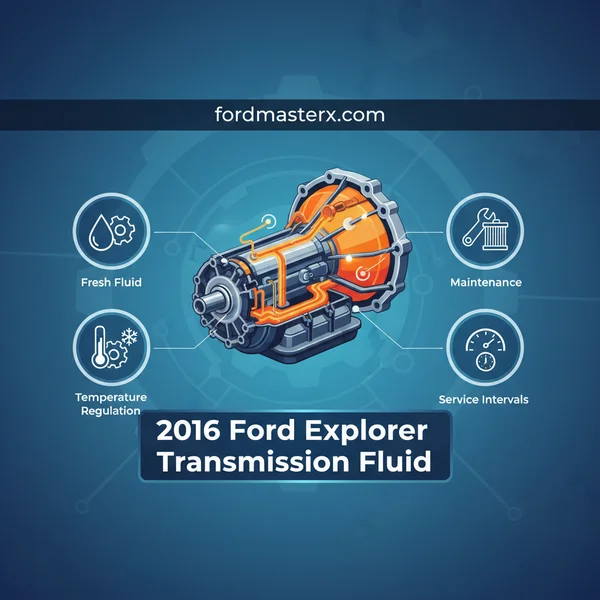
Getting these specifications right is the difference between a transmission that lasts 200,000 miles and one that fails prematurely. Because the 2016 Explorer uses a “filled-for-life” philosophy from the factory, the maintenance intervals are often stretched too thin. Performing a standard drain-and-fill service using the exact capacity and fluid type listed below is the most effective way to protect your investment. Whether you are driving the base V6 or the twin-turbo EcoBoost, the fluid chemistry is the backbone of your drivetrain’s performance.
Technical Specifications for Mercon LV Transmission Fluid


The 2016 Ford Explorer utilizes the 6F series of transmissions, which are highly sensitive to fluid friction coefficients. Ford specifically engineered Mercon LV (Motorcraft Part No. XT-10-QLVC) to provide the thermal stability needed for the Explorer’s heavy chassis. This fluid is designed to stay stable at operating temperatures ranging from -40°F to over 300°F. Unlike older fluids, Mercon LV does not require friction modifiers, as they are already chemically “baked into” the formula to support the electronic pressure control solenoids.
📤 Share
💾 Download
Why You Must Avoid Substitutes
- Viscosity Requirements: Mercon LV is thinner than previous fluids. Using a thicker fluid like Mercon V will cause slow engagement and delayed shifts, especially when the engine is cold.
- Seal Compatibility: The internal seals and gaskets in your 2016 Explorer are made of elastomers that are specifically compatible with the synthetic base stocks of LV fluid.
- Anti-Foaming Agents: Your 6F50 or 6F55 transmission operates under high pressure; Mercon LV contains specific anti-foaming agents that prevent air bubbles from causing gear slippage.
Identifying Genuine Motorcraft Mercon LV
When purchasing your fluid, look for the WSS-M2C933-A specification on the back of the bottle. This is the Ford engineering standard for the 2016 model year. If you are buying an aftermarket brand, ensure it explicitly states it is 100% compatible with Mercon LV and meets that specific WSS code. However, most professional technicians recommend staying with the Motorcraft brand to ensure the additive package perfectly matches the factory fill.
2016 Ford Explorer Transmission Fluid Made Easy: Your Essential Action Plan


The 2016 Ford Explorer is a workhorse, but its 6F35 or 6F55 automatic transmission requires clean fluid to prevent common issues like rough shifting, “shuddering,” or premature gear wear. Unlike older vehicles where a transmission service was a simple “drain and fill,” the 2016 Explorer features a somewhat tucked-away dipstick and specific fluid requirements that can catch DIYers off guard. This guide provides a comprehensive walkthrough for performing a transmission fluid drain and refill—the most effective way to extend the life of your drivetrain without a costly shop visit. By following these steps, you ensure that your Explorer remains reliable for daily commutes and family road trips alike.
Step 1: Gather Specific Materials and Tools
What you need: 6 quarts of Motorcraft MERCON LV Automatic Transmission Fluid, 11mm socket and ratchet, a long-neck funnel, a torque wrench, a large drain pan (at least 7-quart capacity), and nitrile gloves.
Instructions: Before you even touch the vehicle, verify you have the correct fluid. The 2016 Ford Explorer strictly requires MERCON LV. Do not use MERCON V or universal fluids, as the viscosity differences can damage the internal solenoids. You will also need to ensure your drain pan is clean to prevent contamination. If you are working on the 3.5L EcoBoost model, your transmission (6F55) is slightly beefier than the standard 2.3L or 3.5L Ti-VCT (6F35), but the service procedure remains nearly identical. Lay out your tools in a clean workspace and ensure the engine is slightly warm—not scalding hot—to help the fluid flow more freely during the drain process.
Pro Tip: Always buy one extra quart of fluid beyond the recommended capacity. It is better to have an unopened bottle to return than to be stranded with a vehicle that is half a quart low on fluid on a Sunday evening.
Step 2: Locate and Access the Transmission Dipstick
What you need: Flathead screwdriver or 8mm socket (for the air intake clamps).
Instructions: On the 2016 Explorer, the transmission dipstick is not immediately visible. It is located deep in the engine bay on the driver’s side, often hidden beneath the air filter intake tube. To access it comfortably, you should loosen the clamps on the large plastic air intake hose and pull the hose aside. Locate the short, yellow (or sometimes black) handle tucked near the battery tray area. This is a “stubby” dipstick rather than the long ones found in older trucks. Remove the dipstick and wipe it clean. Removing it now also acts as a vent, allowing the fluid to drain much faster once you pull the plug from underneath the vehicle.
Pro Tip: Use a bright LED flashlight to peer down past the battery. The dipstick is much lower than you’d expect, and clearing the air intake path is the only way to pour new fluid back in without a massive mess.
Step 3: Elevate and Level the Vehicle
What you need: Floor jack, two jack stands, and a spirit level (optional).
Instructions: For an accurate fluid service, the vehicle must be as level as possible. Use a floor jack to lift the front of the Explorer and secure it on high-quality jack stands. However, if the front is significantly higher than the rear, you won’t get a complete drain. If possible, use four jack stands to lift the entire vehicle, or park on a slight incline so that when the front is on stands, the transmission pan remains level. Safety is paramount: never work under a car supported only by a jack. Give the vehicle a firm “shake test” before crawling underneath to ensure it is stable and won’t shift while you are loosening the drain plug.
Pro Tip: If you only have two jack stands, you can check the level by placing a spirit level on the door sill. Adjust the jack stand height until the bubble is centered to ensure the transmission case isn’t tilted.
Step 4: Drain the Old Transmission Fluid
What you need: 11mm socket, drain pan, and shop towels.
Instructions: Position your drain pan directly under the transmission drain plug, located on the bottom of the transmission case (not the engine oil pan!). Use your 11mm socket to loosen the plug. As it reaches the last few threads, prepare for a quick flow. The 2016 Explorer usually drains between 4.5 and 5.5 quarts during a standard service. Observe the color and smell of the fluid. Healthy MERCON LV should be pinkish-red. If it is dark brown or black and smells “burnt,” your clutches may be wearing, and you should consider a professional inspection. Let the fluid drip until it slows to a very sparse trickle, which usually takes about 10 to 15 minutes.
Pro Tip: Use a graduated drain pan or an old milk jug to measure exactly how much fluid came out. This gives you a perfect baseline for how much new fluid to put back in, preventing overfilling.
Step 5: Clean and Reinstall the Drain Plug
What you need: Clean rag and a torque wrench.
Instructions: While the fluid finishes dripping, inspect the drain plug. Some 2016 models feature a magnetic plug that catches fine metal shavings. A small amount of “clutch fuzz” (gray paste) is normal, but large metal chunks indicate a mechanical failure. Wipe the plug threads and the mounting surface on the transmission case perfectly clean. Reinstall the plug by hand first to avoid cross-threading. Once snug, use your torque wrench to tighten it to 9-10 lb-ft (12 Nm). Do not overtighten, as the aluminum housing can crack or the threads can strip, leading to an expensive and difficult repair involving a re-tap or a new case.
Pro Tip: If the rubber O-ring on the drain plug looks flattened or cracked, replace it. A $2 O-ring is cheap insurance against a slow leak that could eventually starve your transmission of fluid.
Step 6: Refill with Fresh MERCON LV Fluid
What you need: 5 quarts of Motorcraft MERCON LV and a long-neck flexible funnel.
Instructions: Insert your long-neck funnel into the dipstick tube you cleared in Step 2. Begin pouring the fresh fluid. If you measured 5 quarts during the drain, start by adding 4.5 quarts. Pour slowly; the fill tube is narrow, and air bubbles can cause the fluid to back up and overflow onto the engine block. Because the fluid is thick and the tube is small, this process requires patience. Once you have added the initial 4.5 quarts, replace the dipstick temporarily and reinstall the air intake hose so you can safely start the engine without triggering a “Check Engine” light or Mass Air Flow sensor error.
Pro Tip: Keep a can of brake cleaner and a rag nearby. If you spill any fluid on the engine or exhaust components, clean it immediately to prevent the smell of burning oil once the engine heats up.
Step 7: Circulate Fluid and Verify Levels
What you need: The vehicle’s ignition and the dipstick.
Instructions: Start the engine and let it idle for about 2-3 minutes. With your foot firmly on the brake, slowly cycle the gear selector through every position: P, R, N, D, S (or L), holding each for 5 seconds. This opens the internal valves and pushes the new fluid into the torque converter and clutch packs. Return the vehicle to Park. With the engine still running and the fluid warmed up to operating temperature (around 180°F–200°F), check the dipstick level. The fluid should fall within the “Crosshatch” or “Hot” zone. If it is low, add fluid in small 2-ounce increments. Overfilling is just as dangerous as underfilling, as it causes foaming and erratic shifting.
Pro Tip: You can check the transmission fluid temperature via the digital display in the instrument cluster on most 2016 Explorer trims. Make sure it reaches at least 175°F before you trust the final “Hot” reading on the dipstick.
✅ Final Checklist
- Verify that the drain plug is torqued to 9-10 lb-ft and there are no active drips.
- Ensure the air intake hose and all clamps are tightened securely.
- Confirm the fluid level is within the crosshatched area on the dipstick while the engine is running and warm.
- Check that the dipstick is fully seated and clicked into place to prevent moisture entry.
- Take a short 10-minute test drive and re-check the level one last time upon return.
Important Notes:
- Safety Warning: Transmission fluid can be extremely hot after a drive; wear eye protection and gloves to avoid burns. Always work on a level, stable surface.
- When to seek professional help: If the drained fluid contains large metal flakes or if the transmission continues to slip after the fluid change, the issue is likely internal/mechanical and requires a professional rebuild.
- Estimated Time and Cost: This project typically takes 1 to 2 hours. The cost for fluid and basic tools ranges from $70 to $100, compared to $250+ at a dealership.
Fluid Capacity Variations Across 2.3L and 3.5L Engines
The amount of fluid you need depends entirely on which engine is under your hood and whether you are doing a standard service or a full overhaul. It is critical to distinguish between initial fill capacity (what the transmission holds when completely dry) and service refill capacity (what you actually drain out during a driveway fluid change). You will never get the full capacity out during a standard drain because a large portion of the fluid remains trapped inside the torque converter.
📤 Share
💾 Download
3.5L Ti-VCT V6 and 3.5L EcoBoost (6F50/6F55 Transmissions)
The 3.5L engines are usually paired with the heavy-duty 6F50 or 6F55 transmissions. These units have a larger footprint and require more fluid to maintain proper hydraulic pressure during towing or high-output acceleration.
- Service Refill Capacity: Approximately 5.5 to 6.0 quarts. When you pull the drain plug, this is the amount you should expect to replace.
- Total Capacity (Dry Fill): 11.6 quarts. This is only relevant if you have replaced the torque converter or rebuilt the entire unit.
- Drain Strategy: Always measure the exact amount you drain out. If you drain 5.7 quarts, start by putting 5.5 quarts back in to avoid overfilling.
2.3L EcoBoost I-4 (6F35 Transmission)
The 4-cylinder EcoBoost model typically utilizes the 6F35 transmission. This unit is slightly more compact than its V6 counterparts and consequently has a lower fluid volume. Overfilling this specific unit can lead to fluid aeration, where the moving parts whip air into the oil, leading to “spongy” shifts.
- Service Refill Capacity: Approximately 4.0 to 4.5 quarts. This is a significantly smaller service volume than the V6.
- Total Capacity (Dry Fill): 9.0 quarts.
- Critical Note: The 2.3L configuration is particularly sensitive to fluid levels. Even being half a quart over or under can trigger a “Check Engine” light or “Transmission Strategy” error codes.
Practical Capacity Tips for DIYers
When you are performing this service, always buy one extra quart than what the manual calls for. It is common to find that your specific vehicle requires a few extra ounces to reach the “Hot” mark on the dipstick. Having 7 quarts on hand for a V6 or 5 quarts for an I-4 ensures you won’t be left stranded with an underfilled transmission. Remember, you cannot accurately check the level until the transmission fluid temperature reaches at least 185°F (85°C), which usually requires a 15-minute drive.
Understanding the 6F50 and 6F55 Transmission Architecture
The 2016 Ford Explorer relies on two primary transmission variants: the 6F50 and the higher-torque 6F55. Both are 6-speed transverse automatics developed through a joint venture between Ford and GM. While they share a similar DNA, understanding their architecture is vital for proper maintenance. The 6F55 is typically paired with the 3.5L EcoBoost engine to handle the increased power, whereas the 6F50 serves the naturally aspirated V6 and the 2.3L EcoBoost models.
A Compact, High-Pressure Design
These transmissions utilize a “clutch-to-clutch” shifting system, which eliminates the need for one-way clutches found in older designs. This makes the unit more compact and efficient, but it also means the fluid works significantly harder. Because the shifts are managed by complex electronic solenoids and high-pressure hydraulic circuits, the MERCON LV fluid must maintain a very specific viscosity to ensure those solenoids react within milliseconds.
The Internal Filter Reality
One critical architectural detail owners should know is that the transmission filter in both the 6F50 and 6F55 is internal. Unlike older vehicles where you could drop a pan and swap a filter in thirty minutes, these units require a full teardown to replace the filter. This makes regular fluid refreshes even more vital. Since you cannot easily change the filter, keeping the fluid clean is your only line of defense against debris buildup within the valve body.
- 6F50: Found in standard FWD/AWD configurations; optimized for fuel efficiency.
- 6F55: Heavy-duty variant; features beefier internal components for turbocharged torque.
- Shared Vulnerability: Both units are sensitive to “varnish” buildup if the fluid is allowed to overheat.
Critical Factors Influencing Fluid Service Intervals
If you look at the official Ford owner’s manual, you might see a recommended service interval of 150,000 miles for the transmission fluid. However, most experienced mechanics and Ford enthusiasts view this as an “ideal world” scenario that rarely applies to daily driving. In reality, the 2016 Ford Explorer often operates under conditions that Ford classifies as “Severe Duty,” which drastically shortens the lifespan of the MERCON LV additive package.
The Heat Factor and Urban Driving
Heat is the primary enemy of the 2016 Explorer’s transmission. If you frequently drive in heavy stop-and-go traffic, the lack of consistent airflow over the transmission cooler can cause fluid temperatures to spike. Over time, this thermal stress breaks down the friction modifiers in the fluid, leading to the “shudder” or “harsh shifting” many owners report. If your Explorer is a dedicated city commuter, consider a fluid “drain and fill” every 30,000 to 45,000 miles to stay ahead of degradation.
Towing and Payload Stress
The Explorer is a popular choice for towing small boats or campers. However, pulling a trailer puts immense pressure on the 6F50/6F55 torque converter. This extra load generates friction heat that can oxidize the fluid, turning it from a bright translucent red to a dark, burnt brown. Specific factors that necessitate more frequent fluid changes include:
- Towing: Even occasional towing of trailers near the 5,000-lb limit.
- Extremely Hot Climates: Consistent operation in temperatures above 90°F.
- Hilly Terrain: Frequent gear hunting while ascending or descending grades.
- Idling: Extended idling periods (common for fleet or police interceptor models).
Pro Tip: Always check your fluid color and smell during every oil change. If the fluid smells like burnt toast or looks like dark cherry juice, it is time for a service, regardless of what the odometer says.
Conclusion
Maintaining the transmission fluid in your 2016 Ford Explorer is the single most effective way to ensure its longevity. By sticking to the MERCON LV specification and respecting the 6F50/6F55 architecture, you can avoid the costly repairs associated with solenoid failure or torque converter shudder. While the manufacturer might suggest a long-term interval, real-world driving conditions—like towing and city traffic—often demand a more proactive approach to fluid health.
Your next steps: First, check your service records to see when the transmission was last serviced. If you are approaching the 60,000-mile mark on the original fluid, consider scheduling a “drain and fill” soon. Staying proactive today will keep your Explorer shifting smoothly for many miles to come!
❓ Frequently Asked Questions
Why is it difficult to find the dipstick on the 2016 Ford Explorer?
The 2016 Explorer uses a ‘sealed-for-life’ design concept with a low-profile dipstick. It is tucked deep in the engine compartment, often requiring the removal or moving of the air filter intake ducting to access the small black twist-cap.
How does engine choice affect transmission fluid capacity?
While all 2016 models use Mercon LV, the 3.5L Ti-VCT V6 typically has a total capacity of 11.0 quarts, whereas the 2.3L and 3.5L EcoBoost engines have a slightly larger capacity of 11.6 quarts due to different cooling requirements.
At what temperature should the transmission fluid be checked?
The fluid level must be checked when the transmission is at a normal operating temperature of 185°F to 200°F (85°C to 93°C). Checking the fluid while it is cold will result in an inaccurate, low reading.
Is the transmission filter replaceable during a fluid change?
No, the 6F50 and 6F55 transmissions have an internal filter that is not accessible without removing and disassembling the entire transmission unit. Because of this, regular fluid exchanges are vital for longevity.
What are the risks of using Mercon V instead of Mercon LV?
Mercon V and Mercon LV have different viscosities and chemical compositions; they are not interchangeable. Using the wrong fluid can lead to internal slipping, harsh shifting, and eventual transmission failure.
What are the common symptoms of low or degraded fluid in this model?
Symptoms include a noticeable ‘shudder’ during gear changes, delayed engagement when shifting into Drive or Reverse, and increased transmission noise or whining during acceleration.