
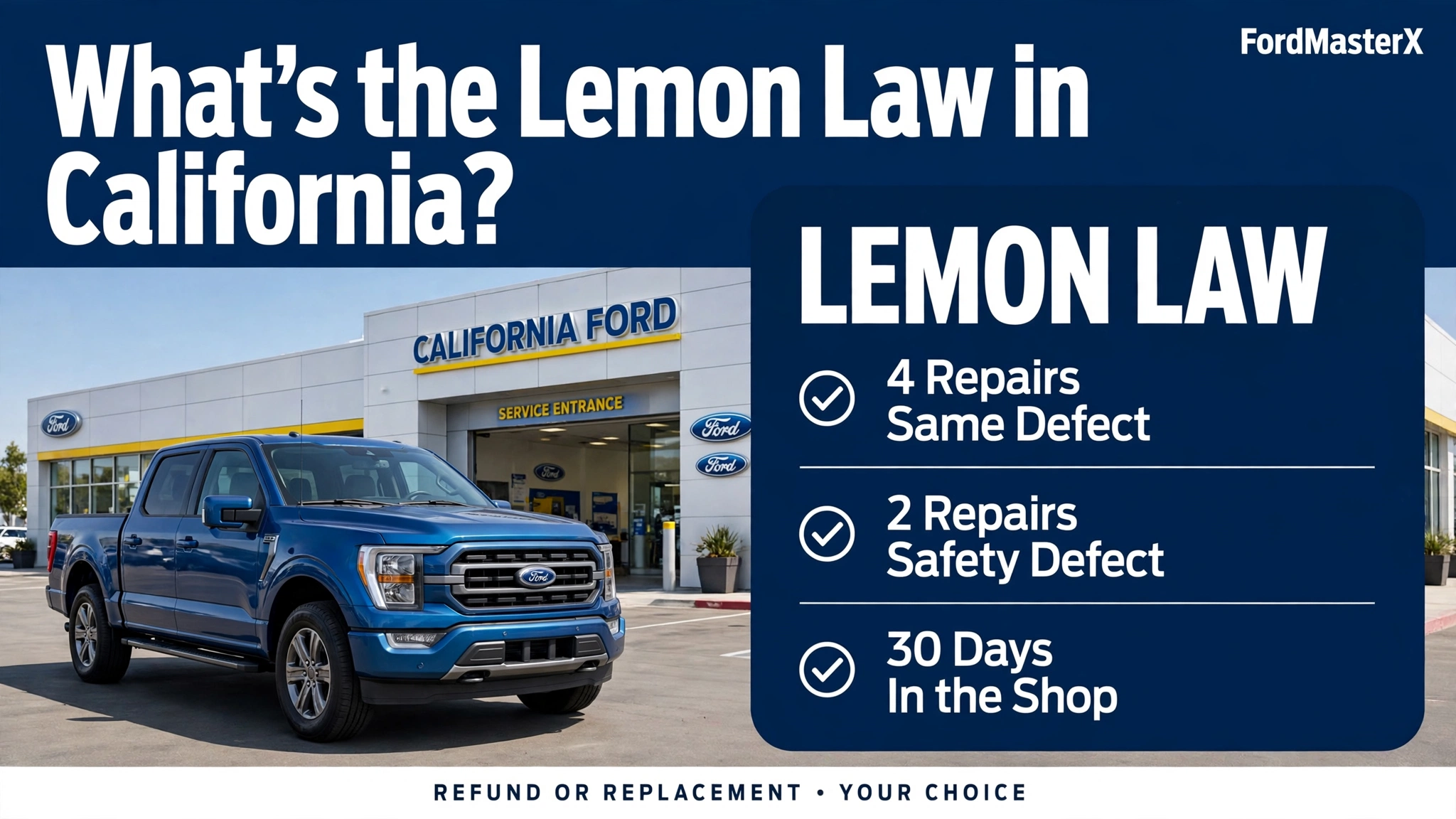
What’s the Lemon Law in California? 2026 Complete Guide

If you are asking what’s the lemon law in California, the short answer is that it is the Song-Beverly Consumer Warranty Act. It says that if Ford cannot fix a serious defect in your truck after a reasonable number of repair attempts, Ford must either replace your truck or buy it back.
California’s version of the law is one of the strongest in the country. The choice between a refund and a replacement belongs to you, not to Ford. You do not have to accept a repair, a discount, or a trade-in offer instead.
This guide explains the law in plain language: who qualifies, how many repair attempts count, what the refund includes, what changed in 2025, and the exact steps a Ford owner should take. This is legal information, not legal advice. Lemon law cases turn on the facts of one truck and one repair history, so talk to a California lemon law attorney about your own case before you act on a deadline.
The Short Answer: California Lemon Law in One Table
Here is the whole law in one table. The infographic after it gives you the same answer to save or share.
| Question | Answer |
|---|---|
| What is the law called? | Song-Beverly Consumer Warranty Act, California Civil Code sections 1790 through 1795.8 |
| What must Ford do? | Replace your vehicle or refund your purchase price if it cannot fix a serious warranty defect after a reasonable number of attempts |
| Who chooses refund or replacement? | You do. The manufacturer does not get to pick for you |
| How many repair attempts trigger the presumption? | 4 or more for the same defect, or 2 or more for a defect likely to cause death or serious injury |
| How many days in the shop trigger it? | More than 30 cumulative calendar days out of service for warranty repairs |
| Within what window? | The first 18 months after delivery or 18,000 miles, whichever comes first |
| What does the refund include? | Price paid, taxes, registration and license fees, and incidental costs, minus a mileage offset |
| What changed in 2025? | AB 1755 and SB 26 added a new opt-in procedure (for manufacturers that opted in) with shorter deadlines and a 30-day pre-suit notice |
California Lemon Law — At a Glance
The Song-Beverly Consumer Warranty Act. Any one trigger inside 18 months or 18,000 miles creates the presumption that Ford had a reasonable number of repair attempts.
| Trigger | Threshold | Window |
|---|---|---|
| Same defect, repaired again and again | 4 or more repair attempts | 18 months or 18,000 miles |
| Safety defect likely to cause death or serious injury | 2 or more repair attempts | 18 months or 18,000 miles |
| Truck out of service for warranty repairs | More than 30 calendar days in total | 18 months or 18,000 miles |
Direct answer: if your Ford has a serious defect Ford cannot fix after 4 tries, 2 tries for a safety defect, or more than 30 days in the shop, California law presumes it is a lemon. You choose a refund or a replacement.
Refund = price paid, taxes, registration and license fees, plus incidental costs, minus the mileage offset: (purchase price x miles at first repair) / 120,000. Check the California Department of Consumer Affairs list to see whether your manufacturer opted into the 2025 AB 1755 procedures. Sources: California Civil Code sections 1793.2, 1793.22, 1794; Code of Civil Procedure sections 871.20-871.30; California Department of Consumer Affairs.
What the California Lemon Law Actually Is
California does not have a separate statute with “lemon law” in its title. The protection lives inside the Song-Beverly Consumer Warranty Act, at California Civil Code sections 1790 through 1795.8. A second provision, the Tanner Consumer Protection Act at section 1793.22, sets out the presumption test that most cases turn on.
The core duty sits in section 1793.2(d). If a manufacturer cannot fix a defect covered by its express warranty after a reasonable number of attempts, it must promptly replace the vehicle or refund the purchase price. The statute says the choice is the buyer’s, and it says the replacement or refund must happen promptly.
“Reasonable number of attempts” sounds vague, and that is exactly why the presumption in section 1793.22 matters. It gives the vague standard hard numbers: four attempts, two attempts, or thirty days. When one of those numbers is hit inside the window, the law presumes the manufacturer has had enough chances, and the burden shifts to the manufacturer to prove otherwise.
The law covers the defect, not the brand. It applies to Ford the same way it applies to every other manufacturer that sells a warranted vehicle in California. A Ford dealer does the repairs, but the obligation to replace or refund belongs to Ford Motor Company, not to the dealer that sold you the truck.
Who Qualifies Under California Lemon Law
The law protects buyers and lessees of new vehicles bought or leased in California that come with a manufacturer’s warranty. The vehicle must be used mainly for personal, family, or household purposes. That covers the typical F-150 or Explorer bought for family use and commuting.
Business use can still qualify, but only within limits. The vehicle must have a gross vehicle weight under 10,000 pounds, and the buyer or the business must have no more than five vehicles registered in California.
A small business running a couple of F-150s can qualify. A fleet of ten Super Dutys cannot use this route for a business truck.
Leased vehicles are covered on the same terms as purchased ones. The lease payments you made are part of what a refund returns. If you leased, keep every lease document and every payment record, because the refund calculation starts from what you actually paid.
What counts as a defect matters as much as who bought the truck. The defect must be a nonconformity that substantially impairs the vehicle’s use, value, or safety.
A transmission that slips out of gear, an engine that stalls in traffic, brakes that fail, or a steering fault all clear that bar easily. A faint rattle, a slightly misaligned trim piece, or a paint blemish usually does not, even if it annoys you every day.
The defect must also be covered by the manufacturer’s express warranty, and it must first appear while that warranty is in force. A problem that shows up for the first time after every warranty has expired is not a lemon law claim, even if the truck is only a few years old. That is why the first repair visit matters so much, and why the section on documentation below is the most practical part of this guide.
What About a Used Ford?
This is where California law changed recently, and where old advice online is now wrong. In October 2024 the California Supreme Court decided Rodriguez v. FCA US, LLC. The court held that the refund-or-replace remedy generally does not extend to a used vehicle sold with only the remainder of the original manufacturer’s warranty.
That does not mean every used Ford is outside the law. A vehicle sold with a new-car warranty issued at that sale still qualifies, and dealer demonstrators are the usual example. A demonstrator that was never titled and is sold with a full new-car warranty is treated as a new vehicle for this purpose.
Certified pre-owned coverage is unsettled after Rodriguez, and lawyers disagree about where the line falls for different certification programs. Federal law is a separate route: a claim under the federal Magnuson-Moss Warranty Act can still be available for a used vehicle, even when the California refund-or-replace remedy is not.
If your truck is used, do not assume you have no claim, and do not assume you have one. Ask a California lemon law attorney before you spend money or miss a deadline.
Motorcycles and off-road vehicles that are not registered for highway use are not covered by the buyback remedy. That exclusion rarely matters to a Ford truck owner, but it matters if the vehicle in question is a side-by-side or a dirt bike with a Ford badge nowhere on it.
The Presumption Test: 4 Repairs, 2 Repairs, or 30 Days
The presumption is the part of the law you should memorize. Under section 1793.22(b), the law presumes the manufacturer has had a reasonable number of repair attempts if any one of three things happens within the first 18 months after delivery or 18,000 miles on the odometer, whichever comes first.
First, four or more repair attempts for the same defect. The attempts must be for the same nonconformity, not four visits for four different problems.
A transmission that shudders on four separate visits counts. Four visits for a rattle, a tire, a mirror, and a software update do not add up to one lemon claim, though they can count toward the days-out-of-service trigger below.
Second, two or more repair attempts for a defect likely to cause death or serious bodily injury if the vehicle is driven. This is the safety trigger, and the bar is lower because the risk is higher.
A brake failure, a steering loss, or an engine stall at highway speed can qualify here after only two failed repairs. RecordingLaw’s 2026 California guide confirms the same three thresholds and the same 18-month and 18,000-mile window.
Third, more than 30 cumulative calendar days out of service for warranty repairs. The days do not have to be consecutive, and they do not have to be for the same defect.
A truck that spends 12 days in the shop for a transmission, 10 days for an electrical fault, and 9 days for a fuel system problem has spent 31 days out of service, and the presumption attaches. What counts is time the truck was unavailable to you because of warranty repair work.
For the four-repair and two-repair paths, the statute also requires you to have told Ford directly at least once, but only if Ford clearly and conspicuously disclosed that requirement in your warranty booklet or owner’s manual, and the notice must go to the address Ford specified there. The 30-days-out-of-service path carries no such notice requirement. Do not rely on dealer visits alone.
Send Ford a written notice as well, and keep proof you sent it. The playbook section below shows how.
What If You Miss the 18-Month Window?
The 18-month or 18,000-mile window is a presumption window, not a filing deadline. Missing it does not end your claim. It only means you lose the shortcut, and you are back to proving a “reasonable number of attempts” on the facts.
Courts have found lemon law claims on vehicles with far more miles and years of service than the presumption window covers. The question becomes whether Ford had a fair chance to fix a serious defect and failed, even if the fourth repair happened at 25,000 miles or in year three. The defect must still have appeared during the warranty period, and your documentation still has to show repeated failed repairs.
Do not wait to find out. The filing deadlines changed in 2025, and they are now much shorter for many manufacturers. The deadline section below explains why waiting is the most expensive mistake you can make.
What You Get: Refund or Replacement
If your truck qualifies, you choose the remedy. Ford does not get to choose a replacement when you want your money back, and it does not get to force a refund when you want an identical new truck. That choice is yours under section 1793.2(d).
A replacement must be a substantially identical new vehicle, and Ford must cover the sales tax, registration, and license fees on the replacement. You should not pay extra fees to swap a defective truck for the truck you should have received in the first place. The mileage offset applies to a replacement too, so read the formula below before you choose.
A refund, usually called a buyback, returns the actual price you paid. That includes your down payment and every monthly payment you made, plus sales tax, license and registration fees, transportation charges, and manufacturer-installed options.
It also includes incidental costs caused by the defect, such as rental car bills and towing charges. Aftermarket accessories you or the dealer added are generally excluded.
There is also a third outcome you will hear about, and it is important to understand what it is. A cash settlement, where you keep the truck and Ford pays you money, is a negotiated deal, not a remedy the statute orders.
It can be the right result when the defect is fixed, the truck is usable, and you would rather keep it with compensation than go through a buyback. It is a settlement you agree to, not a right you can demand.
The Mileage Offset: The Only Deduction
The mileage offset is the one deduction the law allows from a refund. It accounts for the use you got out of the truck before the defect first sent you to the dealer. The statute fixes the formula, so there is nothing to negotiate about the arithmetic, only about the mileage number that goes into it.
| Step | What to do |
|---|---|
| 1. Find the mileage | Read the odometer on the first repair order for that defect |
| 2. Multiply | Purchase price x miles at first repair |
| 3. Divide | Divide the result by 120,000 |
| 4. Subtract | Subtract the offset from the total amount paid |
Here is the formula with real numbers. Take a $40,000 truck that first went in for the defect at 5,000 miles.
The offset is $40,000 times 5,000, divided by 120,000, which comes to $1,666.67. The refund on the $40,000 price alone, before tax, fees and incidental costs, would be about $38,333.
Now change one number. The same $40,000 truck first goes in at 20,000 miles, and the offset jumps to $8,333.33. That is why the first repair visit matters so much to your wallet.
Reporting a defect early is the single most effective way to protect your refund, because miles driven after that first visit do not increase the offset at all. The number freezes at the first repair.
Check the mileage on that first repair order carefully. Manufacturers sometimes use a later odometer reading, and that inflates the deduction. The statute ties the offset to the first repair attempt for the specific defect, and a later reading is not the right input.
Civil Penalties and Attorney Fees
If Ford willfully fails to replace or refund a qualifying vehicle, section 1794(c) allows a civil penalty of up to two times your actual damages. That penalty is why the pre-suit notice requirement in the 2025 changes matters so much: you generally cannot seek it without sending the notice first. A court decides whether the failure was willful, and no outcome is guaranteed.
Section 1794(d) says a buyer who prevails recovers reasonable attorney fees and costs from the manufacturer. That fee rule is the reason California lemon law lawyers commonly take these cases with no upfront fee from the owner.
The manufacturer pays the lawyer if you win. If you lose, the fee arrangement depends on the agreement you signed, so read it before you sign anything.
Do not let a fee worry stop you from getting a case review. Most California lemon law attorneys review a case for free, and the review itself costs you nothing but the time to send your repair orders. The review is where you learn whether your truck’s history fits the presumption or not.
What Changed in 2025: AB 1755 and SB 26
California’s lemon law changed more in 2025 than it had in decades, and most of what you read before 2025 is now out of date on procedure. Assembly Bill 1755 was signed on September 29, 2024, and its main provisions took effect on January 1, 2025. Senate Bill 26 followed on April 2, 2025, as an urgency cleanup bill that changed how AB 1755 actually works.
The important point first: AB 1755 changed the process, not the right. Your right to a refund or a replacement when Ford cannot fix a serious defect is the same as it was.
What changed is the procedure, the deadlines, and the steps you must take before suing. The new rules live in the Code of Civil Procedure at sections 871.20 through 871.30.
SB 26 made the new procedures opt-in. They apply only to manufacturers that formally elected them. A manufacturer that opts in is locked in for five years.
The Department of Consumer Affairs publishes the official list of opted-in manufacturers and updates it by December 15 each year. LemonLawAssist’s 2026 explainer of AB 1755 and SB 26 confirms the opt-in structure and the five-year lock-in.
One Ford-specific 2026 source reports that Ford Motor Company opted in, with an opt-in date of April 25, 2025. Treat that as reported, not as a fact you should rely on without checking.
The DCA list is the authoritative source, and it is the first thing to check before you plan around a deadline. The list can change, and the DCA publishes it, not Ford.
The New Deadlines
For a manufacturer that opted in, a lawsuit must be filed within one year after the applicable express warranty expires, and in no event more than six years after the vehicle was first delivered. Whichever limit comes first controls. That is a much shorter window than the old rule, which was generally four years from when the claim arose under Commercial Code section 2725.
For a manufacturer that did not opt in, the old four-year rule still governs. That creates two parallel tracks in California in 2026, and which one applies to your truck depends on a decision Ford already made.
Practitioners recommend treating the shorter AB 1755 deadline as the planning limit either way. Waiting past it risks dismissal even if you believed the longer deadline applied to you.
Some of the clock can be paused while a dispute program runs, because section 1793.22(c) extends the filing deadline by the days that program takes, but tolling rules are fact-specific. Do not count on tolling to save a late filing. File early, and let a lawyer confirm the exact date for your truck.
The 30-Day Pre-Suit Notice
Under the new track, you must send the manufacturer a written notice at least 30 days before filing a lawsuit that seeks civil penalties. The notice requirement took effect on July 1, 2025, after SB 26 moved it from the original April 1 date. If you skip the notice, you can lose the civil penalty claim even if the underlying buyback claim succeeds.
Once Ford receives your written demand, it has 30 days to make a buyback or replacement offer, and 60 days to complete the transaction. Those are firm clocks, and they are the reason the written demand is now a formal step rather than a courtesy letter. During the notice period, keep the truck and do not sell or trade it in.
Faster Litigation and Wider Coverage
If a case reaches court under the new track, the pace is set by statute. The parties must exchange initial documents within 60 days after the answer is filed, complete initial depositions within 120 days, and attend mediation within 150 days. That is far faster than the open-ended litigation that came before it.
AB 1755 also cleared up a coverage question for newer Fords. Battery degradation, charging-system failures, and software defects are now explicitly covered as qualifying defects.
That matters for a Mustang Mach-E or an F-150 Lightning, where the defect may be a battery or a software fault rather than a mechanical part. A defect that leaves the truck unable to charge or drive is a defect like any other under the new language.
Arbitration or Lawsuit: Which Path Fits Your Case
Arbitration is not required before a California lemon law claim. You can go straight to state court, including a jury trial, if that is the better path for your case. One exception affects the presumption test, and it is explained next.
That surprises many owners, because some warranty booklets and dealer letters suggest arbitration comes first. Under California’s lemon law, it does not.
There is one qualification that matters for Ford owners. Under Civil Code section 1793.22(c), if Ford gave you timely written notice of its state-certified arbitration program, you must first resort to BBB AUTO LINE before you can rely on the presumption test.
You can still file a lawsuit without the presumption, and you can still reject an arbitration award and sue. Check your warranty guide for that notice before you decide which path to take first.
The state does offer a free alternative. The Department of Consumer Affairs runs an Arbitration Certification Program that certifies and monitors manufacturer arbitration programs.
Filing is free for the consumer, and decisions usually come within 40 days after the program accepts your claim. If you accept the decision, the manufacturer must perform it within 30 days.
An arbitration award is binding on the manufacturer but not on you. If the award is too low, you can reject it and file a lawsuit instead.
That one-sided protection is the reason arbitration is worth considering even though it is not required. The DCA’s arbitration information page lists the certified programs and explains how to apply.
Ford’s state-certified program is BBB AUTO LINE, at (800) 955-5100. It is the program Ford’s warranty guide names for California owners.
Note one federal wrinkle: Ford’s warranty guide requires BBB AUTO LINE before asserting rights under the federal Magnuson-Moss Warranty Act. That requirement comes from federal law, not from California’s lemon law, and it does not block a California claim.
Arbitration has trade-offs a lawyer should weigh with you. It is faster and free, but the record is thinner and the discovery is narrower than in court.
A strong case with clean repair orders often does well in arbitration. A case that needs depositions, expert inspection, or a willfulness finding for civil penalties usually belongs in court.
Step by Step: What a Ford Owner Should Do
The law rewards the owner with the best paper trail. Every step below is about building that trail while the truck is still under warranty, when the evidence is easiest to collect. Start at the first sign of trouble, not at the fourth repair.
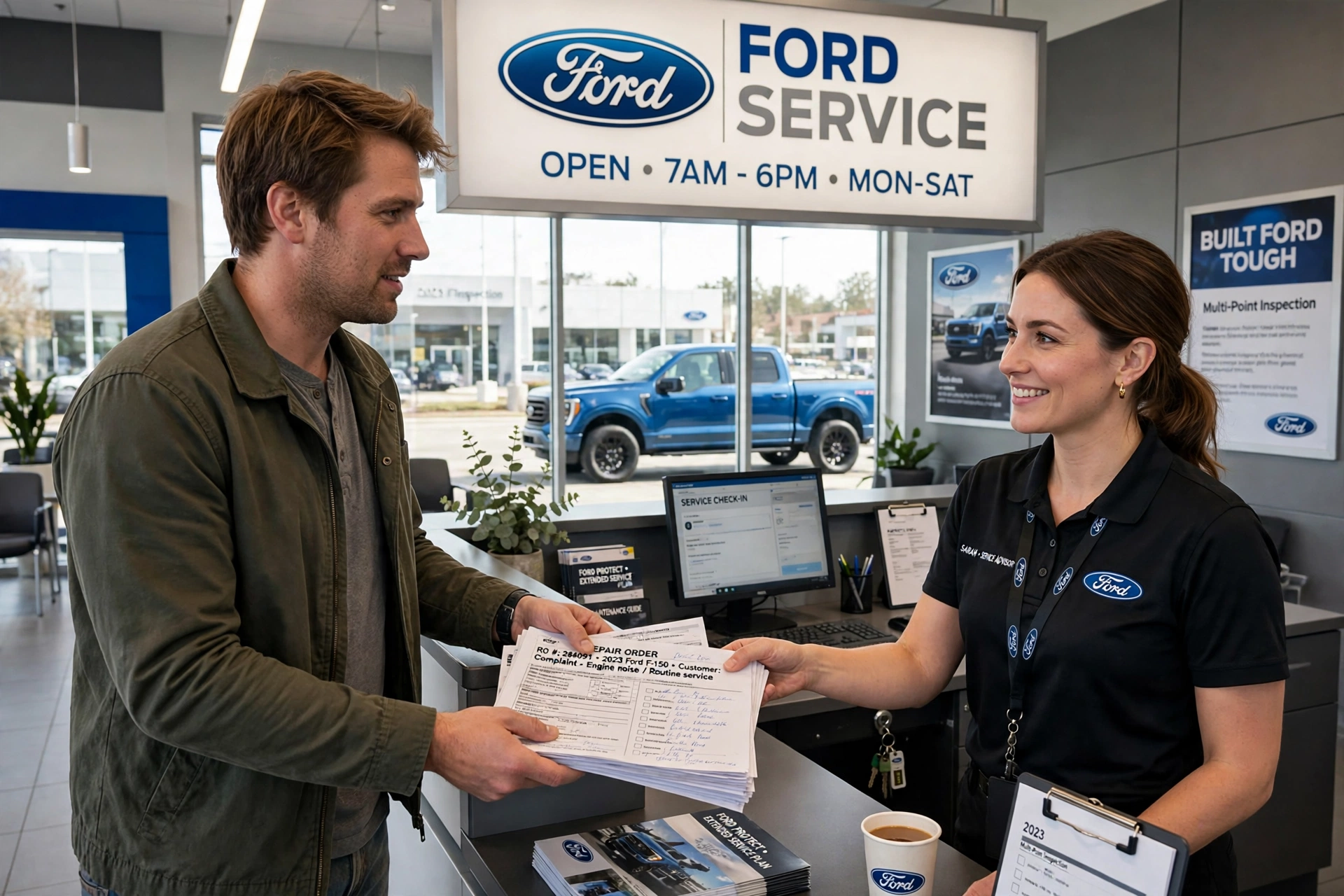
AI-generated illustration: a Ford owner handing repair paperwork to a service advisor at a dealership service desk.
- Report the defect at the first sign of trouble. Book a dealer visit as soon as the problem appears, and describe the symptom in your own words on the repair order. The mileage on that first visit fixes your offset, so an early visit protects your refund.
- Check your warranty before every visit. Our guide to how to check your Ford warranty shows how to confirm coverage by VIN, so you know which warranty layer is paying for the repair.
- Keep every repair order. Get a copy before you leave the dealer, and check that it lists the complaint, the mileage, the dates in and out, and what was done. If the order says “could not duplicate,” keep it anyway: that phrase is evidence of a failed repair attempt, not a reason to throw the paper away.
- Write down every warning light and symptom. Note the date, the mileage, the road conditions, and what the truck did. Our guide to the Ford check engine light explains what the common warnings mean, and your notes turn a vague complaint into a dated record.
- Notify Ford in writing, not only the dealer. After the second failed repair, send Ford a dated letter describing the defect, the repair history, and the repair order numbers. Keep proof of mailing: written notice supports the presumption and satisfies the AB 1755 pre-suit step if you later seek civil penalties.
- Know which warranty layer covers the part. Our powertrain warranty guide explains the 5-year and 60,000-mile powertrain layer, and our emissions warranty guide covers the longer federal and California emissions terms that can outlast the bumper-to-bumper warranty.
- Send a formal written demand when the presumption is met. Once you have four attempts, two safety attempts, or more than 30 days out of service, send Ford a written demand for a refund or a replacement. The 30-day and 60-day clocks in the new procedure start from that demand.
- Choose arbitration or a lawyer. If Ford gave you timely written notice of BBB AUTO LINE, use that program first before relying on the presumption test. Otherwise, file with BBB AUTO LINE for a free, fast decision, or take your file to a California lemon law attorney for a free case review, but do not do both at once without advice, because the two paths use the same facts differently.
- Keep driving the truck normally, and keep the truck. Do not sell it, trade it in, or modify it while a claim is pending. A sale during the notice period can damage the claim, and modifications give the manufacturer an argument that you caused the defect.
- Save every receipt. Rental cars, towing, rideshares to the dealer, and time off work all belong in the file. Incidental costs are part of a refund, but only if you can prove them with receipts.
Ford Warranty Layers and the Lemon Law
A new Ford does not carry one warranty. It carries a stack of them, and the lemon law attaches to the warranty that covers the defective part.
Knowing the stack helps you see how long your protection actually runs. Ford’s own warranties and coverage page lists the periods, and your warranty guide controls the details for your truck.
| Ford warranty layer | Period | What it covers |
|---|---|---|
| New Vehicle Limited Warranty, bumper to bumper | 3 years or 36,000 miles | Almost every part of the truck |
| Powertrain Warranty | 5 years or 60,000 miles | Engine, transmission, and drivetrain parts Ford lists |
| Power Stroke diesel powertrain | 5 years or 100,000 miles | Diesel engine and drivetrain parts Ford lists |
| Emissions warranties | Varies by part and state | Emissions components, with longer California terms |
| Hybrid and electric unique components | 8 years or 100,000 miles | Battery and electric drive components |
Every period above is whichever comes first. A truck with 62,000 miles is out of powertrain coverage even if it is only four years old. The clock starts on the Warranty Start Date, which is the day you take delivery or the day the truck first goes into service as a demonstrator, whichever is first.
California buyers get one helpful wrinkle. For new retail sales in California on or after July 1, 2023, the Warranty Start Date and the mileage start no earlier than delivery to the customer. A truck that sat on the lot or served as a demonstrator before you bought it does not burn your warranty before you own it.
Our Ford factory warranty guide walks through the full stack, and our guide to how to cancel a Ford extended warranty explains the separate service-contract layer. An extended warranty is a contract you bought, not a factory warranty, and cancelling it while a lemon claim is pending can complicate your file. Ask your lawyer before you cancel anything.
The powertrain layer matters most for lemon claims, because the expensive failures live there. A transmission that keeps failing is a powertrain problem with five years of coverage, not three. Our full powertrain warranty guide lists the covered parts, and the emissions guide matters too, because some repairs that look like engine faults are emissions faults with longer coverage.
Mistakes That Kill a California Lemon Law Claim
Most lemon law claims fail on paperwork, not on the law. The defect is real, the repairs failed, and the owner still loses because the file does not prove it. These are the mistakes that do the damage, and all of them are avoidable.
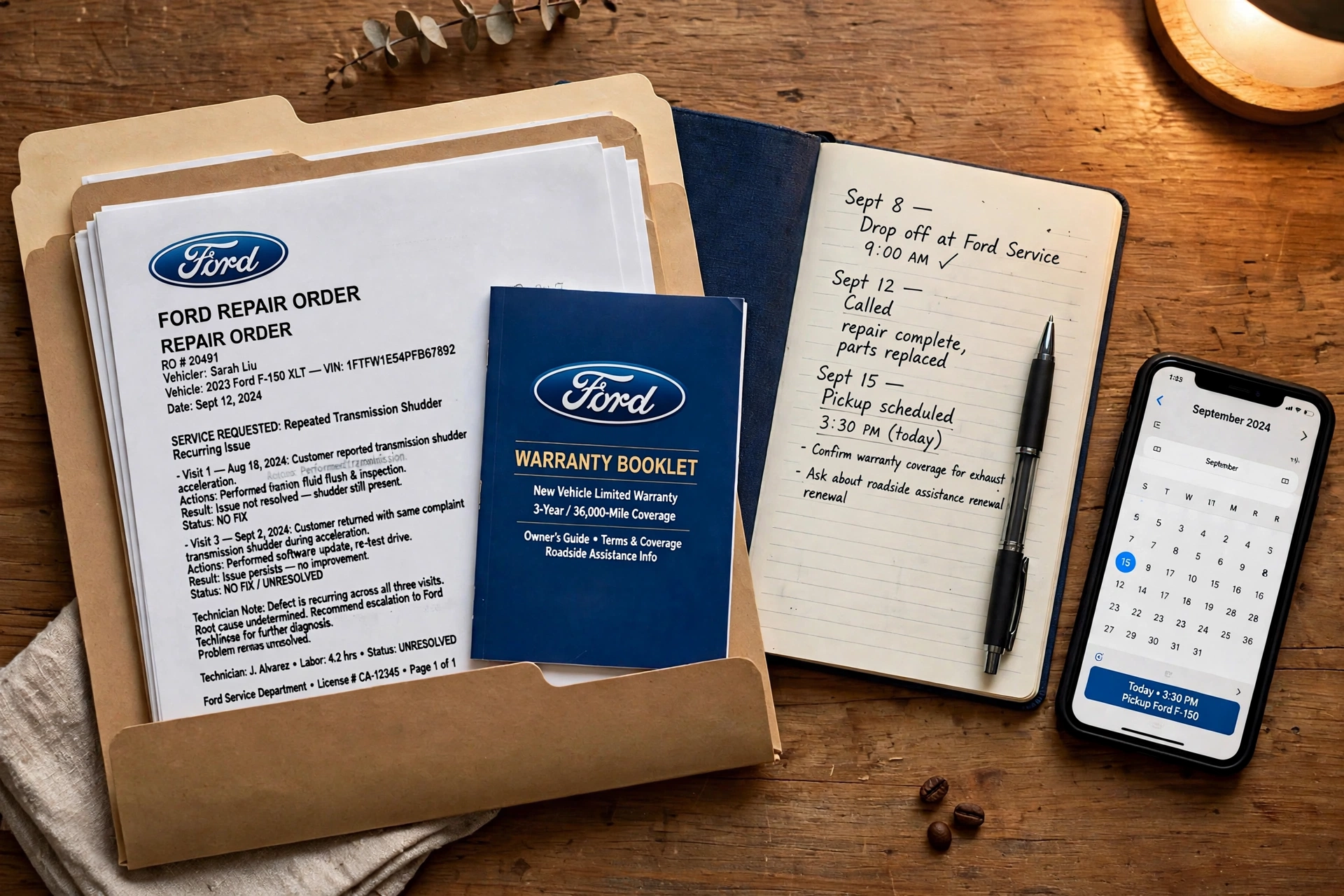
AI-generated illustration: repair orders, warranty paperwork, and dated notes kept together as lemon law documentation.
Waiting too long to report the problem. Every week you drive with a known defect pushes the first-repair mileage higher and shrinks your refund through the offset.
It also gives Ford an argument that the problem was not serious enough to report. Report it at the first sign, even if the dealer cannot reproduce it that day.
Going to an independent shop instead of the dealer. The law counts repair attempts by the manufacturer or its authorized dealers.
An independent shop may fix the truck, but its work does not build the same record, and Ford can argue it never had a fair chance to repair the defect itself. Use the dealer for warranty defects while a claim is possible.
Accepting “could not duplicate” and driving away. A repair order that says the dealer could not reproduce the problem is still a repair attempt, and it still counts toward your history.
Keep the order, note the symptom yourself, and come back with a video or a written description of when it happens. The Focus transmission control module is a good example: our guide to the 2015 Focus transmission control module shows how an intermittent fault can fail several times before a dealer captures it.
Trading the truck in before the claim ends. Selling or trading the vehicle during the notice period can end the claim, because the remedy is a refund or a replacement of that vehicle. Keep the truck until the claim is resolved, even when you are tired of driving it.
Modifying the truck. A tune, a lift, or an aftermarket part on the affected system gives Ford an argument that you caused the defect. Leave the truck stock until the claim is done.
Missing the new deadline. The one-year-after-warranty deadline for opted-in manufacturers is the shortest California has ever had.
Mark the warranty end date on a calendar the day you buy the truck, and treat the AB 1755 deadline as the real one. A lawyer can confirm the date, but only if you ask before it passes.
Frequently Asked Questions About the California Lemon Law
What’s the Lemon Law in California?
It is the Song-Beverly Consumer Warranty Act. If Ford cannot fix a serious warranty defect after a reasonable number of attempts, Ford must replace your vehicle or refund your purchase price, and you choose which one. The law presumes enough attempts after four repairs of the same defect, two repairs of a safety defect, or more than 30 days in the shop, all inside 18 months or 18,000 miles.
How Many Times Does Ford Get to Try to Fix My Truck?
There is no single magic number, but the presumption gives you the numbers that matter. Four attempts for the same defect, two for a safety defect, or more than 30 days out of service in total. Outside the presumption window, the standard is still “a reasonable number,” and a strong case can exist with fewer attempts if the defect is serious and the repair history is clear.
Does the Lemon Law Cover a Used Ford?
Usually not for the refund-or-replace remedy, after the California Supreme Court’s 2024 decision in Rodriguez v. FCA. A used truck sold with only the remainder of the original warranty generally does not qualify.
A demonstrator or a vehicle sold with a new-car warranty issued at that sale can still qualify, and a federal Magnuson-Moss claim may still be available. Ask a lawyer about your specific truck.
How Much Money Will I Get Back?
The refund is the price you paid, including taxes, registration, and license fees, plus incidental costs such as rental cars and towing, minus the mileage offset. The offset is your purchase price times the miles at the first repair, divided by 120,000.
A $40,000 truck first repaired at 5,000 miles loses $1,666.67 to the offset. No one can promise you an exact figure until your repair history and payments are reviewed.
Do I Have to Pay a Lawyer?
California law says a buyer who wins recovers reasonable attorney fees and costs from the manufacturer. That is why lemon law attorneys in California commonly review cases for free and take them with no upfront fee from the owner. Read any fee agreement before you sign it, and confirm what happens if the case does not succeed.
Can I Just Trade the Truck In Instead?
You can, but a trade-in is usually the most expensive option. You absorb the depreciation, the defect, and the repair history, and the dealer prices all of it into the trade. A buyback returns your money minus only the mileage offset.
Before you trade a truck with a serious repeated defect, get a free lemon law case review and compare the numbers. Our guide to how many miles trucks last can help you judge what the truck is worth over a full life, but it does not replace a case review.
Is My Ford Focus Covered by the Lemon Law?
The law covers the defect, not the model. A Focus with a repeated transmission or control module failure under warranty can qualify the same way an F-150 can, if the defect is serious and the repair history meets the test. Our Is Ford Focus a Good Car guide covers the model’s overall reliability, and the repair history of your specific car is what decides a lemon claim.
Your Next Step
If you are asking what’s the lemon law in California because your Ford keeps going back to the dealer, start tonight. Gather every repair order, write down every symptom with its date and mileage, and check the DCA list to see whether Ford is on the AB 1755 opt-in roster. That file is your case, and it is easiest to build while the truck is still under warranty.
Then get a free case review from a California lemon law attorney. Bring the repair orders, the warranty guide, and your written notice to Ford. The review will tell you whether your truck meets the presumption, which deadline applies, and whether arbitration or a lawsuit fits your facts better.
Do not wait for the fourth repair to start keeping records. The first repair order is the one that fixes your mileage offset, and the written notice is the one that protects your civil penalty claim. The law is strong in California, but it rewards the owner who documents early and acts before the deadline.