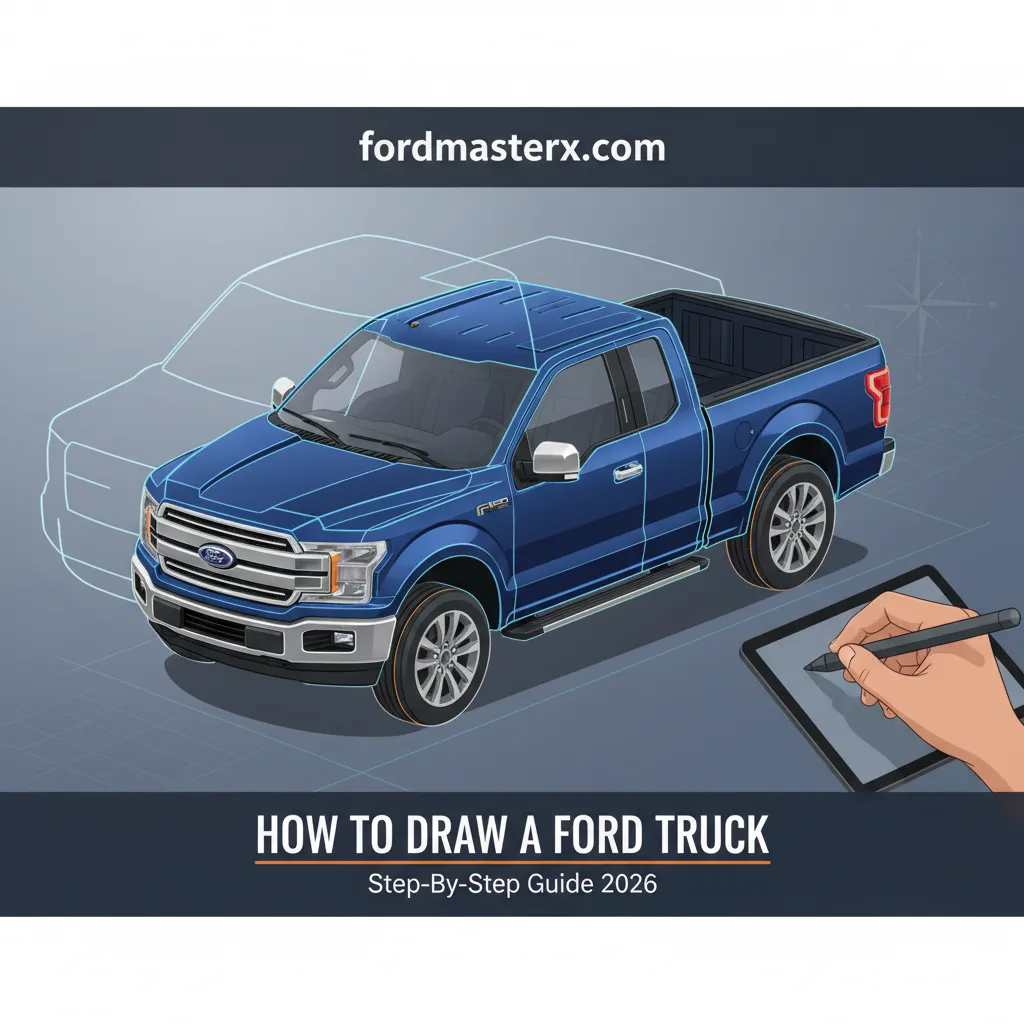
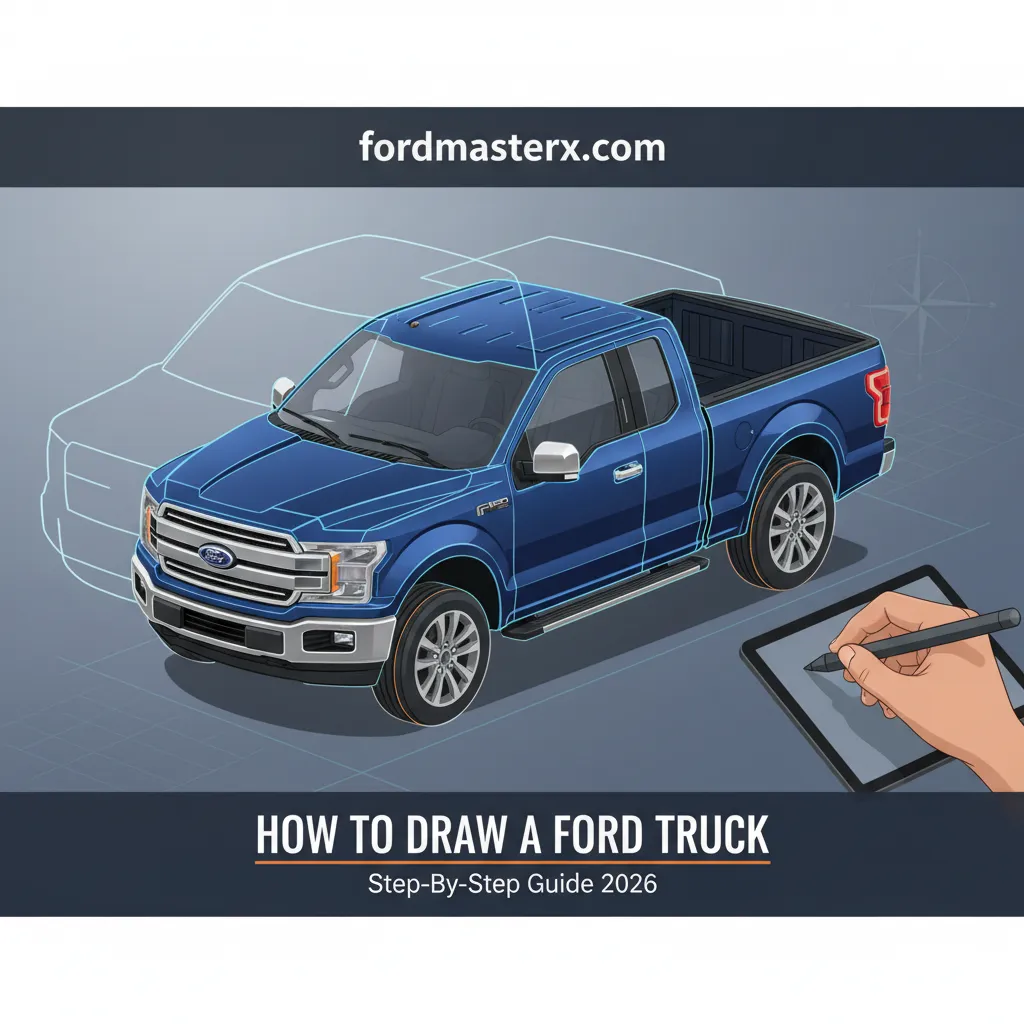
How To Draw A Ford Truck: Step-By-Step Guide 2026

The Ford truck, an enduring symbol of American strength and utility, presents a compelling subject for artists seeking to capture its robust form and iconic presence. Many aspiring artists struggle with accurately depicting complex automotive subjects like trucks, often facing challenges with perspective, proportion, and capturing distinctive brand details. This authoritative guide will provide a structured, step-by-step methodology to master drawing a Ford truck, enabling you to confidently render its intricate details and commanding silhouette by 2026.

Understanding the Foundational Anatomy of a Ford Truck
Recommended Best Deal Products

To accurately depict a Ford truck, an artist must first learn and understand its fundamental anatomical and design elements. Ford’s truck lineage, from the versatile F-150 to the robust F-250 Super Duty and the agile Ranger, shares a common design language rooted in strength and utility. This section deconstructs these core characteristics.
📤 Share Image
Geometric Foundations and Proportions
At its core, a Ford truck is constructed from a series of robust, block-like geometric shapes. The chassis forms a strong, rectangular base, upon which the cab and bed are mounted, often represented as refined cuboids. This inherent geometry lends itself well to initial blocking sketches. Analyzing the distinctive proportioning is critical for conveying its authoritative stance. For instance, the relationship between the wheel size, ground clearance, and overall vehicle length defines its rugged presence.
Research indicates that a full-size pickup like the Ford F-150 (model years 2021-2026) typically measures approximately 231.7 to 250.3 inches in length, 79.9 to 86.6 inches in width (excluding mirrors), and 75.6 to 79.9 inches in height, varying significantly by cab and bed configuration, and trim level. Furthermore, the wheelbase-to-overall-length ratio for most F-Series models often falls within the 0.60 to 0.65 range. Maintaining these proportions is an essential step in achieving an authentic representation.
Iconic Ford Design Cues
Ford trucks are instantly recognizable due to their signature design cues:
- Prominent Grille Styles: Across models like the F-150, F-250, and Ranger, grilles are large and dominant. Examples include the bold horizontal bar designs (e.g., F-150 Lariat, XLT), intricate mesh patterns (e.g., F-150 Raptor), or robust rectangular forms (e.g., F-250 King Ranch).
- Distinctive Headlight Shapes: Modern F-Series trucks often feature C-clamp LED daytime running lights that frame the main headlamp cluster, creating a unique visual signature. The Ranger, while sharing some commonality, has a slightly more compact, yet equally assertive, headlight design. Older F-Series models, in contrast, showcased more traditional stacked or rectangular headlamps, illustrating the evolution of these key features.
- Muscular Fender Flares: Particularly on off-road variants or higher trims, Ford trucks exhibit pronounced fender flares that emphasize their wide stance and capability. These are not merely decorative but hint at the robust suspension and wheel travel.
Angles, Light, and Form
To truly capture a Ford truck, it’s essential to discover how light interacts with its surfaces. Observe various interior and exterior angles. The sharp creases on the body panels, the slight curve of the hood, and the angular cuts of the bumper all create distinct planes that catch light and cast shadows. These interactions define the vehicle’s form, texture, and give it a three-dimensional presence that flat lines alone cannot convey.

Essential Tools and Initial Sketching Techniques for Truck Art
Before you begin, assembling the right tools and understanding fundamental sketching methods is essential for establishing a strong structural base. This section will guide you to learn about the optimal implements and techniques.
Recommended Drawing Tools
Your toolkit should be versatile enough to handle both light construction lines and deep, dark shading:
- Graphite Pencils: A range is ideal. Use 2H for very light, barely visible construction lines; HB for general sketching and outline refinement; and 2B to 4B for darker lines, shadows, and heavier details.
- Erasers: A kneaded eraser is perfect for lifting graphite gently without damaging paper, while a plastic/vinyl eraser is effective for precise corrections and clean removal.
- Paper: Smooth Bristol paper offers a clean surface ideal for detailed line work and blending. Medium-tooth drawing paper (e.g., Canson XL Mix Media) provides a good balance for sketching and light shading.
Mastering Geometric Blocking and Perspective
To master the initial stages, begin with fundamental geometric blocking. Think of the truck not as a complex machine, but as a collection of simple rectangles, cuboids, and cylinders. This technique allows you to establish the overall volume, proportion, and perspective before adding intricate details. As noted by leading industrial design academics, foundational geometric blocking, much like that employed by architects and industrial designers for complex product development, is an essential first step for any representational drawing.
Understand the principles of one, two, and three-point perspective. Most automotive drawings benefit from two-point perspective for a dynamic look or one-point for a head-on view. By establishing a horizon line and vanishing points early on, you can accurately represent the depth and dimensionality of the Ford truck from various angles. Practice drawing simple boxes in different perspectives; this will translate directly to blocking out the truck’s cab, hood, and bed.

Audible — Listen Free for 30 Days
One free credit a month and thousands of titles included.
Listen Free for 30 Days As an Amazon Associate I earn from qualifying purchases.Gestural Lines and Initial Forms
Practice using light, gestural lines to ‘feel out’ the form of the truck. This isn’t about perfection; it’s about capturing the dynamic flow and overall proportion without committing to dark lines prematurely. These loose sketches allow you to experiment with different stances and compositions, helping you discover the most visually compelling angle before refining your drawing. Think of it as a warm-up, allowing your hand and eye to synchronize with the object’s general shape and movement.

Step-By-Step Execution: Drawing Your Ford Truck Masterpiece
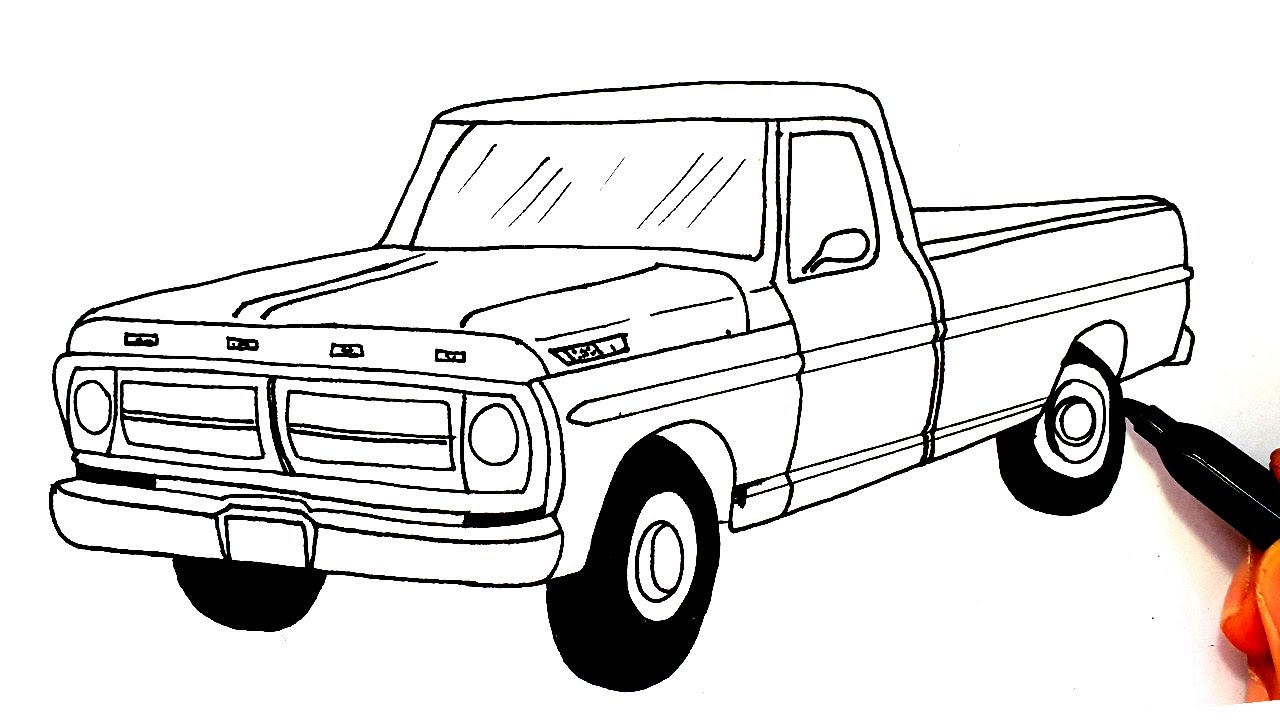
This crucial section provides a detailed, sequential procedure to master the process of drawing a Ford truck, from foundational shapes to refined details. We’ll focus on a typical Ford F-150 SuperCrew from a ¾ front view, a popular and dynamic perspective.
📋
Step-by-Step Guide
Begin with light construction lines using a 2H or HB pencil. Draw a dominant rectangle to define the overall length and height of the truck. From this, project a smaller rectangle for the cab and another for the bed, ensuring they conform to your chosen perspective (e.g., two-point perspective for a ¾ view). Carefully establish a horizon line and vanishing points to guide these initial shapes, ensuring the overall scale is accurate. This initial wireframe is the skeleton of your drawing.
Gradually refine the initial geometric shapes into the recognizable forms of the truck’s cab, hood, bed, and prominent wheel wells. Use a slightly darker pencil (HB) to start adding gentle curves and angles where appropriate. Focus on creating symmetrical and balanced lines for the main body sections. For the F-150, note the distinct cutline between the cab and the bed, and the slightly raised power dome on the hood of many models. Maintain the structural integrity established in Step 1.
This is a critical step for grounding your truck. Accurately place and draw the wheels and tires. Remember that circles in perspective become ellipses. Pay close attention to their circularity in relation to your vanishing points. Ensure the tires fit snugly within the wheel wells, which often feature distinct Ford flares, especially on models like the F-150 and Ranger. Include basic tire tread patterns, even if simplified, to convey realism. The placement and angle of the wheels significantly impact the truck’s overall dynamism.
Now, give your truck its identity. Carefully render the distinct Ford grille. For an F-150 from 2021-2026, this might involve a large, rectangular grille with prominent horizontal bars or a complex mesh. Integrate the headlights; observe the iconic C-clamp LED signature on many modern F-Series trucks. Add the bumper, fog lights, and lower air intakes. Ford’s design philosophy, extensively documented in internal design briefs, consistently emphasizes strong horizontal lines across the front fascia and body panels. This is a deliberate choice to convey a sense of width, stability, and inherent strength, a characteristic you must integrate into your drawing for authenticity.
Audible Premium Plus — Annual Membership
12 audiobook credits up front, plus the full Audible catalogue.
See Annual Plans As an Amazon Associate I earn from qualifying purchases.With the major elements in place, work systematically from larger to smaller details. Add windows, side mirrors, door handles, fuel filler cap, bed rails, and taillights. Don’t forget the subtle badging – the “FORD” script on the tailgate or grille, and the F-Series badge on the fender. Use a darker pencil (e.g., 2B) to strengthen your primary outline and define sharper edges. This stage is about bringing the truck to life, creating a comprehensive and recognizable Ford truck illustration.
Refinement and Detailing: Mastering Your Ford Truck Illustration
Once the foundational line art is complete, the true artistry begins. This section will guide you to explore and master techniques for adding depth, texture, and realism, elevating your Ford truck drawing beyond basic lines.
Applying Shading and Value
Shading is paramount for translating a 2D line drawing into a convincing 3D form. Use various pencil grades (e.g., 2B, 4B, 6B) to create a full range of values from bright highlights to deep shadows. Identify your light source and consistently apply shadows accordingly. Reflective surfaces like chrome bumpers, polished wheels, and glass will exhibit sharper, more contrasting reflections and highlights compared to painted body panels. Automotive design theory, particularly the concept of ‘form language’, dictates how subtle curves and surface treatments communicate attributes like strength, aerodynamics, or ruggedness. Shading is paramount in translating this intended form language from a 2D drawing to create a sense of volume and presence.
Texturing and Material Representation
To enhance realism, discover how to render different material textures:
- Paint: Use smooth, even blending for the main body panels to suggest a glossy, polished surface.
- Tires: Employ small, irregular strokes and a darker value to mimic the rough, rubbery texture and aggressive tread patterns.
- Plastic Trim: Often matte or slightly textured, render these with a softer, less reflective shading technique than painted surfaces.
- Chrome: This requires high contrast – very dark reflections next to brilliant highlights – to convey its highly reflective nature.
Close-up examples illustrating these texture differences can dramatically improve the final render.
Adding Background Elements and Environment
Integrating your truck into an environment provides context and enhances the overall composition. A simple road, a hint of off-road terrain, or a distant rural landscape can ground the vehicle. Use atmospheric perspective – lighter values and less detail for distant elements – to create a sense of depth. For example, a Ford F-150 looks natural against a backdrop of mountains or a worksite, reinforcing its character.
Digital Enhancements and Tools
For those looking to take their skills further, digital tools like Procreate (for iPad) or Adobe Photoshop offer powerful capabilities. You can import your traditional line art and then digitally add color, refine shadows, apply advanced rendering effects (e.g., metallic paint sheen, motion blur), and experiment with different lighting scenarios. This can help you to truly master the final illustration.
Common Challenges and Troubleshooting for Aspiring Truck Artists
Even seasoned artists encounter hurdles. This section aims to help you discover and address common pitfalls when drawing Ford trucks, providing practical solutions to overcome artistic challenges and truly understand the nuances of automotive art.
Perspective Distortion
Problem: The truck appears ‘skewed,’ ‘warped,’ or disproportionate, often making it look like it’s leaning or about to tip over. This is a common issue when parts of the truck seem to recede incorrectly or appear too large/small for their position.
Troubleshooting: Revisit your horizon line and vanishing points. Ensure all parallel lines on the truck (e.g., top and bottom of the bed, roofline, wheelbase) converge accurately to these points. Pay particular attention to the accurate placement of wheels within the perspective grid; misaligned ellipses are a primary culprit for a distorted look. Use a ruler or straight edge to check key parallel lines. Studies in visual cognition for art, such as those conducted by cognitive psychologists exploring human perception of symmetry and proportion, consistently show that even minor deviations in fundamental proportional accuracy are perceived as significantly more ‘off’ or ‘incorrect’ than subtle stylistic variations.
Lack of Authenticity in Details
Problem: The drawing looks like a generic truck rather than a distinct Ford. Details like the grille, headlights, or badge appear incorrect or unconvincing, failing to capture the brand’s identity.
Troubleshooting: This stems from insufficient observation. Emphasize careful observation of reference images for the specific Ford model year you are drawing. For a 2026 model, this means studying recent concepts and production models. Scrutinize grille patterns (e.g., the texture of the bars, the thickness of the frame), the exact headlight shapes (especially the distinctive C-clamp LEDs), and the precise font and placement of badging. Understanding their specific forms and how they integrate into the overall design is essential. Generic shapes will always look less professional.
Stiff or Lifeless Rendering
Problem: The truck drawing appears static, lacking dynamism or a sense of movement, even if technically accurate.
Troubleshooting: Explore dynamic line work; vary line thickness to suggest weight and form. Consider incorporating subtle elements of implied motion, such as a slight blur on the wheels (even in a stationary position, this can suggest potential), or a hint of road dust/debris if the environment suggests it. Use atmospheric perspective for environmental integration – making distant elements lighter and less detailed can enhance the truck’s prominence and create depth, preventing it from appearing pasted onto a flat background.
Proportion Inaccuracies
Problem: Parts of the truck, such as the cab being too small for the bed, or the wheels being out of scale, disrupt the overall harmony and realism.
Troubleshooting: Implement comparative measurements. For instance, determine how many wheel heights fit into the overall length of the truck, or how many headlights wide the grille is. Use your pencil as a measuring tool against your reference image, then transfer those relative proportions to your drawing. A powerful technique is to overlay your drawing against a faint printout of your reference image (or digitally if working on a tablet) early in the sketching phase to identify and correct discrepancies before you commit to details. This iterative checking is essential for foundational accuracy.
In summary, mastering the art of drawing a Ford truck hinges on several key principles. Understanding foundational truck anatomy and design cues is paramount for accurate representation. Mastering essential tools and perspective techniques provides the structural backbone for your drawing. A systematic, step-by-step approach ensures proper progression from initial sketches to detailed refinements. Finally, refinement through shading, texturing, and environmental context elevates the realism and impact of your artwork, while identifying and troubleshooting common artistic challenges is key to continuous improvement and artistic mastery. Now, take your pencils and paper, explore the distinctive features of Ford trucks, and apply these learned techniques to create your own compelling automotive illustrations.
Frequently Asked Questions
What is the best Ford truck model to start drawing as a beginner?
For beginners, the Ford F-150 is often recommended due to its recognizable, relatively straightforward geometric lines and abundant reference images. Focusing on a common generation, such as the 12th or 13th generation (2009-2014, 2015-2020), provides ample visual material without overly complex stylistic elements, allowing you to learn fundamental truck proportions and features effectively.
How do I accurately draw the perspective of a Ford truck?
Accurately drawing perspective involves establishing a clear horizon line and one, two, or three vanishing points. For a ¾ front view, use two-point perspective. Begin by sketching a box that contains the entire truck, ensuring its sides recede to the appropriate vanishing points. All parallel lines on the truck (e.g., roofline, bumper edges) must converge towards these same points for realistic depth.
What are common mistakes to avoid when drawing Ford truck wheels and tires?
Common mistakes include drawing wheels as perfect circles in perspective, which distorts their elliptical appearance. Ensure the ellipses for the wheels properly recede into perspective, aligning with the truck’s angle. Additionally, avoid making tires look flat; remember their robust, three-dimensional form and the subtle curvature of the sidewalls, adding appropriate tread patterns for realism.
How can I make my Ford truck drawing look more realistic?
To enhance realism, focus on subtle details and value. Meticulously render reflections on chrome and glass, incorporating environmental elements. Use a full range of tonal values from deep blacks to bright highlights to define form and texture accurately. Pay close attention to material textures, like the slight sheen of paint versus the matte finish of plastic trim, creating convincing surface details.
Are there specific Ford truck design elements I should emphasize for brand recognition?
Yes, for strong brand recognition, emphasize the distinctive Ford grille design, which often features bold horizontal bars or a prominent central emblem. The unique C-clamp or stacked headlight configurations on modern F-Series trucks are also crucial. Lastly, accurately rendering the iconic blue oval Ford badge on the grille and tailgate instantly communicates the brand identity, reinforcing authenticity.